In this past Friday’s edition of the Delaware Business Times, I have an opinion piece making the case that Delawareans should approach the corporate franchise like fossil fuels – and recognize that there are costs that come along with these revenues, as well as benefits.
But how different is Delaware’s corporate franchise from the oil industry, really?
…
ike oil revenues in Alaska, the corporate franchise in Delaware helps fund state government. In fiscal year 2025, business entities domiciled here paid $2.25 billion in revenue, making up some 33.7% of the state’s general fund – a considerable portion, albeit much higher now than in the past.
The benefits are obvious. But what does the corporate franchise cost Delawareans?
Industry’s demands bend the judiciary, too. It’s not uncommon for members of the state’s top courts to take jobs at major corporate law firms after they leave the bench, where they advise clients – and state officials – on the past, present, and future of Delaware law.
These arrangements might be politely described as “regulatory capture.”
Like the oil business, the corporate law industry extracts wider costs. …
As I noted in a prior post, Delaware’s Secretary of State, Charuni Patibanda-Sanchez, recently announced that DE is creating and testing “a new entity form:” the “artificial intelligence company,” or “AIC.” She made this announcement in a paywalled Fortune commentary, co-authored with a deeply-invested CEO, John Nay of Norm AI. The SecState and the CEO’s essay advertises a simple concept, albeit one that – if we read it seriously as a policy program, and as a statement of values – is both corrupting and ridiculous.
According to the pair, a Delaware AIC will be a legal identity “wrap” for “autonomous” computing systems. They frame it as an “iteration of a corporate legal structure” – but not just the next step in entities, but a huge leap, the “most consequential” form of entity ever devised. An AIC will grant legal personhood to software, with all the civil and political rights that other legal entities like corporations, LLCs and trusts already provide: to have, hold, and dispose of property, incur obligations, sue and be sued in courts of law, fund to political campaigns, exercise protected free speech, vote in local elections, etc., etc., etc.
In return for providing the human founders and funders of a capital good with an immensely powerful political tool and a durable liability shield, Delaware will subject the AIC to temporary oversight, via “regulatory sandbox.” By this childish metaphor – borrowed from au courant tech-biz-bro lingo – the co-authors appear to mean such entities will be subject, at their chartering, to review by an un-elected committee of indeterminate government officials and indiscriminate “technologists.” In addition to this once-over, AICs will face some of the rules all other state-registered organizations already do: they will be required to keep business records (“a log of its activities”), and – like the solvent banks of yore – AICs will be required to be “adequately capitalized.” (What “adequately” might mean is left as an exercise to the reader).
This advance in corporate coverture is urgently needed, the SecState and CEO insist, because AI technology is moving so fastyou guys.[1] With the singularity almost upon us – and since AI-controlled business entities are already legal, if not extant, per Nay – a new legal framework is required to keep “autonomous commerce” onshore and visible to American courts, or at least in sight of Delaware’s famously blinkered jurists.[2]
The Fortune piece is – literally – a company press release for Norm AI. In keeping with genre conventions, it’s light on substance, long on hype. But don’t let the format obscure things too much: the exercise – like the AIC concept itself – is fundamentally ridiculous. If we’re to take it seriously (and I’m afraid we must), it makes a mockery of the sovereign powers a democratic government should, or could, exercise: it debases any concept of deliberative process, by announcing a fait accompli and promises manufactured entities for sale, before any legislation has been passed, much less made public or debated; and it insults the idea of a government for the people, by the people, by pretending that the mass production of new capital creations is purely a matter of meeting market needs, an economic action only – as if that’s the only thing at stake in a state where capital literally gets a vote.
a good boy but no basis for a system of government
The honking clownishness of the proposal and its vagueness are both strategic choices, and should be read as such. The Secretary of State could have chosen to be more forthright, and less laughable: reliable journalists have reported that the proposed legislation exists, and even has a familiar attributed author. So it’s notable she chose to share real details only with potential out-of-state business partners, and not the grubby rabble of the Delaware citizenry.[3] In the First State, the groundlings might be the reason for the stage – hell, we might be the people who set it up – but the real show is for the the box seats only.
Credit where it’s due, as a marketing gimmick, the trick is working. The proposal has met with enthusiasm in all the usual quarters, and no serious criticism. (Though I do wonder if the AIC boosters appreciate their biggest fans comparing the “regulatory sandbox” to the infamous fences at Jurassic Park?). Still, there has been some light skepticism expressed in the business press – some commentators, outside the familiar retailers of manufactured consent, have noted that the whole plan has been proposed by the hungry foxes who aim to guard the hen house.
The AIC proposal is a joke, if a profoundly sick and anti-democratic one. But like all jokes in the time of Trump, it’s the kind of kidding-on-the-square that will have real consequences. So while I think it’s healthy, as good small-r republicans, to point and laugh at the officials of a state infamous for corporate corruption when they propose a new and shockingly more venal way of selling off citizens’ sovereignty, we must also <heavy sigh> take it seriously.
So with that in mind, I want to offer three observations that zoom out from the proposal’s irritating gestures, and consider what this governance by blog post can tell us about the wider political economy of tech oligarchs acting through their favorite puppet, the State of Delaware.
The State of Delaware’s Plan
First: What’s news in the Fortune piece is not the law-adjacent tech hype, but Delaware officials’ admission that they plan to start this “experiment” with government failure, via regulatory capture.
The key bit is the closing line of the fifth paragraph, where the co-authors declare that “[t]he framework for industry engagement with AICs is being developed in Delaware as part of a public-private partnership led by Norm Ai.”
The – surprising! – present tense suggests that the State has already contracted with Norm Ai to do the work (a FOIA opportunity, perhaps!). Norm Ai is a company that builds software to provide legal services, and, critically, seeks to build software that provides governments with regulatory supervision services. That means that Norm Ai CEO John Nay has found in Delaware the state partner he described as necessary to run the business experiment outlined in his 2023 Science article. Nay and Norm AI both need Delaware as a host body politic, to pay off their investment strat and to transmit the results of the experimental infection to the rest of the United States through the Full Faith and Credit clause (and more generally, through the legal concept of comity).
As Julian Lim notes in Startup Fortune, the timing is … unsubtle. Norm Ai finished its latest fundraising round – with investments from Blackstone, Vanguard, and Bain – just a week before the Fortune announcement. For a company that wants be “the compliance machinery” layer – that is, to run the the state-authorized oversight and governance, “[t]hat funding round fits the Delaware proposal almost too neatly.” I agree, and would add that it’s clear that Norm Ai has dictated terms to Delaware, not the other way around.
Announcing their willingness to be used by Norm Ai for the corporation’s business development also means that Delaware has decided to forgo developing state capacity – while (presumably) forking over a healthy chunk of public money for the privilege. (Say, wouldn’t a FOIA of that contract be useful?).
Now, a single vendor monopolizing a government in order to dictate its own contracts and make itself indispensable is not unusual (unfortunately). It’s a model that describes a lot of government services in the United States – but it’s a proven failure everywhere.
As journalist Annie Kim detailed in her book Poverty for Profit (and as many academics have studied), outsourcing government services is endemic in the neoliberal era. The pattern is readily apparent in welfare offices, tax services, prison management, healthcare, and education: by replacing government with corporate bureaucracy, a company is able to build expertise while controlling information, strangling the state’s ability to benefit from market competition among vendors, or even assess contract performance. Like all monopolies this results in much higher costs, worse service, and an enormous amount of abuse (financial, but also often bloodily physical).[4]
This is the system DE uses to provision prison healthcare and other government services, so it’s not surprising that it’s defaulted to it when seeking to create and govern a new legal regime. One might even come to the conclusion that Delaware’s officials don’t know better – or choose not to.
Still, it’s disappointing that the Meyer administration has gone straight to regulatory capture before they even begin administering these new entities. Fully automated oligarchic control over state government seems … well, less than ideal! At least if your ideal for who government should serve is “the people,” and “the people” means “human beings” – all shaky assumptions in Delaware.
an AIC, ready to wash away responsibility
Second: the novel part of “AICs” isn’t the AI, it’s the way the entity wraps an old device – the accountability sink – in shiny new paper.
In his excellent 2024 book, The Unaccountability Machine, financial analyst and ex-regulator Dan Davies introduced the world to a wonderfully powerful explanatory concept, the “accountability sink.” Drawn from his close reading of early cybernetic theorists, an “accountability sink” is simply the part of an organizational design that removes any specific human being from the critical moment of decision-making, “thereby severing the connection that’s needed for the concept of accountability to make sense.”
Davies’s book digs into a large number of examples of accountability sinks operating in the real world, in existing and historical real-world systems – including many business corporations. Because it is such a useful tool for those in authority (at whatever level) it has become ubiquitous. It can be as simple as the airline rule book that the gate agent points at, to deny you a re-booking; or as complex as the interlocking firms, regulators, and markets that created the mortgage-backed securities crisis we all got to know so well in 2008. If you look, you’ll see accountability sinks everywhere, in every endlessly looping phone menu, in each insurance claim denial; they dominate our present bureaucratic reality, globally.
AICs are accountability sinks. They create an information-killing gap using a new and still scarily shiny technology – one that many people already treat as a magic black box – and then wrap it in a shell company, to provide human owners and funders with extra insulation from decisions, and thus culpability.
So an AIC will indeed be a powerful thing, but not for the reasons the co-authors claim. It’s not any novel capability for “autonomous commerce” – vending machines, trading algos, and health insurance company websites all already exist, and do just fine – but the new layers of obfuscation it provides. The AIC is a entity designed to kick sand over a trail of footprints, then stamp the dust down with a herd of horses and shovel on a fresh layer of hot asphalt; when it’s through, no trace of human responsibility will be left on a decision, and that’s by design.
Note that the Fortune co-authors would have us believe the reverse: they claim that an AIC would create a “defined target to which responsibility and damages can attach.” But that already exists! In law and reality, there is an attachment rooting AIs already, at least insofar as any law can make one real. It’s the warranty claims of the makers, the property claims of the owners, and job liabilities incurred by the operators of the AI who are the people responsible for it, in the same way that an aircraft’s manufacturer, owners, and operators are responsible for a jet. Making a jet with autopilot capabilities its own recursive legal entity would not make accidents less common, or disastrous, or allow victims to recover damages better.
Saying a capital good, a machine, does not have accountability attached is marketing nonsense, pure and simple – another irresponsible jest.[5]
an early record of Delaware lawmakers putting property over people
Third: There is a deep resonance between the legal logic advocates for AICs have deployed, and the logic found in the historical law of slavery. They both use law to reconcile the irreconcilable, in order to profit property over people.
For the SecState and CEO, the problem for lawmakers, supposedly, is that “autonomous software” can make economic decisions by itself – but since the AI is definitionally not “a person” in the law (yet), the State needs to create a new kind of entity so responsibility can “attach” to the agent. The SecState or CEO don’t have sufficient evidence to establish AIs as autonomous persons in the manner they describe; that’s magical thinking, and unserious except insofar as the weight of oligarchs’ heavy investments has brought an airy farce to ground, scarring the earth as it lands.
However, I will note that a great of pre-1865 American law was devoted to a similar problem. That is: who was responsible when a species of property created by state law – an enslaved human being – took action independent of the property owner, their enslaver?
Antebellum American jurists, including Delaware’s, spent a huge amount of time trying to reconcile slavery’s morally repugnant but obvious untruths – that human beings, as people, could be rationally treated in law as form of unthinking property – because it profited the wealthy and powerful.[7] That they failed intellectually – and morally – did not mitigate the project’s success as a means of generating secure property values, and profit, at least for a few decades.
The AIC proposal strikes me as operating in a parallel fashion: trying to reconcile inverse but still obvious, morally repugnant untruths – that algorithms, as property, can be rationally treated in law as a thinking kind of person – and for the same reason, it profits the wealthy and powerful.[8]
the author, emotionally
I don’t have a witticism to end this essay.
AICs might be a joke, but the proposal to create them is a bitter one that reveals a real depravity among the corporate elite and Delaware officials. It would be a better world if Delaware’s government would – for once – take the responsibility of democracy seriously, and use the power delegated to it by the citizens of the state to preserve human dignity, rather than degrade it for some outsider’s fintech fancies.
We at least deserve a cute dog for mayor.
——
Header Image: A Google Gemini-modified version of “Slaps Chicken” meme, altered so that the chicken in question is colored blue, like Delaware’s famous hens. (NB: using a tool does not mean I endorse making that tool a legal person with rights. I don’t think my car should get to vote, either; frankly, Honda Civics Hybrids trend too close to eco-terrorism as it is).
Notes
[1] As I noted elsewhere, the AIC is rooted in Silicon Valley’s millenarian cult, TESCREAL, which imagines – indeed, hopes – for the end of humanity. Norm AI’s own marketing materials eagerly assume that AGI (artificial general intelligence) is mere moments away, and with it, the rise of a new, intelligent but non-human species – which they are hoping to control and monetize to sell as legal counsel and compliance officers.
So perhaps the logic of “the kids are always going to drink and drive – there’s nothing we can do to stop them – so they might as well drive drunk at home” should not guide official Delaware policy?
[3] This is the same tried-and-true tactic that Delaware officials since the 1960s have used to move corporate legislation through state government: keep the details secret, claim an hostage-situation level of urgency regarding state revenues, and then rush a bill through the assembly to put out the house fire they started.
[4] Until this AI company announcement, Delaware’s failures in this regard were most visible in its disastrous prison healthcare system – where the state’s utter failure to engage in oversight means services are dictated by cruel corporate vendors, with immense, avoidable human suffering the consequence.
[5] As for novelty: as Nay noted in his 2023 Science article, US law already does not require human beings to sit on a board, have human owners, or human managers. In Delaware of course, being human isn’t necessary to vote, either. So an AIC isn’t new for not having humans.
Too, the provision that AICs have to “keep a log of its activities” is yawn-inducing. Artificial entities of all sorts are already required by law to keep business records (do they? well … sometimes). Shareholders’ right to consult those “books and records” – and sue for managements’ or directors’ missteps therein discovered – is part of what Delaware’s legislature has narrowed in recent oligarch-scrivened “reforms.” So why would those rules apply to AI, anew?
There’s good reason to doubt an AI would keep any kind of accurate log, given the way the technology operates. Because it is built to flatter, and to calibrate output according to the best language game result, there is no permanence to what an AI decides, no central reference point; that’s part of the value! And naughty AIs overwriting their instructions and backfilling datasets like so many octopuses escaping their aquariums is rather a trope in news reports about the tech these days.
[6] The multi-state project to rationalize slave law was sparked by the persistent efforts of the enslaved and their allies to use the tools of their oppressors to make the contradictions of the slave system unsustainable. “Freedom suits,” and similar, were grit in the gears of Americans’ legalized inhumanity, even when they failed. (Or perhaps you’ve heard of Dred Scott v. Sanford? That one moved the needle…)
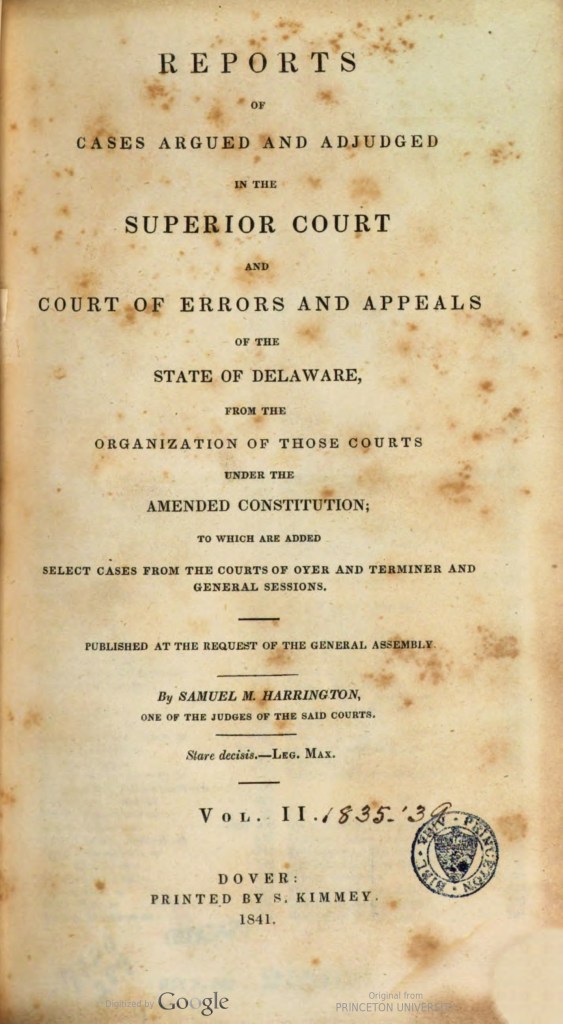
For a good example of this wrestling in the legal mind of a slaveholder in Delaware, see: John M. Clayton, Chief Justice, Delaware Superior Court, majority opinion, in “Isaac Tindal, n. vs Daniel Hudson (1838),” in Delaware Reports (Dover, DE: Printed by A.M. Schee, 1841), 2:442.
Clayton’s opinion was in its own time (in)famous for stating baldly what Black residents of Delaware knew well, viz., that the state’s racist laws robbed nominally free African Americans of nearly all their civil rights, rendering their citizenship hollow, and little different than slave status as a lived experience.
As Clayton put it: “But the negro is not such a freeman as to extend protection; he is though nominally free, almost as helpless and dependent on the white race as the slave himself; he has few civil rights, being merely protected in his person and property by the law, and being allowed in some cases to give his evidence in a court of justice. He can hold no office of honor, trust or profit; cannot act as a juror or legislator, cannot make or execute laws. He cannot, therefore, in any sense extend to a slave the protection due from a master, having no voice in the making, altering, enforcing or executing the laws; and having himself constantly to resort to the protection of the whites.”
[7] While slavery as a legal practice is (mostly) banned by the 13th amendment, slave law precedents still form the basis for all kinds of commercial, property, and indeed corporation law. Justin Simard’s Citing Slavery Project documents how foundational slave law is to modern jurisprudence, partly in an effort to get the legal system to acknowledge the scope of the problem, and correct it by moving away from citing slave cases. As far as I know Delaware’s jurists have not made any effort to detach themselves from slave law precedent, in any regard.
Or, A Tale of Ditches, Schools, and Municipal Lighting
Corporate Voters Project – Research Note #9
As a historian, I am trained to dig for origins. Chronology suggests causation, after all; today’s one damn thing happened only after another. So if there’s a phenomena out in the world you seek to understand – and perhaps even to explain – as a historian, one of your standard moves is to try and trace the stream to its source.
Corporate voting has proved a difficult quarry in this respect. Partly, it’s about language: the formal charter provisions authorizing corporate voting in a municipal context have changed form over time, making it difficult to search for examples. Too, as the sordid history of the Town of Fenwick Island illustrates, corporate voting has been practiced outside the sanction of municipal charters – governed (I use the term loosely) by unpublished bylaws or oral traditions, which are difficult to get ahold of using standard historical methods.
Still, I’ve made an attempt to identify the origins of corporate voting with the sources that are readily accessible – Delaware’s published session laws – and I think I’ve come up with some likely candidates.
The earliest is an 1893 law that enfranchises artificial entities in Middletown, DE, as part of a public lighting utility financing scheme – a measure that comes a full six years before Delaware passed its copy+paste of New Jersey’s notorious corporate code, and hitched the state’s wagon to corporate franchise revenues. The next earliest is a 1917 law that explicitly grants corporations the right to vote in bond referenda financing Laurel Public Schools.
Those are the earliest, explicit grants of suffrage to non-humans, and track closely with my prior findings, viz., that corporate voting in Delaware is first introduced through Progressive innovations in financing modern municipal infrastructure (water, sewers, roads, power – and schools).
But if we loosen the definition a bit, and include laws that do not specify voters as persons with human characteristics like age, race, or gender, but only indicate that voters have to be landowners – if we look for the first loophole, in other words – then we could say that an 1819 law setting up a tiny local government to manage drainage is what first opened the door to non-human voting.[1]
Lighting, schools, or maybe even swamp management: in every case, the earliest versions of corporate voting appeared in Delaware attached to property ownership, in measures intended to capture community wealth for the community’s benefit, though infrastructure.
~~~
The first instance of Delaware law granting artificial entities voting rights does so through a short but significant pronoun: it.
At said election each tax-payer shall have one vote for every dollar and fractional part of a dollar paid by him, her or it, respectively, as town tax, within one year next preceding said election, and all tax-payers shall have the right to vote at such election in person, or by proxy duly signed and witnessed.
~ 19 Del. Laws, c. 745, “AN ACT to amend Chapter 242, Volume 19 of the Laws of Delaware, entitled “An act to provide for the Lighting of Middletown,” February 21, 1893, p.1026 [emphasis added]
The context for this implicit corporate voting rights provision is a law changing who can borrow, and how much, on the Town of Middletown’s credit, for the purpose of building and running a lighting utility.
In 1891, the state legislature gave Middletown itself the authority to borrow up to $10,000 to “establish an electric plant and conductors, or to erect gas works and lay pipes” to light the town (or buy existing equipment).
That legislation included a bond referenda mechanism for local approval: to raise funds by issuing bonds, Middletown would have to hold a public meeting to approve the debt; and at that meeting, residents could cast votes on the basis of “one vote for every dollar…by him or her paid” in town taxes. [2] Property taxes enfranchised voters, but only those with a gender (so: not corporations).
Then, in response to the town’s request in 1893, the state changed Middletown’s mechanisms for administering utilities and issuing bonds. The 1893 bill quoted above subdivided responsibility for running the town’s lighting, removing it from the powers of the town commissioners and entrusting it to a separately elected “board of light and water commissioners.”
And for unknown reasons, it departed from the common phrasing of other town borrowing bills, adding an “it” that opened the door for non-human but tax-paying persons – including corporation – to vote in bond approval elections.
~~~
Middletown’s innovation did not catch on. The taxable-dollar-per-vote scheme for bond elections was quite common across Delaware – increasingly so until the middle of the 20th-century – and towns up and down the state continued to add borrowing authority for municipal utilities. But the enabling legislation for those increased financial powers almost stuck to formulations identifying “tax-payers” or “taxables” as gendered human beings (“him or her” or “male or female”). (The inclusion of property-owning women is notable in an era before women’s suffrage in state or federal elections, and fits with a general pattern of local voting rules being more inclusive rather than less). [3]
Then, in 1917, amid a flurry of education reform bills that aimed to train teachers, police truants, and raise standards, the General Assembly passed a law empowering Laurel Public Schools to erect new school buildings – and expanded suffrage to corporations, explicitly, in the bargain. [4]
At such [bond referenda] election every taxable who resides within the limits of said Incorporated School Districts and every Corporation within the limits of said Incorporated School Districts, which is taxed for school purposes therein, shall have the right to cast one vote for every dollar or majority fraction thereof of school tax paid by him, her or it.” ~ 29 Del. Laws, c. 195, “An ACT to authorize and empower Laurel Public Schools …,” March 23, 1917, pp. 644 [emphasis added]
As with Middletown’s suggestive loophole, Laurel’s innovation in corporate voting did not spread. A few years later, in 1921, when the state authorized Newport to issue bonds to buy out private investors who had built a waterworks – including a paint company – the legislation used the “him, her or it” formulation to identify those persons who could qualify as bond referenda voters, but did not explicitly endorse corporations as voters.
It wasn’t until 1931 that another local government in Delaware (the Town of Milford) extended voting rights to corporations in a manner as directly as Laurel had – and then it seemed to do so primarily to include all types of property owners “whether individual, partnership, or corporation.” [5]
~~~
If one is willing to squint a bit, there is an argument that corporate voting could have been possible (formally, legally) as early as 1819. That’s when Delaware formally incorporated a special form of local government – today known as a “tax ditch” – to manage the drainage ditches abutting White Clay Creek and Red Clay Creek, waterways in New Castle County.
“Tax ditch” companies were chartered corporations with taxation powers that provided them with the means to do what corporations typically did in the U.S. until the late nineteenth-century: borrow state power, temporarily, to build infrastructure – or, in the phrasing more common to the early US, build “internal improvements.” (The idea that corporations are normatively businesses is a late-nineteenth century invention, like the chocolate bar, or eugenics).
In this case, the company was granted the power to assess all landowners with property touching the drainage works for a tax, in order to finance the creation and maintenance of ditches, sluices, gates and other necessary drainage works. To authorize that assessment and elect ditch commissioners – who would oversee the work – the state gave property owners voting rights in the company, typically scaling the amount of votes according to the amount of the neighboring acreage they owned.
In later legislation, the types of voters within the company were specified by race, age, and gender (and as with later bond referenda, these qualifications were sometimes more inclusive than voter qualifications in other elections).
But in 1819, for whatever reason, Delaware legislators left the matter of personhood unaddressed – and thus open to corporate voting:
… and in all elections for officers as aforesaid, or otherwise, the said owners or possessors, owning or possessing any quantity of meadow marsh or cripple not exceeding five acres shall be entitled to one vote, all over live acres and not exceeding ten acres two votes, all over ten acres and not exceeding twenty acres three votes, and all over twenty acres four votes.”
~ 5 Del. Laws, c. 225, “An ACT to incorporate the owners and possessors of a certain tract of meadow, marsh, and cripple, known by the name of the White-clay creek and Red-clay-creek marshes, in the county of Newcastle, …” February 5, 1819, pp.405.
This is a loophole a clever and ambitious corporate lawyer could have taken advantage of; but it unlikely it ever was. Corporations in 1819 certainly could and did own real estate, but it was unusual to own farmland of the type that would be affected by ditch company work, unless it came to a bank through a foreclosed mortgage. A trust was more likely to hold farmland – but since the legislation did not lay out how proxy voting could occur (cf. later tax ditch legislation, which often did), an artificial entity exercising any kind of franchise would have probably met with more frustration than success, in practice.
There were simpler ways to direct the ditch digging, should that have been someone’s goal. But weirder things have certainly happened in Delaware…
~~~
A brief word on methods and sources
My sources for this inquiry are the seventy-two volumes of “session laws” published by the State of Delaware under the title Laws of the State of Delaware (aka Del. Laws). These volumes encompass all published laws passed by the General Assembly from the colonial era to the new millennium, 1700-2000.[6]
In myprior research, I’ve worked backwards, tracking municipal charter revisions from a moment where a town was known to have corporate voting provisions to earlier versions, to see where the provision came into being. That was a more efficient mode of discovery than reading through each massive statute tome, but it was limited.
However, that work has provided a number of examples of corporate voting provisions – formulations which I could then use as models to search the entire Del. Laws corpus as a whole.
Doing so was relatively straightforward, but depended on electronic versions and machine methods. Full scans of Del. Laws are available online in several different versions (Delaware Public Archives, HathiTrust).
To correct for prior machine-errors, I used the very capable OCR software built-in to DevonThink 3 (ABBY FineReader) to improve the existing text layers of the scanned pdf volumes – making them more accurate (this OCR version handles the medial “s” with no problem) and machine-readable (ABBY FineReader handles text structure better, too).
Then, I used the examples of corporate voting provisions I already had to develop a set of regular expressions I could use to search the Del. Laws corpus, and identify new instances of the practice as it appeared in previously unknown legislation.
That proved quite effective, producing a manageable list of hits, which I then read over individually, and analyzed each specific instance of potential corporate voting, myself (“by hand”).
Because I’m a Luddite in the original sense – and not opposed to new technology, on principle – I did initially tried to use Google Gemini to develop pattern sets and analyze volumes.
But you know what Alphabet’s university-grade LLMs can’t do? Reliably read OCR’d PDFs for textual patterns, or apply extant text examples to large sets of scanned books. The robot even complained that historical documents were too difficult to read (an unpersuasive whinge presumably drawn from on all the stolen student papers these things were trained on…)
It seems like the kind of thing the probabilistic plagiarism machine should be able to do, but for a data set this small and bounded, it was not worth the time it would have taken to train the model when other, better tools were available. So it goes!
—
Image: Lafayette Studios, Irving Air Chute; Digging Dirt; Man in a Field Holding a Shovel, January 10, 1942, black-and-white photograph, University of Kentucky, https://exploreuk.uky.edu/catalog/xt7z348gg90h_3_326.
[1] These special purpose local governments for drainage management are still around in Delaware. Today termed “tax ditches,” they are governmental subdivisions created by Superior Courts (i.e. county courts), administered by DNREC, and run by the “taxables,” the landowners with property drained by the ditch who are assessed taxes for its construction and maintenance. The portions of the Delaware Code regulating tax ditches do not expressly provide corporations or other artificial entities with voting rights – though it does award votes at tax ditch meetings based on “the number of dollars assessed against the land of such owner.” See 7 Del C. §4154. “Tax Lagoons” – also intended for farm use – are governed similarly. 7 Del C. §4343 .
My thanks to Dave Redlawsk for the heads up about these organizations!
[2] 19 Del. Laws, c. 242, “AN ACT to provide for Lighting the Town of Middletown,” May 14, 1891, p.478-479. This was not Middletown’s first utility: an 1887 act authorized $15,000 in bonds for a waterworks. 18 Del. Laws, c. 158, “An ACT To authorize the Commissioners of the town of Middletown to borrow money and erect water works,” February 10, 1887, pp.255-256
[3] Newark’s expansion of its borrowing authority was typical: 24 Del. Laws, c.192 “An ACT authorising and empowering ‘The Council of Newark’ to borrow money and to issue bonds … “ , April 4, 1907, pp 395- 397
[4] Train teachers: 29 Del. Laws, c. 181, “AN ACT to amend Chapter 71 of the Revised Statutes of the State of Delaware relative to the holding of Teachers’ Institutes,” April 2, 1917, pp. 617-618; police Truants: 29 Del. Laws, c.182, “AN ACT to amend Chapter 71, of the Revised Code of the State of Delaware, requiring the Board of Police Commissioners of the City of Wilmington to assist in arresting truants and others who fail to attend school,” April 12, 1917, p. 619; raise standards: 29 Del. Laws, c. 184, “AN ACT to provide for the giving of Meritorious Recognition andAwards to all Free Schools, not having Special Powers by Incorporation or Consolidation, that attain a certain Standard of Excellence and Efficiency,” April 18, 1917, pp. 622-624Laurel’s bonds: 29 Del. Laws, c. 195, “AN ACT to authorize and empower Laurel Public Schools to procure a site and erect thereon a new Public School Building; to borrow money to pay for the same; to issue bonds to secure said loan, and to levy a tax to pay said bonds,” March 23, 1917, pp. 639-645.
Like many bills authorizing the issuance of bonds in this period, legislators specified the language to be printed on the bond and its coupons, laying out in careful detail all the terms of the bond contract. Perhaps legislators did not trust town officials to manage these complex financial transactions themselves? Or consider them capable of negotiating with underwriters without overextending government credit. See 29 Del. Laws, c. 195 §3, p. 640-642.
[5] 32 Del. Laws, c. 120, “AN ACT authorizing the “Commissioners of Newport” to repay certain moneys advanced by certain persons and corporations for the completion of a water works and sewer system for the Town of Newport, and to Issue bonds to secure the payment thereof,” March 15, 1921, pp. 363-69; 37 Del. Laws, c. 162, “An Act Changing the Name of ‘The Town of Milford’ to ‘The City of Milford’ and Establishing a Charter Therefor,” Approved April 25, 1931 pp. 595.
[6] After 1866, the State of Delaware excludes from publication “all acts of incorporation, and other acts of a private nature.” Frustrating if you’re interested in business corporation and divorces; but this same measure specifies that charters for certain kinds of corporations – “railroad companies, towns and banks” – don’t fall under this exclusion, and so continue to be published in later volumes. 13 Del. Laws, c. 1, “An Act Concerning the Publication of Laws,” February 17, 1866, p.3.
I was interviewed by Ingrid Burrington for the latest episode of RIP Corp, your favorite business podcaster’s favorite business podcast. The episode gets into the history and current status of Delaware’s whole deal w/r/t corporations and asks: is the Delaware Way for Corporations dead?
“Generally, when people remember that Delaware exists it’s for two boring and embarrassing things: Joe Biden (who wasn’t even born there) and being where a lot of corporations are. Or is it where all the corporations were? Last year, there was a bit of a kerfuffle in Delaware over a potential exodus of corporations out of the state. The so-called “Dexit” appears to have been somewhat exaggerated, but it made the team here at RIP Corp want to dig a little deeper into the corporation capital of the United States: why is it like that? How does this tiny little state shape corporate law across the country? And how does it affect actual people who live in Delaware?”
It’s been a busy few months for corporate voting in Delaware. As late spring turned to summer heat, the practice emerged as a politically salient issue, attracting local, state, and national attention. In both the courtroom and Legislative Hall, Delawareans have been articulating their positions on it – doing so publicly for perhaps for the first time in the state’s history.
In the process, supporters of corporate voting have outlined a clear theory of local oligarchy. In this vision, the ownership of taxable real estate justifies rights to formal electoral power – and perhaps especially so if the property owner in question is a non-human business entity who cannot otherwise act locally (while thinking globally).
In a moment when rights claims based on residence and birthright are under sustained attack by fascists and their allies, Delaware’s defenders of corporate voting have reinvigorated an old idea for a new era. Like early modern republicans, they envision a world in which ownership of taxable property produces and justifies citizenship – at least at the level of government closest to the ground. Unlike their predecessors, though, Delaware’s apologists for corporate voting imagine artificial entities, the law’s golems, as equally worthy bearers of a municipality’s political rights as any flesh and blood burgher might be. Jus soli might be hanging on by a single SCOTUS vote – the plain text of the Fourteenth Amendment be damned – but for some in the First State, legitimate voting power springs from owning the soil, for human and entity alike.
For their part, opponents of corporate voting have not questioned the importance of property to power, but only averred that human beings, alone and individually, should access the ballot. They’ve avoided the question of whether wealth itself is sufficient justification for suffrage, and dodged bigger problem of non-resident (human) property-owner voting, which is widespread and popular in Delaware, and not entirely unheard of beyond the state. There are limits to Delaware’s institutional advocates for human-centered democracy.
This debate marks a new phase in Delaware’s self-understanding about the foundations of its local political economies, one in which the parties engaged in the contest, and the values at stake, are finally named. Too, with this controversy, the connections between the capillary oligarchy of local government and the better-known corporate domination of the state’s politics have emerged from obscurity – or perhaps they’ve been forged for the first time.
It’s an exciting time to be doing frustratingly difficult historical research!
~ ~ ~
A lawsuit kicked off Delaware’s unprecedentedly public debate over corporate voting. In December 2025, the ACLU of Delaware sued the Town of Fenwick Island over the municipality’s practice of awarding votes to the “corporations, partnerships, trusts, and limited liability companies” that owned property there. The ACLU-DE argued that by allowing 214 non-human artificial entities to registered to vote – with no limit on more – the town “risks the dilution of votes cast by natural persons” and therefore was in violation of the Delaware Constitution’s guarantee of “free and equal” elections.
The ACLU-DE also tied corporate voting to the state’s better-known corporate franchise, and its status as the “Corporate Capital.” In a press release, the plaintiff’s attorney, Andrew Bernstein, noted that “[t]here are over 2 million artificial business entities incorporated in Delaware and only about 1 million people,” and in those circumstances “the people of Delaware risk having their voices drowned out when towns like Fenwick Island allow artificial entities to vote.”
In response to the suit, Fenwick Island Mayor Natalie Magdeburger offered a robust defense at a Town Council meeting. She insisted, pace the ACLU-DE’s insinuations of corporate influence, that “a great number of the artificial entities that vote in Fenwick Island elections are family trusts,” not corporations per se. But regardless of the type of artificial entity, she said the Town would defend their rights to political representation. “We think it’s important that everyone in town who pays taxes, who is subject to our ordinances whether they’re a business owner or not, have a right to a vote.” An entity’s compulsory monetary contributions to the local fisc, made on the basis of assessed real estate, was, in her view, the entry ticket to town government.
Perhaps fitting the unusual circumstances, Judge Karsnitz’s opinion was a curious one. After some throat-clearing featuring a wandering quotation from an obscure Luso-Luxembourger teacher of English, Judge Karsnitz explained his dismissal did not rest on any detailed scrutiny of newly-gathered facts.[1] Reasoning that because the Delaware General Assembly’s laws are presumed constitutional, challenges to Fenwick’s charter must meet a high burden to merit review – a burden he argued the ACLU-DE failed to meet, not least because the state did not just extend voting rights to corporations once, but several times, in different municipalities.[2] Then, going well beyond election law and constitutional provisions, Karsnitz argued that because the State of Delaware’s business law explicitly recognizes trusts, partnerships, LLCs, and corporations as “persons” in limited circumstances, their votes cannot be considered as diluting other persons’ votes.[3] He concluded by stating that while he “appreciate[s] that Plaintiff may disagree with Delaware’s policy of authorizing” corporate voting, the vision of “faceless large corporations or even HAL, controlling a small town” are “the stuff of science fiction” – and not a suitably adjudicable problem.[4]
The ACLU-DE has appealed the dismissal. In their press release following the decision, they noted that the judge’s ruling has “garned national attention” – one might also say outrage and bewilderment – and that many people had expressed concern about the precedent it would set. Responding to the ruling, Fenwick Island Mayor Natalie Magdeburger reiterated the Town’s position, and expanded her emphasis on the righteousness of the cause, stating that “[w]e firmly believe our voting system is just, fair and gives everyone a voice.” Every property owner paying taxes “should have a say in who represents them on our Town Council,” she explained. In the political arithmetic of corporate voting, property taxation to any amount is a moral liability that can only be balanced by representation, an asset that takes the form of one vote per entity.
~ ~ ~
While this courtroom drama was playing out, the Delaware General Assembly was considering – and then passing – HB 430, legislation that would amend the state constitution to restrict voting in all Delaware elections to “natural persons,” and thereby end corporate voting. (Constitutional amendments in Delaware are enacted if they pass both houses of the legislature with a two thirds majority, in two successive sessions. The earliest this bill could become law is when the legislature meets next spring 2027).
According to its sponsor, House Majority Leader Rep. Kerri Evelyn Harris (D-Dover), the bill is not about “how municipalities govern themselves” but rather “who gets to decide who gets to choose their governments in the first place.” For Harris and the other cosponsors of the bill (all Democrats), “voting is a right that belongs to human beings,” not corporations. Anticipating pushback from local officials, Harris further noted that the state had undisputed power to issue these restrictions. The General Assembly, she informed a House committee, has never treated municipalities as “independent sovereigns”; their powers are defined by the charters that the state grants them. (Historically, state and federal governments share sovereign powers in the US; localities have no constitutional claims to “home rule.”)
HB 430 passed the Delaware House of Representatives on June 16, 2026 with the required two-thirds majority. The vote was bipartisan, but just: only one GOP representative voted for it. Though the Republican caucus opposed it, only one member spoke against the bill. Rep. Bryan Shupe (R-Milford) sought to put on the record that he and other “small business owners” who used LLCs were responsible, as human beings, for paying taxes, and that is why some municipalities have allowed – and still others seek to allow – “small business owners” to vote in municipal elections. For Shupe, voting rights in exchange for payments was simply a fair transaction, hallowed by long use. In response, Rep. Harris noted that tradition was no defense: “just because something is a longstanding practice does not mean that it should continue.”[5]
In these and later comments, Rep. Shupe attempted to draw a distinction between large corporations and mom-and-pop LLCs, while still leaving unexplained the justification for property earning a vote. “We don’t necessarily want the Fortune 500 having a say in elections here,” he told the Wilmington News Journal, “but homegrown businesses should.” (Why that should be the case, he left unstated).
Similarly, the mayor of Fenwick Island declared the HB 430 vote “a shame” and a “glaring example of the erosion of home rule.” “The ACLU has come in and painted Fenwick Island as a town that has been taken over by corporate entities,” Mayor Magdeburger told Coastal Point, but most of the artificial entities registered to vote in Fenwick were trusts, LLCs, or limited partnerships. While maintaining that critics concerns that “businesses are going to take over and dilute the vote” were unfounded, the mayor also complained that if made law, HB 430 would disenfranchise around 200 of the Town’s 900 registered voters (i.e. ~22% of the electorate).
On the last day of the legislative session, HB 430 passed the Senate on a strict party-line vote, with all Democrats voting in favor and all Republicans against, completing the first “leg” of the constitutional amendment process. Reportedly, Sen. Gerald Hocker, GOP minority leader – and the legislative sponsor of Fenwick’s 2008 charter that established the present regime – “vocally opposed” the bill.
~ ~ ~
Corporate voting in Delaware is not the creation of world-dominanting oligarchs, nor is it a tool they use. Amazon.com, Inc. is not going to spoil the race for town council in Middletown by voting its warehouse holdings; JPMorgan Chase & Co. is unlikely to cast the deciding ballot for a beach-town mayor on the basis of repossessed mortgages. Rather, corporate voting in Delaware is a vehicle for granting those lesser grandees who own property – specifically, taxable real estate – extra political power because of their local, landed wealth.
As Rep. Shupe’s comments and Mayor Magdeburger’s statements make clear, for defenders of corporate voting in Delaware, there are distinctions to be drawn among artificial entities, but no disagreement over whether property creates citizenship rights for fictional people. In the courtroom, in the legislature, and in the public square, apologists for corporate voting imply that corporations are somehow different than other kinds of business entities – they are distant, faceless, perhaps malevolent – in contrast to LLCs, trusts, and limited partnerships.
This difference has little relationship to reality. While legally these entities are distinct in their governance and their means of assigning tax responsibilities, those structural differences do not determine their proximity to a human community or their degree of similarity to “natural persons.” An LLC can be a huge, opaque, and far-away abstraction, and a corporation can be a one-person operation familiar and friendly to all on Main Street. Neither of them are human beings.
It’s important to note here that Delaware’s critics of corporate voting have not attacked the practice of granting civil and political rights to individual human beings purely on the basis of their personal property ownership. The objection of HB 430’s sponsors and the ACLU-DE is to the type of person – artificial or natural – submitting a ballot, not the basis upon which they do so.
That’s notable because corporate voting is just one way for property-owning nonresidents to exercise control over places where they do not live. This may be part of the reason why it is so common in Sussex County, an area with valuable beach front property – owned, in many cases, by absentees, members of the “family trusts” that Fenwick’s mayor has been fond of invoking (with emphasis on “family”).
In granting property owners more power than mere mortal persons, corporate voting echoes anti-democratic mechanisms from earlier eras of American history. Like the U.S. Constitution’s 3/5ths clause (granting enslavers more representation on the basis of their human property) or Jim Crow Delaware’s poll taxes (which limited the vote to taxpayers, stealing suffrage from the poor), corporate voting is yet one more way those with more money get a louder voice in public affairs.
Whether artificial entities get to keep that register for their influence is an open question now in a way it was not before, a salutary development for all fans of democracy. Still, that landed wealth remains unquestioned as a source of citizenship, even amid this change – and perhaps may emerge stronger as a unifying principle across parties and activist groups – should raise some red flags.
[2] Worthy magistrate Karsnitz only mentions the 2008 Fenwick charter in his decision. Am. Civ. Lib. Union of Del. v. Town of Fenwick Island, Del. Super., C.A. No. S25C-12-003, Karsnitz, R.J. (May 26, 2026)(ORDER), p.6; see pp. 8-12 for wider consideration on charters.
[4] If you’re wondering if this sober jurist used the opportunity of his own dated reference to insert a superfluous citation to a famous film, why yes, yes he did. Am. Civ. Lib. Union of Del. v. Town of Fenwick Island, Del. Super., C.A. No. S25C-12-003, Karsnitz, R.J. (May 26, 2026)(ORDER), p. 19
[5] Delaware House of Representatives, 153rd General Assembly, Legislative Session 2, 36th Legislative Day, June 16, 2026, 7:29pm-7:39pm.