
Or, Three Observations On the State’s Newest Immodest Proposal

UPDATE: While I was writing this post, the draft legislation was ferreted out and made public by the good eggs at The Chancery Daily. You can find it at this link.
As I noted in a prior post, Delaware’s Secretary of State, Charuni Patibanda-Sanchez, recently announced that DE is creating and testing “a new entity form:” the “artificial intelligence company,” or “AIC.” She made this announcement in a paywalled Fortune commentary, co-authored with a deeply-invested CEO, John Nay of Norm AI. The SecState and the CEO’s essay advertises a simple concept, albeit one that – if we read it seriously as a policy program, and as a statement of values – is both corrupting and ridiculous.
According to the pair, a Delaware AIC will be a legal identity “wrap” for “autonomous” computing systems. They frame it as an “iteration of a corporate legal structure” – but not just the next step in entities, but a huge leap, the “most consequential” form of entity ever devised. An AIC will grant legal personhood to software, with all the civil and political rights that other legal entities like corporations, LLCs and trusts already provide: to have, hold, and dispose of property, incur obligations, sue and be sued in courts of law, fund to political campaigns, exercise protected free speech, vote in local elections, etc., etc., etc.
In return for providing the human founders and funders of a capital good with an immensely powerful political tool and a durable liability shield, Delaware will subject the AIC to temporary oversight, via “regulatory sandbox.” By this childish metaphor – borrowed from au courant tech-biz-bro lingo – the co-authors appear to mean such entities will be subject, at their chartering, to review by an un-elected committee of indeterminate government officials and indiscriminate “technologists.” In addition to this once-over, AICs will face some of the rules all other state-registered organizations already do: they will be required to keep business records (“a log of its activities”), and – like the solvent banks of yore – AICs will be required to be “adequately capitalized.” (What “adequately” might mean is left as an exercise to the reader).
This advance in corporate coverture is urgently needed, the SecState and CEO insist, because AI technology is moving so fast you guys.[1] With the singularity almost upon us – and since AI-controlled business entities are already legal, if not extant, per Nay – a new legal framework is required to keep “autonomous commerce” onshore and visible to American courts, or at least in sight of Delaware’s famously blinkered jurists.[2]
The Fortune piece is – literally – a company press release for Norm AI. In keeping with genre conventions, it’s light on substance, long on hype. But don’t let the format obscure things too much: the exercise – like the AIC concept itself – is fundamentally ridiculous. If we’re to take it seriously (and I’m afraid we must), it makes a mockery of the sovereign powers a democratic government should, or could, exercise: it debases any concept of deliberative process, by announcing a fait accompli and promises manufactured entities for sale, before any legislation has been passed, much less made public or debated; and it insults the idea of a government for the people, by the people, by pretending that the mass production of new capital creations is purely a matter of meeting market needs, an economic action only – as if that’s the only thing at stake in a state where capital literally gets a vote.
It’s a bit like electing a dog to be mayor, but without any opportunity for a cute photo-op.

The honking clownishness of the proposal and its vagueness are both strategic choices, and should be read as such. The Secretary of State could have chosen to be more forthright, and less laughable: reliable journalists have reported that the proposed legislation exists, and even has a familiar attributed author. So it’s notable she chose to share real details only with potential out-of-state business partners, and not the grubby rabble of the Delaware citizenry.[3] In the First State, the groundlings might be the reason for the stage – hell, we might be the people who set it up – but the real show is for the the box seats only.
Credit where it’s due, as a marketing gimmick, the trick is working. The proposal has met with enthusiasm in all the usual quarters, and no serious criticism. (Though I do wonder if the AIC boosters appreciate their biggest fans comparing the “regulatory sandbox” to the infamous fences at Jurassic Park?). Still, there has been some light skepticism expressed in the business press – some commentators, outside the familiar retailers of manufactured consent, have noted that the whole plan has been proposed by the hungry foxes who aim to guard the hen house.
The AIC proposal is a joke, if a profoundly sick and anti-democratic one. But like all jokes in the time of Trump, it’s the kind of kidding-on-the-square that will have real consequences. So while I think it’s healthy, as good small-r republicans, to point and laugh at the officials of a state infamous for corporate corruption when they propose a new and shockingly more venal way of selling off citizens’ sovereignty, we must also <heavy sigh> take it seriously.
So with that in mind, I want to offer three observations that zoom out from the proposal’s irritating gestures, and consider what this governance by blog post can tell us about the wider political economy of tech oligarchs acting through their favorite puppet, the State of Delaware.

First: What’s news in the Fortune piece is not the law-adjacent tech hype, but Delaware officials’ admission that they plan to start this “experiment” with government failure, via regulatory capture.
The key bit is the closing line of the fifth paragraph, where the co-authors declare that “[t]he framework for industry engagement with AICs is being developed in Delaware as part of a public-private partnership led by Norm Ai.”
The – surprising! – present tense suggests that the State has already contracted with Norm Ai to do the work (a FOIA opportunity, perhaps!). Norm Ai is a company that builds software to provide legal services, and, critically, seeks to build software that provides governments with regulatory supervision services. That means that Norm Ai CEO John Nay has found in Delaware the state partner he described as necessary to run the business experiment outlined in his 2023 Science article. Nay and Norm AI both need Delaware as a host body politic, to pay off their investment strat and to transmit the results of the experimental infection to the rest of the United States through the Full Faith and Credit clause (and more generally, through the legal concept of comity).
As Julian Lim notes in Startup Fortune, the timing is … unsubtle. Norm Ai finished its latest fundraising round – with investments from Blackstone, Vanguard, and Bain – just a week before the Fortune announcement. For a company that wants be “the compliance machinery” layer – that is, to run the the state-authorized oversight and governance, “[t]hat funding round fits the Delaware proposal almost too neatly.” I agree, and would add that it’s clear that Norm Ai has dictated terms to Delaware, not the other way around.
Announcing their willingness to be used by Norm Ai for the corporation’s business development also means that Delaware has decided to forgo developing state capacity – while (presumably) forking over a healthy chunk of public money for the privilege. (Say, wouldn’t a FOIA of that contract be useful?).
Now, a single vendor monopolizing a government in order to dictate its own contracts and make itself indispensable is not unusual (unfortunately). It’s a model that describes a lot of government services in the United States – but it’s a proven failure everywhere.
As journalist Annie Kim detailed in her book Poverty for Profit (and as many academics have studied), outsourcing government services is endemic in the neoliberal era. The pattern is readily apparent in welfare offices, tax services, prison management, healthcare, and education: by replacing government with corporate bureaucracy, a company is able to build expertise while controlling information, strangling the state’s ability to benefit from market competition among vendors, or even assess contract performance. Like all monopolies this results in much higher costs, worse service, and an enormous amount of abuse (financial, but also often bloodily physical).[4]
This is the system DE uses to provision prison healthcare and other government services, so it’s not surprising that it’s defaulted to it when seeking to create and govern a new legal regime. One might even come to the conclusion that Delaware’s officials don’t know better – or choose not to.
Still, it’s disappointing that the Meyer administration has gone straight to regulatory capture before they even begin administering these new entities. Fully automated oligarchic control over state government seems … well, less than ideal! At least if your ideal for who government should serve is “the people,” and “the people” means “human beings” – all shaky assumptions in Delaware.

Second: the novel part of “AICs” isn’t the AI, it’s the way the entity wraps an old device – the accountability sink – in shiny new paper.
In his excellent 2024 book, The Unaccountability Machine, financial analyst and ex-regulator Dan Davies introduced the world to a wonderfully powerful explanatory concept, the “accountability sink.” Drawn from his close reading of early cybernetic theorists, an “accountability sink” is simply the part of an organizational design that removes any specific human being from the critical moment of decision-making, “thereby severing the connection that’s needed for the concept of accountability to make sense.”
Davies’s book digs into a large number of examples of accountability sinks operating in the real world, in existing and historical real-world systems – including many business corporations. Because it is such a useful tool for those in authority (at whatever level) it has become ubiquitous. It can be as simple as the airline rule book that the gate agent points at, to deny you a re-booking; or as complex as the interlocking firms, regulators, and markets that created the mortgage-backed securities crisis we all got to know so well in 2008. If you look, you’ll see accountability sinks everywhere, in every endlessly looping phone menu, in each insurance claim denial; they dominate our present bureaucratic reality, globally.
AICs are accountability sinks. They create an information-killing gap using a new and still scarily shiny technology – one that many people already treat as a magic black box – and then wrap it in a shell company, to provide human owners and funders with extra insulation from decisions, and thus culpability.
So an AIC will indeed be a powerful thing, but not for the reasons the co-authors claim. It’s not any novel capability for “autonomous commerce” – vending machines, trading algos, and health insurance company websites all already exist, and do just fine – but the new layers of obfuscation it provides. The AIC is a entity designed to kick sand over a trail of footprints, then stamp the dust down with a herd of horses and shovel on a fresh layer of hot asphalt; when it’s through, no trace of human responsibility will be left on a decision, and that’s by design.
Note that the Fortune co-authors would have us believe the reverse: they claim that an AIC would create a “defined target to which responsibility and damages can attach.” But that already exists! In law and reality, there is an attachment rooting AIs already, at least insofar as any law can make one real. It’s the warranty claims of the makers, the property claims of the owners, and job liabilities incurred by the operators of the AI who are the people responsible for it, in the same way that an aircraft’s manufacturer, owners, and operators are responsible for a jet. Making a jet with autopilot capabilities its own recursive legal entity would not make accidents less common, or disastrous, or allow victims to recover damages better.
Saying a capital good, a machine, does not have accountability attached is marketing nonsense, pure and simple – another irresponsible jest.[5]
Third: There is a deep resonance between the legal logic advocates for AICs have deployed, and the logic found in the historical law of slavery. They both use law to reconcile the irreconcilable, in order to profit property over people.
For the SecState and CEO, the problem for lawmakers, supposedly, is that “autonomous software” can make economic decisions by itself – but since the AI is definitionally not “a person” in the law (yet), the State needs to create a new kind of entity so responsibility can “attach” to the agent. The SecState or CEO don’t have sufficient evidence to establish AIs as autonomous persons in the manner they describe; that’s magical thinking, and unserious except insofar as the weight of oligarchs’ heavy investments has brought an airy farce to ground, scarring the earth as it lands.
However, I will note that a great of pre-1865 American law was devoted to a similar problem. That is: who was responsible when a species of property created by state law – an enslaved human being – took action independent of the property owner, their enslaver?
Antebellum American jurists, including Delaware’s, spent a huge amount of time trying to reconcile slavery’s morally repugnant but obvious untruths – that human beings, as people, could be rationally treated in law as form of unthinking property – because it profited the wealthy and powerful.[7] That they failed intellectually – and morally – did not mitigate the project’s success as a means of generating secure property values, and profit, at least for a few decades.
The AIC proposal strikes me as operating in a parallel fashion: trying to reconcile inverse but still obvious, morally repugnant untruths – that algorithms, as property, can be rationally treated in law as a thinking kind of person – and for the same reason, it profits the wealthy and powerful.[8]

I don’t have a witticism to end this essay.
AICs might be a joke, but the proposal to create them is a bitter one that reveals a real depravity among the corporate elite and Delaware officials. It would be a better world if Delaware’s government would – for once – take the responsibility of democracy seriously, and use the power delegated to it by the citizens of the state to preserve human dignity, rather than degrade it for some outsider’s fintech fancies.
We at least deserve a cute dog for mayor.
——
Header Image: A Google Gemini-modified version of “Slaps Chicken” meme, altered so that the chicken in question is colored blue, like Delaware’s famous hens. (NB: using a tool does not mean I endorse making that tool a legal person with rights. I don’t think my car should get to vote, either; frankly, Honda Civics Hybrids trend too close to eco-terrorism as it is).
Notes
[1] As I noted elsewhere, the AIC is rooted in Silicon Valley’s millenarian cult, TESCREAL, which imagines – indeed, hopes – for the end of humanity. Norm AI’s own marketing materials eagerly assume that AGI (artificial general intelligence) is mere moments away, and with it, the rise of a new, intelligent but non-human species – which they are hoping to control and monetize to sell as legal counsel and compliance officers.
[2] Their argument works only insofar as you buy the implicit premise, that there is no danger associated with the underlying technology or behavior. But consider what AI is best known for, currently: writing emails and code, yes, but also generating CSAM, lying to co-workers, and encouraging the kinds of psychotic breaks with reality that end lives. Oh, and enabling mass death through the destruction of vital government agencies.
So perhaps the logic of “the kids are always going to drink and drive – there’s nothing we can do to stop them – so they might as well drive drunk at home” should not guide official Delaware policy?
[3] This is the same tried-and-true tactic that Delaware officials since the 1960s have used to move corporate legislation through state government: keep the details secret, claim an hostage-situation level of urgency regarding state revenues, and then rush a bill through the assembly to put out the house fire they started.
[4] Until this AI company announcement, Delaware’s failures in this regard were most visible in its disastrous prison healthcare system – where the state’s utter failure to engage in oversight means services are dictated by cruel corporate vendors, with immense, avoidable human suffering the consequence.
[5] As for novelty: as Nay noted in his 2023 Science article, US law already does not require human beings to sit on a board, have human owners, or human managers. In Delaware of course, being human isn’t necessary to vote, either. So an AIC isn’t new for not having humans.
Too, the provision that AICs have to “keep a log of its activities” is yawn-inducing. Artificial entities of all sorts are already required by law to keep business records (do they? well … sometimes). Shareholders’ right to consult those “books and records” – and sue for managements’ or directors’ missteps therein discovered – is part of what Delaware’s legislature has narrowed in recent oligarch-scrivened “reforms.” So why would those rules apply to AI, anew?
There’s good reason to doubt an AI would keep any kind of accurate log, given the way the technology operates. Because it is built to flatter, and to calibrate output according to the best language game result, there is no permanence to what an AI decides, no central reference point; that’s part of the value! And naughty AIs overwriting their instructions and backfilling datasets like so many octopuses escaping their aquariums is rather a trope in news reports about the tech these days.
[6] The multi-state project to rationalize slave law was sparked by the persistent efforts of the enslaved and their allies to use the tools of their oppressors to make the contradictions of the slave system unsustainable. “Freedom suits,” and similar, were grit in the gears of Americans’ legalized inhumanity, even when they failed. (Or perhaps you’ve heard of Dred Scott v. Sanford? That one moved the needle…)
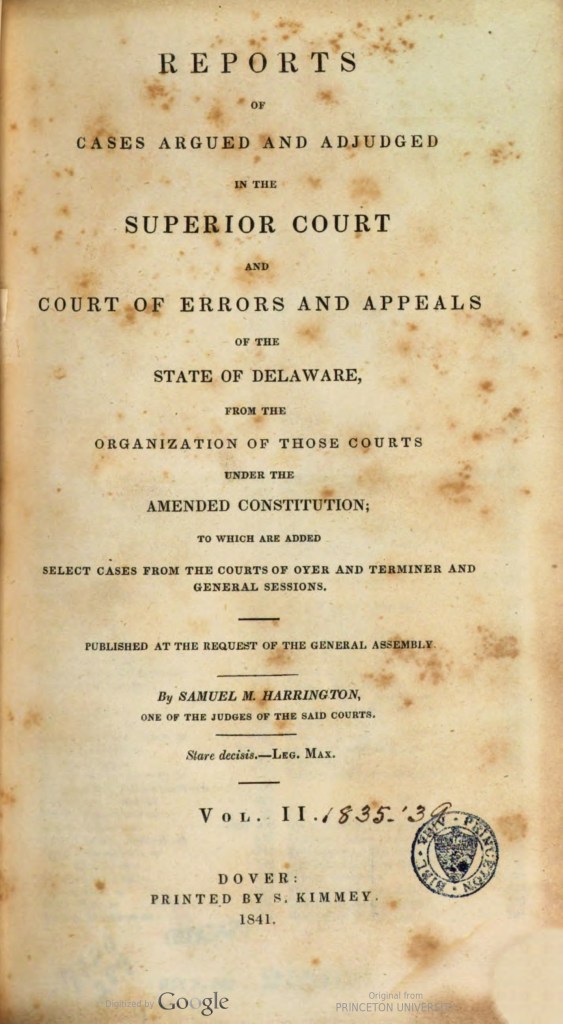
For a good example of this wrestling in the legal mind of a slaveholder in Delaware, see: John M. Clayton, Chief Justice, Delaware Superior Court, majority opinion, in “Isaac Tindal, n. vs Daniel Hudson (1838),” in Delaware Reports (Dover, DE: Printed by A.M. Schee, 1841), 2:442.
Clayton’s opinion was in its own time (in)famous for stating baldly what Black residents of Delaware knew well, viz., that the state’s racist laws robbed nominally free African Americans of nearly all their civil rights, rendering their citizenship hollow, and little different than slave status as a lived experience.
As Clayton put it: “But the negro is not such a freeman as to extend protection; he is though nominally free, almost as helpless and dependent on the white race as the slave himself; he has few civil rights, being merely protected in his person and property by the law, and being allowed in some cases to give his evidence in a court of justice. He can hold no office of honor, trust or profit; cannot act as a juror or legislator, cannot make or execute laws. He cannot, therefore, in any sense extend to a slave the protection due from a master, having no voice in the making, altering, enforcing or executing the laws; and having himself constantly to resort to the protection of the whites.”
[7] While slavery as a legal practice is (mostly) banned by the 13th amendment, slave law precedents still form the basis for all kinds of commercial, property, and indeed corporation law. Justin Simard’s Citing Slavery Project documents how foundational slave law is to modern jurisprudence, partly in an effort to get the legal system to acknowledge the scope of the problem, and correct it by moving away from citing slave cases. As far as I know Delaware’s jurists have not made any effort to detach themselves from slave law precedent, in any regard.


 Dael A. Norwood