Or, Some Early Investigations into the History of Delaware’s Revenues, with Particular Attention to Corporate Franchise Fees
Value of the Franchise – Research Note #1
Today, many Delawareans (and esp. state politicians) consider maintaining the state’s dominance in corporate registrations to be one government’s most urgent tasks. Having an outsized number of outside companies domiciled in the First State supplies a hefty portion of state revenues – $1.3 billion in franchise fees alone in 2025, nearly 20% of total revenues for that year.
Delaware’s dependency on outside businesses for government funding makes the state unique – and perhaps uniquely corrupt, too – but the situation also raises some urgent historical questions. Namely: how long has this been going on?
To hear Delaware’s current judicial, legislative, and executive officials tell it, Delaware’s current situation is of ancient standing, defining its political economy since at least 1911, when New Jersey supposedly “lost” the registration game, or perhaps even 1899, when Delaware changed its corporate law to attract more fee-paying registrants.
But I’m a historian; a lot of water has passed under the bridge in 127 years, particularly when it comes to how American states organize and pay for themselves. Is the common wisdom of Delaware today true? Has the Small Wonder really had its political economy stuck in amber for more than a century?
To find out, I went looking for data that could help put Delaware’s current, desperate efforts to maintain it’s corporate franchise in context. And I found some!1 And now I’ve got information on Delaware state revenues, 1880-2024, from two series (see note on sources, below, for details).
What follows is a first pass look on patterns that jump out, illustrated with some ugly graphs (because I don’t know yet how to make nice ones).
~~~
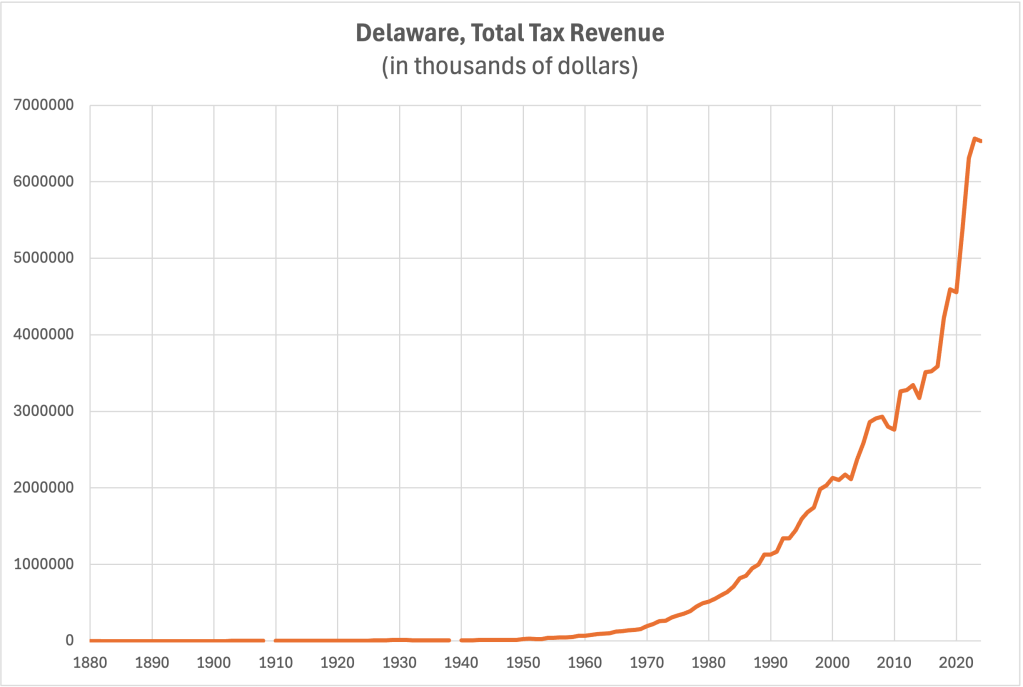
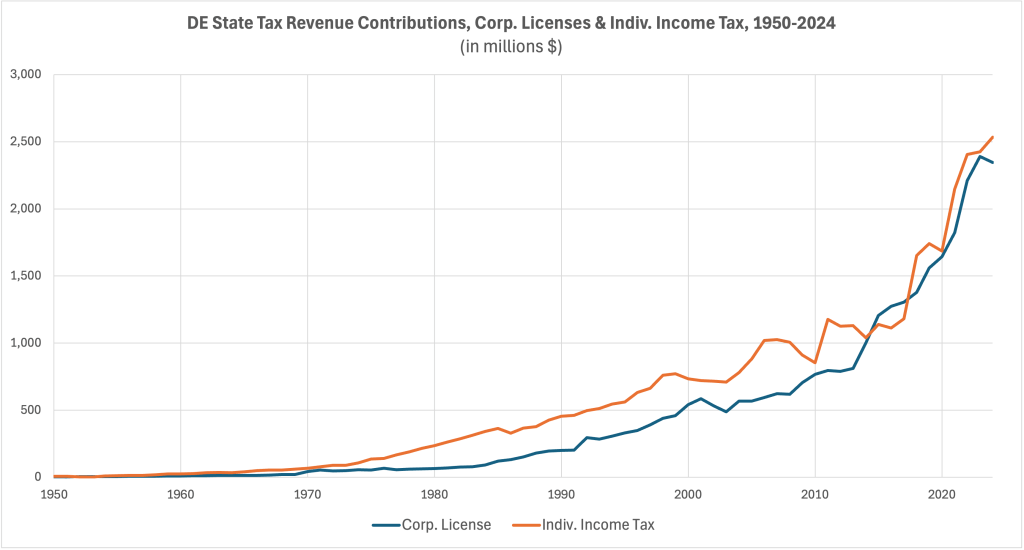
First: the fiscal resources captured by Delaware’s state government through taxation have dramatically increased since WWII, with an especially steep rise since the turn of the 21st century. This graph illustrates some of that change.
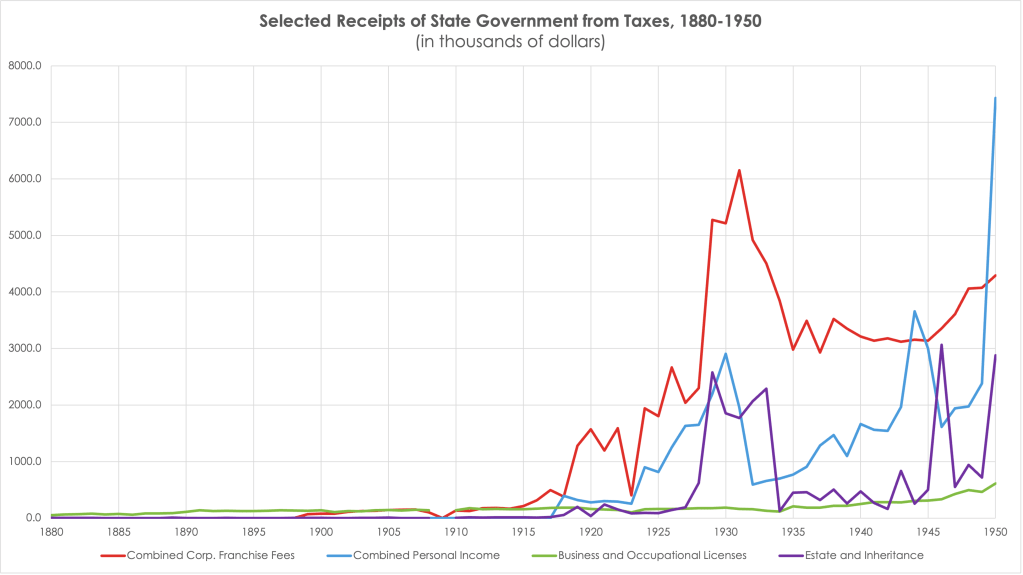
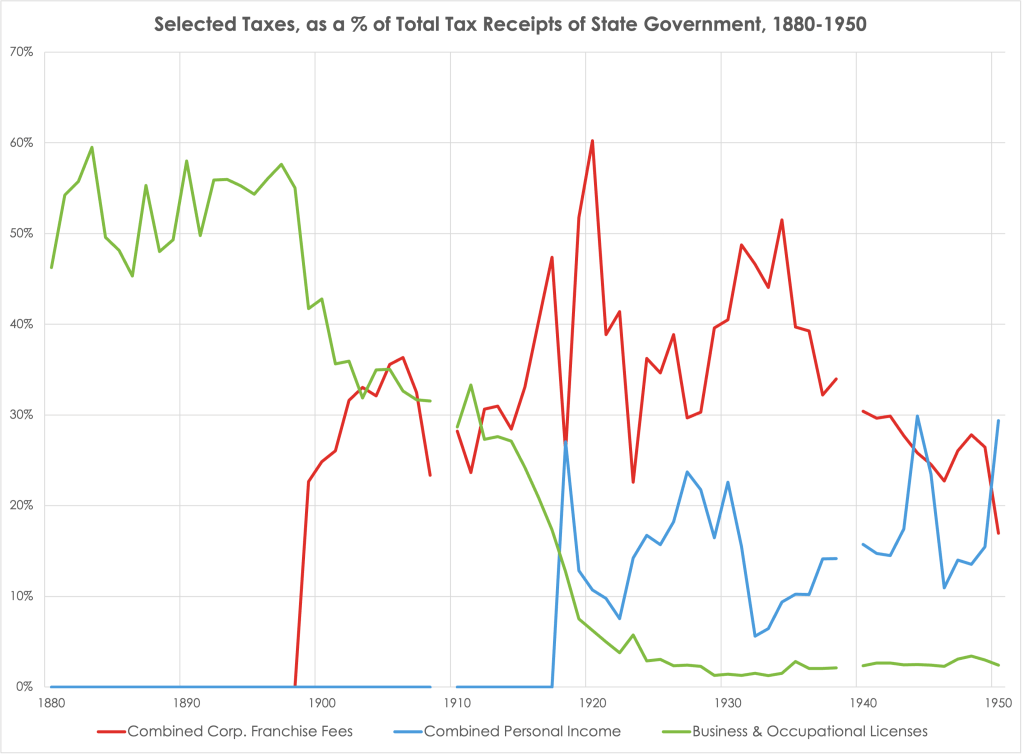
Second: Delaware’s revenue mix changed dramatically in the 1910s. Prior to WWI, the state’s overall revenues were quite small, and business and occupational license fees accounted for a clear majority of them (that is: things like barber’s licenses). The introduction of corporate franchise fees in 1899 changed that – but only after war kicked off in Europe did the franchise start kicking in more than official permissions to give haircuts. These growing franchise revenues were additive: other revenue sources did not disappear, but instead combined to grow the entire pie – which rose still higher starting in 1919 with the introduction of personal income taxes and hikes in the inheritance tax.
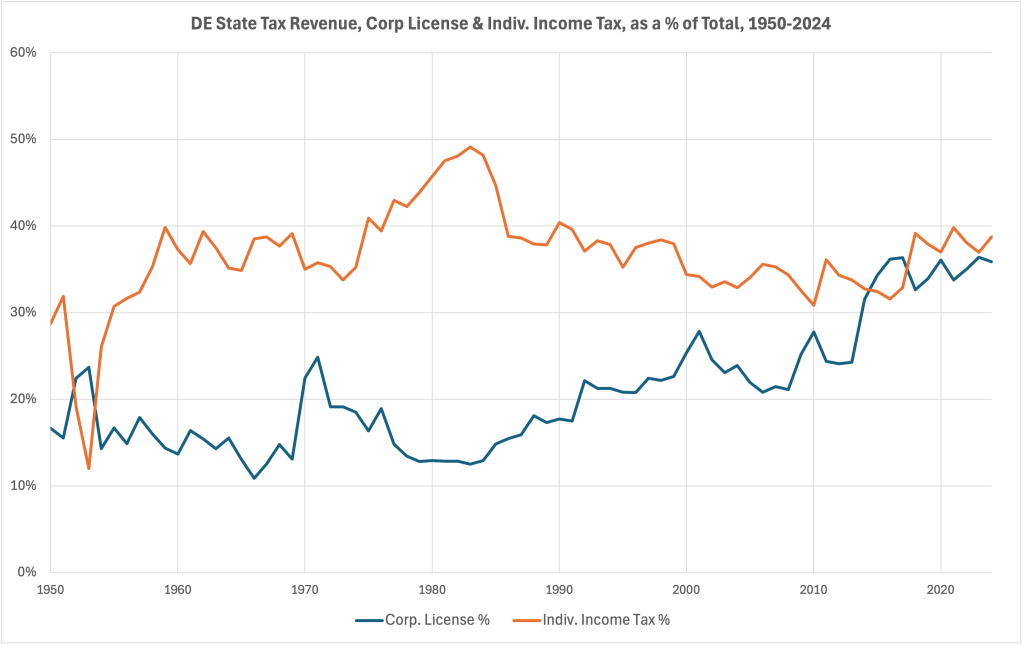
Third: Postwar, individual income tax revenues routinely outpaced the total dollar contributions of the corporate franchise and its percentage of total revenues. That’s the “normal” of modern Delaware: for 70 out of 75 years covered by this data (1950-2024), income taxes contribute more to state revenues than the corporate franchise – and usually 2-3X more.
That gap is large in the immediate postwar decades, but starts to narrow steadily in the 1990s – and 2015, the corporate franchise’s contributions briefly outpace individual income taxes again. The current status quo, where the franchise is as important, or nearly so, as personal income taxes dates from the post-2008 crisis era, aka the Markell administration
So how long has the State of Delaware been dependent on the corporate franchise? It depends. The franchise has contributed substantively to state revenues since its inception, and, at times, provided the a clear majority of fiscal resources. Too, the growth of the corporate franchise tracks closely with the expansion of the state government of Delaware – insofar as our little backward province has a modern fiscal apparatus, it’s origins and development are coincident with the franchise.
But! The current status quo, where corporate franchise fees account for a third of total tax receipts is a relatively new circumstance. That is: the state’s deep dependency on oligarchs’ whims is younger than Zoom, more recent than the MCU – more youthful, even, than my undergraduate students. Which suggests that it’s something that could be unwound, or at least altered – if Delaware politicians wanted to expose themselves, and residents of the state, to less extreme exploitation from the richest of the rich.
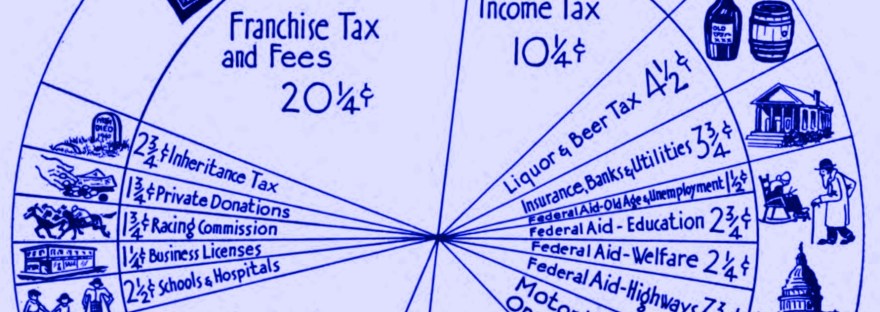
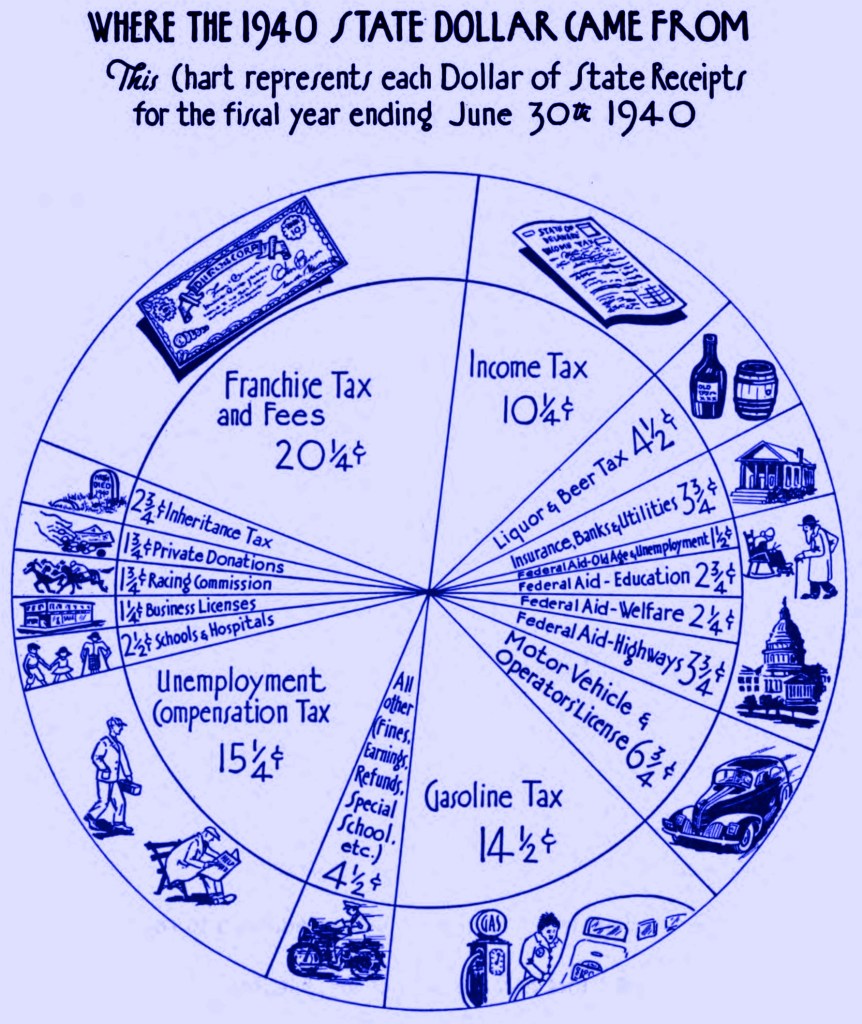
—— Header image source:“State of Delaware: Where the 1940 State Dollar Came From,” Annual Report of the Delaware State Tax Commissioner, 1939-1940 (Dover, DE), p. 26.
A Note on Sources:
I drew on two sets of sources to compile a dataset on Delaware state revenues from 1880-2024.
These printed reports are idiosyncratic: their contents depend, in large part, on the whims of the State Tax Commissioner. I drew from two specific reports that featured an especially detailed series of historical data on tax receipts, 1880-1950: 1930-940, pp. 34-35 and 1950, pp. 18-19. While later reports are extant – even digitized through to 1970 – they tend to report annual data only, and not longer historical series.
Though it draws on state officials for data, the Census Bureau organized that data slightly differently, using standard categories rather than state-specific terms. (What in the Delaware State Tax Commissioner’s hands is often denoted as “Corporate Franchise” revenues are in the STC described as “Corporate Licenses.”) Though the STC includes a few scattered datapoints for the 1940s, the records run in series only from 1950 to 2024.
Neither of these series provided data on other state revenues that derive from corporate registrations, like escheatment; that’s a significant blind spot, as some of these have paid out hundreds of millions into the state treasury in recent years.
While this dataset is extremely detailed, and includes many different details on the specific funds revenues feed into, as well as categories, divisions, and departments, it goes back only to 2017 – a few years after one of the major shifts in the importance of the franchise to state revenues, overall.
—
Well, eventually I did, in print sources and online datasets. That was after I visited the Delaware Public Archives to try and locate historical tax records – an effort proved to be a waste of time because the State of Delaware does an awful job when it comes to recording and archiving its past revenues, either in their original format or even the annual aggregate reports. (When it comes to government reports, most executive department records are organized by Governor, and held in that officials’ personal papers – and mixed together willy-nilly with all kinds of other material, like dinner invitations, like the state is some kind of medieval kingdom.) It may be these records exist in more or discoverable or usable form, but I’ll be damned if I could figure out where they are. ↩︎
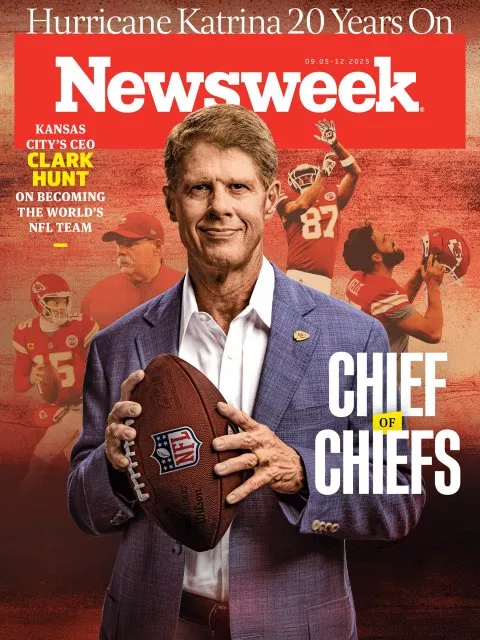
I was quoted in a short article in Newsweek, offering an assessment on just how much of a radical break Trump’s seizure of effective control of several major American industrial corporations is, historically.
Dael Norwood, an associate professor of history at the University of Delaware, told Newsweek a key difference between the Intel deal and those bailouts made during the Great Recession is that those programs were “quickly unwound.”
Another key difference from these historical deals is that those of Trump seem to be “arbitrary exercises of personal power, very directly tied to Trump himself,” Norwood said.
“A ruler seizing direct, personal control of large corporations (though various means) and using public policy to directly benefit his family’s enterprises is a massive break with the history of US capitalism, at least as since the American Revolution,” he said.
“In no case did the executive branch seek to exercise either strategic or tactical control over the business, much less extort them for personal gain,” he said.
…
Dael Norwood, an associate professor of history at the University of Delaware, told Newsweek: “I think these ‘deals’ suggest we’re witnessing a profound break with the historical patterns of American capitalism. American capitalism has always been deeply and inescapably intertwined with government – markets and private property exist only insofar as the law creates, legitimates, and regulates them; corporations are all literally creations of state and federal governments; government funding through grants or purchases has always been critical to the development and marketing of new technologies; and so on.”
Per the article, this take puts me in some agreement with a VP of the Cato Institute and Rand Paul, apparently – though I disagree that any of this is “socialism – but firmly on the other side from a corporate governance scholar at the University of Chicago, who advances a shockingly imaginative retelling of U.S. business history.
Strange days!
You can see more of what I have to say on this topic on my post on the US Steel “deal,” “Autocracy, Incorporated.”
Or, How U.S. Steel Now Resembles the Royal African Company – and What That Means for American Democracy & American Capitalism
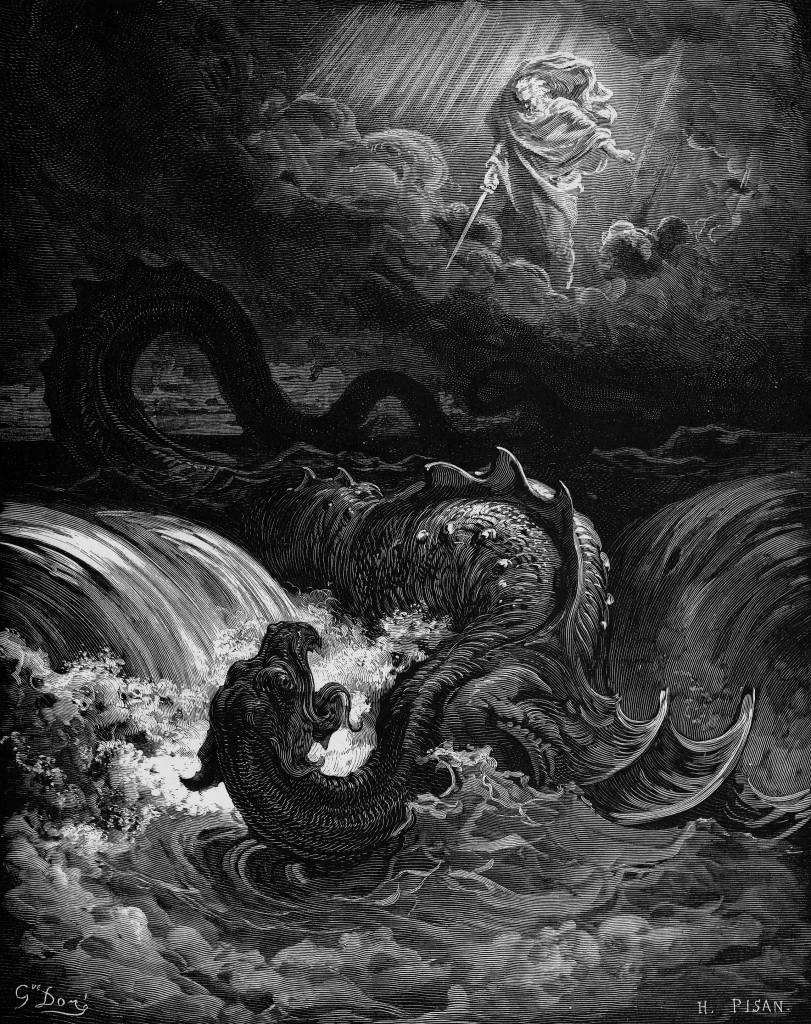
How does an autocrat affect the business world? As Leviathan thrashes his bulk and churns the seas, how many adventurers’ ships do his waves swamp and founder? And how might the folks interested in those ships attempt to appease Leviathan?
The US is six months into the MAGA Restoration, and having effed around, I think we’re starting to find out.
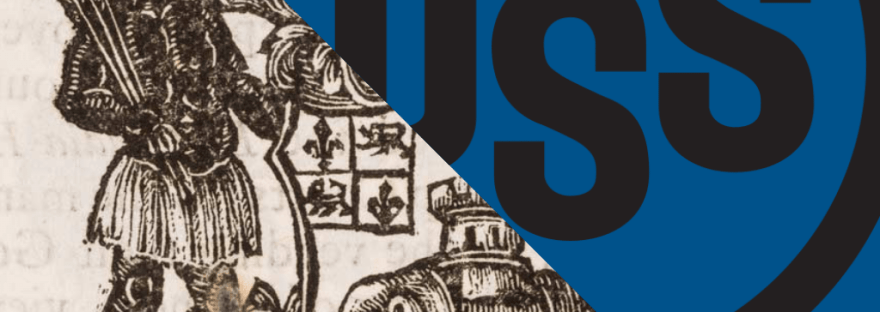
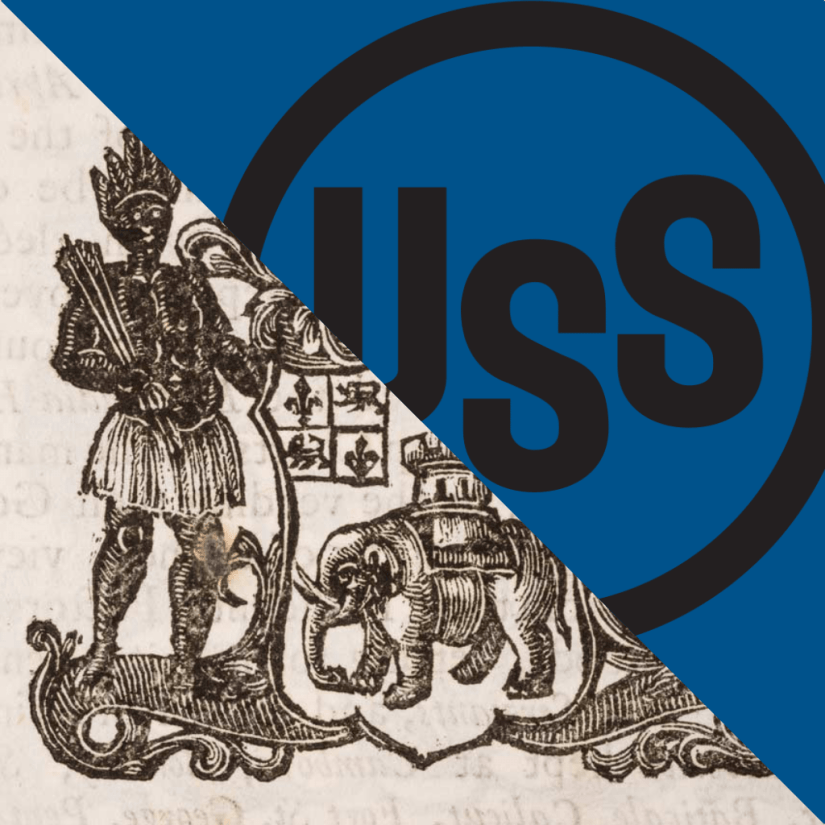
Left: Coat of Arms of the Royal African Company; Right: Logo of U.S. Steel
~~*~~
On June 18, 2025, Nippon Steel acquired U.S. Steel for $14.1 billion dollars, making the long-lived American industrial corporation into a wholly-owned subsidiary of the Japanese company. The deal to create the world’s second-largest steel operation was a long-simmering one, running over eighteen months, largely due to federal opposition on “national security” grounds, first from the Biden administration and then the Trump regime.
The impasse broke in mid-June, when the companies involved found a novel way to satisfy Trump’s vanity: they promised him a powerful, personal “golden share.” Journalists at the NYT, Bloomberg, WSJ and elsewhere all reported – seemingly only on the basis of company-issued materials – that holding this “Class G share” would grant President Midas-Touch unusual power over the operations of the new subsidiary, still to be named U.S. Steel.
“Nippon Steel and U.S.Steel struck a National Security Agreement with the US, in which US Steel will issue a so-called golden share to the government. The golden share gives consent rights to the US president concerning reductions in capital investments, changing US Steel’s name and headquarters, redomiciling outside the US, transferring jobs or production outside the US, acquisitions and decisions to close or idle existing facilities.”
Some context: a “golden share” is a special class of stock that allows its holder, typically a government, to outvote all other shareholders in some circumstances, like during proposed charter amendments. The term appears to date to Thatcher-era Great Britain, though the practice of a government assuring itself control of an important corporation by taking an ownership stake is far older (central banks, for example, often operate this way). In the contemporary moment, “golden shares” seem to function like a glitzed-up, nationalized version of the dual class shares that oligarchs, like Mark Zuckerberg and Warren Buffett, use to maintain personal control of their companies without tying up their capital in equity.
But while “golden share” structures are common outside the US – Brazil holds a “golden share” in aircraft manufacturer Embraer, the PRC owns shares of companies like ByteDance, etc – the arrangement is quite rare, and perhaps unique, in the US. Even when the federal government re-capitalizes failing companies, as it does during bailouts (e.g. GM’s after 2008, or any number of railroads, airlines, and financial institutions), US officials have stayed far away from using the resulting equity to assert control over operations, much less business strategy.
Instead, Article VI U.S. Steel’s new charter grants “Donald J. Trump” vast control over the operations of the company. While he is serving as president, “written consent of Donald J. Trump or President Trump’s Designee” is required for the corporation to: alter its charter, change the company name, move its headquarters out of Pittsburgh, re-domicile outside the US, change its capital investments, sell any production location, acquire any other company, implement price changes, accept financial assistance from the Japanese government, reduce employee salaries, or “make material changes to the Corporation’s existing raw materials and steel sourcing strategy in the United States.”[2]
When or if Donald J. Trump is no longer president – a future the new charter does not contemplate except by implication – these powers fall to the US Department of Treasury and the US Department of Commerce, though who within those departments can act, or how they are to act together, is unspecified.
So: Nippon Steel has provided a specific person, President of the United States Donald J. Trump, with governing power over their subsidiary corporation, a company worth (as of last week) $14 billion dollars. He holds this power not as an owner of equity, or as a director with fiduciary duties to equity owners, but simply by virtue of his office and political power.
To be blunt: is the kind of thing corporations do to satisfy autocrats. Only in a personalist dictatorship do you give the head of state a role in your foundational corporate charter; it’s a courtier’s pact, made to curry special favor, and bind a political patron to the business.
No, what’s odd about this U.S. Steel deal is that the Trump regime appears to have arranged personalized governing power over a corporation, without acquiring ownership. They seized the opportunity to assert sovereign authority over a national enterprise, through a single person, not an owner’s property rights. In U.S. Steel, they have recreated the powers of a king.
~~*~~
There are many ways to think about the shape that business takes in an autocracy. We don’t lack for models: from the Congo Free State under Leopold II to Jim Crow Mississippi to fascist Italy or today’s PRC, there are diverse examples of how capitalist expansion continues – and, arguably, thrives – under despotic rule of many different types and in many different places.
But this U.S. Steel disaster resonates with a deeper history, I think, the place and period of where capitalism first emerged, alongside – and in partnership – with ambitious autocrats: early modern England. At least, there seem to be several familiar chords in this music. First, in this period, the British (neé English) empire relied on corporations as a critical tool for colonial and commercial expansion – corporations that, for the most part, were created by the Crown, not Parliament. Second, the early British empire was quite unstable, riven by repeated cycles of revolution and restoration, coups and counter-coups – which provided lots of opportunities for negotiating and re-negotiating the relationship between state and corporations, monarchs and market institutions, and a lot of explicit writing and wrangling about what these relationships could, should, or did mean.
Finally, the autocrats of the period – and in particular, the well-coiffed but fragile-necked Stuart kings – provided the whetstone against which early Americans, and their political heirs, sharpened their ideas about liberty to a cutting edge. It’s a period rich in relevant material, as well as direct influence, on the politics of our present moment.
Which brings me to the Royal African Company. The RAC was a joint stock trading corporation with a monopoly on all English trade with West Africa. First granted letters patent (e.g. a charter) by Charles II in 1660 under the title “Company of Royal Adventurers into Africa,” it took on its more well-known name, and some additional powers, with a re-chartering in 1672. [3]
The RAC was, in many respects, a bog standard corporation of its time and place. It was one of dozens of companies chartered in 17th-century England, and like the Levant Company, the East India Company, or the Hudson’s Bay Company, its charter not only granted its associates unified legal personhood – and thus the ability to concentrate and deploy capital beyond the means of any one merchant – but also monopoly rights over a specific trading territory, and governing power there. Like these other companies, the RAC was explicitly a tool for colonization and imperial competition: it could establish forts, manors, and plantations, set up courts, and develop, marshal, and maintain military force on land and sea, as needed to fulfill that purpose.
While it’s fashionable in corporate law and finance circles today to approach corporations as organizations with ultimately “private” origins that the state must, reluctantly, regulate to maintain the basic health, safety, and financial transparency standards markets need to function, the RAC reminds us that this libertarian conception of corporate life is detached both from historical reality as well as the letter of the law. Like modern corporations domiciled in Delaware, the Royal African Company was a subdivision of the state, a temporary division of sovereign authority, granted to a body of subjects to accomplish a purpose – and therefore ultimately and always a creature of government, in all senses. [4]
Two things made the RAC unique, amid this host of incorporated adventuring companies. First, while the company’s initial business was the gold trade, it quickly – and quite successfully – expanded into slave trading. Indeed, a few years into its existence, the RAC became the dominant player in the trans-Atlantic traffic in human beings, and over its life it shipped more people across the Atlantic into chattel bondage than any other single institution. [5]
Second, from its first charter onward, the company’s lead founder and “first governor” (e.g. board chairman and CEO) was the king’s brother, James, Duke of York. And James… James was a special guy. Amid some serious competition from his grandfather, father, and elder brother, James Stuart, Duke of York and (briefly) King James II (of England and Ireland) and VII (of Scotland) distinguished himself for his zeal for building an absolute monarchy based on the divine right of kings – and, unsurprisingly, also by his penchant for cruelty and the brutal persecution of his critics.
While James II didn’t meet the sharp end his father did – he fled England before anyone could effect the traditional familial separation between head and body – his time as Duke and then King made a lasting impression on British political development, as an example of what not to do. Following his fall, the power of British kings was forever broken, more tightly circumscribed by law and kept in check by the active exercise of sovereign power by Parliament.
Why? Well, all the Stuarts had been committed a project of centralizing power under the Crown, and growing the monarchy’s bureaucracy at the expense of other governing institutions. Briefly checked by the loss of Charles I’s head and the interregnum, the post-Restoration Stuarts doubled down on the monarch’s right to arbitrary authority. So under Charles II, the monarchy took to simply disappearing troublesome subjects to foreign prisons “beyond the seas” – a practice Parliament attempted to circumscribe by legislating habeas corpus in 1679. And because James II was the last – and arguably the most aggressive – champion of this project, he receives particular opprobrium for it. As historian Holly Brewer has recently reminded us, James II expanded on his family’s efforts, efficiently corrupting the judiciary with patronage in order to remove any check on the monarch’s whims. (A tune that should sound familiar to modern Americans…)
But back to the RAC: James’s executive role in the company was not in name only. He used the company to advance his colonial projects all over the Atlantic world, as a means to supply the slaves that his colonial adventures in North America and the Caribbean needed to profit. And he also wielded state power on its behalf – directing the Royal Navy to seize African forts during wars against the Dutch, for example. (Among other wartime accidents, these Anglo-Dutch conflicts led to James, as the Duke of York, briefly becoming the proprietor of the tiny, failing sub-colony of Delaware – a disappointment to all involved, surely).
In practice and in theory, there was no clear line between the operations of the RAC as a capitalist enterprise, and James’s personal exercise of autocratic power. Indeed, they co-constituted each other – with humanity all the worse for it.
But what does the Royal African Company have to do with U.S. Steel? I would argue there is a similarity in political shape. The grant of governing power to a ruler is not an act undertaken in a political economy defined by free enterprise and universal rights; it’s not even the kind of play one makes in a robust oligarchy. Rather, it’s the move a board of directors makes when playing court politics, in a monarchy.
Too, the fact the Trump and his minions worked to produce this outcome – and not a simple bribe – makes it worse than bare graft. It’s an enactment of the MAGA Restoration’s theory of politics, of a piece with the anti-democratic philosophy the movement’s intellectuals advocate, the same philosophy that’s leading the regime to crush universities, the press, and tighten its chokehold on the federal courts and Congress. It’s a politics of absolute monarchy akin to what the Stuarts and their lackeys celebrated as divinely justified (an apologia constantly offered by Trump supporters, too). That autocracy has now come to corporate America.
But despite it’s best attempts, tyranny is never the only game in town. The House of Stuart was nearly a century fled from Britain’s empire, and their pretense to rule equally dead, when the American Revolution took its first percussive bloody breaths on Lexington Green. And yet, the Stuarts’ shade remained, substantial enough to cast a defining shadow when American patriots submitted a “history of repeated injuries and usurpations” to a “candid world” to demonstrate the “absolute Tyranny” of King George III. As they sought to justify themselves for rising to rebellion and declaring independence by reference to the King’s outrageous acts (like “transporting usbeyond Seasto be triedfor pretended offences”) American revolutionaries recalled and remade a political language first articulated by by a group of seventeenth century anti-Stuart partisans, the “Country Whigs,” within a broader European discourse about the necessarily popular roots of political order and legitimacy (e.g. “republicanism”). Stuart tyranny was the lens through which revolting colonials observed the actions of King George and Parliament, and it served as the foil to the English liberty they sought to restore through rebellion.
Americans identified the dangers of arbitrary monarchical rule in part through its corporate manifestations. The Tea Act, the legislation granting the East India Company a monopoly on tea sales in North America and laying a small tax on tea to pay for government bureaucracy, was condemned by Massachusetts Whigs as a “master-piece of policy for accomplishing the purpose of enslaving us.”[6]
That sounds like a wild overreaction to tax policy – and a weird reason to destroy millions in fragrant property – until you understand that like other British colonials, Massachusetts activists saw political events through the lens of Stuart abuses. A corporate monopoly, designed to generate taxes to fund state action, wasn’t just a discrete policy, but a conspiracy to undermine the imperial constitution and drown free men’s liberties. How did they know? Their political forefathers had lived through it one before, and written a great deal about it – and those essays survived and circulated widely among the politically engaged colonial elite; and too, the colonies they inhabited took the shape and form they did in no small part due to the actions – and reactions – to James II’s wielding of corporate power.
Based on their understanding of the Stuart example, they thought the leviathan’s bulk was necessarily nourished by blood flowing through corporate veins.
Thus, the legacy of the Royal African Company, and the importance of its corrupt echo in the corporate structure of U.S. Steel lies not only in the personal despotism these companies actively embodied or embody. It rests also in the liberatory ideology that tyranny inspired, as an instrument that detects corruption in the body politic as the rot sets in, identifies it as a danger to free people, and provides the means – the words and the actions – through which it can be opposed, and destroyed.
The best way to survive a cancer is to catch it early, and treat it. U.S. Steel’s new charter shows up as a large malignant mass on America’s scan; will we be willing to cut the tumor out before its too late?
[3] For the 1660, 1662, and 1672 charters of these corporate entities that became the Royal African Company, see Cecil T. Carr, Select Charters of Trading Companies, A.D. 1530-1707, Publications of the Selden Society (London: B. Quaritch, 1913), pp. 172, 177, and 186 et seq.
[4] The source of “sovereign” authority was disputed, however. In theory, in the US today “the People” constitute “the state,” which creates corporations (state and federal). In seventeenth century England, however, the Crown asserted that authority, through the sovereign body of the monarch – though, at various moments Parliament also claimed that authority too, leading to some rather nasty civil conflicts, coups, counter-coups, and counter-counter coups, that were only resolved once the Dutch got involved – a messy outcome.
[5] The RAC shipped some 150,000 people during its primary years of activity, from 1672 to the 1720s. William A. Pettigrew, Freedom’s Debt: The Royal African Company and the Politics of the Atlantic Slave Trade, 1672-1752 (Chapel Hill, NC: The University of North Carolina Press, 2013), p.11.
However, British slave trading would soar to all-time world-historical highs only after the RAC’s monopoly was broken. Independent British slave traders then far surpasses – in a shorter amount of time – the human trafficking of every other slave-trading Atlantic nation. The end of the RAC’s monopoly was a development that planters in North America welcomed, by the way, as now they had cheaper sources for slaves. Another example of the magic of the free market, a blood-soaked sort of necromancy.
Much like the recent revisions to state law themselves, these reactions to mild criticism are expressions of myopia. Criticism of the sort SB 313 attracted in 2024 – that it proceeded anti-democratically, that it harmed ordinary people, that it was motivated by a small set of special interests’, and would lead to abuse – were leveled at Delaware state legislators when the state’s corporate law first passed in 1899.
If anything, earlier observers of Delaware corporate law in the Gilded Age were far more blunt in their criticism than anyone in the 21st century has ever thought about being. To illustrate, lend your eyes to this brief article from the American Law Review, a legal journal based in St. Louis: “Little Delaware Makes a Bid for the Organization of Trusts,” American Law Review 33, no. 3 (May-June 1899): 418–24.
Well-known to Delaware lawyers – and recently, at least one historian – the article takes the form of an unsigned “note,” one of a few dozen that appeared at the back section of every journal issue, after the treatises and articles, but before the listings of recent major court decisions. My assumption is that it is either written by the editors, Seymour D. Thomson and Leonard A. Jones, or one of their close associates – and either way expresses their editorial views.
And my goodness, are the Am.L. Rev. editors unimpressed with Delaware trying to copy New Jersey’s loose corporate charter rules, much less their attempt to “improve” on them by giving corporations even more expansive powers. After some praise for Delaware’s old Democratic (and enslaving) political establishment (and some sharp elbows at the emerging state Republican party), the editors note that the curious feature of US federalism – that state sovereign powers are equal, and that states set corporate law – is what provides the temptation that Delaware has now given into:
“The “sovereign” States of the American Union are equal: equal in the Senate, for little Delaware wields the same voting power there as does great New York. They are also equal in regard of the deviltry they can do – equal in regard of the injury they can inflict upon their sister States. It is as though a Klondike gold mine had been discovered in New Jersey, and all Delaware were on the rush to get there. In other words little Delaware, gangrened with envy at the spectacle of the truck-patchers, sand-duners, clam-diggers and mosquito-wafters of New Jersey getting all the money in the country into her coffers, – is determined to get her little tiny, sweet, round, baby hand into the grab-bag of sweet things before it is too late.” (p. 419)
And, the editors note, this law will be a jobs-employment program for Delaware politicians; they may need to even import labor:
“But with this exception; and herein the little great “State of Delaware” casts its little great anchor to the windward. Although ” any three persons may organize a corporation,” yet ” only one director need be a resident of Delaware.” And this ” one director'” is going to be paid for being a director, and don’t you forget it. If the rush to organize corporations and trusts under this new Delaware law is as great as under the New Jersey law, there will not be politicians enough in Delaware to serve as directors of corporations and trusts for all the other States of the Union, but professional directors will have to migrate to Delaware from other States, and their name will be Legion.” (p.420)
Delaware legislators’ grandiose proclamations about their new law’s global applicability seem to be particularly grating:
” Nor will you be confined, in the conduct of your business, when so happily incorporated, to your drought-smitten and grasshopper-eaten prairies. “It,” – that is to say you when you have turned yourselves into Delaware corporations – ” may conduct business anywhere in the world.” Certainly you may. Why not? The great State of Delaware says so, and is not that enough?” (p. 421)
Halfway through, the editors re-frame their note as addressing the great political enemies of the Big Corporations in this particular moment – the hardworking, Populist Party-supporting farmers of Kansas. (This is for rhetorical effect; I doubt too many populists were reading this attorney-specialty journal). And in this section, the editors suggest that should these farmers try to use the state power they control, they’ll face a potent force – in law, if not actually in the military.
“If Kansas attempts, through its legislation, to interfere with the sovereign prerogatives of Delaware, Delaware will be there with its oyster-boat and clam-boat navy, and with its unterrified militia; and what then will Kansas do about it?” (p.423)
And then finally, they note the alchemical aspects of Delaware’s new law.
“Let us not forget, oh, toiling brothers of the Kansas deserts, one other feature of this congenial law: 6. “The liability of the stockholder is absolutely limited when the stock has once been issued for cash, property or services.” Brother, do you need to photograph this sentence by means of an X-ray? Can you not see through it? Is it not pellucid ? It says, ” issued for cash.” It does not say paid for in cash. Is it not ” issued for cash” when it is issued for the promise of cash? and is it not issued for property or services when it is issued for the promise of such commodities? And if the gold bugs, bond- holders and other octopi, should render it hard to redeem your promise to pay for your shares – even in chips and whetstones, – why should you so pay? You have launched your corporation; the sovereign laws of Delaware allow you to commence business before any “sum whatever was paid in; ” and who or what is going to stop you from continuing your business? Do you not see that here is a scheme to turn the world into a sudden millennium? And if you object that a millennium must consist of a thousand years and cannot be created in a day, the answer is that all things are possible with the sovereign State of Delaware. What were the dreams of the ancient alchemists to this? They at most could, by processes somewhat tedious and expensive, convert gross metal into gold. But, without any gross metal of any kind to work upon, not even silver at the ratio of 16 to 1, the sovereign State of Delaware stretches forth her wand over the prairies of Kansas and calls upon money to come, and it comes.” (p.424)
What the irritated attorneys have described here is the central magic of finance, generally, and corporate finance, in particular. With some law and a bit of market faith – and a willingness to grift – you can conjure something out of nothing, and profit. Devolving sovereign power onto private parties who derive artificial persons, and then mortgage those “persons’ ” future cash flows for current income to actually do something (well, sometimes) – That’s Capitalism, Baby! If it feels like fraud, well, you probably don’t sit on the right corporate boards.
This is all to say that criticism of those would weave this kind of spell – and of Delaware legislators’ meddling in its magics, specifically – is nothing new in 2024. The First State’s legislators been catching heat for playing sorcerer’s apprentice, and carrying water for outside financial interests, for a very long time. Maybe they should get used to it? (Or, I dunno, change their ways?)
Or, figuring out if you’ve hit a typo, a fnord, or some history
Doing historical research – reading sources – you find things. That’s more or less the point, after all. But sometimes the things you find are … odd things. Confusing things, things that raise more questions than they answer.
The historian’s standard approach to this situation is to to explore further, to keep reading until you know what’s going on. The only way out is through; ever upwards – excelsior and etc. One reason historians work this way is that confusion is a sign of context collapse – you can’t see the window until you find the frame. The other is that confusion is a sign of a gap. Reading until you figure out why Parisian apprentices thought murdering cats was so damned funny can isn’t just a key to understanding the (horrible) joke, but something bigger about the constellation of power and people in a critical moment in the past. And that’s more or less the point, after all.
Sometimes, you fail to figure out your little mystery. Sometimes, your little detour doesn’t lead to enlightenment, at least not directly. Sometimes, the puzzle remains unsolved.
And sometimes, you run into a neuro-mudkiller, and it leaves you flat.
~~~
Last week, following up on a suggestion from a colleague, I was poking around in some early 20th-century US newspaper databases to see if people in the 1920s were reinterpreting Paul Revere like they had done George Washington – that is, reading him as a “businessman.” While I didn’t find much to support that theory, I did run into an unexplained historical phenomenon.(1)
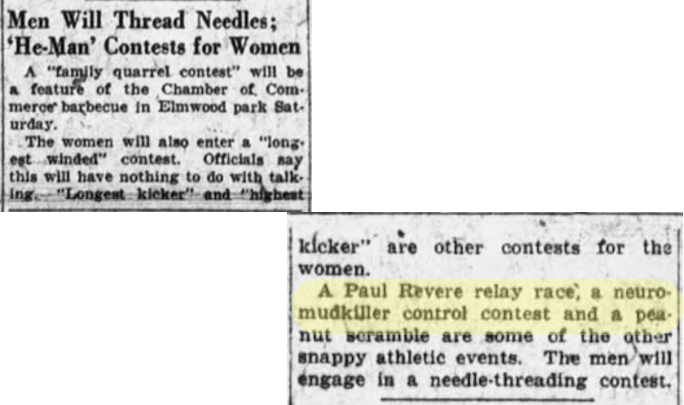
It took the form of a short notice in the Omaha Daily Bee published Friday, May 25, 1923. Sandwiched in the middle of page two was a two paragraph article describing a public barbecue to be hosted Chamber of Commerce the following day in Elmwood park, a major recreation area on the city’s western side. The C. of C. party, the piece promised, would feature a “ ‘family quarrel contest.’” Most events on the roster for this “battle of the sexes” are readily legible as games or contests of skill, like a “longest kicker” match or a “needle-threading contest.” Others took a bit more to understand: a “peanut scramble” is when you toss candy and peanuts in the air for children to catch and collect.
But as I read through this piece, I ran across one event that defied my understanding: “a neuro-mudkiller control contest.”(2) And <BOOM> went the Parisian cat.
~~~
I tried a number of different methods to get a handle on this phrase. I searched for the term in other newspapers, and then, when that failed, other large full-text databases, like the Internet Archive and HathiTrust. I read other reports about the event, and accounts of previous’ years similarly-organized Chamber-sponsored “field days.”
Then I tried that all again with variants of the phrase, its components, its near alikes: mudsiller, mudskipper, mudbiller, etc. I broke each term into component parts.
Alas, nothing has led me any closer to figuring out what a “neuro-mudkiller control contest” might be – or what, ssuming the intervention of some wandering fingers on the linotype machine, the Daily Bee reporter had intended to say, originally.
Having lost hours down this rabbit hole, the phrase for me now conjures Melville’s white whale, by way of Frank Herbert’s desert-addled space opera. (Or perhaps a “neuro-mudkiller control contest” is a fnord that slipped through spacetime for surrealist ends, or to waste my time.)
~~~
Friends, the neuro-mudkiller still eludes me. But by plinking away at search bars and reading across morning editions and evening issues, I learned some things about Omaha and its roaring twenties denizens. I learned that Omaha newspapers have a non-trivial amount of typos, for one.
I also learned the Omaha Chamber of Commerce was an active, and seemingly successful, civic association. In May of 1923 alone, the body sponsored a “trade booster tour” to Wyoming, built and hosted a new “rest room” for business women and professional at its downtown headquarters, and weighed in on a dozen different matters of public import, from traffic regulations to fraternal organizations’ convention bookings.
I further learned that the Chamber of Commerce in Omaha was operating, organizationally, as a primus inter pares. Its leading members led the city’s other leading civic, social, and charitable institutions; and those organizations participated in Chamber events, like the party in Elmwood park. Internally, the Chamber was structured with standing committees of volunteers and a guiding, paid manager (a “commissioner and secretary”) – a successful implementation of the Cleveland “modern chamber” model that famed commercial secretaryRyerson Ritchie developed and then theorized, to national acclaim. (3)
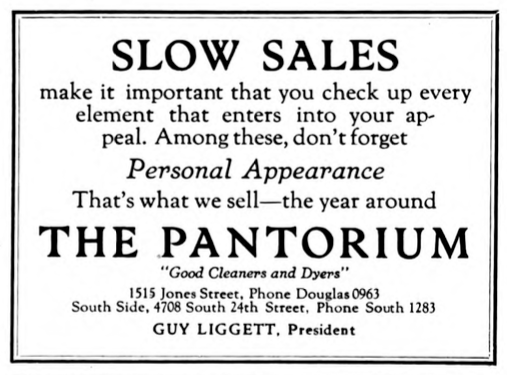
I learned that there was a local laundry called “Pantorium” (they did more than just wash pants). (4)
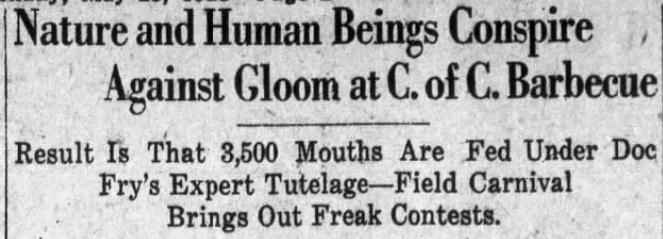
And I learned that the party at Elmwood park was a “Great Success,” at least in the eyes of local reporters. It fed “3,5000 Mouths” with “1,500 pounds of Steer and Lamb” prepared under the expert eye of “Doc Fry,” a local “master of the art of barbecue,” and served alongside with truckloads of bread, pickles, mustard, onions, radishes and – distressingly, given the temperature and the hour – coffee. Attendees were “knocked…dead” with delight by an amateur “minstrel show” and a fake horse race, sponsored by the Continental and the Lions clubs, respectively. With Boy Scouts and visiting nurses on hand to organize and aid participants, the barbecue’s roster athletic events went off without a hitch; winners got a prize donated by a local business, and their names – and addresses – in the paper. (Congratulations, Doris Frederick of 5020 California street, for winning the “longest-winded” (balloon blowing) contest). And as the afternoon turned to evening, a twenty-piece band started playing and “those who cared to tripped and stumbled the light fantastic until it was time to go home.”(5)
Finally, I learned that while the “neuro-mudkiller control contest” was happening – or not, if it wasn’t actually real – another conspiracy was being busted across town, when the Omaha “police morals squad” raided the house of a man named Nick Carmo, and seized his sugar, corn, mash and still.(6)
Violent and unpleasant, that history at least made some sense.
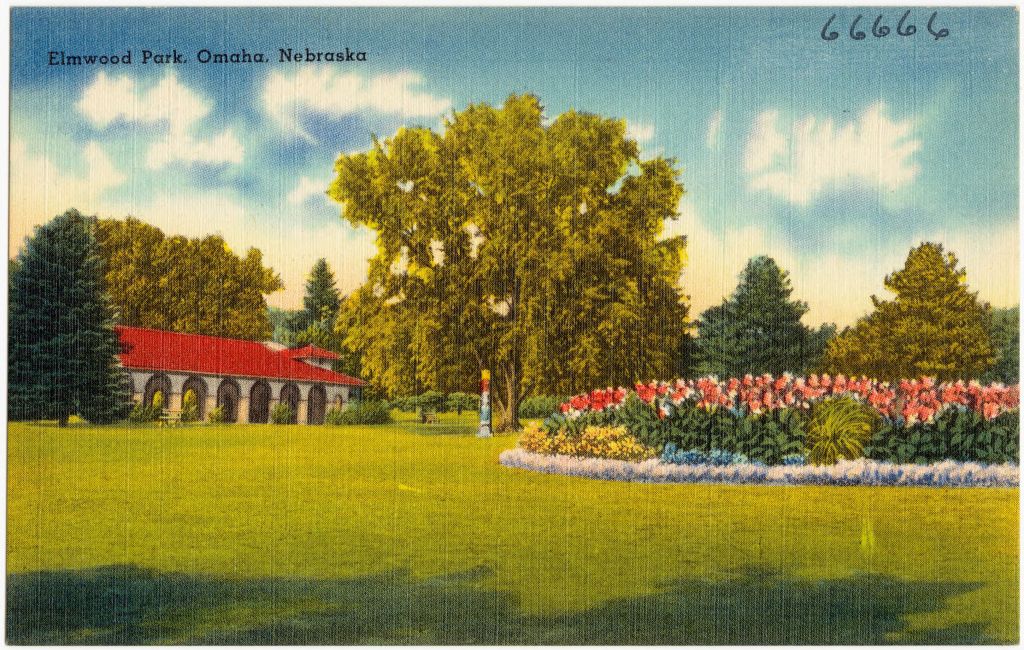
Image Source:”Elmwood Park, Omaha, Nebraska.” Card. Pub. by General Distributors Company, Omaha, Nebraska. “Tichnor Quality Views,” Reg. U. S. Pat. Off. Made Only by Tichnor Bros., Inc., Boston, Mass., [ca. 1930–1945]. Digital Commonwealth, https://ark.digitalcommonwealth.org/ark:/50959/xs55mk23n (accessed June 27, 2024).
(1) David Hackett Fischer, in his biography of Paul Revere, includes an appendix in which he tracks the popular and academic historical “image” of Paul Revere through the centuries. He dates the reconceptualization of Revere as a “Capitalist Democrat” (a propagandist for “free enterprise”) to the early Cold War – a more than a generation later than when Washington was reconfigured. David Hackett Fischer, Paul Revere’s Ride (New York: Oxford University Press, 1995), 339.
(3) “Firms Sign for 1923 Trade Booster Tour,” Omaha World-Herald, Sat. April 1923, p.8; “Open Women’s Lounge C. of C., With Reception,” Omaha World-Herald, Fri, May 25, p.1; “Meetings,” The Omaha Daily News, Mon., June 4, 1923, p.11
(5) “Entertain 4,000 at Big Barbecue,” Omaha Daily News, Sat, May 26, 1923, p.1; “Crowd of 3,500 at Field Day Barbecue: Annual Stunt of Chamber of Commerce Proves Great Success: Appetites Enormous,” Omaha World Herald, Sunday, May 27, 1923, p. 2; “Barbecue Guests Eat 1,500 Pounds of Steer and Lamb,” Omaha Daily News, Sunday, May 27, 1923, p.2C; “Nature and Human Beings Conspire Against Gloom at C. of C. Barbecue: Result is that 3,500 Mouths Are Fed under Doc Fry’s Expert Tutelage–Field Carnival Brings Out Freak Contests,” Omaha Daily Bee, Mon. May 28, 1923, p.2
(5) “Sugar, Corn, Still Are Seized in Raid,” Omaha World Herald, Sunday, May 27, 1923, p.2.


 Dael A. Norwood
.jpg)
