Greetings, I hope this finds you well. I wanted to bring a recent piece of news to your attention, as it bears on the General Assembly’s treatment of corporate law.
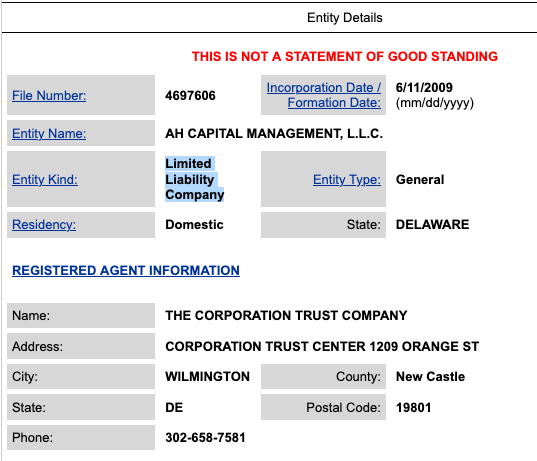
Here’s the thing, though: Andreessen Horowitz (AH Capital Management) is not a Delaware corporation. It’s a Delaware LLC.
As a limited liability company, it can’t “move” its incorporation anywhere; it doesn’t exist. More to the point, none of Andreessen Horowitz’s complaints about Delaware apply to their firm, or to any of the subsidiaries they have registered here as LLCs or Limited Partnerships (LPs), as a quick search of the DE Division of Corporation Business Entity Filing database will attest. This distinction is not a mere matter of synonyms, but one with material consequences for how a business operates. As legal scholars have observed, “An LLC By Any Other Name Is Still Not A Corporation.”
It seems unlikely that the leaders of the world’s wealthiest venture capital firm cannot distinguish between two basic types of business entity structure. It seems equally unlikely, then, that Andreessen Horowitz’s decision to leave Delaware is motivated by their stated reasons. Their critique, in other words, appears to be made in bad faith.
As you and your colleagues contemplate further revisions to Delaware’s corporate law, I urge you to keep this evidence of deceptive arguments from Delaware’s critics in mind – whether they come from business owners, directly, or the locally influentiallegal advocates they employ.
Sincerely, your constituent, DN
NB: most of the outlets reporting on this move – NYT, Bloomberg, Inc – reproduce Andreessen Horowitz’s statement without comment, and thus its errors.
Or, How U.S. Steel Now Resembles the Royal African Company – and What That Means for American Democracy & American Capitalism
How does an autocrat affect the business world? As Leviathan thrashes his bulk and churns the seas, how many adventurers’ ships do his waves swamp and founder? And how might the folks interested in those ships attempt to appease Leviathan?
The US is six months into the MAGA Restoration, and having effed around, I think we’re starting to find out.
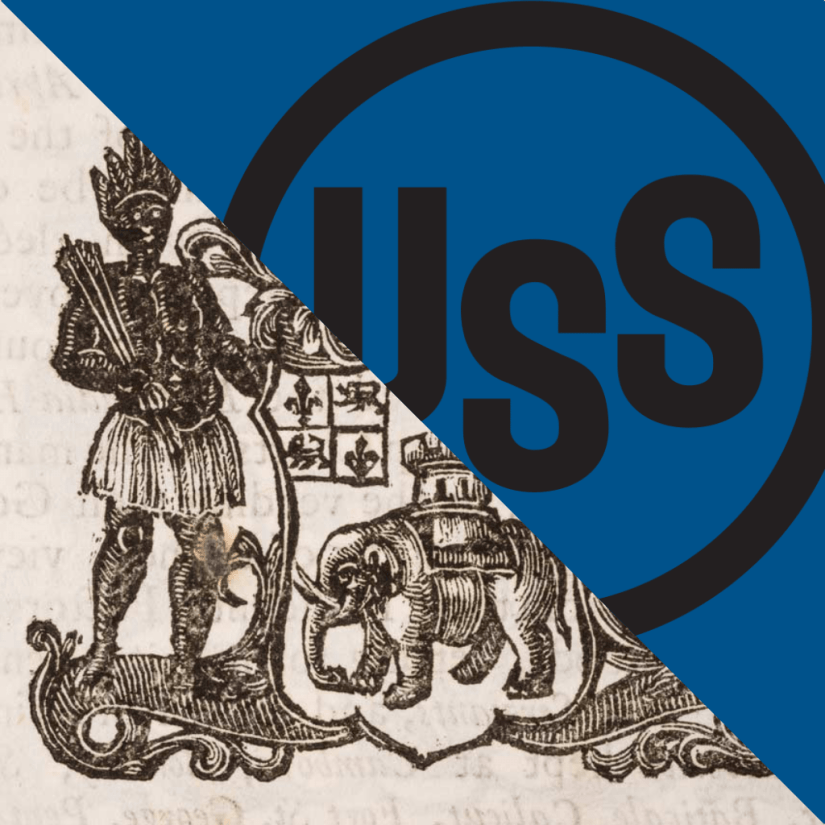
Left: Coat of Arms of the Royal African Company; Right: Logo of U.S. Steel
~~*~~
On June 18, 2025, Nippon Steel acquired U.S. Steel for $14.1 billion dollars, making the long-lived American industrial corporation into a wholly-owned subsidiary of the Japanese company. The deal to create the world’s second-largest steel operation was a long-simmering one, running over eighteen months, largely due to federal opposition on “national security” grounds, first from the Biden administration and then the Trump regime.
The impasse broke in mid-June, when the companies involved found a novel way to satisfy Trump’s vanity: they promised him a powerful, personal “golden share.” Journalists at the NYT, Bloomberg, WSJ and elsewhere all reported – seemingly only on the basis of company-issued materials – that holding this “Class G share” would grant President Midas-Touch unusual power over the operations of the new subsidiary, still to be named U.S. Steel.
“Nippon Steel and U.S.Steel struck a National Security Agreement with the US, in which US Steel will issue a so-called golden share to the government. The golden share gives consent rights to the US president concerning reductions in capital investments, changing US Steel’s name and headquarters, redomiciling outside the US, transferring jobs or production outside the US, acquisitions and decisions to close or idle existing facilities.”
Some context: a “golden share” is a special class of stock that allows its holder, typically a government, to outvote all other shareholders in some circumstances, like during proposed charter amendments. The term appears to date to Thatcher-era Great Britain, though the practice of a government assuring itself control of an important corporation by taking an ownership stake is far older (central banks, for example, often operate this way). In the contemporary moment, “golden shares” seem to function like a glitzed-up, nationalized version of the dual class shares that oligarchs, like Mark Zuckerberg and Warren Buffett, use to maintain personal control of their companies without tying up their capital in equity.
But while “golden share” structures are common outside the US – Brazil holds a “golden share” in aircraft manufacturer Embraer, the PRC owns shares of companies like ByteDance, etc – the arrangement is quite rare, and perhaps unique, in the US. Even when the federal government re-capitalizes failing companies, as it does during bailouts (e.g. GM’s after 2008, or any number of railroads, airlines, and financial institutions), US officials have stayed far away from using the resulting equity to assert control over operations, much less business strategy.
Instead, Article VI U.S. Steel’s new charter grants “Donald J. Trump” vast control over the operations of the company. While he is serving as president, “written consent of Donald J. Trump or President Trump’s Designee” is required for the corporation to: alter its charter, change the company name, move its headquarters out of Pittsburgh, re-domicile outside the US, change its capital investments, sell any production location, acquire any other company, implement price changes, accept financial assistance from the Japanese government, reduce employee salaries, or “make material changes to the Corporation’s existing raw materials and steel sourcing strategy in the United States.”[2]
When or if Donald J. Trump is no longer president – a future the new charter does not contemplate except by implication – these powers fall to the US Department of Treasury and the US Department of Commerce, though who within those departments can act, or how they are to act together, is unspecified.
So: Nippon Steel has provided a specific person, President of the United States Donald J. Trump, with governing power over their subsidiary corporation, a company worth (as of last week) $14 billion dollars. He holds this power not as an owner of equity, or as a director with fiduciary duties to equity owners, but simply by virtue of his office and political power.
To be blunt: is the kind of thing corporations do to satisfy autocrats. Only in a personalist dictatorship do you give the head of state a role in your foundational corporate charter; it’s a courtier’s pact, made to curry special favor, and bind a political patron to the business.
No, what’s odd about this U.S. Steel deal is that the Trump regime appears to have arranged personalized governing power over a corporation, without acquiring ownership. They seized the opportunity to assert sovereign authority over a national enterprise, through a single person, not an owner’s property rights. In U.S. Steel, they have recreated the powers of a king.
~~*~~
There are many ways to think about the shape that business takes in an autocracy. We don’t lack for models: from the Congo Free State under Leopold II to Jim Crow Mississippi to fascist Italy or today’s PRC, there are diverse examples of how capitalist expansion continues – and, arguably, thrives – under despotic rule of many different types and in many different places.
But this U.S. Steel disaster resonates with a deeper history, I think, the place and period of where capitalism first emerged, alongside – and in partnership – with ambitious autocrats: early modern England. At least, there seem to be several familiar chords in this music. First, in this period, the British (neé English) empire relied on corporations as a critical tool for colonial and commercial expansion – corporations that, for the most part, were created by the Crown, not Parliament. Second, the early British empire was quite unstable, riven by repeated cycles of revolution and restoration, coups and counter-coups – which provided lots of opportunities for negotiating and re-negotiating the relationship between state and corporations, monarchs and market institutions, and a lot of explicit writing and wrangling about what these relationships could, should, or did mean.
Finally, the autocrats of the period – and in particular, the well-coiffed but fragile-necked Stuart kings – provided the whetstone against which early Americans, and their political heirs, sharpened their ideas about liberty to a cutting edge. It’s a period rich in relevant material, as well as direct influence, on the politics of our present moment.
Which brings me to the Royal African Company. The RAC was a joint stock trading corporation with a monopoly on all English trade with West Africa. First granted letters patent (e.g. a charter) by Charles II in 1660 under the title “Company of Royal Adventurers into Africa,” it took on its more well-known name, and some additional powers, with a re-chartering in 1672. [3]
The RAC was, in many respects, a bog standard corporation of its time and place. It was one of dozens of companies chartered in 17th-century England, and like the Levant Company, the East India Company, or the Hudson’s Bay Company, its charter not only granted its associates unified legal personhood – and thus the ability to concentrate and deploy capital beyond the means of any one merchant – but also monopoly rights over a specific trading territory, and governing power there. Like these other companies, the RAC was explicitly a tool for colonization and imperial competition: it could establish forts, manors, and plantations, set up courts, and develop, marshal, and maintain military force on land and sea, as needed to fulfill that purpose.
While it’s fashionable in corporate law and finance circles today to approach corporations as organizations with ultimately “private” origins that the state must, reluctantly, regulate to maintain the basic health, safety, and financial transparency standards markets need to function, the RAC reminds us that this libertarian conception of corporate life is detached both from historical reality as well as the letter of the law. Like modern corporations domiciled in Delaware, the Royal African Company was a subdivision of the state, a temporary division of sovereign authority, granted to a body of subjects to accomplish a purpose – and therefore ultimately and always a creature of government, in all senses. [4]
Two things made the RAC unique, amid this host of incorporated adventuring companies. First, while the company’s initial business was the gold trade, it quickly – and quite successfully – expanded into slave trading. Indeed, a few years into its existence, the RAC became the dominant player in the trans-Atlantic traffic in human beings, and over its life it shipped more people across the Atlantic into chattel bondage than any other single institution. [5]
Second, from its first charter onward, the company’s lead founder and “first governor” (e.g. board chairman and CEO) was the king’s brother, James, Duke of York. And James… James was a special guy. Amid some serious competition from his grandfather, father, and elder brother, James Stuart, Duke of York and (briefly) King James II (of England and Ireland) and VII (of Scotland) distinguished himself for his zeal for building an absolute monarchy based on the divine right of kings – and, unsurprisingly, also by his penchant for cruelty and the brutal persecution of his critics.
While James II didn’t meet the sharp end his father did – he fled England before anyone could effect the traditional familial separation between head and body – his time as Duke and then King made a lasting impression on British political development, as an example of what not to do. Following his fall, the power of British kings was forever broken, more tightly circumscribed by law and kept in check by the active exercise of sovereign power by Parliament.
Why? Well, all the Stuarts had been committed a project of centralizing power under the Crown, and growing the monarchy’s bureaucracy at the expense of other governing institutions. Briefly checked by the loss of Charles I’s head and the interregnum, the post-Restoration Stuarts doubled down on the monarch’s right to arbitrary authority. So under Charles II, the monarchy took to simply disappearing troublesome subjects to foreign prisons “beyond the seas” – a practice Parliament attempted to circumscribe by legislating habeas corpus in 1679. And because James II was the last – and arguably the most aggressive – champion of this project, he receives particular opprobrium for it. As historian Holly Brewer has recently reminded us, James II expanded on his family’s efforts, efficiently corrupting the judiciary with patronage in order to remove any check on the monarch’s whims. (A tune that should sound familiar to modern Americans…)
But back to the RAC: James’s executive role in the company was not in name only. He used the company to advance his colonial projects all over the Atlantic world, as a means to supply the slaves that his colonial adventures in North America and the Caribbean needed to profit. And he also wielded state power on its behalf – directing the Royal Navy to seize African forts during wars against the Dutch, for example. (Among other wartime accidents, these Anglo-Dutch conflicts led to James, as the Duke of York, briefly becoming the proprietor of the tiny, failing sub-colony of Delaware – a disappointment to all involved, surely).
In practice and in theory, there was no clear line between the operations of the RAC as a capitalist enterprise, and James’s personal exercise of autocratic power. Indeed, they co-constituted each other – with humanity all the worse for it.
But what does the Royal African Company have to do with U.S. Steel? I would argue there is a similarity in political shape. The grant of governing power to a ruler is not an act undertaken in a political economy defined by free enterprise and universal rights; it’s not even the kind of play one makes in a robust oligarchy. Rather, it’s the move a board of directors makes when playing court politics, in a monarchy.
Too, the fact the Trump and his minions worked to produce this outcome – and not a simple bribe – makes it worse than bare graft. It’s an enactment of the MAGA Restoration’s theory of politics, of a piece with the anti-democratic philosophy the movement’s intellectuals advocate, the same philosophy that’s leading the regime to crush universities, the press, and tighten its chokehold on the federal courts and Congress. It’s a politics of absolute monarchy akin to what the Stuarts and their lackeys celebrated as divinely justified (an apologia constantly offered by Trump supporters, too). That autocracy has now come to corporate America.
But despite it’s best attempts, tyranny is never the only game in town. The House of Stuart was nearly a century fled from Britain’s empire, and their pretense to rule equally dead, when the American Revolution took its first percussive bloody breaths on Lexington Green. And yet, the Stuarts’ shade remained, substantial enough to cast a defining shadow when American patriots submitted a “history of repeated injuries and usurpations” to a “candid world” to demonstrate the “absolute Tyranny” of King George III. As they sought to justify themselves for rising to rebellion and declaring independence by reference to the King’s outrageous acts (like “transporting usbeyond Seasto be triedfor pretended offences”) American revolutionaries recalled and remade a political language first articulated by by a group of seventeenth century anti-Stuart partisans, the “Country Whigs,” within a broader European discourse about the necessarily popular roots of political order and legitimacy (e.g. “republicanism”). Stuart tyranny was the lens through which revolting colonials observed the actions of King George and Parliament, and it served as the foil to the English liberty they sought to restore through rebellion.
Americans identified the dangers of arbitrary monarchical rule in part through its corporate manifestations. The Tea Act, the legislation granting the East India Company a monopoly on tea sales in North America and laying a small tax on tea to pay for government bureaucracy, was condemned by Massachusetts Whigs as a “master-piece of policy for accomplishing the purpose of enslaving us.”[6]
That sounds like a wild overreaction to tax policy – and a weird reason to destroy millions in fragrant property – until you understand that like other British colonials, Massachusetts activists saw political events through the lens of Stuart abuses. A corporate monopoly, designed to generate taxes to fund state action, wasn’t just a discrete policy, but a conspiracy to undermine the imperial constitution and drown free men’s liberties. How did they know? Their political forefathers had lived through it one before, and written a great deal about it – and those essays survived and circulated widely among the politically engaged colonial elite; and too, the colonies they inhabited took the shape and form they did in no small part due to the actions – and reactions – to James II’s wielding of corporate power.
Based on their understanding of the Stuart example, they thought the leviathan’s bulk was necessarily nourished by blood flowing through corporate veins.
Thus, the legacy of the Royal African Company, and the importance of its corrupt echo in the corporate structure of U.S. Steel lies not only in the personal despotism these companies actively embodied or embody. It rests also in the liberatory ideology that tyranny inspired, as an instrument that detects corruption in the body politic as the rot sets in, identifies it as a danger to free people, and provides the means – the words and the actions – through which it can be opposed, and destroyed.
The best way to survive a cancer is to catch it early, and treat it. U.S. Steel’s new charter shows up as a large malignant mass on America’s scan; will we be willing to cut the tumor out before its too late?
[3] For the 1660, 1662, and 1672 charters of these corporate entities that became the Royal African Company, see Cecil T. Carr, Select Charters of Trading Companies, A.D. 1530-1707, Publications of the Selden Society (London: B. Quaritch, 1913), pp. 172, 177, and 186 et seq.
[4] The source of “sovereign” authority was disputed, however. In theory, in the US today “the People” constitute “the state,” which creates corporations (state and federal). In seventeenth century England, however, the Crown asserted that authority, through the sovereign body of the monarch – though, at various moments Parliament also claimed that authority too, leading to some rather nasty civil conflicts, coups, counter-coups, and counter-counter coups, that were only resolved once the Dutch got involved – a messy outcome.
[5] The RAC shipped some 150,000 people during its primary years of activity, from 1672 to the 1720s. William A. Pettigrew, Freedom’s Debt: The Royal African Company and the Politics of the Atlantic Slave Trade, 1672-1752 (Chapel Hill, NC: The University of North Carolina Press, 2013), p.11.
However, British slave trading would soar to all-time world-historical highs only after the RAC’s monopoly was broken. Independent British slave traders then far surpasses – in a shorter amount of time – the human trafficking of every other slave-trading Atlantic nation. The end of the RAC’s monopoly was a development that planters in North America welcomed, by the way, as now they had cheaper sources for slaves. Another example of the magic of the free market, a blood-soaked sort of necromancy.
Or, A Bibliography of News, Opinion, and Sources Relating to the 2025 Attempt to Revise Delaware’s General Corporation Law. Final update: 3/26/25.
Emma Willard, “The Temple of Time” (1846), via Cartography Associates (CC BY-NC-SA 3.0)
Note: SB 21 (repackaged as SS 1 for SB 21) passed the Delaware House late on Tuesday, March 25, 2025 and was signed into law the same night by Governor Meyer. The bibliography below is updated to include reports through the following day – March 26, 2025 – but nothing beyond that point.
Since it was dropped on an unsuspecting public two weeks ago, Senate Bill 21 has occasioned a great deal of both propaganda and conversation – and even some reporting and evidence-based analysis. This short bibliography (or, less pretentiously, link-roundup) is intended to help Delawareans and other folks get up to speed on the issue, understand the forces in play, and get a sense of the stakes.
I will update it, as my time allows, and events merit. I have tried to (mostly) link publicly accessible sources, but there may be some paywalled exceptions.
Some caveats: the bibliography below is not comprehensive, nor is it intended to be. It’s what, in my judgment, is the most useful for understanding what the hell is going on.
Also! It is not a guide to the bloggy conversations among corporate law specialists, a play-by-play for Dover courtiers’ inside baseball, or the group chat among oligarchics’ agents – though it intersects with all of those discourses. (Go to LinkedIn, Facebook, and Signal, respectively, if you want those.)
Senate Substitute 1 for Senate Bill 21: “AN ACT TO AMEND TITLE 8 OF THE DELAWARE CODE RELATING TO THE GENERAL CORPORATION LAW,” filed March 12, 2025, passed March 25, 2025, https://legis.delaware.gov/BillDetail/141930
Summary: “This Amendment mirrors the proposed changes in SS 1 for Senate Bill 21, but provides that the corporation must “opt-in” to adopt them. It adds a new section one, which describes the method by which the corporation may opt in to the changes from the default, existing law.”
Senate Bill 21: “AN ACT TO AMEND TITLE 8 OF THE DELAWARE CODE RELATING TO THE GENERAL CORPORATION LAW,” filed February 17, 2025, https://legis.delaware.gov/BillDetail/141857 [original bill]
Internal emails between personnel in Gov. Matt Meyer’s office and various Musk & Zuckerberg associated lawyers, coordinating drafts, details, & messaging around the push for SB 21;
The items below represent a wide spectrum of debate on SB21 and the political economy of Delaware’s corporate law; inclusion is not an endorsement that a given piece is reliable, truthful, or accurate – simply influential. This list is organized chronologically, working backwards from most recent.
Andrew Verstein, “The Corporate Census,” SSRN Scholarly Paper (Rochester, NY: Social Science Research Network, February 25, 2025), https://papers.ssrn.com/abstract=5154952.
NB this item is a working paper – meaning, it is an unpublished draft, that has not undergone peer review. All arguments should be understood as preliminary, and incomplete.
Public Citizen, Americans for Financial Reform, American Association for Justice, Consumer Federation of America, STOP DELAWARE SENATE BILL 21, https://www.stopsb21.com
The rationale for this rash action is fear: fear that if Delaware does not extinguish judicial independence to better fit Musk’s perverse desires, Delaware will lose critical revenues, as Musk leads corporations to “DExit,” or registering in other states, because of Chancery Court decisions that since 2022 have supposedly upset the balance of power between shareholders and corporate managers.
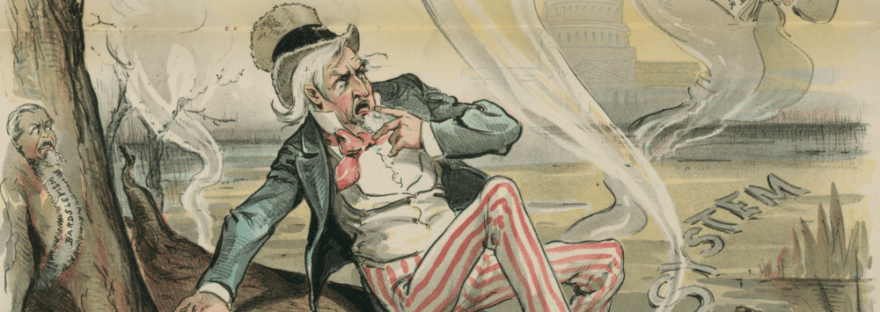
The data does not support the panicked narrative that SB 21’s supporters have been promoting, however. That narrative seems to be a product of Musk, and his paid agents, spreading misinformation like a miasma across the state.
Delaware’s Corporate Franchise is a Volume Business
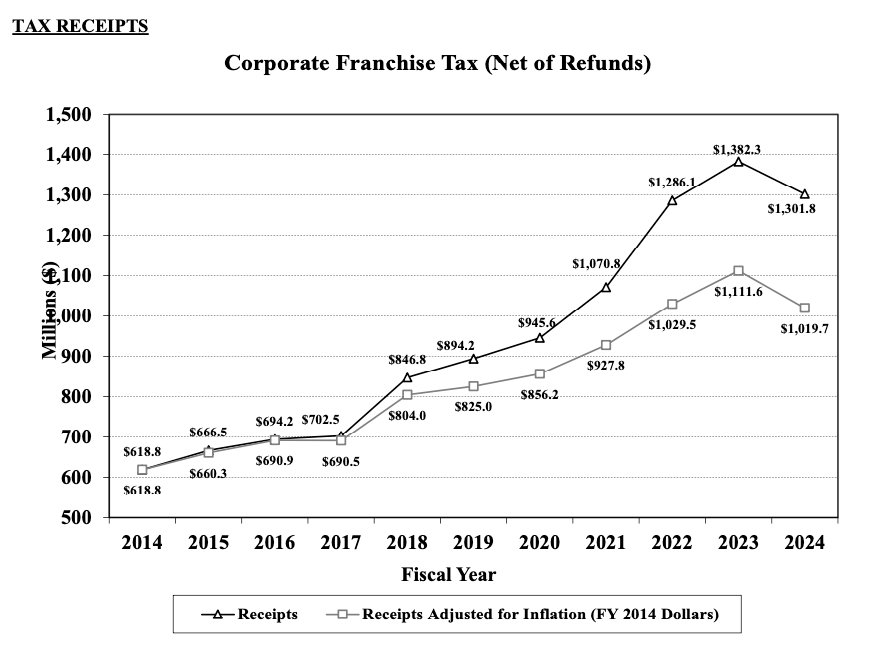
Delaware benefits in several ways from having outside corporations registered here. The most valuable benefit is revenues from the “corporate franchise tax.” This is a fee that corporations headquartered outside the state provide Delaware for the “privilege of being incorporated in Delaware.” (Fiscal Notebook, 2024 ed, p. 108). In recent years, the corporate franchise tax, alone, has provided ~20% of total state revenues, or about 1.2 billion dollars. (Personal income tax, paid by human people, provides 33% of the total state revenue). (Fiscal Notebook, 2024 Ed, p. 32).
The critical thing to know about the corporate franchise tax is that it is not an income tax: it’s a set of tiered fees, assessed based on a corporation’s total number of authorized shares – but with a max payment cap of $250,000.
In other words, Delaware is in a volume business, not a value business. Delaware has – or rather, should have – an interest in appealing to the largest number of corporate registrants, not the wealthiest billionaires. That’s a critical point, because the interests of most corporations – and most investors – do not align much at all with the desires of oligarchs like Elon Musk. If it wants revenue, Delaware shouldn’t be catering to the tiny cohort of vampires.
Back to Delaware politicians’ panic: you would think if the corporate franchise tax revenue is indeed in peril – if the “DExit” movement is real, and not just a propaganda hallucination – then there would be some data to support that claim.
Alas for Musk et al., and their well-paid agents, three data points suggest the opposite is true.
1) Startups Continue to Choose Delaware
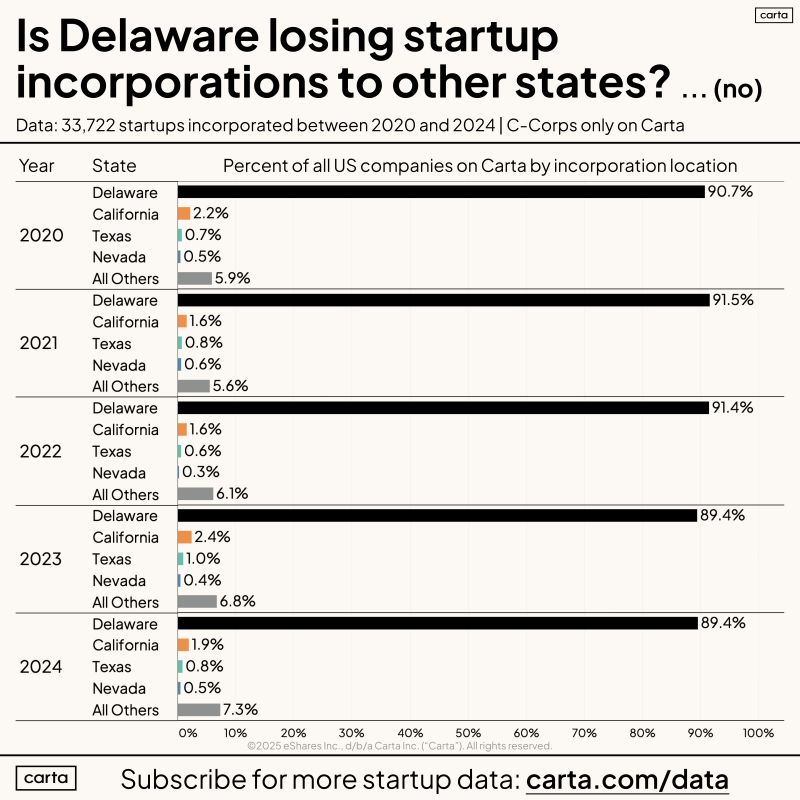
Peter Walker, “head of insight” at Silicon Valley data infrastructure firm Carta, recently shared a chart from his company’s private dataset demonstrating that 90% of startup C-Corps are domiciled in Delaware – a percentage that has “barely shifted in the last 5 years.” Including in 2024.
2) The Number of Corporations Filing Franchise Taxes Keeps Going Up
The most recent public figures show that 309,911 firms filed franchise tax payments in FY 2024 – an increase that continues the unbroken upward trend of the last decade, before the recent Chancery Court decisions, and then through and beyond them.
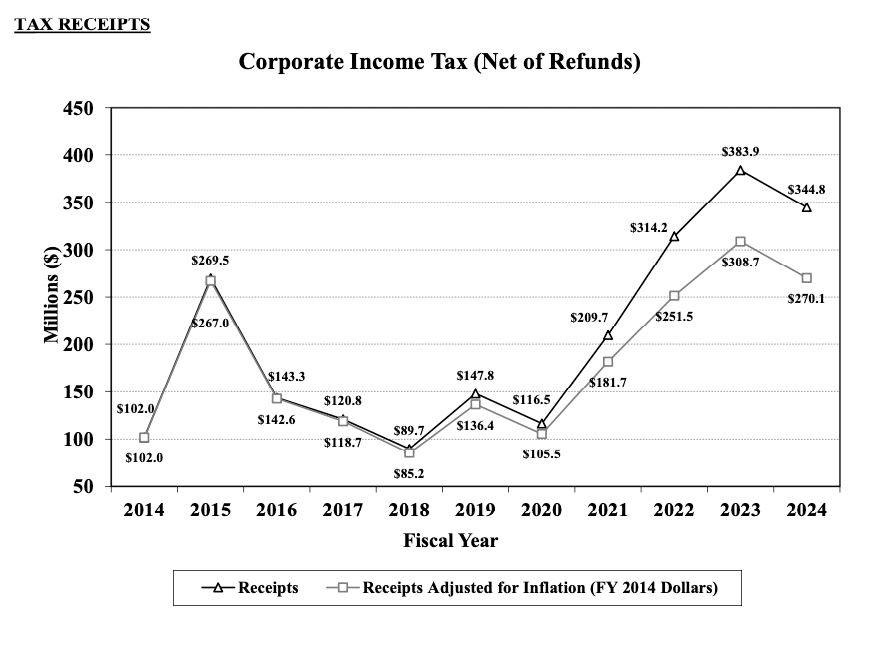
Now, total corporate franchise tax receipts have dipped, somewhat, from 2023 to 2024. But they have done so following the same patterns as the Corporate Income Tax.
Source: “Tax Receipts: Corporate Franchise Tax,” and “Tax Receipts: Corporate Income Tax,” in Fiscal Notebook FY 2024 ed., pp. 109, 115
That suggests to me that the cause lies in macroeconomic conditions – unemployment, inflation – rather than anything to do with Delaware’s legal regime. (Corporations paying income tax here do business here; they can’t exit as easily as paper registrants, and have less incentive to do so).
Since 1977, Delaware’s state government has relied on the Delaware Economic & Financial Advisory Council, or DEFAC, for economic forecasts. DEFAC meets quarterly to assess data, and issue guidance – guidance that the General Assembly usually regards as binding on legislation.
At the December meeting, DEFAC forecasts steady franchise revenues for FY 2025, 2026, and 2027. That is consistent with economic indicators – at least, prior to Musk’s installation as co-president – and suggests this expert body saw no threat in the data of the sort SB 21’s draftees were already hallucinating.
Musk’s Pungent Miasma is Not Reality
In short, private and public data sources agree: there is no observable decline in incorporations in Delaware, and no evidence that “DExit” is occurring in response to Chancery Court rulings. Further, the advisors specifically tasked with forecasting future franchise tax revenues – that is, a body of people mostly not employed by Elon Musk – do not see evidence for dramatic change.
An alternate explanation does fit the data better, though. Elon Musk’s lawyers drafted SB 21 to benefit their oligarchic clients, not Delaware. Musk’s paid agents are breathing the bad vibe fumes they want to see in the world into existence. The odor of panic they’ve wafted into lawmaker’s nostrils is thus a miasma, in the classic sense: unhealhy and unpleasant air, produced as the unpleasant exhalation of rot and corruption, that causes feverish illness.
Delaware’s leaders should not radically revise our laws, and gut a valuable franchise, on the basis of huffing Musk’s swamp gas.
Note: while by statute, the heads of Delaware’s state agencies are supposed to provide public reports on things like the total number of corporations registered here, and revenues derived from them, in practice Delaware state government is … uninterested in transparency. Opacity is part of the value Delaware provides, apparently.
The upshot is that basic data, and foundational statistics, are often hard to get, and difficult to parse using normal methods even when located. Still, while our state government officials are intentionally(?) incompetent at communicating to the public, they have not shirked their duties completely; there are sources worth your time & examination.
While this report is not linked on the DE Finance Department’s page, you can find it at that URL. An annual report, it offers a wealth of up-to-date statistics on the fiscal situation of the government of Delaware, including revenues and expenditures, as well as detailed supplemental information on specific taxes, fees, pension contributions, bond obligations, and subsidiary agencies.
The fiscal notebook is a rehashing of much of what is in the ACFR, but summarized and more richly contextualized look at the state budget, with historical data and legislative histories. If you want to know when the corporate income tax changed, and under what legislation, the Fiscal Notebook is your guide. It has some charmingly 1990s graphic design, as well. Prior reports are available here.
DEFAC posts cryptic briefing books and terse meeting minutes, grouped by date, on this page. If you dig far enough, you can find their predictions; and if you want a bit of fun, take a look at how far off they were in their predictions (usually they underestimate revenues by quite a bit, and overestimate the cost of expenditures; there appears to be a spirally structural austerity built into their models, assuming any models actually exist beyond intuition).
In theory, under the law, this page should contain the division’s up-to-date annual reports, detailing numbers of business entities registered in Delaware, and other pertinent information. In practice, this website is a wasteland.
Or, What’s a Little Light Voting Restriction Between Friends, Across Decades?
Corporate Voters Project – Research Note #3
Having surveyed the swampy landscape of corporate voting in present-day Delaware, I’ve now turned to digging post holes in it. That is, to get a clearer sense of when as well as why the practice of enfranchising business entities took hold, I’m taking a closer look at a handful of municipalities with corporate citizens, by investigating the legal history of their charters – specifically, when corporate voting entered their basic law – and trying to contextualize those developments using historical newspapers.
Ten miles from the coast as crows and google maps fly, Dagsboro was first incorporated in 1899. The town proper was carved out of Dagsborough Hundred, in Sussex County. (“Hundreds” are unincorporated subdivisions of counties – not unique to Delaware, but unusually long-lived here, where they served as the primary local political unit from the colonial era through to the 1940s. Most were defined by waterways: “White Clay Creek Hundred,” in what is today Newark, centered on said creek, for example; there’s a similar story behind the much more metal “Murderkill Hundred”) [1].
According to Thomas Scharf, the excitable, voluble, and occasionally reliable nineteenth-century chronicler of Delaware history, Dagsborough Hundred was named after its lead proprietor under late British rule, John Dagworthy. Alternately described by Scharf in the course of one printed page as a captain, colonel, and general, in 1774, Dagworthy was granted generous tracts of land – known as “Dagworthy’s Conquest” – as a reward for military service rendered, and well-placed connections worked, in the Seven Years’ War. He repaid this boon during the American Revolution by seizing British war matériel and arresting accused loyalists. When not offering such forceful signs of ingratitude to the British Crown, Scharf records that “General” Dagworthy:
“built a capacious one story house upon an eminence at the east end of the town…The approach was a broad avenue lined with trees. There surrounded by his family and a retinue of slaves he dispensed a liberal hospitality.”[2]
What a swell a petty tyrant, eh?
When he died, Dagworthy was buried under the chancel at Prince George’s Chapel, a tiny but persistent house of worship, just off the main drag of what became the Town of Dagsboro in 1899.
Dagsboro’s inaugural charter has a number of interesting features – but corporate voting is not one of them. The municipal franchise, per Section 3, is reserved for tax-paying property owners: “every male taxable of said town above the age of twenty-one years” as well as the “husbands of woman freeholders in said town.” (It pays to marry well!)
The franchise was premised on landholding – a “freeholder” is a resident who owns real estate in fee simple – and, critically, paying in to the town treasury: to vote you had to be up-to-date on your assessed taxes.[3]
The amount of tax you paid mattered, too. You’ve heard of voting with your dollars? Well, so had the legislators who chartered Dagsboro. In their wisdom, they decided that this jumped-up village was going to be an oligarchy, not a democracy. At town elections “each person entitled to vote shall be entitled to one vote for each dollar, or fractional part thereof, which shall have been paid by them or their wives as town tax on the property so assessed.”
To put it more plainly: the more land you owned, and the more tax you paid, the more votes you could cast! Like most oligarchies, this regime lasted only a short while: in 1903, the charter was amended to eliminate the vote-per-dollar scheme – though voting was still restricted to landowners, or men who married women who owned land.[4]
The press noted the Dagsboro charter’s passage through the legislature in January 1899 only perfunctorily. There are more stories about the sick wife of the charter bill sponsor (and first town commissioner), Rep. William P. Short, and his subsequent arrest for bribery (later dismissed), than there are about Dagsboro’s creation itself.
That’s understandable: a town with at best one crossroads warrants little notice most days, and much less in a year when Delaware politics were as lively and consequential as they ever get. Dagsboro’s competition for column inches was, first, the extensive extralegal efforts of one J. Edward Addicks, erstwhile Republican, to bribe himself into the U.S. Senate (Rep. Short was part of that effort – caught but not prosecuted); and then second, the total revolution in the state’s political economy, via the wholesale adoption of the New Jersey corporate code. (This was Delaware’s bid to steal their northern neighbor’s revenue scheme – though it took until 1913 for fruit of that poisonous tree to fully ripen).[5]
~*~
Corporate voting first appeared in Dagsboro with the town’s re-chartering and re-incorporation in 1941. So far, I have only found spare notices of this in state or local newspapers: Sen. Alden P. Short shepherded the bill through the General Assembly, but what his relation was to William P. Short, or why 1941 was the year to do this civic business, remains unclear.[6]
What is clear, though, is that the 1941 charter enfranchises corporations to vote in bond referenda. In these “special elections,” residents and property owners, “whether individual, partnership or corporation” all received “one vote for every dollar and fractional part of tax paid.” Oligarchy, again!
Voting for annual municipal elections in Dagsboro was, in this revision, more open – reserved for taxpayers 21 and over, with no stated racial or gender restrictions – but the process became malignly unusual. To indicate their choice for town commissioner, voters “shall cross out the names of all candidates which he or she does not desire to vote for” – that is, in Dagsboro you vote via negation. I read this as a form of Jim Crow-restrictions in action: a purposefully confusing process put in place to allow white election officials to reject votes at their discretion. [7]
And while thus far, I have not found any newspaper accounts that shed light on why this re-incorporation happened when it did, I think it’s notable that the bond referenda section re-used the 1899 charter’s “one dollar, one vote” mechanism – even while other voting restrictions were loosened, or altered.
The past is never truly past, especially if property is involved.
~*~
In 1991, the Town of Dagsboro re-incorporated again, and once again revised its charter. This time corporate voting was brought fully into all elections, both annual and special. The path, again, for corporate enfranchisement was property ownership – though now limited to one vote per person/entity.[8] As with the 1941 revisions, the motivation for this overhaul is not immediately clear from the newspaper record – but there is a notable coincidence, involving sewers.
The charter revision bill was sponsored by Sen. Richard S. Cordrey, a powerful pol from nearby Millsboro, who was then serving as Senate pro-tem. And while Cordrey’s other initiatives made the newspapers regularly – there was a redistricting that session, as well as smaller fights with the Governor over appointments and the budget – Dagsboro’s new charter only appears in the press as a one-line entries in legislative recap articles.[9]
What did make the papers was a slow-moving effort by Sussex County to build new sewers to accommodate an ongoing wave of new residents and housing developments. Beginning in 1990, the County and affected towns – including Dagsboro – were involved in a series of lawsuits and legislative wrangling to select sites for wastewater treatment and disposal. By 1991 work was sufficiently underway on the job of replacing Dagsboro’s private septic systems with a County-administered municipal flush that the Wilmington News Journal, the state’s biggest newspaper, thought it warranted a town profile.
The New Journal’s Southern Delaware correspondent noted the Dagsboro was a sleepy place, with one hill, one stoplight, and one predatory, “hawk-eyed lawman” eager to “fatten the town’s coffers” with tickets written to out-of-towners. But beyond that picaresque character, the story was that Dagsboro’s citizens – and possibly it’s corporate voters, too – expected the sewers to set off a “boom time,” attracting new residents and new economic vibrancy into the town.[10]
My hunch is that sewers and corporate voting are linked, both metaphorically and politically. The 1991 charter revision, by empowering non-resident property owners, both human and corporate, could have been part of a horse trade, to get the infrastructure investment needed to enable a “boom time.” Giving corporations the vote could have been what was needed to get them to invest in the project of the town’s growth – and in return, corporations got to help decide how much they’ll pay for all the new shit they bring.
Call it the “Cum Cloacarum et Corporationes, Civitas” theory of government.[11]
~*~
For the curious and civic-minded, the Town of Dagsboro website explains local election procedures. If you are a human resident – but not lucky enough to be a property owner – you face some hurdles. You have to present yourself with identification and documentation at the Town Hall office, during business hours, to be certified and entered into the town voter registration book. (Unlike other Delaware municipalities, Dagsboro does not participate in the state voter registration system). Then, come election time, provided the clerk can find and verify you in that book, you can vote.
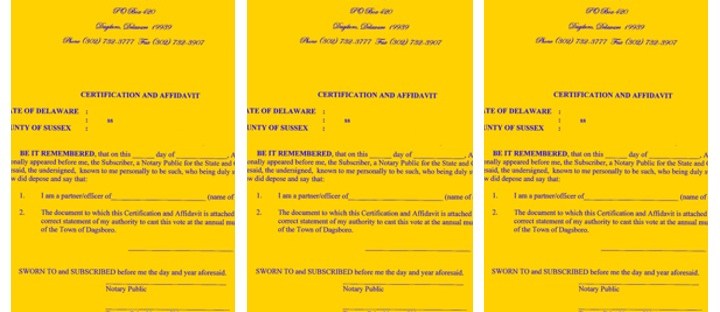
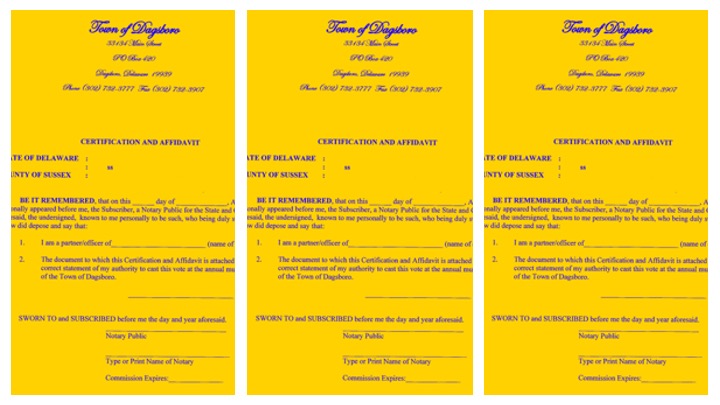
However, if you are a property owner – whether a natural person or artificial entity – your task is requires less of a time expenditure. Simply appear at the polling place with your name on a deed to a property within the corporate limits; and if “you” are a business entity – a partnership, or a corporation – you proxy must appear with that deed, plus “a certified resolution of said entity authorizing the person therein to vote for the entity.” Two pieces of paper, and you’re golden, no fuss, no waiting.
[1] The best and most detailed account of Delaware’s extraordinarily creaky administrative state that I have encountered is Penjerdel Corporation and Pennsylvania Economy League, Historical Development of Local Government in the Penjerdel Region, Penjerdel Governmental Studies 1 (Philadelphia, PA: Penjerdel, 1961), https://catalog.hathitrust.org/Record/005888599.
[3] 21 Del. Laws, c. 285: “An Act to Incorporate the Town of Dagsboro,” Approved February 9, 1899, pp. 549.
[4] 22 Del. Laws, c. 437: “An Act to Amend Chapter 285, Volume 21, Laws of Delaware, Being Entitled ‘An Act to Incorporate the Town of Dagsboro, Approved February 9, 1899’,” Approved March 31, 1903, p.435.
[5] Typical of press coverage of the charter is “Legislature,” News Journal, Mon, May 5, 1941, p.4. On Short’s wife’s pneumonia, “Mr. Short’s Sad Message,” Wilmington Daily Republican, February 24, 1899, p.2. On his dismissed bribery indictment: “Kent Bribery Cases,” Middletown Transcript, April 29, 1899, p.3, https://chroniclingamerica.loc.gov/lccn/sn84026820/1899-04-29/ed-1/seq-3/
[6] 43 Del. Laws, c. 161: “An Act to Reincorporate the Town of Dagsboro,” Approved May 14, 1941; “Legislature,” News Journal, Mon, May 5, 1941, p.4.
[7] On bond elections, 43 Del. Laws, c. 161, Sec. 22(B)6; on regular muncipal elections, Sec. 5(D).
[8] 68 Del. Laws, c. 138; “An Act to Reincorporate the Town of Dagsboro,” Approved July 9, 1991. On annexations, see Sec. 3(F); on muncipal elections Sec. 7(G); and on bond referenda, Sec 33(A)5
[9] “Legislature,” News Journal, Thu, June 20, 1991, p.19; “Legislature,” News Journal, Thu, June 27, 1991, p.15; “Legislature,” News Journal, Sat, June 29, 1991, p.7; Nancy Kesler, “Castle OKs restrictions on adult entertainment,” News Journal, July 10, 1991, p.12
On the Susex sewers saga – which involved the legislature overturning a Chancery Court decision within weeks of its announcement – see: Bruce Pringle, “Court Blocks Sewer Plants Outside District,” News Journal, Wed, Mar 21, 1990, p.1; Bruce Pringle, “Sussex: Change Sewer District Rules,” News Journal, Thu, Mar 22, 1990, p.1; Bruce Pringle, “Sussex OKs boundaries for sewer district,” News Journal, Fri, Mar 23, 1990, p.5 ; Nancy Kessler, “Castle Signs Sussex County Sewer District Bill,” News Journal, April 19, 1990, p.22; “Sussex County Has Eye On Parcel,” News Journal, May 30, 1990, p.2; Bruce Pringle, “Decision on Sussex disposal site expected within 2 weeks,” News Journal, Thu, June 28, 1990, p.1; Bruce Pringle, “Piney Neck Picked for sewage disposal site,” News Journal, Wed, July 4, 1990, p. 1
[11] Google translate latin for “With Sewers and Corporations, [the] City.”


![Louis Dalrymple, “Uncle Sam’s Dismal Swamp,” Puck, November 15, 1893, https://www.loc.gov/pictures/resource/ppmsca.29155. Print shows Uncle Sam sitting on a log in a swamp labeled "Spoils System" from which snakes labeled "Quayism", "Bardsleyism", and "Tannerism", and noxious fumes rise in the form of shades labeled "Raumism - Pension Swindler, Crokerism, McLaughlinism, Tweedism, Prendergast - Political Assassin, [and] Guiteau - Political Assassin". Also shown among the tree roots is Charles A. Dana.](https://daelnorwood.com/wp-content/uploads/2025/02/dismalswampcrop.png?w=839)

 Dael A. Norwood
.jpg)
