Corporate Voters Project, Delaware, Power At Play

A Corporate Political Kingdom

Or, Is Delaware’s Depravity Literally Unthinkable?  

Corporate Voters Project – Research Note #6

A view of the "Magic Kingdom" in Walt Disney World in Orlando Florida. A fairytale castle's spires rise above a 19th-century mansard roof style town hall, in the foreground there is a fence with patriotic buntin and dozens of people, on the border of a body of water.
Clément Bardot, English:  Magic Kingdom, Disney World, Orlando, Florida, USA, May 27, 2015, May 27, 2015, Own work, https://commons.wikimedia.org/wiki/File:Magic_Kingdom,_Disney_World.jpg#/media/File:Magic_Kingdom,_Disney_World.jpg.

The more I dig into Delaware’s law and politics, the more apparent it becomes that lawyers and judges from outside of the state cannot bring themselves to imagine – much less acknowledge – the depth of state’s commitment to servicing corporations. The devotion of Delaware’s political class (past and present) to wealthy corporations, over and above any kind of public good so far defies the expectations of strangers – even well-informed ones – that it blinds them to the state’s fundamental features. [1] 

A pair examples from the last week’s reading can illustrate the point. 

First, an excerpt from Maurice Wormser’s book Disregard of the Corporate Fiction, originally published in 1927. Wormser was a renowned appellate attorney, and a well-known law professor; he’s still the namesake of Fordham’s Moot Court Competition. Among other things, he popularized the phrase “piercing the corporate veil,” which you’ve heard a lot if you follow Chancery Court nonsense. 

Discussing various definitions of the corporation, he observed:  

“Just what the corporation is, no two legal authorities are in accord. Definitions are dangerous. While I have no desire to enter into the philosophy of the subject, it should be observed that there are a number of very distinct theories, each hopelessly repugnant to the others. The German, or association theory, which has such an eminent English follower as Sir Frederick Pollock, views a corporation almost as a natural person and regards it as acquiring an “organic character which qualifies it to participate prominently in the life of the state and in the law.”  I doubt, however, whether even the most advanced German philosopher would seriously argue that a corporation could marry or be given in marriage, or that it could vote at an election.” [emphasis mine] [2]

Worsmer, deeply experienced corporate law – and thus a man familiar with Delaware – should have known better. A few years later, in 1931, Milford, DE did what Wormser thought no German philosopher would argue for, and amended its municipal charter to grant corporations suffrage rights, to wit: “every owner of property whether individual, partnership, or corporation shall have one vote for every dollar or part of dollar of tax paid” in special bond elections. So not only could corporations “vote at an election,” they could do so at a bargain exchange rate of one dollar per vote. [3] 

(NB: Milford was probably not the first Delaware municipality to do this – there was probably at least one town with corporate voting rights extant when Wormser published – but it’s the first I have specific evidence for).

Second: a half-century later, but similarly unfamiliar with Delaware’s expanding grants of corporate suffrage rights, in 1973, Justice William Douglas wrote in horrified dissent from the majority in Sayler Land Company v. Tulare Lake Basin Water Storage District. The case was one of a series that sought to re-establish property as the preeminent force in American politics, after anti-democratic forces had lost ground with end of Jim Crow and the development of the “one man, one vote” doctrine. In this particular case, the majority approved voting rights for large agricultural corporations in special Texas water district elections, on the basis of these corporations having a “personal” stake in the districts, as ratepayers.

Douglas, a proud New Dealer outvoted by an increasingly reactionary majority, was appalled at this extension of corporate personhood into the voting booth:

“It is indeed grotesque to think of corporations voting within the framework of political representation of people. Corporations were held to be “persons” for purposes both of the Due Process Clause of the Fourteenth Amendment, and of the Equal Protection Clause. Yet, it is unthinkable in terms of the American tradition that corporations should be admitted to the franchise. Could a State allot voting rights to its corporations, weighting each vote according to the wealth of the corporation? Or could it follow the rule of one corporation, one vote?

It would be a radical and revolutionary step to take, as it would change our whole concept of the franchise. … Four corporations can exercise these governmental powers as they choose, leaving every individual inhabitant with a weak, ineffective voice. The result is a corporate political kingdom undreamed of by those who wrote our Constitution.” [emphasis mine] [4]

Alas for Douglas – and for us – there are more things in Delaware than dreamt of in his philosophy.


Image source: Clément Bardot, English:  Magic Kingdom, Disney World, Orlando, Florida, USA, May 27, 2015, May 27, 2015, Own work, https://commons.wikimedia.org/wiki/File:Magic_Kingdom,_Disney_World.jpg#/media/File:Magic_Kingdom,_Disney_World.jpg.

[1] This lack of imaginative capacity is perhaps analogous – if less justifiable – to “normie” or “apolitical” Americans’ approach to the authoritarianism of the Trump/Musk regime; it is so out of scope that such a thing would happen, that it simply can’t be happening. 

[2] I. Maurice Wormser, Disregard of the Corporate Fiction and Allied Corporation Problems (New York: Baker, Voorhis and Co., 1929), p. 3 

[3] 37 Del. Laws, c. 162, “An Act Changing the Name of ‘The Town of Milford’ to ‘The City of Milford’ and Establishing a Charter Therefor,” Approved April 25, 1931, p.595

[4] Sayler Land Co. et al. v. Tulare Lake Basin Water Storage District, U.S. 410 (1973): 741-42 

Delaware

DGCL Fiasco 2025: Sources

Or, A Bibliography of News, Opinion, and Sources Relating to the 2025 Attempt to Revise Delaware’s General Corporation Law. Final update: 3/26/25.

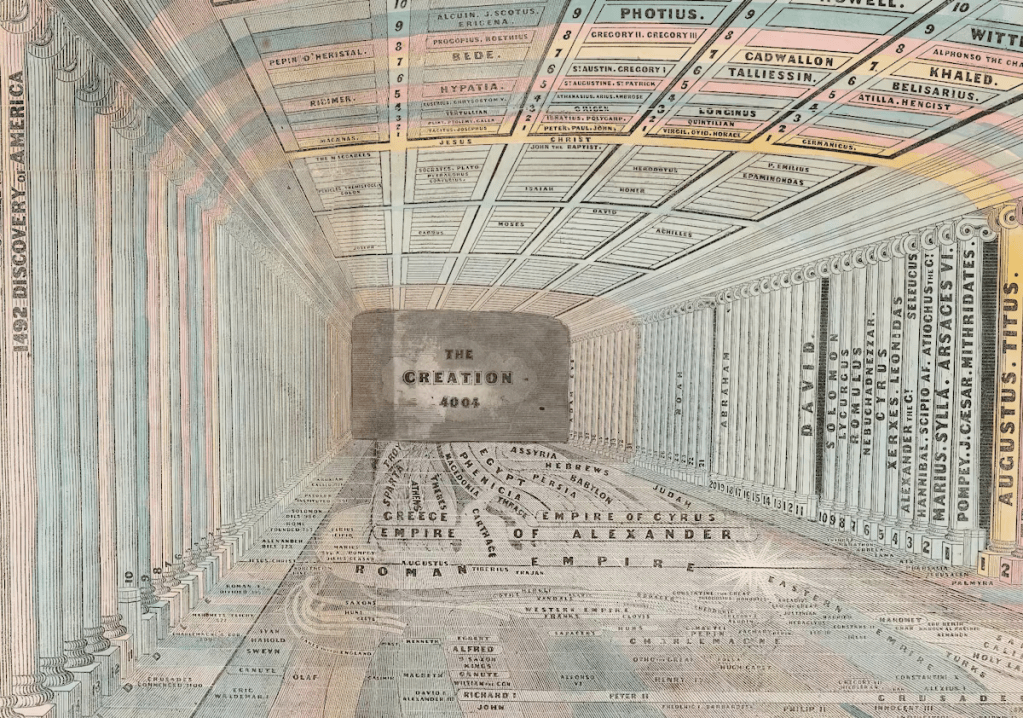
A printed image of a long receding hallway in a grecian temple, with timelines and chronologies forming the wall, floors, and ceilings. Emma Willard, “The Temple of Time” (1846), via Cartography Associates (CC BY-NC-SA 3.0) https://www.davidrumsey.com/luna/servlet/detail/RUMSEY~8~1~315043~90083688:The-Temple-of-Time#
Emma Willard, “The Temple of Time” (1846), via Cartography Associates (CC BY-NC-SA 3.0)

Note: SB 21 (repackaged as SS 1 for SB 21) passed the Delaware House late on Tuesday, March 25, 2025 and was signed into law the same night by Governor Meyer. The bibliography below is updated to include reports through the following day – March 26, 2025 – but nothing beyond that point.

Since it was dropped on an unsuspecting public two weeks ago, Senate Bill 21 has occasioned a great deal of both propaganda and conversation – and even some reporting and evidence-based analysis. This short bibliography (or, less pretentiously, link-roundup) is intended to help Delawareans and other folks get up to speed on the issue, understand the forces in play, and get a sense of the stakes. 

I will update it, as my time allows, and events merit. I have tried to (mostly) link publicly accessible sources, but there may be some paywalled exceptions. 

Some caveats: the bibliography below is not comprehensive, nor is it intended to be. It’s what, in my judgment, is the most useful for understanding what the hell is going on.

Also! It is not a guide to the bloggy conversations among corporate law specialists, a play-by-play for Dover courtiers’ inside baseball, or the group chat among oligarchics’ agents – though it intersects with all of those discourses. (Go to LinkedIn, Facebook, and Signal, respectively, if you want those.)  

Get Up To Speed

Xerxes Wilson, “Controversial Corporate Law Changes Passed by House, Signed by Delaware Governor,” The News Journal, March 26, 2025, https://www.delawareonline.com/story/news/2025/03/25/delaware-corporate-law-changes-chancery-court-signed-into-law-by-governor-matt-meyer/82655315007/;

Karl Baker and Jacob Owens, “Meyer Signs Controversial Senate Bill 21 into Law after Bitter House Debate,” Spotlight Delaware, March 26, 2025, http://spotlightdelaware.org/2025/03/26/meyer-signs-senate-bill-21/.

Lora Kolodny, “Meta’s Potential Exit from Delaware Had Governor Worried Enough to Call Special Weekend Meetings,” CNBC, March 19, 2025, https://www.cnbc.com/2025/03/19/meta-billions-of-dollars-at-stake-in-overhaul-delaware-corporate-law.html.

Lora Kolodny, “Tesla’s Law Firm Drafts Delaware Bill That Could Salvage Musk Pay Package,” CNBC, February 18, 2025, https://www.cnbc.com/2025/02/18/firm-representing-musk-tesla-drafts-bill-for-delaware-corporate-law.html.

Jordan Howell, “DelDems Roll over for Musk,” Delaware Call, February 17, 2025, https://delawarecall.com/2025/02/17/deldems-roll-over-for-musk/.

Primary Source(s)

Senate Substitute 1 for Senate Bill 21: “AN ACT TO AMEND TITLE 8 OF THE DELAWARE CODE RELATING TO THE GENERAL CORPORATION LAW,” filed March 12, 2025, passed March 25, 2025, https://legis.delaware.gov/BillDetail/141930

  • Primary sponsor: Sen. Townsend
  • Cosponsors: Sen. Sokola, Lockman, Hocker, Pettyjohn; Reps. Griffith, Minor-Brown, Harris, Osienski, Dukes, Spiegelman

House Amendment 1 to Senate Substitute 1 for Senate Bill 21, filed March 18, 2025, [proposed amendment, not picked up] https://legis.delaware.gov/BillDetail?LegislationId=141964

  • Sponsor: Rep. S. Phillips
  • Summary: “This Amendment mirrors the proposed changes in SS 1 for Senate Bill 21, but provides that the corporation must “opt-in” to adopt them. It adds a new section one, which describes the method by which the corporation may opt in to the changes from the default, existing law.”

Senate Bill 21: “AN ACT TO AMEND TITLE 8 OF THE DELAWARE CODE RELATING TO THE GENERAL CORPORATION LAW,” filed February 17, 2025, https://legis.delaware.gov/BillDetail/141857 [original bill]

  • Primary sponsor: Sen. Townsend
  • Cosponsors: Sen. Sokola, Lockman, Hocker, Pettyjohn; Reps. Griffith, Minor-Brown, Harris, Osienski, Dukes, Spiegelman

Senate Concurrent Resolution 17, https://legis.delaware.gov/BillDetail/141858

  • Primary sponsor: Sen. Townsend
  • Cosponsors: Sen. Sokola, Lockman, Hocker, Pettyjohn; Reps. Griffith, Minor-Brown, Harris, Osienski, Dukes, Spiegelman

Delaware General Corporation Law, Delaware Code, Title 8, https://delcode.delaware.gov/title8/c001/

Office of the Governor, “Discussion Re: Corporate Franchise,” February 2025, https://www.scribd.com/document/840790103/CNBC-copy-2025-03-12-de-Governor-FOIA-Response-38#download&from_embed.

  • Internal emails between personnel in Gov. Matt Meyer’s office and various Musk & Zuckerberg associated lawyers, coordinating drafts, details, & messaging around the push for SB 21;

Dig Deeper

The items below represent a wide spectrum of debate on SB21 and the political economy of Delaware’s corporate law; inclusion is not an endorsement that a given piece is reliable, truthful, or accurate – simply influential. This list is organized chronologically, working backwards from most recent.

Xerxes Wilson, “Controversial Corporate Law Changes Passed by House, Signed by Delaware Governor,” The News Journal, March 26, 2025, https://www.delawareonline.com/story/news/2025/03/25/delaware-corporate-law-changes-chancery-court-signed-into-law-by-governor-matt-meyer/82655315007/;

Karl Baker and Jacob Owens, “Meyer Signs Controversial Senate Bill 21 into Law after Bitter House Debate,” Spotlight Delaware, March 26, 2025, http://spotlightdelaware.org/2025/03/26/meyer-signs-senate-bill-21/.

Karl Baker, “Lobbying on Corporate Law Change SB21 Enters Final Stretch,” Spotlight Delaware, March 21, 2025, http://spotlightdelaware.org/2025/03/21/sb21-final-stretch/.

Katie Tabeling, “Top Delaware Firm Takes Quiet Role in Corporate Amendment Debate,” Delaware Business Times, March 20, 2025, https://delawarebusinesstimes.com/news/firm-quiet-role-in-corporate-amendment/.

Lora Kolodny, “Meta’s Potential Exit from Delaware Had Governor Worried Enough to Call Special Weekend Meetings,” CNBC, March 19, 2025, https://www.cnbc.com/2025/03/19/meta-billions-of-dollars-at-stake-in-overhaul-delaware-corporate-law.html.

Yvonne Deadwyler, “Preserving the Corporate Franchise Is in the Interest of All,” Delaware Business Times, March 18, 2025, https://delawarebusinesstimes.com/news/viewpoint-sb-21-deadwyler/

Katie Tabeling, “Meet the Business Organizations Endorsing SB 21,” Delaware Business Times, March 17, 2025, https://delawarebusinesstimes.com/news/business-endorsing-sb-21/

Joel Friedlander, “Are Hamermesh, Chandler and Strine Making Delaware Corporate Law Great Again?,” The News Journal, March 17, 2025, https://www.delawareonline.com/story/opinion/2025/03/17/are-hamermesh-chandler-and-strine-making-delaware-corporate-law-great-again-opinion/82490918007/.

Joseph R. Mason, “SB 21 Could Cost Delaware Millions,” Delaware Business Times, March 17, 2025, https://delawarebusinesstimes.com/news/viewpoint-sb21-could-cost-millions/

Matthew G. Jacobs, General Counsel, CalPERS to Senator Bryan Townsend, et al, Re: “Delaware Senate Bill No. 21,” March 14, 2025, https://s3.documentcloud.org/documents/25590146/letter-from-calpers-to-delaware-leadership.pdf.

Katie Tabeling, “How a New Bill Raises Uncertainty in Wilmington’s Legal Economy,” Delaware Business Times, March 14, 2025, https://delawarebusinesstimes.com/news/sb-21-legal-economy/.

Karl Stomberg, “Capital Fight or Flight: Delaware’s History of Gangster Capitalism and the Need for a Democratic Economy,” Delaware Call, March 13, 2025, https://delawarecall.com/2025/03/13/capital-fight-or-flight/.

Greg Vallaro, “Delaware Senate Bill 21 Is a Disaster. It’s Time to Call Strike Three,” News Journal, March 12, 2025, https://www.delawareonline.com/story/opinion/2025/03/12/delaware-senate-bill-21-is-a-disaster-opinion/82277898007/.

Jeffrey P. Mahoney, “SB 21 Threatens Long-Term Shareholder Rights,” Delaware Business Times, March 10, 2025, https://delawarebusinesstimes.com/news/viewpoint-sb-21-shareholder-rights/.

Alan Jagolinzer et al., “The False Crisis Pushing Delaware to Surrender Shareholder Rights,” ProMarket, March 7, 2025, https://www.promarket.org/2025/03/07/the-false-crisis-pushing-delaware-to-surrender-shareholder-rights/.

William Chandler and Lawrence Hamermesh, “Delaware’s Corporate Law, Proposed Amendments Play Fair,” Delaware Business Times, March 6, 2025, https://delawarebusinesstimes.com/news/viewpoint-sb21-chandler-hamermesh/.

June Carbone, Nancy Levit, and Naomi Cahn, “Elon Musk and the Rise of the Dictator CEO,” Washington Monthly, March 6, 2025, http://washingtonmonthly.com/2025/03/06/elon-musk-and-the-rise-of-the-dictator-ceo/.

Cris Barrish, “Is ‘DExit’ a Real Threat to Delaware’s $2B-a-Year Incorporation Kingdom, and Will the Proposal Protect or Destroy ‘the Franchise’?,” WHYY, March 5, 2025, https://whyy.org/articles/dexit-delaware-franchise-incorporation-industry-billionaires-bill/

“Legal Experts Weigh in on Townsend’s Remarks in Delaware Call Interview,” Delaware Call, March 4, 2025, https://delawarecall.com/2025/03/04/legal-experts-weigh-in-on-townsends-remarks-in-delaware-call-interview/

Daniel Taylor, “Delaware’s Manufactured Corporate Crisis,” Delaware Business Times (blog), March 4, 2025, https://delawarebusinesstimes.com/news/viewpoint-taylor-sb-21/.

Chris Foulds, “Billionaire Corporate Law Smash-and-Grab Could Destroy Delaware’s Economy,” News Journal, March 3, 2025, https://www.delawareonline.com/story/opinion/2025/03/03/billionaire-corporate-law-smash-and-grab-could-destroy-delawares-economy-opinion/80549853007/.

Andrew Verstein, “The Corporate Census,” SSRN Scholarly Paper (Rochester, NY: Social Science Research Network, February 25, 2025), https://papers.ssrn.com/abstract=5154952
  • NB this item is a working paper – meaning, it is an unpublished draft, that has not undergone peer review. All arguments should be understood as preliminary, and incomplete.

Ann Lipton, “Rip American Shareholder Capitalism,” Financial Times, February 24, 2025, sec. FT Alphaville, https://www.ft.com/content/85eccee4-3890-4c25-bd89-eb522b95efb9

Lawrence Cunningham, “Delaware Aptly Balances Certainty and Scrutiny in Corporate Law,” Bloomberg Law, February 24, 2025, https://news.bloomberglaw.com/us-law-week/delaware-aptly-balances-certainty-and-scrutiny-in-corporate-law.

Dael Norwood, “The Data Does Not Support the Narrative,” Goose Commerce (blog), February 23, 2025, https://daelnorwood.com/2025/02/23/the-data-does-not-support-the-narrative/.

Jordan Howell, “Delaware Call Interviews Sen. Bryan Townsend About SB21,” Delaware Call, February 21, 2025, https://delawarecall.com/2025/02/21/delaware-call-interviews-sen-bryan-townsend-about-sb21/.

Ryan Cooper, “Why Are Delaware Democrats Trying to Give Elon Musk $55 Billion?,” The American Prospect, February 21, 2025, https://prospect.org/api/content/63bddae0-efd3-11ef-9411-12163087a831/.

Jacob Owens, “Chief Justice Seitz Warns Lawmakers against Reducing Courts’ Independence – Spotlight Delaware,” Spotlight Delaware, February 21, 2025, https://spotlightdelaware.org/2025/02/21/chief-justice-warns-lawmakers-against-reducing-courts-independence

Peter Walker, “Is Delaware Losing Startup Incorporations to Other States? … (No),” LinkedIn (blog), February 21, 2025, https://www.linkedin.com/feed/update/urn:li:activity:7298753740558254080/.

Delaware Working Families Party (DE-WFP), Stop Elon Musk’s Corporate Law Bill, https://actionnetwork.org/letters/stop-elon-musks-corporate-law-bill

Public Citizen, Americans for Financial Reform, American Association for Justice, Consumer Federation of America,  STOP DELAWARE SENATE BILL 21https://www.stopsb21.com

Andrew Blumberg, Ben Potts, and Tom James, “Delaware Corporate Law Myth-Busting: The ‘Expanding Definition’ of Controlling Stockholder,” The Harvard Law School Forum on Corporate Governance (blog), February 21, 2025, https://corpgov.law.harvard.edu/2025/02/21/delaware-corporate-law-myth-busting-the-expanding-definition-of-controlling-stockholder/.

Jennifer Kay and Jef Feeley, “Musk’s War on Delaware Spurs State Bill to Hang On to Businesses,” Bloomberg.Com, February 19, 2025, https://www.bloomberg.com/news/articles/2025-02-19/musk-s-war-on-delaware-spurs-state-bill-to-hang-on-to-businesses.

Collin Woodard, “Musk’s New Plan To Get His $56 Billion: Change The Law,” Jalopnik (blog), February 19, 2025, https://www.jalopnik.com/1794019/musks-new-plan-to-get-his-56-billion-change-the-law/.

Dael Norwood, “The Golden Goose Is An Arsonist,” Delaware Business Times, February 19, 2025, https://delawarebusinesstimes.com/news/viewpoints/viewpoint-the-golden-goose-is-an-arsonist/.

Karl Baker and Jacob Owens, “Landmark Delaware Corporate Law Changes Aim to Stem Exits,” Spotlight Delaware, February 19, 2025, http://spotlightdelaware.org/2025/02/19/delaware-corporate-law-change-sb-21/.

Ann Lipton, “Delaware Decides Delaware Law Has No Value,” Business Law Prof Blog (blog), February 18, 2025, https://www.businesslawprofessors.com/2025/02/delaware-decides-delaware-law-has-no-value/.

Jacob Owens, “Meyer Considers Corporate Court Reform, Drawing Concern,” Spotlight Delaware, February 11, 2025, http://spotlightdelaware.org/2025/02/11/meyer-chancery-court-reform/.

Ann Lipton, “Delaware Decides Delaware Law Has No Value,” Business Law Prof Blog (blog), February 18, 2025, https://www.businesslawprofessors.com/2025/02/delaware-decides-delaware-law-has-no-value/.

Delaware

The Data Does Not Support the Narrative

Or, Why Are Delaware’s Leaders Huffing Musk’s Swamp Gas? 

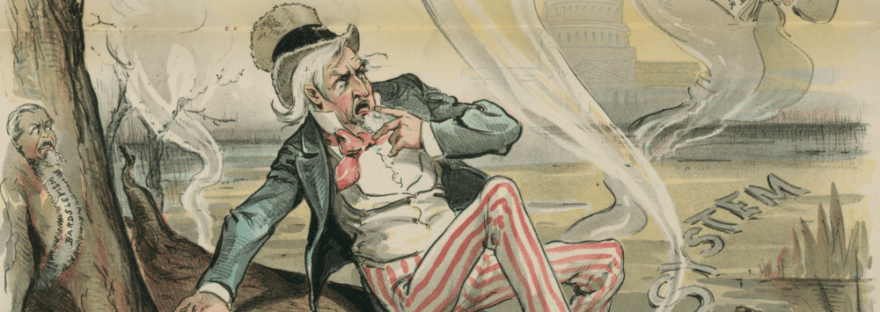
Louis Dalrymple, “Uncle Sam’s Dismal Swamp,” Puck, November 15, 1893, https://www.loc.gov/pictures/resource/ppmsca.29155. Print shows Uncle Sam sitting on a log in a swamp labeled "Spoils System" from which snakes labeled "Quayism", "Bardsleyism", and "Tannerism", and noxious fumes rise in the form of shades labeled "Raumism - Pension Swindler, Crokerism, McLaughlinism, Tweedism, Prendergast - Political Assassin, [and] Guiteau - Political Assassin". Also shown among the tree roots is Charles A. Dana.

The state government of Delaware is in the process of amending its corporate law to benefit Elon Musk, personally, and people like Elon Musk – oligarchic managers who use their control of corporate boards to loot regular investors – more generally. The mechanism is Senate Bill 21, legislation that was drafted by Elon Musk’s attorneys, a fact confirmed by the bill’s filer, Senator Bryan Townsend.

The rationale for this rash action is fear: fear that if Delaware does not extinguish judicial independence to better fit Musk’s perverse desires, Delaware will lose critical revenues, as Musk leads corporations to “DExit,” or registering in other states, because of Chancery Court decisions that since 2022 have supposedly upset the balance of power between shareholders and corporate managers. 

The data does not support the panicked narrative that SB 21’s supporters have been promoting, however. That narrative seems to be a product of Musk, and his paid agents, spreading misinformation like a miasma across the state.

Delaware’s Corporate Franchise is a Volume Business

Delaware benefits in several ways from having outside corporations registered here. The most valuable benefit is revenues from the “corporate franchise tax.” This is a fee that corporations headquartered outside the state provide Delaware for the “privilege of being incorporated in Delaware.” (Fiscal Notebook, 2024 ed, p. 108). In recent years, the corporate franchise tax, alone, has provided ~20% of total state revenues, or about 1.2 billion dollars. (Personal income tax, paid by human people, provides 33% of the total state revenue). (Fiscal Notebook, 2024 Ed, p. 32).

The critical thing to know about the corporate franchise tax is that it is not an income tax: it’s a set of tiered fees, assessed based on a corporation’s total number of authorized shares – but with a max payment cap of $250,000. 

In other words, Delaware is in a volume business, not a value business. Delaware has – or rather, should have – an interest in appealing to the largest number of corporate registrants, not the wealthiest billionaires. That’s a critical point, because the interests of most corporations – and most investors – do not align much at all with the desires of oligarchs like Elon Musk.  If it wants revenue, Delaware shouldn’t be catering to the tiny cohort of vampires. 

Back to Delaware politicians’ panic: you would think if the corporate franchise tax revenue is indeed in peril – if the “DExit” movement is real, and not just a propaganda hallucination  – then there would be some data to support that claim.

Alas for Musk et al., and their well-paid agents, three data points suggest the opposite is true.

1) Startups Continue to Choose Delaware

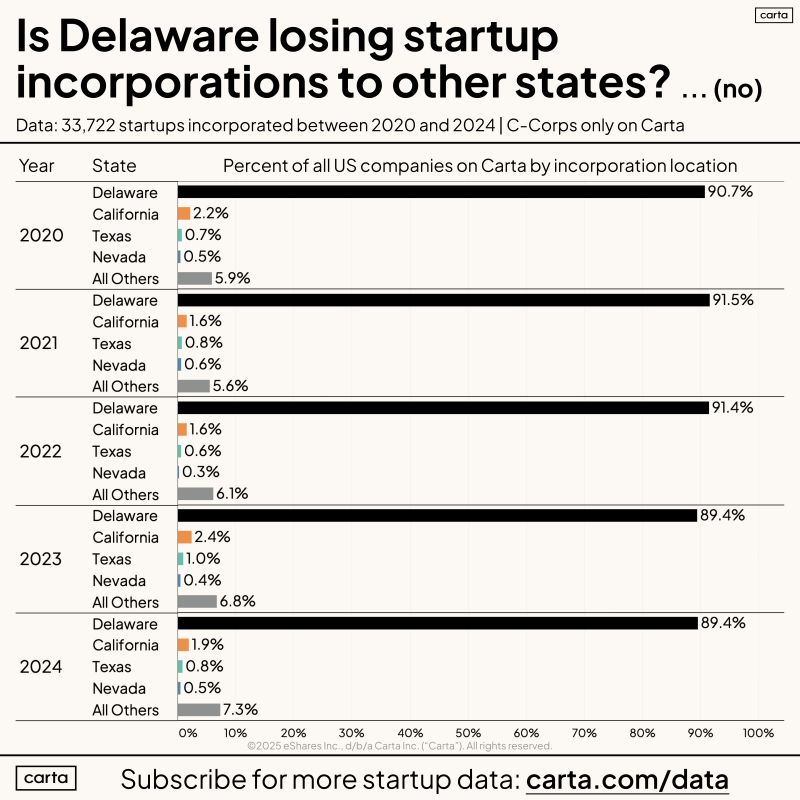
Peter Walker, “head of insight” at Silicon Valley data infrastructure firm Carta, recently shared a chart from his company’s private dataset demonstrating that 90% of startup C-Corps are domiciled in Delaware – a percentage that has “barely shifted in the last 5 years.” Including in 2024.

Source: Peter Walker, “Is Delaware Losing Startup Incorporations to Other States? … (No),” LinkedIn (blog), February 21, 2025, https://www.linkedin.com/feed/update/urn:li:activity:7298753740558254080/.

2) The Number of Corporations Filing Franchise Taxes Keeps Going Up

The most recent public figures show that 309,911 firms filed franchise tax payments in FY 2024 – an increase that continues the unbroken upward trend of the last decade, before the recent Chancery Court decisions, and then through and beyond them.  

A bar chart showing a steady increase in the number of franchise tax filers from 2015 to 2024. Annual Comprehensive Financial Report, FY 2024 (Delaware Department of Finance, Division of Accounting, 2024), p.206.

Source: Annual Comprehensive Financial Report, FY 2024 (Delaware Department of Finance, Division of Accounting, 2024), p.206

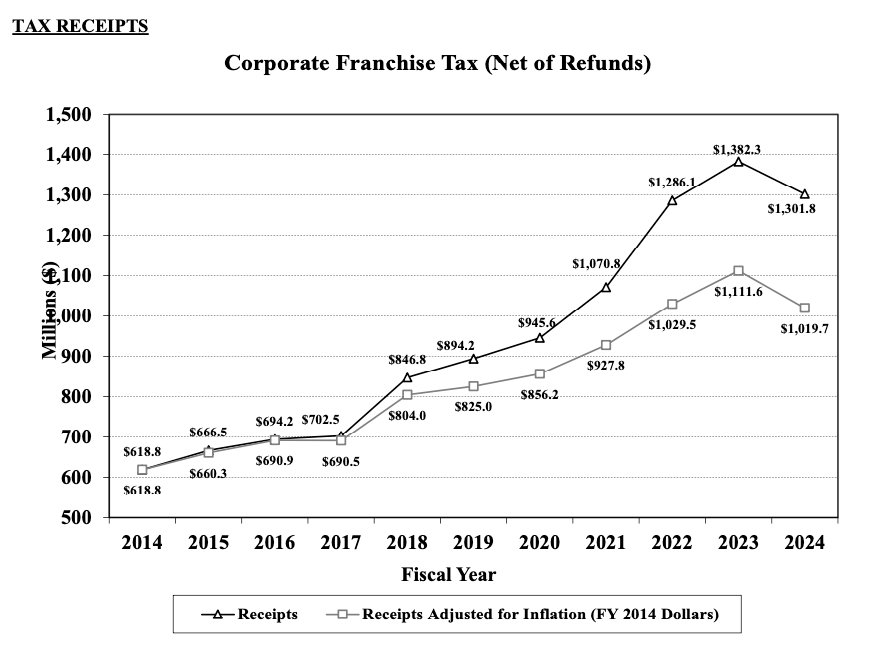
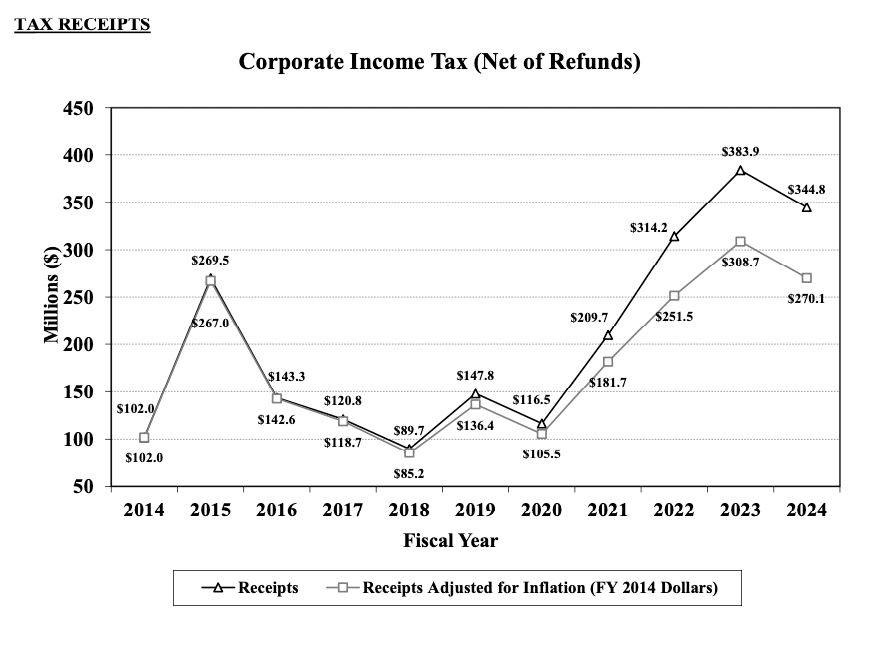
Now, total corporate franchise tax receipts have dipped, somewhat, from 2023 to 2024. But they have done so following the same patterns as the Corporate Income Tax. 

Source: “Tax Receipts: Corporate Franchise Tax,” and “Tax Receipts: Corporate Income Tax,” in Fiscal Notebook FY 2024 ed., pp. 109, 115

That suggests to me that the cause lies in macroeconomic conditions – unemployment, inflation – rather than anything to do with Delaware’s legal regime. (Corporations paying income tax here do business here; they can’t exit as easily as paper registrants, and have less incentive to do so). 

3) DEFAC Forecasts Steady Corporate Franchise Tax Receipts

Since 1977, Delaware’s state government has relied on the Delaware Economic & Financial Advisory Council, or DEFAC, for economic forecasts. DEFAC meets quarterly to assess data, and issue guidance – guidance that the General Assembly usually regards as binding on legislation.

At the December meeting, DEFAC forecasts steady franchise revenues for FY 2025, 2026, and 2027. That is consistent with economic indicators – at least, prior to Musk’s installation as co-president – and suggests this expert body saw no threat in the data of the sort SB 21’s draftees were already hallucinating.

Musk’s Pungent Miasma is Not Reality

In short, private and public data sources agree: there is no observable decline in incorporations in Delaware, and no evidence that “DExit” is occurring in response to Chancery Court rulings. Further, the advisors specifically tasked with forecasting future franchise tax revenues – that is, a body of people mostly not employed by Elon Musk – do not see evidence for dramatic change. 

An alternate explanation does fit the data better, though. Elon Musk’s lawyers drafted SB 21 to benefit their oligarchic clients, not Delaware. Musk’s paid agents are breathing the bad vibe fumes they want to see in the world into existence. The odor of panic they’ve wafted into lawmaker’s nostrils is thus a miasma, in the classic sense: unhealhy and unpleasant air, produced as the unpleasant exhalation of rot and corruption, that causes feverish illness.

Delaware’s leaders should not radically revise our laws, and gut a valuable franchise, on the basis of huffing Musk’s swamp gas. 

———-

Header Image source: Louis Dalrymple, “Uncle Sam’s Dismal Swamp,” Puck, November 15, 1893, Library of Congress, https://www.loc.gov/pictures/resource/ppmsca.29155.

Data Sources

Note: while by statute, the heads of Delaware’s state agencies are supposed to provide public reports on things like the total number of corporations registered here, and revenues derived from them, in practice Delaware state government is … uninterested in transparency. Opacity is part of the value Delaware provides, apparently. 

The upshot is that basic data, and foundational statistics, are often hard to get, and difficult to parse using normal methods even when located. Still, while our state government officials are intentionally(?) incompetent at communicating to the public, they have not shirked their duties completely; there are sources worth your time & examination.

Delaware Department of Finance, Division of Accounting, Annual Comprehensive Financial Report, FY 2024https://accountingfiles.delaware.gov/docs/2024acfr.pdf.

While this report is not linked on the DE Finance Department’s page, you can find it at that URL. An annual report, it offers a wealth of up-to-date statistics on the fiscal situation of the government of Delaware, including revenues and expenditures, as well as detailed supplemental information on specific taxes, fees, pension contributions, bond obligations, and subsidiary agencies. 

Delaware Fiscal Notebook: 2024 Edition (Delaware Department of Finance, 2024), https://financefiles.delaware.gov/Fiscal_Notebook/2024/2024-Fiscal-Notebook-Combined.pdf. (aka Fiscal Notebook, 2024 ed)

The fiscal notebook is a rehashing of much of what is in the ACFR, but summarized and more richly contextualized look at the state budget, with historical data and legislative histories. If you want to know when the corporate income tax changed, and under what legislation, the Fiscal Notebook is your guide. It has some charmingly 1990s graphic design, as well. Prior reports are available here.

Delaware Economic & Financial Advisory Council (DEFAC), https://finance.delaware.gov/financial-reports/defac-revenue-forecast/ 

DEFAC posts cryptic briefing books and terse meeting minutes, grouped by date, on this page. If you dig far enough, you can find their predictions; and if you want a bit of fun, take a look at how far off they were in their predictions (usually they underestimate revenues by quite a bit, and overestimate the cost of expenditures; there appears to be a spirally structural austerity built into their models, assuming any models actually exist beyond intuition).  

Delaware Division of Corporations, https://corp.delaware.gov/

In theory, under the law, this page should contain the division’s up-to-date annual reports, detailing numbers of business entities registered in Delaware, and other pertinent information. In practice, this website is a wasteland. 

a white goose, wing raised in attack, stands in front of a burning house
Delaware

The Golden Goose Is An Arsonist

Is Delaware More Than A Corporate Cut-Out? Its Elected Officials Don’t Seem to Think So

The following is a departure from my usual historical research and archival content – but related to it, insofar as I am attempting to puzzle through why Delaware’s political economy has produced elected officials so eager to aid, rather than oppose, mortal threats to American democracy. 

a white goose, wing raised in attack, stands in front of a burning house
subtle, right?

The federal constitution that Delaware was first to ratify in 1787 is no longer in effect. That doesn’t seem to worry Delaware’s leaders, though. In word and deed, they seem much more concerned with Elon Musk’s feelings. 

Since inauguration day 2025, Congress’s constitutionally-designated control over spending has been nullified. Instead, South African investor Elon Musk and his underage minions have been busy stealing private data and public cash from one federal agency after another. President Donald Trump has okayed this crime spree through a stream of unconstitutional proclamations, cutting off funds for cancer research, law enforcement, air traffic control, and dozens of other critical services – while banning any speech or research that uses keywords found on the official MAGA censorship list. Trump has also installed new political commissars, under Musk’s direction, in every department. Court orders mandating a stop to these flagrantly illegal actions have had no effect

In short, alleged ketamine enthusiast Elon Musk and his junior partner president, Donald Trump, have declared that there is only one branch of government: them. L’État, c’est DOGE. 

Amid this obvious and flagrant coup, Delaware’s elected federal officials are difficult to find. Even compared to the median opposition party member’s tepid efforts, Senators Coons and Blunt Rochester and Representative McBride are striking in their absence from public view. If you are able to reach their offices by phone – good luck, the lines are busy, leave a message – staffers repeat vague statements of concern, and bland praise for bipartisan civility. They have taken no meaningful action, however.

Doing nothing is bad enough, but the Delaware state government is actively campaigning for worse – collaborating to open a second front of the new business plot against America. Explaining why requires taking a bit of a long view…

Since the early 20th-century, Delaware has been the official residence of choice for business entities seeking easy registration, light fees, and a pliable, circumspect, and pointedly incurious government. Further, since the 1980s, Delaware law – through black-letter legislation and court precedents – has bent itself to the task of enforcing an extreme Friedmanite orthodoxy on American corporations (“The Social Responsibility of Business is to Increase its Profits.”) In combination, this means that Delaware is the proximate reason why the relentless maximization of stockholder wealth has become the sine qua non of modern American corporate capitalism. Corporate directors and executives can be sued – and lose – if they can’t prove their decisions put stockholders’ wealth first, last, and only. 

Curiously, the gospel of shareholder primacy has not been greeted as good news by the current class of robber barons. A cohort of oligarchs who double-dip as head managers and major investors have chafed when they’ve received pushback in Delaware courts for filling their pockets with private side deals instead of filling their pockets and stockholders’ pockets, simultaneously. And that pushback – gentle, partial, and oddly principled though it might be – has left them seething. 

More specifically: in response to recent lawsuit losses, emerald mine heir Elon Musk and other like-minded techbros have mounted a furious propaganda attack against the legitimacy of Delaware law. (The particular target of their ire are the jurists of the Chancery Court, the primary venue for most corporate cases – and importantly, led by a woman). Last year Delaware’s General Assembly replied to these public tantrums with a hasty revision of the Delaware General Corporation Law. As is customary in Delaware, this critical amendment bill was drafted in secret, by a select committee of a local lawyers group, the Corporation Law Section of the Delaware State Bar Association. Less usually (though not unprecedentedly), the amendments overturned Chancery Court decisions, cutting against decades of precedent to restrict stockholders’ rights. The new law destroyed the pretense of judicial independence and expertise – which was the point, of course – and was intended as a peace offering to the addled billionaires, a balm to soothe their frenzied anger and calm any advanced irritation afflicting other corporate directors.  

Alas, bullies are greedy and rarely satisfied, and so attacks on Delaware have only increased since. Musk et al. have been recruiting other tech CEOs to “DExit,” i.e. remove their formal business registrations from Delaware to other, redder states. Still just a trickle, this movement could be a big deal for the state’s budget, if it turns into a flood: 30-40% of annual state revenues come from the various fees and taxes collected from the businesses registered to, but not operating in, Delaware. This windfall, and its attendant benefits, is collectively known as “the franchise.” 

Now, MAGAfied billionaires’ bleating threats have provoked panic in the Diamond State. It is not just a matter of the state budget: threats to public revenues also threaten the private profits of law firms and business service companies who act as oligarchs’ local agents. The Delaware State Chamber of Commerce has been particularly shrill in its alarm, claiming that by failing to immediately jump as high as particular outside business leaders demand, Delaware will kill the “golden goose.” 

So far, the new administration of Governor Matt Meyer agrees – and has been leaping as Lord Elon demands. Despite some early tough talk about protecting Delawareans from Washington’s assaults, former corporate lawyer Gov. Meyer has executed an about face, going on an abject apology tour. To any business reporter who will listen, he has promised to “reform” Delaware’s courts to appease temperamental corporate executives, telling Business Insider that “[i]t’s really important we get it right for Elon Musk or whoever the litigants are in Delaware courts.” 

In Meyer’s new dispensation, Delaware can’t just be bought: it’s a fire sale, with deep discounts for the loudest and worst people in the world. 

The leaders of the General Assembly have been less visible in their appeasement, but seemingly just as eager to fall in line. Since the new session has opened, they’ve done nothing to respond to any of the Trump/Musk regime’s attacks on Delaware’s residents or its institutions, and pulled bills that might have offered some protection. 

Their capitulation last year to corporate demands has opened the door to other bullies, too. Spotlight Delaware reports that regional “nonprofit” healthcare monopolist ChristianaCare has filed suit in the Court of Chancery opposing the weak and watered-down cost control law passed last year. ChristianaCare argues that cost reviews would erode “the integrity and viability of the (Delaware) corporate franchise.” Making healthcare more affordable would kill the golden goose, you see – so it can’t be done.

Seen in the fuller light of Delaware’s political economy, the gormless abdication of responsibility by Delaware’s members of Congress is less surprising. How could they be expected to move bravely to counter a revanchist coup, when they’ve built whole careers in a state dedicated to fulfilling every billionaires’ unhinged whim?

For over a century, Delaware has benefited from the fact that nowhere else in the country has a ruling elite more willing to give outside oligarchs what they want, when they want it, and fast. From a certain angle, our corporate law, and the “the franchise” it spawned, has indeed been a goose that lays golden eggs. It has made some lawyers, some lobbyists, and some business service executives quite rich; and it’s allowed generations of voters, legislators, and governors to avoid hard choices. You can see why no one wants to upset the goose.

But geese are jerks. And now Delaware’s specific, special goose – the unelected billionaire goose  – is burning down our house, while our family sleeps inside.

Might it be time to cook that goose, instead? The alternative is to be cooked, ourselves. Golden eggs aren’t worth much when your democracy is dead, even in Delaware.

IMAGE

Jani Kantokoski, “House on Fire,” https://www.pexels.com/photo/house-on-fire-25490565/
“Goose Attack,” Wikimedia, https://commons.wikimedia.org/wiki/File:Goose_attack.jpg 

Corporate Voters Project, Delaware, Power At Play

Corporations are Voters, My Friends

Or, An Investigation Into Just How Deep Delaware’s Commitment to the Bit Goes

Corporate Voters Project – Research Note #1

In Delaware, corporations can vote. So can LLCs, partnerships, and trusts, provided they own real property within the municipality where the election is taking place. In “The Company State,” capital not only has a voice – it has the franchise. 

And I want to know why.  

~*~

I first learned about corporations’ access to the ballot when I moved to Newark, DE in the summer of 2018. In breaks between schlepping boxes to our rented house, I caught up on local news, and learned that the City of Newark had recently held a referenda to authorize infrastructure borrowing – bonds to pay for new parks, and better sewers. All the measures passed handily. But of the over 2,000 ballots cast, some 118 “came from non-residents and corporations” – including 31 votes made by one representative of a local real estate company

So just as I became a new, working citizen of Delaware, I discovered that my rights paled next to the those enjoyed by old, rentier capital.

Though the election raised many questions – as well as my blood pressure – in the busy season of a new semester on an unfamiliar campus, I let it lie as an oddity. In the wake of that bond election, there was enough concern expressed by other locals that the City Council petitioned the state legislature to revise its charter, to limit the franchise to human residents and human non-resident property owners “in accordance with the principle of ‘one person, one vote.’” The charter was successfully amended in 2019. [1] 

But “dead labour” in the form of company capital, wasn’t done enlivening Delaware’s politics. In late spring 2023, news broke that the leaders of Seaford, DE had got a charter revision bill of their own introduced. It was the mirror image of Newark’s reform. Seaford wanted to empower a property owner, “whether a natural person or an artificial entity,” to vote in all town elections. (It seems the unpopular town council in Seaford was eager to substitute property for people, as voters). Delaware Republicans, eager to claim fifteen minutes of public infamy for supporting corporations’ right to stuff the ballot, used parliamentary tactics to bring the legislature to a screeching halt until the bill passed in the House. It did – though the measure was later quietly smothered in a Senate committee, and never became law. [2]

Needled twice by the news, my interest – and my ire – was piqued. And if that’s not a reason for research, what is?

~*~

If there was anywhere in the United States you might expect to find a corporation voting, Delaware is it. A state that only recently reached the milestone of one million human residents, the self-proclaimed “Corporate Capital of the World” is home to over two million business entities, including two-thirds of the Fortune 500.  

Corporations and LLCs don’t come here for the beaches, though. They sink shallow roots into our clayey soils because the state government offers a uniquely “business-friendly” regime. In return for filing a simple registration form and paying some light taxes and fees, DE state officials ask few questions, and impose fewer regulations. When conflicts between companies arise, as they tend to in the hurly-burly world of modern business, Delaware’s uniquely commercially-oriented Court of Chancery offers speedy, jury-free resolutions. And if that service fails to satisfy, well, the Delaware legislature is ready to bend to meet the whims of capital with a flexibility an Olympic gymnast would envy.

While intentionally obscured from ordinary residents, “The Franchise,” so-called, is well understood by CEOs and corporate lawyers, as well as the state’s politicians and their lobbyist handlers. For multinational conglomerates, secretive shell companies, and mom & pop landlords alike, Delaware offers the best deal within U.S. territory for running your business cheaply, opaquely, and just “legally” enough. 

This frictionless pliability pays for Delaware’s government. In fiscal year 2023, for example, the various fees and taxes levied on nominally Delaware-domiciled corporations and business entities provided $2.9 billion in revenue – a fairly typical 46.4% of total state collections. Whether clued in or not, all Delawareans are complicit in these arrangements. Their tax burden is low, yet their roads remain well-paved – because the First State has decided to use its sovereign power to charge a light toll in return for  displacing the true costs of unchecked capitalism onto the rest of the nation, and the world. [3]

It’s a little gift, from our little state. 

~*~

Still, even in Delaware, the idea that a corporation can vote gives people pause. It sure as heck arrested my attention, and puzzled me. So as the furor of the 2023 Seaford bill died down, and with my new hometown’s recent bond vote in mind, I’ve spent the last month or so digging into the practice of corporate voting in Delaware. 

I’ve tried to keep my questions simple, obvious, and answerable:  

  • How widespread is corporate voting? Does it only happen in Delaware towns, or beyond? 
  • When did the practice take hold – and under what circumstances? Is corporate voting a relic of the state’s Jim Crow past, or a more recent disease of the body politic? 
  • And finally: why? Of all the ways to arbitrarily pervert the democratic process to favor the wealthy, why have Delawareans chosen this method? And how is the local “corporate franchise” connected to “The Franchise” – if it is at all? 

My research plan is similarly straightforward. I’ve completed the first step, a close examination of the current charters of all 57 municipalities incorporated in the state of Delaware.  

Some early findings:

  • 70% of DE municipalities (40 towns & cities) allow corporations and other “artificial entities” to vote in at least some circumstances, usually referenda on annexation and/or bonds; 
  • Three towns (Dagsboro, Fenwick Island, and Henlopen Acres) allow corporate voting in all circumstances
  • The local corporate franchise is premised on property ownership: the “entity” must own real property within municipal limits (or proposed municipal limits, for annexations); and generally companies exercise their voting rights through a representative with power of attorney;
  • Most towns that allow corporate voting limit it using a “one person / one entity” rule – but not all of them do;

There is also a pronounced geography to corporate voting rights in Delaware: it gets more common as you travel south. New Castle County only counts 3 municipalities that allow it; Kent Co. has 16; and Sussex Co., land of beaches, chicken farms, and confederate monuments, has a whopping 21.   

Since it quickly became apparent to me reading charters that property ownership is critical to local corporate voting rights, I also tallied how many Delaware towns enfranchise non-resident property owners, and found that:

  • 81% of DE municipalities (46 towns & cities) allow non-resident real property owners to vote in at least some circumstances (again, most commonly annexation and bond elections); 
  • However, fully 23% of them (13 towns & cities) allow non-residents to vote in all elections – and some even allow people who don’t reside within the municipality to govern, as members of the town council!

As with corporate voting, the enfranchisement of non-resident property owners is more common in Sussex (24 towns), than it is in Kent Co. (17 towns), with New Castle coming last in the number of municipalities that allow it (just 5 towns).

Now that I’ve gotten a sense of the current landscape of corporate and property-defined voting, my next task is to dig into the history of a handful of municipalities, using newspapers and legislative archives, to see if I can find out when – and perhaps why – this corporate citizenship first appeared. 

I have no doubt but that further unpleasant surprises await; but that’s history, in Delaware.


[1]: Charter of the City of Newark, Art. IV,  Sec. 407.2(5)82. Del. Laws., Ch 107

For coverage, see: Karl Baker, “Newark, Delaware, Where Some People Can Vote More than Once,” News Journal, July 5, 2018, https://www.delawareonline.com/story/news/2018/06/29/newark-delaware-where-some-people-can-vote-more-than-once/735314002/; Karl Baker, “Only Person with ‘Heartbeat,’ Not Companies, Should Vote in Newark Elections, Council Says,” News Journal, March 12, 2019, https://www.delawareonline.com/story/news/2019/03/12/latest-backlash-against-llc-voting-newark-sends-heartbeat-voting-standards-dover/3127235002/ ; Josh Shannon, “Newark Asks State to Eliminate LLC Voting Rights from City Charter,” Newark Post, March 13, 2019, https://www.newarkpostonline.com/news/newark-asks-state-to-eliminate-llc-voting-rights-from-city-charter/article_afc76923-c835-5c68-a61e-79fed13d80ca.html

[2] HS 1 for HB 121: “An Act to Amend the Charter of the City of Seaford Relating to the City’s Ability to Authorize Artificial Entities, Limited Liability Corporations’ Partnerships and Trusts to Vote in Municipal Elections Held in Seaford,” (April 20, 2023), https://legis.delaware.gov/BillDetail?LegislationId=130205.

For coverage, see: Meredith Newman, “Why This Delaware Town Wants Corporations to Vote in Its Local Elections,” News Journal, May 11, 2023, https://www.delawareonline.com/story/news/politics/2023/05/11/why-seaford-wants-corporations-to-vote-in-town-elections/70203037007/ ; Meredith Newman, “If Seaford Gets Its Way, These Corporations and LLCs Could Be Voting in the next Election,” News Journal, May 17, 2023, https://www.delawareonline.com/story/news/politics/2023/05/17/delaware-llcs-could-vote-in-seaford-elections-if-charter-passes/70224526007/; Meredith Newman, “House Gop Kills $1.4 Billion Bond Bill After Effort to Allow LLCs in Seaford to Vote Fails,” News Journal, June 29, 2023, https://www.delawareonline.com/story/news/politics/2023/06/29/delaware-house-republicans-bond-bill-not-passed/70368194007/ ; Meredith Newman, “House Democrats OK Seaford LLC Voting Charter, Leading GOP to Pass Spending Bills,” News Journal, June 30, 2023, https://www.delawareonline.com/story/news/politics/2023/06/30/delaware-legislature-bond-bill-grant-in-aid-house-democrats-ok-llc-voting-bill/70372196007/

[3]“State General Fund, Revenue by Category (FY 2022-FY 2024),” Delaware Fiscal Notebook: 2023 Edition (Delaware Department of Finance), Section 2, p. 32, https://finance.delaware.gov/financial-reports/delaware-fiscal-notebook/.

In my calculation of the revenues generated by “The Franchise,” I include the corporate income tax, the franchise tax, the LLC/LP tax, business entity fees, “unclaimed property” (aka escheatment, aka Delaware skimming off of unused gift cards), and the bank franchise tax. 

For more on this system see: Hal Weitzman, What’s the Matter with Delaware?: How the First State Has Favored the Rich, Powerful, and Criminal―and How It Costs Us All (Princeton, NJ: Princeton University Press, 2022).