Delaware, The Past is a Foreign...Something

The Best Thing to Ever Happen to the State of … Delaware?

Or, It’s Time to Imagine a Future Beyond the Franchise 
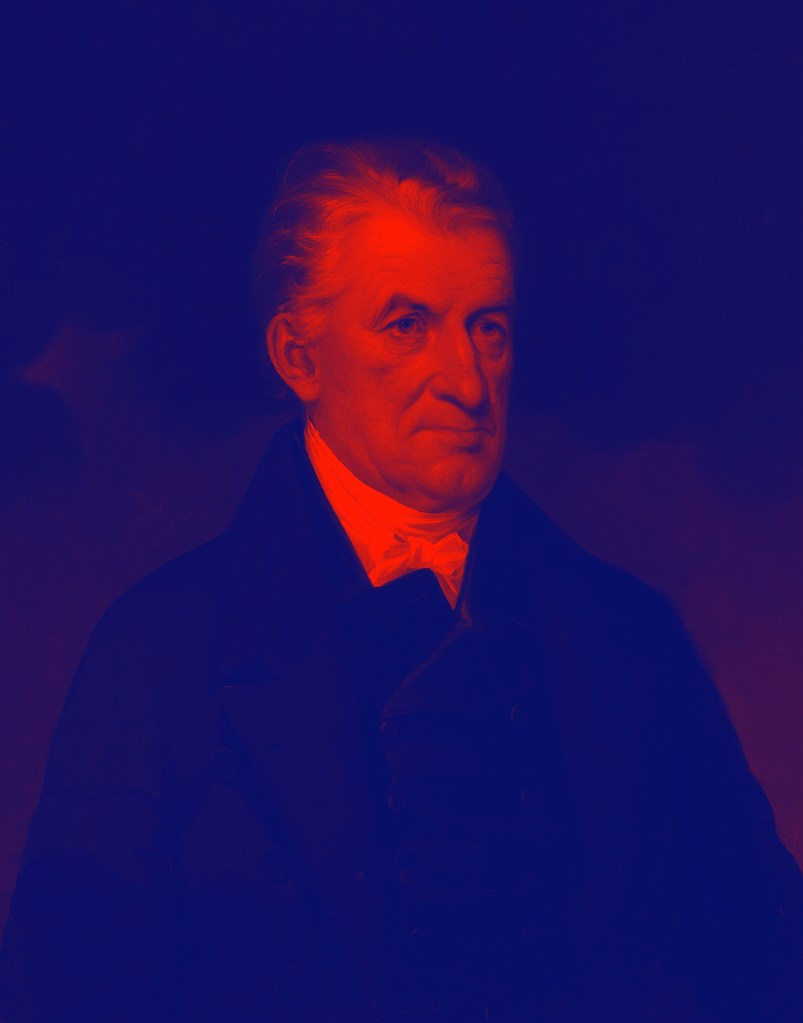
Lyman Beecher – a guy who saw some downfalls and declensions in his time

The Delaware franchise has been under serious attack for some time. Leading the charge are the richest men in the world, billionaire tech financiers, who see in Delaware law an outrageous affront to their power. 

The conflict is something of a tragic irony for First State jurists. Emerging from the coddled confines of Palo Alto office parks, Manhattan penthouses, and group chats, these monied men understand themselves to be heroic innovators rather than well-placed directors of capital flows, men of history who are by dint of genetic excellence and genius effort elevated beyond the common clay. They therefore bristle at what a prior generation regarded as the final victory of Friedmanite ideology, viz., Delaware’s judge-made law that requires all business decisions to be made in favor of shareholder gain, and nothing else.

For anyone outside the cult of Gordon Gekko, it’s clear that the federalist jujitsu that’s made Delaware’s perverse insistence on shareholder primacy and short-term profit go global has been a disaster – for human health and flourishing, generally, and democracy in the United States, specifically. But for our modern robber barons, the application of judicial restraints – even for the purpose of maximizing shareholder gains! – has been as enraging and painful as a public flogging. In retaliation for this keenly felt but entirely imaginary insult, they and their servants in the corporate law world have fanned the flames for “DExit.” The goal, transparently and repeatedly announced, is to punish Delaware, and especially its judges, by denying the state the corporate franchise fees and escheats upon which it has grown dependent. They want to starve the horse they rode in on.

Delaware’s governors and legislators have responded to these attacks with abject capitulation. But since the root of the conflict lies in rich narcissists’ hurt feelings, appeasement has not worked. Instead, attacks have continued. In the past week, leaders of the world’s largest VC firm, known for hiring homicidal vigilantes, proudly declared they were “Leaving Delaware” and invited others to do likewise, in order to escape Delaware’s onerous bias “against technology startup founders and their boards.”

Leaving aside the bizarre dissembling involved with officers of an LLC claiming they will change the “state of its incorporation,” the conclusion that must be drawn from this latest tantrum is that the fuel for “DExit” is far from finished.  True, the corporate stampede that SV billionaires have attempted to kickstart has not yet caught on. But given the power this cohort of corporate aristocrats wields – oceans of capital, vast media megaphones, and a keystone place in the revanchist coalition governing the United States – a future in which Delaware’s corporate franchise is crippled, or killed outright, seems a distinct possibility. 

So what happens when the standing order of a state comes crashing down? 

~

In 1818, the State of Connecticut adopted a new constitution, and disestablished the Congregational church. After almost two centuries of legally mandated taxpayer support, the state’s church was overthrown – out-muscled by a coalition of Democratic-Republican partisans and rival Protestant denominations, who took the opportunity of the Federalist Party’s decline to crack the central pillar of Connecticut’s “Standing Order,” and wedge in a measure of religious freedom in the bargain. 

The war for disestablishment was fiercely fought for years. Lyman Beecher, a popular and ambitious Congregationalist minister, was among the leading anti-disestablishmentarians. In his early forties when the institutions that defined his life and successful career started to totter, he worked frantically to shore them up, organizing political supporters and leading evangelical revivals “with all [his] might” to salvage what he regarded as humanity’s last best hope for salvation. 

Beecher worked until his “health and spirits began to fail,” but he and his co-religionists still lost – and fell into grief when they were beaten. Harriet Beecher Stowe, his daughter, remembered that when news of the key election loss arrived at their home, “a perfect wail arose.” Beecher himself recalled the period was “as dark a day as I ever saw” (quite a thing for a guy living in an era of high infant mortality to say). 

However, in time, he changed his mind. 

“I suffered what no tongue can tell for the best thing that ever happened to the State of Connecticut.” [emphasis in original] [1]

In describing disestablishment this way, Beecher didn’t mean that the state itself benefited, as a government. He meant that society as a whole did. Being thrown “wholly on their own resources and on God” increased ministers’ influence, he argued, by forcing their evangelizing to go to ground – to save souls through “voluntary efforts, societies, missions and revivals” rather than through coercive force or the trappings of wealth and power. Disestablishment, for Beecher, furthered God’s cause by making it more authentic, and thus more popular.  

Beecher came to this perspective after a long life of successful (and controversial) evangelical work. He was also riding a tsunami of transformative evangelical fervor in the Second Great Awakening, a wave of dramatic cultural change with origins, energy, and effects that drew on waters far deeper and wider than any in the Nutmeg state. 

Still, I think Beecher’s late-life observation is worth keeping in mind, particularly when considering changes in a state’s political economy that might seem apocalyptic. He saw the downfall of the Connecticut’s Standing Order, an establishment much sturdier and long-lived than any kind of Delaware Way, and lived to call it a blessing.

~

We live in times in which it is difficult to imagine the future. Or at least, difficult to envision latter days where a boot isn’t stamping on a human face – for ever

And yet, change comes. As Ursula Le Guin explained, “[w]e live in capitalism. Its power seems inescapable; so did the divine right of kings.” In that moment, Le Guin was contemplating art amid Amazon’s growing monopoly, but she did so with a historical sense that stretched beyond Bezos’s horizons, and an anthropologist’s awareness of how all human societies, like human beings, are mortal

Delaware’s corporate franchise is itself transitory. As Vice Chancellor J. Travis Laster has recently observed, “[f]or the first 120 years of Delaware’s existence, corporations were no more significant to Delaware than to any other state.”[3] Delaware, as a self-governing polity, has existed for a handful of years longer under its current corporate configuration than it has without it – but the years where franchise revenues were critical to state finances are many fewer than that. Delaware’s current political economy has a history – and it’s not a long one, nor inevitable.

That’s important to keep in mind today, when the power of the franchise seems both inescapable and irresistible. It’s a force that routinely turns politicians who ran (and wrote!) as progressives into staid corporate defenders, and constantly skews governing priorities toward ends that do substantial social harm, in Delaware and beyond. By setting up shop as the preeminent caterer for corporate whims, Delaware has caught the corporate “wolf by the ear,” and can neither function as a state without depending on its revenue, nor function as a representative democracy within that dependence.

In this sense, the tech billionaires’ revolt  – like their intellectual ancestors’ rebellion for treason in defense of slavery – could be the rare kind of creative destruction that allows a greater freedom for the many, rather than exploitation by the few. 

But if Delaware is to get to that outcome, some study and planning for that future is needed, now. This year, the legislature has invested in research to maintain the status quo, but a serious effort for a truly forward-thinking and realistic agenda will require something different. [4]

Some questions Delaware must answer: 

  • What sources do similarly small states rely on for revenue? Rhode Island persists, without a franchise; could Delaware?
  • How much could a sales tax bring in – and what rate would maximize revenue while minimizing the burden on the least able to afford it? What kind of transition procedure would be least disruptive?
  • Delaware Democrats recently quashed an effort to update personal income tax brackets to make them more equitable. Could a successful effort capture sufficient revenue from high-income earners to make up for a portion of franchise losses? (Ironically, in this case the actors most responsible for the “DExit” flight – corporate defense lawyers – may be the most directly able to bear new taxes to make up its loss).
  • The Delaware State Bar claims that corporate law services bring in billions, but the industry’s economic impact has not been rigorously studied by independent researchers.[5] What is the industry’s true value, and what effect will the decline and loss of the franchise have on employment, and public revenues? If billionaires and tech corporations abandon the state, but LLCs and other business entities continue to be formed here, what effect will that have on court usage and lawyers’ employment?  
  • Finally, it would be well to expand our historical understanding of the franchise. Shockingly little is known about the actual operations of the franchise in the past, or its development, as a functioning support for government. When did Delaware become dependent on the corporate franchise for revenue – and how did that process unfold? Recent research suggests the oft-repeated story, that Delaware’s dominance of the corporate charter market started with New Jersey’s fall in 1911, has a severe evidence problem.[6] So when did things start to change, who drove it, and with what consequences? A firmer grasp of the facts of what happened would, I suspect, change our ideas about what is possible.  

The life or death of the corporate franchise is not a matter within Delawareans’ control. That, in itself, is a reason to want to diversify the state’s revenue sources. But even if First State politicos are unwilling to quit the gravy train cold turkey, their dealers seem ready to cut off the supply, nonconsensually.

In either case, its time for Delawareans to start thinking hard about what a future without the franchise might mean – the problems it would bring, but also the opportunities. Because stasis isn’t just unlikely; it’s impossible.

—–

[1] Lyman Beecher, Autobiography of Lyman Beecher, ed. Barbara M. Cross (Cambridge: Belknap Press of Harvard University Press, 1961), 1: 252-253 

[2] Le Guin, as quoted in Rachel Arons, “‘We Will Need Writers Who Can Remember Freedom’: Ursula Le Guin and Last Night’s N.B.A.s,” The New Yorker, November 20, 2014, https://www.newyorker.com/books/page-turner/national-book-awards-ursula-le-guin.

[3] J. Travis Laster, “An Eras Tour Of Delaware Corporate Law,” Journal of Corporation Law 50, no. 4 (July 2, 2025): 1189–1263, https://jcl.law.uiowa.edu/articles/2025/07/eras-tour-delaware-corporate-law. Laster, as a jurist, is rather looser with chronology than any persnickety historian would be: Delaware’s period of “normal” corporate engagement lasted 123 years, while its era of eager corporate solicitation has lasted 126 (so far). That said, the article is a valuable exercise in periodizing legal history, and offers readers many claims worthy of further investigation and research. 

[4] In it’s most recent session, the Delaware General Assembly reserved $200k for research into the “corporate franchise,” and sponsored a resolution directing the “AI Commission” and the Secretary of State to study AI’s uses for “corporate governance.” It seems unlikely that either effort will result in measures that improve democratic outcomes. See: HB 230, “An Act Making Appropriation for Certain Grants-in-Aid,” July 1, 2025, Section 19; and HJR 7 w HA 1, “Directing the Artificial Intelligence Commission,” June 30, 2025.

[5] Paul Larson, William Latham, and Kenneth Lewis, “The Contributions of the Legal Industry to the Delaware Economy” (Delaware State Bar Association, June 2019), https://www.morrisnichols.com/media/news/15068_Delaware%20Bar%20Study_Legal%20Industry%20Contributions%20to%20Delaware%20Economy_06-2019.pdf.

[6] Andrew Verstein, “The Corporate Census,” SSRN Scholarly Paper (Rochester, NY: Social Science Research Network, February 25, 2025), https://papers.ssrn.com/abstract=5154952
And now for something completely different..., Archival Follies, Beginning the "Businessman", The Past is a Foreign...Something

Fear is the neuro-mudkiller

Or, figuring out if you’ve hit a typo, a fnord, or some history 

Doing historical research – reading sources – you find things. That’s more or less the point, after all. But sometimes the things you find are … odd things. Confusing things, things that raise more questions than they answer. 

The historian’s standard approach to this situation is to to explore further, to keep reading until you know what’s going on. The only way out is through; ever upwards – excelsior and etc. One reason historians work this way is that confusion is a sign of context collapse – you can’t see the window until you find the frame. The other is that confusion is a sign of a gap. Reading until you figure out why Parisian apprentices thought murdering cats was so damned funny can isn’t just a key to understanding the (horrible) joke, but something bigger about the constellation of power and people in a critical moment in the past. And that’s more or less the point, after all. 

Sometimes, you fail to figure out your little mystery. Sometimes, your little detour doesn’t lead to enlightenment, at least not directly. Sometimes, the puzzle remains unsolved.

And sometimes, you run into a neuro-mudkiller, and it leaves you flat.

~~~

Last week, following up on a suggestion from a colleague, I was poking around in some early 20th-century US newspaper databases to see if people in the 1920s were reinterpreting Paul Revere like they had done George Washington – that is, reading him as a “businessman.”  While I didn’t find much to support that theory, I did run into an unexplained historical phenomenon.(1) 

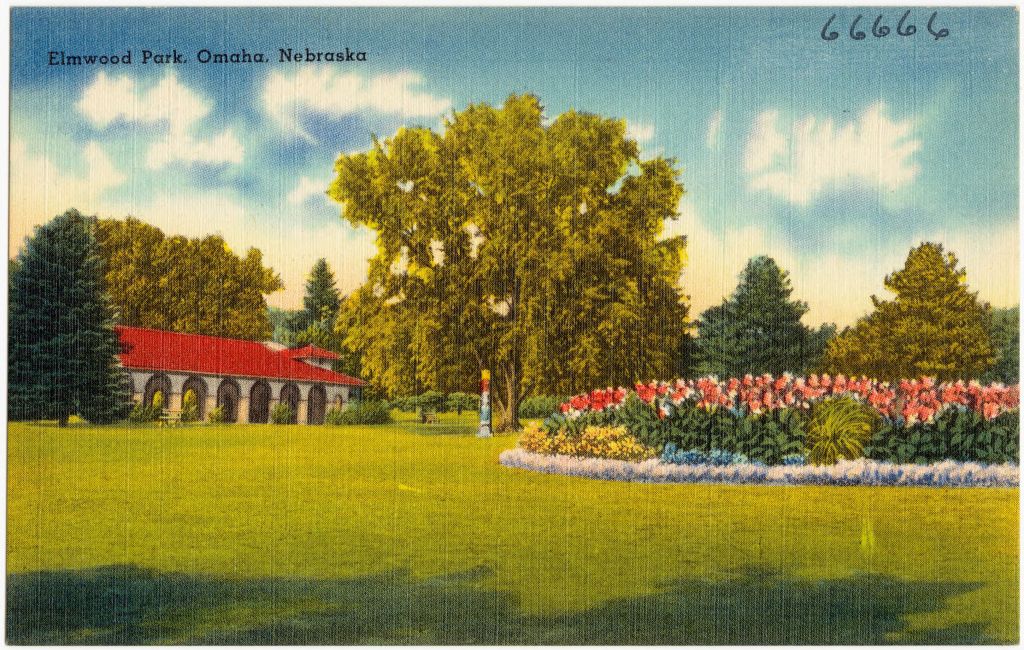
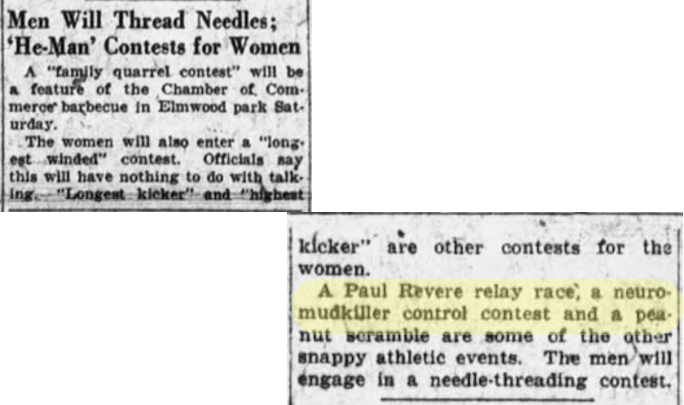
It took the form of a short notice in the Omaha Daily Bee published Friday, May 25, 1923.  Sandwiched in the middle of page two was a two paragraph article describing a public barbecue to be hosted Chamber of Commerce the following day in Elmwood park, a major recreation area on the city’s western side. The C. of C. party, the piece promised, would feature a “ ‘family quarrel contest.’” Most events on the roster for this “battle of the sexes” are readily legible as games or contests of skill, like a “longest kicker” match or a “needle-threading contest.” Others took a bit more to understand: a “peanut scramble” is when you toss candy and peanuts in the air for children to catch and collect. 

But as I read through this piece, I ran across one event that defied my understanding: “a neuro-mudkiller control contest.”(2) And <BOOM> went the Parisian cat.

~~~

I tried a number of different methods to get a handle on this phrase. I searched for the term in other newspapers, and then, when that failed, other large full-text databases, like the Internet Archive and HathiTrust. I read other reports about the event, and accounts of previous’ years similarly-organized Chamber-sponsored “field days.” 

Then I tried that all again with variants of the phrase, its components, its near alikes: mudsiller, mudskipper, mudbiller, etc. I broke each term into component parts.

Alas, nothing has led me any closer to figuring out what a “neuro-mudkiller control contest” might be – or what, ssuming the intervention of some wandering fingers on the linotype machine, the Daily Bee reporter had intended to say, originally.

Having lost hours down this rabbit hole, the phrase for me now conjures Melville’s white whale, by way of Frank Herbert’s desert-addled space opera. (Or perhaps a “neuro-mudkiller control contest” is a fnord that slipped through spacetime for surrealist ends, or to waste my time.)

~~~

Friends, the neuro-mudkiller still eludes me. But by plinking away at search bars and reading across morning editions and evening issues, I learned some things about Omaha and its roaring twenties denizens. I learned that Omaha newspapers have a non-trivial amount of typos, for one. 

I also learned the Omaha Chamber of Commerce was an active, and seemingly successful, civic association. In May of 1923 alone, the body sponsored a “trade booster tour” to Wyoming, built and hosted a new “rest room” for business women and professional at its downtown headquarters, and weighed in on a dozen different matters of public import, from traffic regulations to fraternal organizations’ convention bookings.

I further learned that the Chamber of Commerce in Omaha was operating, organizationally, as a primus inter pares. Its leading members led the city’s other leading civic, social, and charitable institutions; and those organizations participated in Chamber events, like the party in Elmwood park. Internally, the Chamber was structured with standing committees of volunteers and a guiding, paid manager (a “commissioner and secretary”) – a successful implementation of the Cleveland “modern chamber” model that famed commercial secretary Ryerson Ritchie developed and then theorized, to national acclaim. (3)

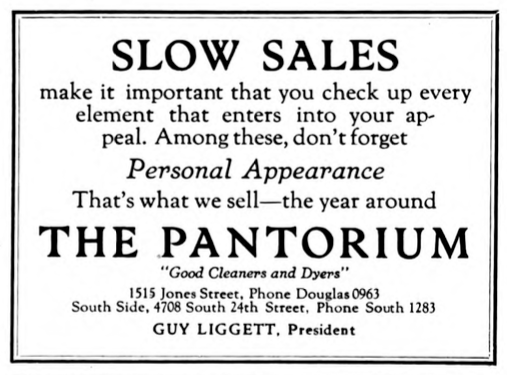
I learned that there was a local laundry called “Pantorium” (they did more than just wash pants). (4)

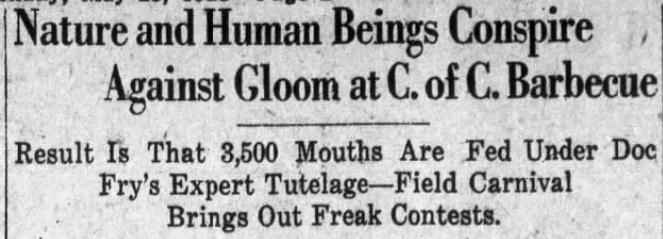
And I learned that the party at Elmwood park was a “Great Success,” at least in the eyes of local reporters. It fed “3,5000 Mouths” with “1,500 pounds of Steer and Lamb” prepared under the expert eye of “Doc Fry,” a local “master of the art of barbecue,” and served alongside with truckloads of bread, pickles, mustard, onions, radishes and – distressingly, given the temperature and the hour – coffee. Attendees were “knocked…dead” with delight by an amateur “minstrel show” and a fake horse race, sponsored by the Continental and the Lions clubs, respectively. With Boy Scouts and visiting nurses on hand to organize and aid participants, the barbecue’s roster athletic events went off without a hitch; winners got a prize donated by a local business, and their names – and addresses – in the paper. (Congratulations, Doris Frederick of 5020 California street, for winning the “longest-winded” (balloon blowing) contest). And as the afternoon turned to evening, a twenty-piece band started playing and “those who cared to tripped and stumbled the light fantastic until it was time to go home.”(5)

Finally, I learned that while the “neuro-mudkiller control contest” was happening – or not, if it wasn’t actually real – another conspiracy was being busted across town, when the Omaha “police morals squad” raided the house of a man named Nick Carmo, and seized his sugar, corn, mash and still.(6)

Violent and unpleasant, that history at least made some sense.


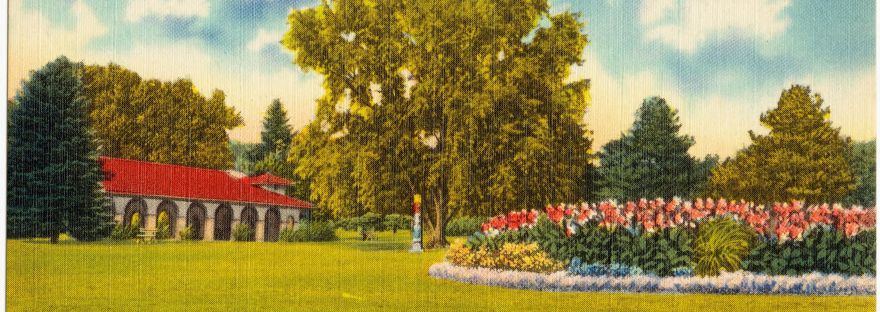
Image Source:”Elmwood Park, Omaha, Nebraska.” Card. Pub. by General Distributors Company, Omaha, Nebraska. “Tichnor Quality Views,” Reg. U. S. Pat. Off. Made Only by Tichnor Bros., Inc., Boston, Mass., [ca. 1930–1945]. Digital Commonwealth, https://ark.digitalcommonwealth.org/ark:/50959/xs55mk23n (accessed June 27, 2024).

(1) David Hackett Fischer, in his biography of Paul Revere, includes an appendix in which he tracks the popular and academic historical “image” of Paul Revere through the centuries. He dates the reconceptualization of Revere as a “Capitalist Democrat” (a propagandist for “free enterprise”) to the early Cold War – a more than a generation later than when Washington was reconfigured. David Hackett Fischer, Paul Revere’s Ride (New York: Oxford University Press, 1995), 339.

(2) “Men Will Thread Needles: ‘He-Man’ Contests for Women,” Omaha Daily Bee, Friday, May 25, 1923, p. 2, https://www.newspapers.com/article/omaha-daily-bee-men-will-thread-needles/150182706/

(3) “Firms Sign for 1923 Trade Booster Tour,” Omaha World-Herald, Sat. April 1923, p.8; “Open Women’s Lounge C. of C., With Reception,” Omaha World-Herald, Fri, May 25, p.1; “Meetings,” The Omaha Daily News, Mon., June 4, 1923, p.11

(4) “Slow Sales,” Omaha Chamber of Commerce Journal, vol. 9, no. 15 (November 27, 1920): 3.

(5) “Entertain 4,000 at Big Barbecue,” Omaha Daily News, Sat, May 26, 1923, p.1;  “Crowd of 3,500 at Field Day Barbecue: Annual Stunt of Chamber of Commerce Proves Great Success: Appetites Enormous,” Omaha World Herald, Sunday, May 27, 1923, p. 2; “Barbecue Guests Eat 1,500 Pounds of Steer and Lamb,” Omaha Daily News, Sunday, May 27, 1923, p.2C; “Nature and Human Beings Conspire Against Gloom at C. of C. Barbecue: Result is that 3,500 Mouths Are Fed under Doc Fry’s Expert Tutelage–Field Carnival Brings Out Freak Contests,” Omaha Daily Bee, Mon. May 28, 1923, p.2

(5) “Sugar, Corn, Still Are Seized in Raid,” Omaha World Herald, Sunday, May 27, 1923, p.2. 

Golden Ghetto, Power At Play, The Past is a Foreign...Something

Freebird!!! Freebird!!!

Or, Ain’t No Party Like a Synchronized Bird Release Party

Some folks make it look easy, but really, international commerce can be a lot of work – and mightily dull at the same time (all those currency conversions, ugh!). But let it never be said that China traders didn’t know a good time when it flew at them in a panic.

(Okay, I’m not sure that it has ever been said, and besides, we’ve covered similar ground before — but just go with me here).

While doing business at Canton and Macau during the 1786/1787 trading season, Major Samuel Shaw – revolutionary hero, pioneer merchant in the China trade, and official U.S. Consul – took some time out to party.

A circumstance that occurred at the entertainment given us by the Portuguese ought not to be omitted. The dessert, which was very elegant, was prepared in a room adjoining that in which we dined, and the tables were ornamented with representations, in paper painted and gilt, of castles, pagodas, and other Chinese edifices, in each of which were confined small birds. The first toast was Liberty! and in an instant, the doors of the paper prisons being set open, the little captives were released, and, flying about us in every direction, seemed to enjoy the blessing which had just been conferred upon them.

How’s that for an evening’s entertainment? This flighty soirée comes up in Shaw’s posthumous memoir-cum-biography, as a footnote in a section kvetching about how the English merchants being, well, bitchy. They hadn’t invited Shaw or any other Americans to dinner, you see, and that was breaking some serious social coding (a breach of, cough, cough, food diplomacy, if you will – though I suspect in this case “food” meant “copious amounts of Madeira and/or rum”):

On [the English’s] arrival at Canton from Macao, the usual visits were made to them by us, and by them returned; and while every other nation paid us the customary civility of giving and receiving a dinner and supper, the English alone omitted that attention, not only to us individually, but to the Americans generally.

Shaw was an old hand at the casual snub, and beyond that, a professional – and so he assures his reader that such bad behavior “did not prevent or interrupt that intercourse which will ever exist among gentlemen.” Ahem.

In classic Early American style, though, he adds a final note of paranoia, suggesting that the lack of keggers was an order from on high:

It is true, that the Court of Directors [the governing body of the English East India Company], in their instructions to the supercargoes…enjoined it upon them to use every endeavor to prevent the subjects of Great Britain from assisting or encouraging in any shape the American commerce ; but if this prohibition was intended by the directors, or construed by their servants, to extend to the civilities heretofore paid the Americans, it cannot be denied that such conduct was extremely illiberal.

Illiberal indeed. Given the weight that Shaw and his compatriots back home gave to the treatment of Americans abroad, such behavior probably only confirmed their worst suspicions about Britons’ incorrigible arrogance.

But at least the Portuguese had the courtesy to stockpile pigeons, right?


Source: Josiah Quincy, ed., The Journals of Major Samuel Shaw: The First American Consul at Canton: With a Life of the Author (Boston: Wm. Crosby and H.P. Nichols, 1847), 234. [Bold emphasis mine, rest in original.]

History and Historians, Now in Actual Work, Our Glorious National Heritage, The Past is a Foreign...Something

The Limits of Sympathy for Teas

Or, How Debt Ceilings, Tea, and the tradition of Governing in the U.S. Tangentially Relate

The political crisis du jour is over whether or not Congress will vote to raise the “debt ceiling,” aka the legal borrowing limit for the Federal Government. The broad consensus is that should the debt ceiling not be raised (as is customary), the Federal government would, for the first time ever, fail to pay – and perhaps even repudiate – its debts.

Now, the consequences of such an action are disputed; those seeking to hold firm on the debt ceiling (the Republicans) maintain that there would be no ill effects, just a healthful readjustment of budgetary priorities, while their opponents – and here that includes the Democratic party and associated partisans and officials, bankers, other Wall Street honchos, and most of the media – maintain that failing to raise the debt limit would be tantamount to a financial apocalypse, for the U.S., and possibly the entire world.

So there’s a bit of a gap in the conversation.

I bring it up here not to comment on the issue in particular – though there are some really interesting discussions happening, including some historical debates related to whether or not the 14th Amendment was designed to prevent just a crisis1 – but because lately I’ve been working through documents from the first few years after the Constitution, a period where Congress was determined to do exactly the opposite of what the Republicans are proposing today. Back in the 1790s, the overriding concern for the rulers of the newly re-organized American republic was to figure out how generate revenue so as to pay the U.S.’s debts.

The rub was that Congress had to find a way to do so consistent with the principles of the Revolution – and since there was no real agreement about what these were, or what that would look like, conflict ensued (some things never change). The parts of these machinations that typically get the most airplay are the debates over the “how, who, and what to pay” issues – the internal structuring of the national debt, the creation of a national bank, division of fiscal powers among the different branches, etc. These are the core issues around which the first partisan divide in the nation’s modern history formed, between “Federalists” (the Hamiltonian/Washingtonian conglomeration in favor of an active national government modeled in its fiscal policies after European powers) and the “Jeffersonians” (TJ and Madison’s more structured opposition party that favored a decentralized republic with weaker coercive power).

The attention this dynamic gets is justified – the people involved in these struggles certainly emphasized the “how, who, and what to pay” issues. But they weren’t the only problems being worked out. I’ve been looking how those early Congresses worked out the other part of the debt equation – the “where do we get revenue from” problem.

Here the partisan divide dissolves a bit, because the answer that the Founders gave to the revenue question basically boils down to one phrase: the tariff. The national government did implement other taxes in the early years – there was a pretty heavy tax on personal carriages2, and of course the excise tax on whiskey is well known – but until the introduction of the permanent income tax in the early 20th century, taxes on imported goods and international shipping were the primary revenue for the Federal Government. And, as you might expect of such an important component of government, during that period between Revolution and the 16th Amendment the tariff was among the most powerful drivers of American politics.

~

Long-time readers of this blog will be unsurprised to find out that Asian trade was a non-trivial part of the tariff, in both the debates setting it up and the legislation itself. And in fact, there is a lot that’s unique about the way the Federal Government handled Americans’ involvement in Asian trade which suggests that policymakers regarded it as particularly important.3 But what interests me in connection with the debt ceiling controversy is not the protections the China trade received, but rather how the Federal Government resolved problems with the collection of tariffs on the trade, and what that says about the ultimate priorities of the Founding generation of legislators.

Despite what a visit to your local art museum might lead you to believe, the West’s trade with China in the late 18th-century was not about porcelain, silks, or lacquered furniture, but rather was almost entirely concerned with exchanging silver for tea. The American trade with China was no different; indeed “china ware” was carried back from Canton to U.S. markets chiefly as ballast. The Founding generation, having concluded that taxing widely-consumed beverages with mild psychoactive effects was the most effective, lucrative and appropriate way of gaining a steady income, made duties on tea one of the linchpins of the American revenue system.4 In the tariff acts from 1789 onward, and in the periodic special taxes for defending the frontier and paying down the debt, tea invariably appears as one of the key enumerated items singled out for special attention – and taxation.5

In the early years, though, both the success of the American trade in teas, and the amount of tax it could reasonably bear, were unknowns. It is unsurprising, then, that the government ran into trouble with collections. The problem was not that tea taxes were somehow verboten because of their role in sparking the Revolutionary struggle.6 The difficulty was more prosaic: an oversupplied market meant that merchants couldn’t pay their taxes without going broke.

It was a classic boom-bust case. Americans’ rush into the China trade in the late 1780s and early 1790s flooded the U.S. market with cargoes of tea – enough in 1790 alone for three years’ of domestic consumption, according to one (admittedly self-interested) China merchant.7 With supply and demand being in an inverse relationship and all, this in turn led to both a precipitous drop in the commodity’s price and a marked rise in petitions to Congress. As merchants found themselves with stocks of teas that could not be sold even at cost, they presented Congress with a dilemma: how to best secure an important source of revenue while at the same time encouraging growth in a key economic sector?8

The merchants themselves were divided. Some requested stronger protections from foreign competitors, up to and including a ban on sales of teas imported by European shippers; others merely requested “to be allowed a farther time for payment of the duties on a quantity of teas imported.” Though there was a strong sentiment in the early Congresses that the development of the China trade was of great importance as a means to national prosperity and security – as “a trade sought after by all the world” it seemed obvious to some members that it should be protected, one way or another – this feeling was not sufficiently shared to move more protective legislation out of committee.

Even Alexander Hamilton, who is sometimes presented as the protectionist avatar of American commerce, was ambivalent. Replying to a request to evaluate a petition from the “merchants of Philadelphia trading to India and China,” he told the House of Representatives that “the trade to India and China appears to lay claim to the patronage of the Government” but “a full and accurate examination should be had into the nature and tendency of that trade” before any “encouragement” or protection could be offered.9 In other words, Hamilton kicked the can down the road, a move likely made out of concern for maintaining government income – as Hamilton knew, protecting the American trade too aggressively was a sure way to choke off the stream of revenue that flowed into the Treasury from the high duties paid by foreign importers (who paid 50% higher duties on teas, and 700% higher tonnage duties). However, in a different report on a similar petition, the Secretary of the Treasury did suggest another option: that Congress extend “credit for the duties” due on tea.10

Though Hamilton’s advice was hardly gospel – Madison and other proto-Republicans in the House were at pains to reduce the his influence in all things financial – in this matter the legislature followed his lead and chose to amend only the administrative aspects of the tariff law. Specifically, Congress extended the amount of time American merchants could store imported teas without paying duties, first from nothing to one full year, and then later from one year to two; all the importer had to do was give the port collector a bond for future payments, which could be made as the tea was sold.11

In the event, this new system worked well: by offering merchants two-year interest-free loans on their taxes, the Federal Government provided the flexibility needed to keep the trade alive beyond one season of oversupply, while at the same time effectively securing an important long-term source of revenue. It was a neat piece of governance which allowed Congress leeway to raise taxes on teas repeatedly over the next few decades, without fear of harming the trade, as merchants would always have time to adjust to new market conditions.

~

So what does this have to do with the debt ceiling negotiations? Well, I think the case of the tea tariffs offers us some insight into the particular ways our own political scene differs from those of the Revolutionary era. For the significant conservative political force in our own moment, the financial reputation of the U.S. is worth chancing in order to achieve a significant change in policy, whereas in the founding decades, for partisans of every stripe, any policy was worth changing in order to secure a sounder financial reputation.

Moreover, I think the audacity of the move – forego taxes in order to secure them! – is one worth remembering in any era where a flexible approach to ideology in governance seems rare.

(It’s also important to remember that – two centuries of hagiography to the contrary – this was not the compromise of a uniquely enlightened age. Recall that a key architect of this decision, Hamilton, got himself shot and killed by a political rival – something that is now, thankfully, nearly unheard of. And trust me when I say that the rhetoric exchanged between partisans, of this or almost any other age of American politics, is quite comparable to ours, in terms of outright viciousness; though earlier generations were perhaps more creative…)

More germane to my own inside baseball, the tea tariff decision overthrows the bipolar conclusions drawn in the current literature on the China trade. In contrast to writers who argue (implicitly or explicitly) that Asian commerce impinged only slightly if at all on the politics of early America, the care policymakers took with the tea trade suggests that concern with economic connections with Asia was most certainly a force in political debate. On the other hand, the government’s strategic deafness to merchant’s calls for commercial protection from competition belies accusations leveled by later politicians and historians that the:

“records of American legislation bear the most satisfactory testimony of the transcendent influence of the mercantile interests, and of the unceasing exertions made to fence it round with every species of protection the government could bestow which secured to the tonnage of our merchants, a monopoly of the whole of the China trade – and gave them paramount advantages in all other foreign trade.”12

Neither a controlling force in government nor a puff of air, the China trade was nonetheless an important component of the nation’s most crucial, and endlessly controversial, revenue laws. And the way the revenue it generated was flexibly supervised within the tariff laws typifies the pragmatic approach that early American politicians took to governing what they hoped would be a nation simultaneously prosperous and free.


1) For example: http://www.tnr.com/blog/jonathan-chait/91347/the-14th-amendment-solution

2) How’s that for Federal intervention into private life! 1 Stat. 373 (June 5, 1794), Chapter 45, 3 Congress, Session 1, “An Act: Laying duties upon carriages for the conveyance of persons.”

3) Among all forms of overseas commerce, only the direct trade in China goods was singled out for protection, distinguished by the trade route rather than what commodity trafficked. Taxes on Asian goods – teas, China ware, etc. – were the lowest if they were imported by Americans directly from Canton, higher if they were brought by Americans from Europe, and highest if they were imported by foreigners to the U.S.

4) Taxes on imported wine and hard alcohol were the other key supports of the system.

5) 1 Stat. 25, Chapter 2, 1 Congress, Session 1, An Act: For laying a duty on goods, wares, and merchandises imported into the United States. (July 4, 1789); 1 Stat 145, Chapter 35, 1 Congress, Session 2, An Act: To provide more effectually for the collection of the duties imposed by law on goods, wares, and merchandise imported into the United States, and on the tonnage of ships or vessels. (Aug. 4, 1790); 1 Stat. 180, Chapter 39, 1 Congress, Session 2, An Act: Making further provision for the payment of the debt of the United States. (Aug 10, 1790); 1 Stat 219, Chapter 26, 1 Congress, Session 3, An Act: Making farther provision for the collection of the duties by law imposed on teas, and to prolong the term for the payment of the duties on wines. (Mar. 3, 1791); 1 Stat 411, Chapter 17, 3 Congress, Session 2, An Act: Supplementary to the several acts imposing duties on goods, wares, and merchandises imported into the United States. (Jan. 29, 1795); 1 Stat 503, Chapter 10, 4 Congress, Session 2, An Act: For raising a further sum of money by additional duties on certain articles imported, and for other purposes. (Mar. 3, 1797); etc.

6) As one republican columnist explained, the political implications of taxes mattered, not what they taxed: “people who revolted against that innovation [the 1773 Tea Act], certainly not for the magnitude of the duty, but from a wise anticipation of the horrid train for which it was calculated to open the way….” “For the National Gazette, On the Secretary’s Report on the Excise,” National Gazette, 26 April 1792

7) “Petition of Elias Hasket Derby, Salem, Mass., 10 June 1789,” in Kenneth R. Bowling, William Charles DiGiacomantonio, and Charlene Bangs Bickford, eds., Petition Histories and Nonlegislative Official Documents, vol. 8, Documentary History of the First Federal Congress of the United States of America, 1789-1791 (Baltimore: Johns Hopkins University Press, 1998), 407.

8.) Fri, Feb 24, 1792 (1st Sess), Journal of the House of Representatives, 520

9) Emphasis mine. United States Congress, American State Papers: Finance, ed. Walter Lowrie and Matthew St. Clair Clarke (Washington, D.C: Gales and Seaton, 1832), 1:107, http://memory.loc.gov/ammem/amlaw/lwsp.html; “Report of the Treasury of the Secretary, 10 February 1791,” in Bowling, DiGiacomantonio, and Bickford, Petition Histories and Nonlegislative Official Documents, 8:382-383.

10) “Report of the Secretary of the Treasury, 2 March 1791,”Bowling, DiGiacomantonio, and Bickford, Petition Histories and Nonlegislative Official Documents, 8:411.

11) 1 Stat. 145, Chapter 35, 1 Congress, Session 2, An Act: To provide more effectually for the collection of the duties imposed by law on goods, wares, and merchandise imported into the United States, and on the tonnage of ships or vessels. (Aug. 4, 1790); 1 Stat. 219, Chapter 26, 1 Congress, Session 3, An Act: Making farther provision for the collection of the duties by law imposed on teas, and to prolong the term for the payment of the duties on wines. (Mar. 3, 1791)

12) Mathew Carey, The New Olive Branch, or, An Attempt to Establish an Identity of Interest Between Agriculture, Manufactures, and Commerce and to Prove, That a Large Portion of the Manufacturing Industry of This Nation Has Been Sacrificed to Commerce, and That Commerce Has Suffered by This Policy Nearly as Much as Manufactures (Philadelphia: M. Carey & Son, 1820), 213-214, http://catalog.hathitrust.org/Record/006512105. Carey’s summary of the early Congress’s favoritism toward the mercantile interest in general and the China trade in particular is repeated in Edward Dewey Graham, American Ideas of a Special Relationship with China, 1784-1900, Harvard dissertations in American history and political science (New York: Garland Publishing, Inc., 1988); Edward Dewey Graham, “Special Interests and the Early China Trade,” Michigan Academician 6, no. 2 (Fall 1973): 233-242.

History and Historians, Power At Play, The Past is a Foreign...Something

Triumphant Return! Et L’Affaire Cronon


It’s Been A While

As Spring threatens to return, I find my thoughts turning once more (as do those of so many rapidly middle-aging historians) to blogging. I know, gentle readers, that I’ve left you without terrible puns and alliterative link dumps for far too long; the Goose Commerce thread in your RSS reader is, no doubt, covered in dust, mites, and then more dust. And, may I say: that’s disgusting.

But awake! Or at least, don’t delete. I’m back! And plan to post at least weekly here until I lose interest again.1

So, to business…

As I’m sure you’re aware, the newest shiny debate in PastLand is L’affaire Cronon, aka the Wisconsin Republican party’s bizarre attack on one of my favorite authors, William Cronon (Mr. Nature’s Metropolis). The AHA has a full roundup on everything you need to catch yourself up

There’s been a lot of commentary, obviously, but for my own purposes the most interesting include those smart things said about the wider legal context of this attack at the egregiously inappropriately-named AmericanScience blog: Part 1, Part 2.

As for what the heck Cronon himself is up to, the best read I’ve seen so far is what Ben Schmidt, professional history’s own Nate Silver, has said over at the wonderful and informative Sapping Attention. I agree with all that Schmidt says2 : seems like the deliberative democracy shoe, consciously consensual and wholly impractical, is what fits.

While I admire Cronon’s position – especially given that he is ascending to a the highest honorific position within the guild, usually not a place that one achieves by making political waves – I can’t say that I agree with his theory of politics. I side with Martin Van Buren: we need parties, and partisanship, to make the system go; playing the center (ideologically, philosophically) is a fool’s game. Conflict is a feature, not a bug: because people just disagree, that’s why.

Which still leaves us with the problem of establishing and policing standards of discourse: so maybe Prof. Cronon has the right idea after all.

In any case, I look forward to making more of these uninformed comments in the future! Now back to actual work for a change.


Image: law_keven, “Do you think he’s alive???…..” Flickr, CC License

1.) Hey, if I’m nothing if not realistic.

2.) Save the bit about Changes in the Land being the better book: it’s good, but clearly, Nature’s Metropolis is in every way more interesting.