Archival Follies

Index of Awesome

Or, Craaazy Cross-Referenced Cacophony of Cool

nph_unicorn

Sometimes you can tell a source is going to be good just from the index.

Case in point, some selections from the index to the “Squadron Letters” (reports to the Navy Department) for Commodore John H. Aulick’s cruise to China, 1851-1853:

California Joe, Chinese coolie, participation in mutiny on the ROBERT BROWNE, 510

CELESTIAL, American clipper ship, chased by a fleet of piratical junks, 565, 685

Flag, United States:
Insult offered to, by the govt of Zanzibar, 267
Saluted by the govt of Zanzibar, 238, 239, 262, 265

Flogging, effects of abolition of, in the US Navy, 99, 100, 161, 162

Shipwrecked Japanese mariners:
Death and burial of leader, 717
Protest their return to Japan in one of our warships, 477, 478
ST MARYS ordered to receive them on board from U.S. revenue cutter POLK, 761
Thirteen of, still on U.S.S. SUSQEUHANNA, 566
Transferred to U.S.S. SUSQEUHANNA from U.S.S. ST MARYS at Macao, 417, 418

Sultan of Muscat and Zanzibar
Detained at Muscat by troubles among Arabian subjects, 230, 261
Not at home, 226

Busy trip, eh? And I’ve left out most of the mutinies.

Unfortunately, awesome means lots more work. Everything has a price…
Archival Follies, History and Historians

Guess the Ref

Or, Am I Doing Digital History? Like Right Now? …. How about now?

Steampunk_Desktop

Following a conversation with fellow grad student, also excited about the applications for new media, and after perusing an old issue of Perspectives, I came back to a knot of questions that’s bothered me since I started my graduate career (oh distant day!) How does one do digital history? Am I doing it right now? How is it different than analog history? And, not to forget that classic historian’s question: So what?

Things like this keep me up at night because I cut my teeth, intellectually, reading the manifestos of the Free Software movement (now in tamer, if more ubiquitous, form as the Open Source movement/industry). My heroes were phone phreaks, Richard Stallman, white hat hackers, and Melvil Dewey (not in that order). I was the kid bothering the Barnes & Noble clerks once a month to ask if the newest issue of 2600 had arrived yet (and no, the irony of asking for a copy at a chain store was not lost on me). I was thrilled by the idea that the ethos of yippiedom could be channeled to do cool, anti-authoritarian, productive things, like make operating systems with recursive acronyms. It fit with my other nerd-love, the library, and the potential for democratic education that it represents.

All a way of saying that my predilections are entirely in the utopian internet evangelist camp.

Continue reading “Guess the Ref”

Archival Follies, Our Glorious National Heritage

We the Snuggies

In Order To Form A More Perfect … Blanket-Like-Thing

The cafeteria / break room in the basement of the main National Archives in downtown Washington is decorated with a mural of sorts, very similar to the wall paintings seen in Barnes & Noble cafés. Except this one isn’t caricatures of famous authors drinking coffee and looking intellectual; it’s of the founding fathers wearing Snuggies (or slankets, if you prefer)
Continue reading “We the Snuggies”

Archival Follies

The Characteristics of American Tourists

Or, One of The Eternal Constants of History

Giza

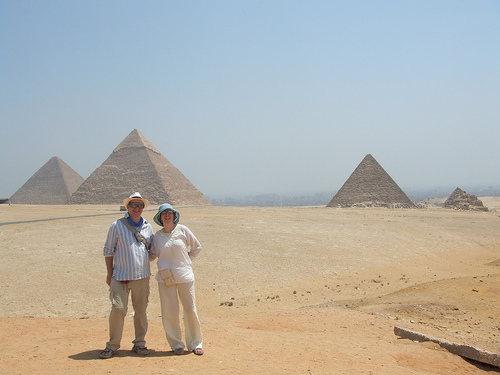
You know how it is. You have a bit of cash, a bit of time for a vacation, and you want to see The World. So you decide that Egypt’s the place — history! pyramids! stargates! — Awesome, with an immensely favorable exchange rate on top of it.

But there are a few obstacles: you haven’t bothered to learn anything about the local contemporary culture, or the politics, or the laws – and you don’t even know a language in the same family, never mind dialect.

So, problems arise.

Having had the opportunity, far too many years ago, to be one of these ignorant schmucks (in the company of a tomb-raiding archeologist friend who, bless his heart, could read Hittite, Aramaic, and all kinds of hieroglyphics, but couldn’t give directions to a cab driver in Arabic), I can sympathize with folks who get stuck paying too much for an uppity camel.

Turns out this experience has quite a patina. Like the Pharaoh’s tombs, American ignorance is too monumental to erode. For proof, look upon this dispatch, ye Mighty, and despair!

The necessity for a Consulate at Cairo is to my mind “a fixed fact.” It does not spring from the commerce of the United States, for the operations of commerce will always be performed at Alexandria; but, it springs from the habits of the American people. Already, it is admitted that three hundred Americans from the United States annually visit the Upper Nile. The increasing facilities for travel, and the increasing affluence of the people of the United States , will swell the aggregate travellers [sic] to a much larger number.

Ignorant of the language and laws of this country these persons are thrown directly upon the hands of the public functionary here. They require boats, crews, rais [boat captains], dragomen [interpreters], &c &c, with whom contracts are to be drawn and legal guarantees are to be given and recorded by the observance of due forms. The discharge of these functions falls upon the consul, as will because of his proper care of his fellow citizens, as of the fact that the claimants do not understand, very frequently, the language or the laws of this country, and unless he does discharge this duty the voyages must be abandoned.

~Humphrey Marshall, “Cairo in Egypt,” to the U.S. Secretary of State, Washington City, 4 December 1852, Despatch No. 3


Image cite: blogefl, Giza,” Flickr, CC License