Archival Follies

The Characteristics of American Tourists

Or, One of The Eternal Constants of History

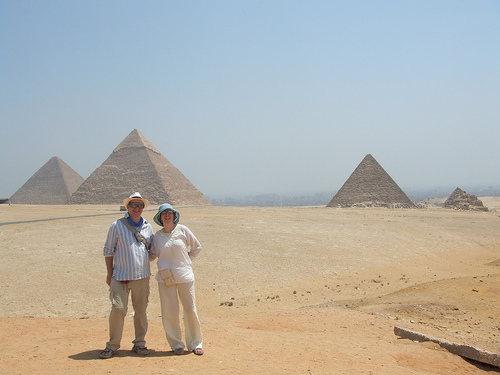
Giza

You know how it is. You have a bit of cash, a bit of time for a vacation, and you want to see The World. So you decide that Egypt’s the place — history! pyramids! stargates! — Awesome, with an immensely favorable exchange rate on top of it.

But there are a few obstacles: you haven’t bothered to learn anything about the local contemporary culture, or the politics, or the laws – and you don’t even know a language in the same family, never mind dialect.

So, problems arise.

Having had the opportunity, far too many years ago, to be one of these ignorant schmucks (in the company of a tomb-raiding archeologist friend who, bless his heart, could read Hittite, Aramaic, and all kinds of hieroglyphics, but couldn’t give directions to a cab driver in Arabic), I can sympathize with folks who get stuck paying too much for an uppity camel.

Turns out this experience has quite a patina. Like the Pharaoh’s tombs, American ignorance is too monumental to erode. For proof, look upon this dispatch, ye Mighty, and despair!

The necessity for a Consulate at Cairo is to my mind “a fixed fact.” It does not spring from the commerce of the United States, for the operations of commerce will always be performed at Alexandria; but, it springs from the habits of the American people. Already, it is admitted that three hundred Americans from the United States annually visit the Upper Nile. The increasing facilities for travel, and the increasing affluence of the people of the United States , will swell the aggregate travellers [sic] to a much larger number.

Ignorant of the language and laws of this country these persons are thrown directly upon the hands of the public functionary here. They require boats, crews, rais [boat captains], dragomen [interpreters], &c &c, with whom contracts are to be drawn and legal guarantees are to be given and recorded by the observance of due forms. The discharge of these functions falls upon the consul, as will because of his proper care of his fellow citizens, as of the fact that the claimants do not understand, very frequently, the language or the laws of this country, and unless he does discharge this duty the voyages must be abandoned.

~Humphrey Marshall, “Cairo in Egypt,” to the U.S. Secretary of State, Washington City, 4 December 1852, Despatch No. 3


Image cite: blogefl, Giza,” Flickr, CC License

Archival Follies, Dismal Scientists

Extra, Extra! Territoriality

Or, History: Slaughter Bench or Treasure Chest?

extra

Over at Marginal Revolution the other day, Tyler Cowen opened a discussion about extraterritoriality as a way to promote economic growth, part of a longer-running conversation about the viability / desirability / possibility of setting up what Paul Romer calls “Charter Cities,” which as far as I can tell are colonies-by-permission.

As Prof. Cowen references some historical works on the concept, I presume he — and his commenters — are at least passing familiar with the way violence was needed to originate and maintain extraterritorial rights, at least over the last two centuries. However, their discussion, as with most of this kind of neo-liberal thought experiment, appears to have no real sense of how power — its mechanics, its actual use, it as a motivating factor — maps on to all of this.

Rather kills the fun, I think.

In that context, I think this excerpt from a letter by an American diplomat in Shanghai — that experiment par excellence in modern extraterritoriality — might serve as a useful correction to the discussion. This is what extraterritoriality meant the first time it was used in earnest: creeping (or running!) imperialism.

It seems that the Imperial troops attempted to intercept cannon which they understood a British House was designing to deliver to the Insurgents, and for this purpose entered the foreign settlement. They were met by foreigners and were driven out of the settlement, with a loss of six of their number, who were shot in the conflict. The Chinese fired also, but did no material damage. There were no citizens of the United States involved in the affair. Commodore Perry has not communicated to me any details of the report of Commander Walker, and I must therefore confine my own statement to the repetition of the brief report of the occurrence as it is mentioned in a private letter from Mr. Cunningham, the vice-consul of the United States.

This affair is a legitimate result from the prior conduct of foreigners generally at Shanghai, and of the British authorities and residents in particular. The Chinese, either Rebels or Imperialists, are unable to protect themselves against European arms; and a knowledge of this fact seems to render foreigners perfectly careless of the extent to which they trespass on their rights. For my stern opposition to all violations of neutrality and my warning that its consequences must be and ought to be the generation of national hostility, I have become quite a mark for scribblers through the British Press in China and, I presume, of animadversion at home. I rely for my vindication upon the determination of my Government to sustain a public servant in the firm discharge of public duty.

In any other country than China men would be arrested and immediately executed for a great many offenses which have been committed here with impunity, and apparently with the sanction of the foreign public authority. I enclose a printed slip containing a remonstrance addressed to the British Consul at Shanghai to his countrymen, which admits a conclusive case against them, yet, it is said, he demanded an explanation of this affair from the Chinese Imperial General, and received some sort of apology for the resistance of the Chinese troops! It must be plain that the Chinese will entertain resentment for such conduct although at present they may be unable to exhibit it. This occurrence has been the apology for strengthening the British guard at Shanghai; and, the foreign quarter of that city may already be said to be, in effect, under British rule. A correspondent of mine writing from that city under date of November 30 says

“The fact is, the authorities of Great Britain are exercising here in Shanghai all the rights and prerogatives of sovereignty, as between themselves and the Chinese. They have actually garrisoned the place on their own hook, refusing to regard it as a mixed and common cause of all foreigners. If the crews of the Spartan and Salamander are not sufficient, of course a Regiment of Ceylon Rifles or British Infantry would be put in requisition. What more could sovereignty do?”

~Humphrey Marshall, U.S. Commissioner to China, to the Secretary of State, 8 December 1853

But hey, maybe if we had a Western power – governed by an ideology of a liberal economics bent, naturally – administer a major city in some poor country’s territory everything would be cool? It might work out this time.

Unlike all the other times…


Image cite: Leekelleher, “extra,” Flickr CC License
Archival Follies, Now in Actual Work

Wheatonesque

Or, Nineteenth-Century Natural History and Geopolitics Go Together Like…*

Frame

Henry Wheaton was a busy man in 1843. Aside from his official duties as U.S. Minister to Prussia – which included everything from issuing passports and entertaining visiting Americans to more serious affairs like preparing for a treaty negotiations with the Zolleverein, the German Customs Union – he was also intensely engaged in writing reports, as a hobby.

And not just a few. In 1843, Wheaton wrote at least ten reports for the National Institution for the Promotion of Science – aka the “National Institute” – a Washington-based organization that sought to : “to promote Science and the Useful Arts, and to establish a National Museum of Natural History, &c. &c.”

Wheaton’s contributions to the Institute fell firmly in the “&c. &c.” category. Though best known for his legal work – he was the first professional reporter for the Supreme Court, and wrote the standard treatises on international and maritime law – his reports for the National Institute trace a wider circle, and depart significantly from the then-standard definitions of “scientific and useful arts.” He wrote absolutely no treatises on New England ferns or Great Lake mollusks (all popular topics with the Washington professionals cum amateur scientists that made up the bulk of the Institute’s membership), which probably accounts for his failure to get the Institute to help publish his work.

Instead, he wrote on a bewildering array of subjects, including:

The geography of Central Asia; the revival of Greek tragedy in Prussia; German canals; the state of the fine arts in Denmark ; the character of Frederick the Great; the last days of the Emperor Charles V; the genius and labors of Liebniz; the life and writings of Diderot; the Panama canal; the history of the reformation in Germany; Egyptian Antiquities, and the Ptolemaic canal across the Isthmus of Suez.

If we ignore the Teutonic flavor of some of the reports (likely the result of his location and occupation; he had been a diplomat in Prussia since 1835), a striking pattern emerges. Almost uniquely among the corresponding members of the National Institute, Wheaton was concerned with history, culture, art – and, above all commerce and geopolitics.
Continue reading “Wheatonesque” →

Archival Follies, The Past is a Foreign...Something

Great Moments in Taking Things Completely Out of Context

Diplomatic Despatches* Edition

Giraffe

“Feeling excited by the Death of the Duke of Orleans.”

~Edward Everett, U.S. Envoy Extraordinary and Minister Plenipotentiary to Great Britain, to Daniel Webster, Secretary of State, 18 July 1842, Despatch No. 17.


* Yes, they spelled it “despatches” not “dispatches.” No, I don’t know why.

Image cite: Swiv,”What?,” Flickr, CC License