Or, You Make a Better Road Than A Destination, America
It’s been a busy week for the appreciation of the promise and perils of transcontinental, or if you prefer, inter-oceanic, travel.
Allow me to explain…
Historian
It’s been a busy week for the appreciation of the promise and perils of transcontinental, or if you prefer, inter-oceanic, travel.
Allow me to explain…

I. The current Met Exhibit on early modern textile trading is FANTASTIC. If you’ve got the means and the opportunity, I heartily recommend getting out to “Interwoven Globe: The Worldwide Textile Trade, 1500–1800.” And do it quickly! It closes January 5th. (And if you can’t get there, at least go to the website and look at some of this stuff). It’s a fascinating display of objects that are astounding enough on their own, but the way Amelia Peck and her colleagues have put them together really does something new. Put briefly, they’ve selected choice conversations in fabric to showcase early modern globalization through one of its driving forces, textile production and consumption.
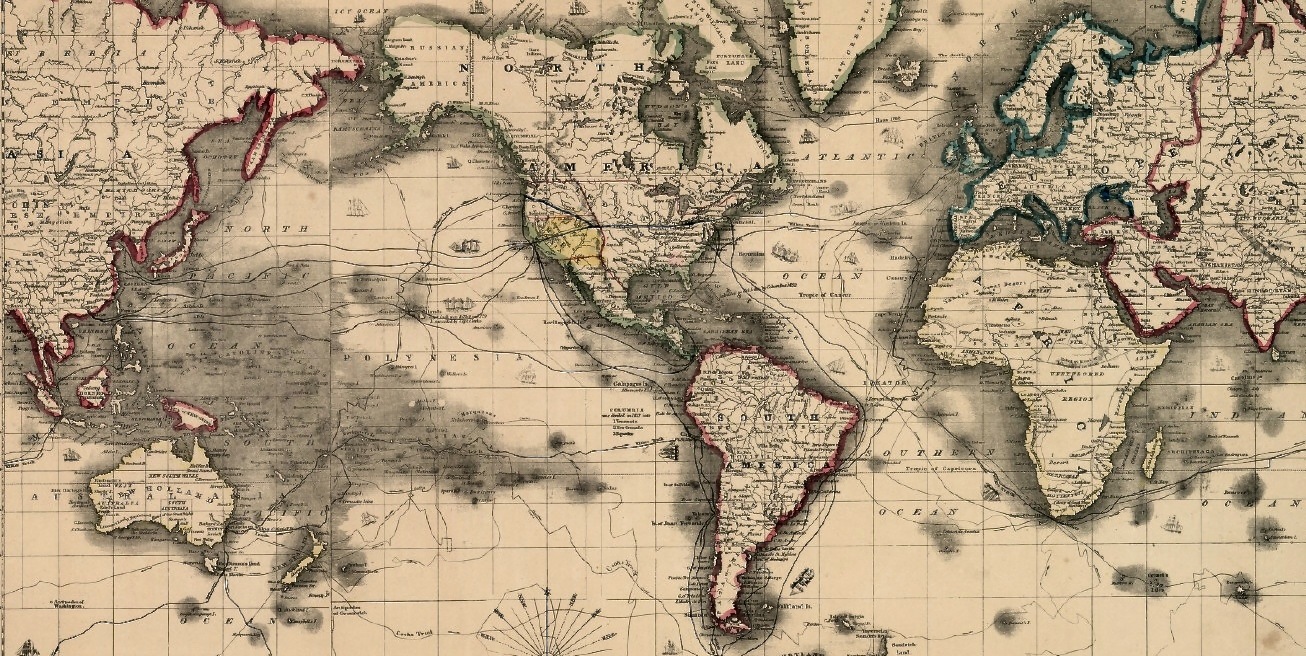
II. But! There are quibbles. First the bigger picture: they’ve got a slideshow at the beginning that depicts trade routes – but only those transoceanic links frequented by Europeans. Now, the centuries-long development of deep-water European maritime trading was a crucial event, but those ventures never operated in a vacuum, even on the water. The Indian ocean was not a blank but for Portuguese ships; it had thriving networks of dhows connecting Hindu, Muslim, and Buddhist worlds. Similarly, China’s traders had fleets of junks making connections to Southeast Asia and Japan that facilitated all kinds of exhange, even of European design ideas. However, the opening presentation leaves one to suppose that all transcultural transmission was the result of traveling Europeans, and announces the show’s narrative to be a simplistic story of East-West interaction (one where Europeans appear to have more agency, in many cases, than non-Europeans).
Luckily this is an interpretation that the items on display emphatically undermine, in myriad ways. So this is not a case of a deep misunderstanding on the part of the curators, but rather a matter of failing, in the introductory instance, to effectively communicate the more complex reality. Still, a more accurate set of maps would have gone a long way to setting things up.
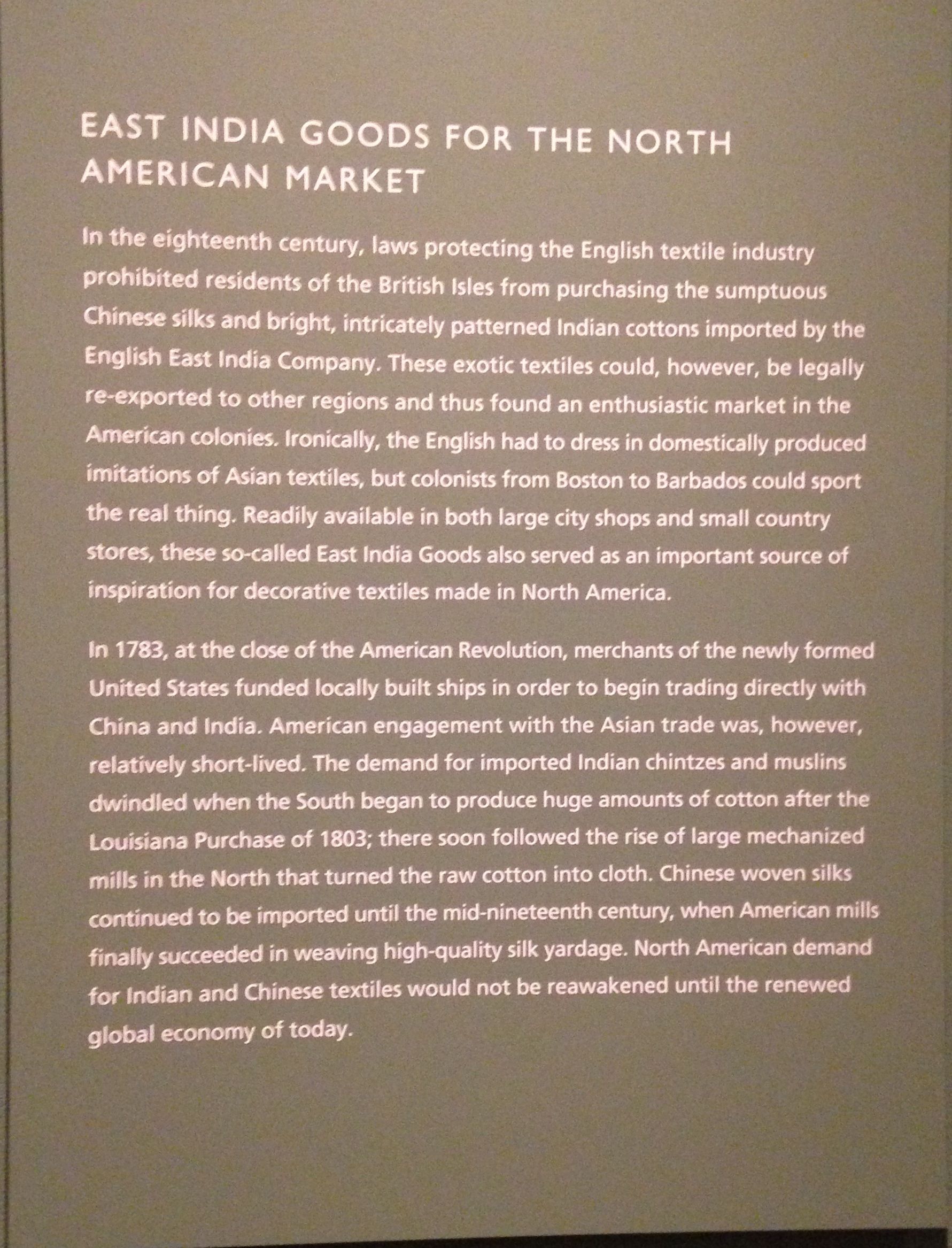
Second, a more personally-interested beef: one of the last wall texts in the exhibit (pictured above) was so full of Nopes (and half-Nopes) about North America and Asian trade that I nearly quibbled myself out of the room. So don’t buy what this sign is selling you: the smuggling trade in Asian goods was extensive, and colonial Americans did indeed have access to “the real thing”; American “engagement with the Asian trade” had its booms and busts, but nonetheless continued throughout the nineteenth-century, not just for a short time; in the specific case of Indian cottons, geopolitics and simple political economy tamped down their consumption well before cotton agriculture or textile production got going in the U.S.; and so on, etc. etc. ad nauseum. Long story short, this wall text channels narratives and just-so stories that come from (way) older scholarship –– or, more generously, takes its cues from the history of fashion or artistic styles alone, and not the wider history.
III. But man, the works on display! Are amazing. Beautiful, incredibly well-preserved, and just gorgeous examples of wonderful art – I really can’t say that enough. The Met’s curators have very ably, and very intelligently, put these items into dialogue, and have thereby made a convincing argument about the need to see world trade, art, and the lived experience of globalization as all operating within the same frame.
I very much hope they do many more such exhibits in the future.
Image 1: “Sarasa with Small Rosettes,” 18th century, India, Cotton. Metropolitan Museum of Art, 2010.57
Image 2: The vexing wall text. Courtesy(?) of the author.
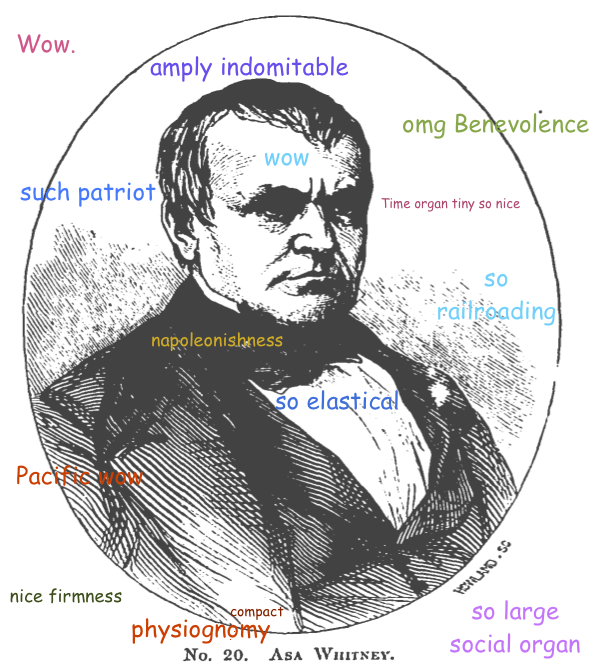
Today I found a portrait and detailed profile of one of the characters I’m currently writing about in the American Phrenological Journal.
Yes folks, in November 1849, Asa Whitney, railroad projector and lobbyist for humanity, was not only the man of the hour and talk of the town, but also the cover model for America’s leading pseudoscientific periodical. Reading what the nation’s foremost experts in head-bumps and skull-shapes had provided to the interested public concerning the former China merchant, it occurred to me that the phrenologist’s analysis might very easily be stripped of its Victorian vagaries, and translated into a jargon with more currency today; that is, into doge speak. Thus, the above.
(Also, per Gary Larson, it was late and I was tired).
Full cite (incl. original image):
“Article LXXI: Phrenological Character of Asa Whitney, with a Likeness,” American Phrenological Journal 11, no. 11 (November 1, 1849): 329–333.

Tom Scocca’s recent snarking on smarm has got me thinking about the connections between history, as it is written and pursued, and one of the defining literary styles of our time. But before I bloviate over a blog post, here’s the essay: go have a look.
I’ll wait.

I’ve been doing some research in-and-around accountancy, including some attempts to learn actual methods. It is what it is; mainly what I’ve noticed is that authors in the field like to get ahead of you on the question of how excruciating (supposedly) their subject can be.
For example, there’s the almost-a-Bond-villain approach:
“Let’s begin with candor. Do you expect to enjoy this introductory course in financial accounting?”
~Clyde P. Stickney, Financial accounting: an introduction to concepts, methods, and uses, 8th ed., The Dryden Press series in accounting (Fort Worth: Dryden Press, 1997).
And the overly-descriptive but also passive-aggressive horror-movie gambit…
“If for many people history is boring and all about dead people, why produce a Companion to the history of a discipline that is widely perceived as a mind-numbing activity performed by the living dead – cold, colourless number crunchers? In this volume we hope to show that accounting history is much more than describing the content of crumbling ledgers, the scrutiny of faded balance sheets and charting impenetrable methods for recording transactions in the past. While we don’t promise to excite readers with historical tales of lust, debauchery, and murder, we do hope to reveal the manner in which the seemingly innocuous practice of accounting has pervaded human existence in numerous and fascinating ways.”
~J. R. Edwards and Stephen P. Walker, eds., The Routledge companion to accounting history, Routledge companions (London ; New York: Routledge, 2009).
But dramatic introduction hooks aside, it’s not really as bad as all that. Money is interesting!
Image: Anton Graff, “Self-Portrait with Eye-Shade,” 1813, Wikimedia Commons
 Dael A. Norwood
