The rationale for this rash action is fear: fear that if Delaware does not extinguish judicial independence to better fit Musk’s perverse desires, Delaware will lose critical revenues, as Musk leads corporations to “DExit,” or registering in other states, because of Chancery Court decisions that since 2022 have supposedly upset the balance of power between shareholders and corporate managers.
The data does not support the panicked narrative that SB 21’s supporters have been promoting, however. That narrative seems to be a product of Musk, and his paid agents, spreading misinformation like a miasma across the state.
Delaware’s Corporate Franchise is a Volume Business
Delaware benefits in several ways from having outside corporations registered here. The most valuable benefit is revenues from the “corporate franchise tax.” This is a fee that corporations headquartered outside the state provide Delaware for the “privilege of being incorporated in Delaware.” (Fiscal Notebook, 2024 ed, p. 108). In recent years, the corporate franchise tax, alone, has provided ~20% of total state revenues, or about 1.2 billion dollars. (Personal income tax, paid by human people, provides 33% of the total state revenue). (Fiscal Notebook, 2024 Ed, p. 32).
The critical thing to know about the corporate franchise tax is that it is not an income tax: it’s a set of tiered fees, assessed based on a corporation’s total number of authorized shares – but with a max payment cap of $250,000.
In other words, Delaware is in a volume business, not a value business. Delaware has – or rather, should have – an interest in appealing to the largest number of corporate registrants, not the wealthiest billionaires. That’s a critical point, because the interests of most corporations – and most investors – do not align much at all with the desires of oligarchs like Elon Musk. If it wants revenue, Delaware shouldn’t be catering to the tiny cohort of vampires.
Back to Delaware politicians’ panic: you would think if the corporate franchise tax revenue is indeed in peril – if the “DExit” movement is real, and not just a propaganda hallucination – then there would be some data to support that claim.
Alas for Musk et al., and their well-paid agents, three data points suggest the opposite is true.
1) Startups Continue to Choose Delaware
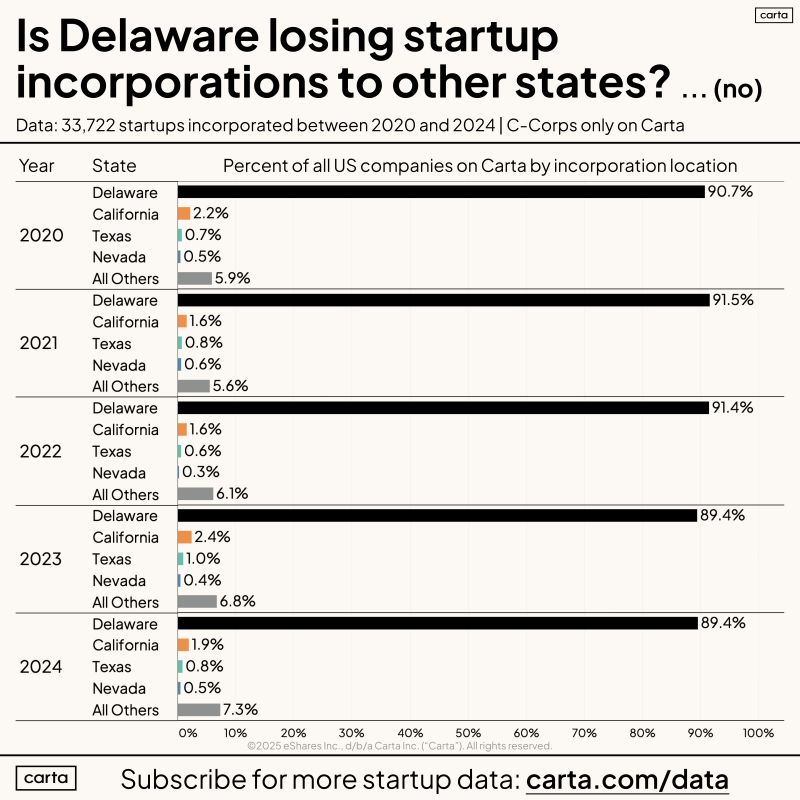
Peter Walker, “head of insight” at Silicon Valley data infrastructure firm Carta, recently shared a chart from his company’s private dataset demonstrating that 90% of startup C-Corps are domiciled in Delaware – a percentage that has “barely shifted in the last 5 years.” Including in 2024.
2) The Number of Corporations Filing Franchise Taxes Keeps Going Up
The most recent public figures show that 309,911 firms filed franchise tax payments in FY 2024 – an increase that continues the unbroken upward trend of the last decade, before the recent Chancery Court decisions, and then through and beyond them.
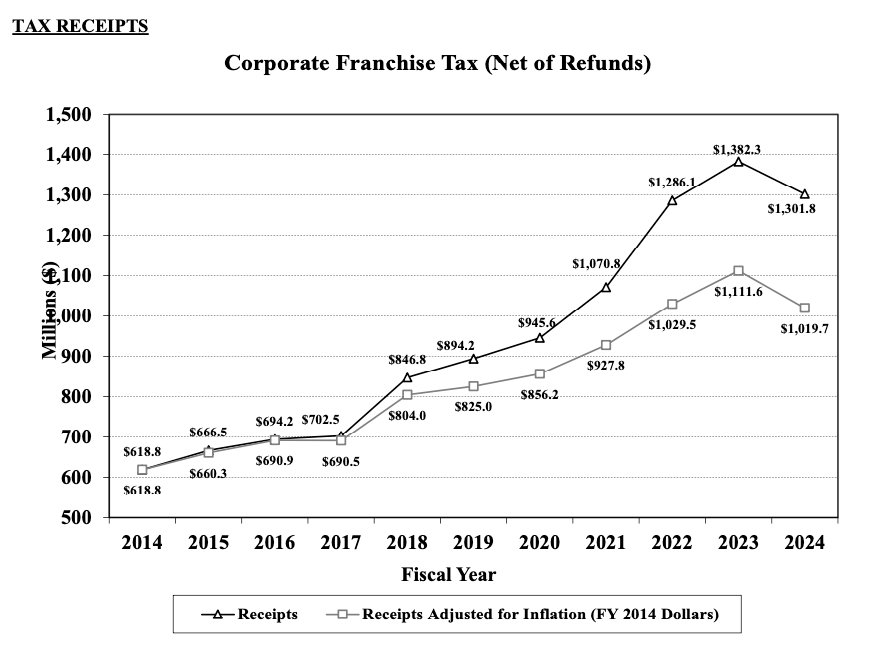
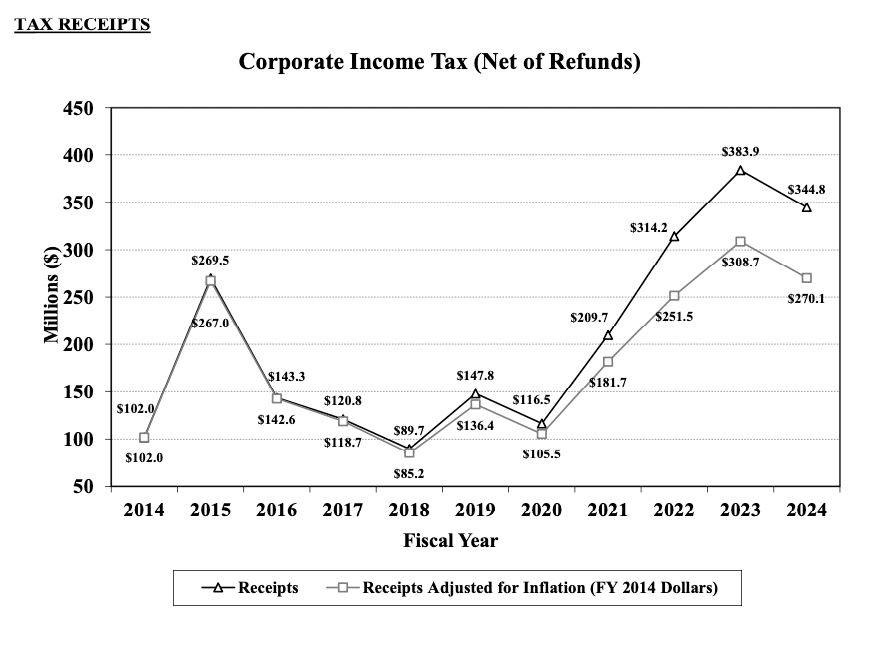
Now, total corporate franchise tax receipts have dipped, somewhat, from 2023 to 2024. But they have done so following the same patterns as the Corporate Income Tax.
Source: “Tax Receipts: Corporate Franchise Tax,” and “Tax Receipts: Corporate Income Tax,” in Fiscal Notebook FY 2024 ed., pp. 109, 115
That suggests to me that the cause lies in macroeconomic conditions – unemployment, inflation – rather than anything to do with Delaware’s legal regime. (Corporations paying income tax here do business here; they can’t exit as easily as paper registrants, and have less incentive to do so).
Since 1977, Delaware’s state government has relied on the Delaware Economic & Financial Advisory Council, or DEFAC, for economic forecasts. DEFAC meets quarterly to assess data, and issue guidance – guidance that the General Assembly usually regards as binding on legislation.
At the December meeting, DEFAC forecasts steady franchise revenues for FY 2025, 2026, and 2027. That is consistent with economic indicators – at least, prior to Musk’s installation as co-president – and suggests this expert body saw no threat in the data of the sort SB 21’s draftees were already hallucinating.
Musk’s Pungent Miasma is Not Reality
In short, private and public data sources agree: there is no observable decline in incorporations in Delaware, and no evidence that “DExit” is occurring in response to Chancery Court rulings. Further, the advisors specifically tasked with forecasting future franchise tax revenues – that is, a body of people mostly not employed by Elon Musk – do not see evidence for dramatic change.
An alternate explanation does fit the data better, though. Elon Musk’s lawyers drafted SB 21 to benefit their oligarchic clients, not Delaware. Musk’s paid agents are breathing the bad vibe fumes they want to see in the world into existence. The odor of panic they’ve wafted into lawmaker’s nostrils is thus a miasma, in the classic sense: unhealhy and unpleasant air, produced as the unpleasant exhalation of rot and corruption, that causes feverish illness.
Delaware’s leaders should not radically revise our laws, and gut a valuable franchise, on the basis of huffing Musk’s swamp gas.
Note: while by statute, the heads of Delaware’s state agencies are supposed to provide public reports on things like the total number of corporations registered here, and revenues derived from them, in practice Delaware state government is … uninterested in transparency. Opacity is part of the value Delaware provides, apparently.
The upshot is that basic data, and foundational statistics, are often hard to get, and difficult to parse using normal methods even when located. Still, while our state government officials are intentionally(?) incompetent at communicating to the public, they have not shirked their duties completely; there are sources worth your time & examination.
While this report is not linked on the DE Finance Department’s page, you can find it at that URL. An annual report, it offers a wealth of up-to-date statistics on the fiscal situation of the government of Delaware, including revenues and expenditures, as well as detailed supplemental information on specific taxes, fees, pension contributions, bond obligations, and subsidiary agencies.
The fiscal notebook is a rehashing of much of what is in the ACFR, but summarized and more richly contextualized look at the state budget, with historical data and legislative histories. If you want to know when the corporate income tax changed, and under what legislation, the Fiscal Notebook is your guide. It has some charmingly 1990s graphic design, as well. Prior reports are available here.
DEFAC posts cryptic briefing books and terse meeting minutes, grouped by date, on this page. If you dig far enough, you can find their predictions; and if you want a bit of fun, take a look at how far off they were in their predictions (usually they underestimate revenues by quite a bit, and overestimate the cost of expenditures; there appears to be a spirally structural austerity built into their models, assuming any models actually exist beyond intuition).
In theory, under the law, this page should contain the division’s up-to-date annual reports, detailing numbers of business entities registered in Delaware, and other pertinent information. In practice, this website is a wasteland.
Is Delaware More Than A Corporate Cut-Out? Its Elected Officials Don’t Seem to Think So
The following is a departure from my usual historical research and archival content – but related to it, insofar as I am attempting to puzzle through why Delaware’s political economy has produced elected officials so eager to aid, rather than oppose, mortal threats to American democracy.
subtle, right?
The federal constitution that Delaware was first to ratify in 1787 is no longer in effect. That doesn’t seem to worry Delaware’s leaders, though. In word and deed, they seem much more concerned with Elon Musk’s feelings.
In short, alleged ketamine enthusiast Elon Musk and his junior partner president, Donald Trump, have declared that there is only one branch of government: them. L’État, c’est DOGE.
Amid this obvious and flagrant coup, Delaware’s elected federal officials are difficult to find. Even compared to the median opposition party member’stepid efforts, Senators Coons and Blunt Rochester and Representative McBride are striking in their absence from public view. If you are able to reach their offices by phone – good luck, the lines are busy, leave a message – staffers repeat vague statements of concern, and bland praise for bipartisan civility. They have taken no meaningful action, however.
Doing nothing is bad enough, but the Delaware state government is actively campaigning for worse – collaborating to open a second front of the new business plot against America. Explaining why requires taking a bit of a long view…
Since the early 20th-century, Delaware has been the official residence of choice for business entities seeking easy registration, light fees, and a pliable, circumspect, and pointedly incurious government. Further, since the 1980s, Delaware law – through black-letter legislation and court precedents – has bent itself to the task of enforcing an extreme Friedmanite orthodoxy on American corporations (“The Social Responsibility of Business is to Increase its Profits.”) In combination, this means that Delaware is the proximate reason why the relentless maximization of stockholder wealth has become the sine qua non of modern American corporate capitalism. Corporate directors and executives can be sued – and lose – if they can’t prove their decisions put stockholders’ wealth first, last, and only.
Curiously, the gospel of shareholder primacy has not been greeted as good news by the current class of robber barons. A cohort of oligarchs who double-dip as head managers and major investors have chafed when they’ve received pushback in Delaware courts for filling their pockets with private side deals instead of filling their pockets and stockholders’ pockets, simultaneously. And that pushback – gentle, partial, and oddly principled though it might be – has left them seething.
More specifically: in response to recent lawsuit losses, emerald mine heir Elon Musk and other like-minded techbros have mounted a furious propaganda attack against the legitimacy of Delaware law. (The particular target of their ire are the jurists of the Chancery Court, the primary venue for most corporate cases – and importantly, led by a woman). Last year Delaware’s General Assembly replied to these public tantrums with a hasty revision of the Delaware General Corporation Law. As is customary in Delaware, this critical amendment bill was drafted in secret, by a select committee of a local lawyers group, the Corporation Law Section of the Delaware State Bar Association. Less usually (though not unprecedentedly), the amendments overturned Chancery Court decisions, cutting against decades of precedent to restrict stockholders’ rights. The new law destroyed the pretense of judicial independence and expertise – which was the point, of course – and was intended as a peace offering to the addled billionaires, a balm to soothe their frenzied anger and calm any advanced irritation afflicting other corporate directors.
Alas, bullies are greedy and rarely satisfied, and so attacks on Delaware have only increased since. Musk et al. have been recruiting other tech CEOs to “DExit,” i.e. remove their formal business registrations from Delaware to other, redder states. Still just a trickle, this movement could be a big deal for the state’s budget, if it turns into a flood: 30-40% of annual state revenues come from the various fees and taxes collected from the businesses registered to, but not operating in, Delaware. This windfall, and its attendant benefits, is collectively known as “the franchise.”
In Meyer’s new dispensation, Delaware can’t just be bought: it’s a fire sale, with deep discounts for the loudest and worst people in the world.
The leaders of the General Assembly have been less visible in their appeasement, but seemingly just as eager to fall in line. Since the new session has opened, they’ve done nothing to respond to any of the Trump/Musk regime’s attacks on Delaware’s residents or its institutions, and pulled bills that might have offered some protection.
Their capitulation last year to corporate demands has opened the door to other bullies, too. Spotlight Delaware reports that regional “nonprofit” healthcare monopolist ChristianaCare has filed suit in the Court of Chancery opposing the weak and watered-down cost control law passed last year. ChristianaCare argues that cost reviews would erode “the integrity and viability of the (Delaware) corporate franchise.” Making healthcare more affordable would kill the golden goose, you see – so it can’t be done.
Seen in the fuller light of Delaware’s political economy, the gormless abdication of responsibility by Delaware’s members of Congress is less surprising. How could they be expected to move bravely to counter a revanchist coup, when they’ve built whole careers in a state dedicated to fulfilling every billionaires’ unhinged whim?
For over a century, Delaware has benefited from the fact that nowhere else in the country has a ruling elite more willing to give outside oligarchs what they want, when they want it, and fast. From a certain angle, our corporate law, and the “the franchise” it spawned, has indeed been a goose that lays golden eggs. It has made some lawyers, some lobbyists, and some business service executives quite rich; and it’s allowed generations of voters, legislators, and governors to avoid hard choices. You can see why no one wants to upset the goose.
But geese are jerks. And now Delaware’s specific, special goose – the unelected billionaire goose – is burning down our house, while our family sleeps inside.
Might it be time to cook that goose, instead? The alternative is to be cooked, ourselves. Golden eggs aren’t worth much when your democracy is dead, even in Delaware.
On May 14, 1990, the Town Council of Dagsboro Delaware considered the topic of business licensure in a way James Scott would find familiar:
I am not how the conversation with the Chamber of Commerce went, with regard to this new effort to make business legible to the town government. I’m curious how Mayor Otis Jefferson pitched it to a group of businessmen generally unwilling to let the state in, even as they constantly sought to use the state for their own ends (including profit).
But something must have gone forward from 1990, because Dagsboro now not only allows businesses to vote – it requires them to be licensed.
Source: “Minutes, May 14, 1990” in Minutes of the Dagsboro Town Council, 1941-1993, Delaware Public Archives, RG 7040-000-001, roll 2
Or, Did a Shit Storm Over Sprawl Lead to Corporate Enfranchisement?
Corporate Voters Project – Research Note #4
When I first heard of Smyrna, Delaware, I thought of smoking opium. But now, I think of corporations voting.[0]
Let me start again.
In the early nineteenth-century, Americans went to the Ottoman port of Smyrna to buy opium, to resell it in China. They were eager to find a cheaper way to pay for the tea they bought at Guangzhou (Canton) – the Spanish silver dollars that Chinese merchants preferred were too expensive, and shipping kegs of coins cut into their profit margins something fierce. So, taking a page from the East India Company’s business plan, Americans sailed the Mediterranean to visit Smyrna (modern-day Izmir, Turkey) and buy smokable opium, which they then smuggled into China, exchanging it for tea. American firms profited massively from trafficking in an illegal narcotic from West Asia to buy a popular stimulant in East Asia – drug dealing is good money, turns out! – and in the process helped kick off a century of violent invasion and civil war in the Qing empire that killed tens of millions of people, and addicted millions more. [1]
I spent over a decade reading and writing about this history, and it pickled my brain in a specific way: which is why when I first moved to Delaware and heard about “Smyrna,” I thought “smoking opium.”
But the nineteenth-century people living in Duck Creek Cross-Roads – what became Smyrna, Delaware – had a different obsession. The local lore is that they renamed their dockside village after an ancient Anatolian city because a Methodist evangelical extraordinaire named Francis Asbury had preached them the good dope about Christ’s redemption of mankind from sin, and in his sermon quoted a Bible verse mentioning Smyrna. The holy flame of Asbury’s call to Christian conversion – mixed, perhaps, with some of hellfire’s heat – branded the city’s name upon the Kent County villagers’ hearts. Later that year they appealed to the General Assembly, asking to have the name of their unincorporated hamlet changed to “Smyrna.”[2] The wise men of Dover agreed, and it’s been an easy-to-mumble moniker ever since.
My more recent research has changed what Smyrna means to me. The town is one of the 70% of Delaware municipalities that allows corporations to vote in local elections. I’ve spent the last couple of weeks investigating how a small town came to enfranchise corporations in special elections for annexation and for bond referenda. And further, I wanted to figure out why Smyrna used two different mechanisms for corporate voting: for annexations, “one man, one vote” – but for bonds, one vote per land parcel (e.g. the more you own the more you get to vote).
I’m not sure I’ve come up with good answers to either of these questions, yet. But I did find some further confirmation for some of my developing theories: to wit, that corporate voting came after, and in some ways replaced, other forms of municipal oligarchy in Delaware; and that the problem of paying for sewers – and the political economy of suburban housing development they support – has something to do with why Delaware towns have granted corporations the right to vote during the last half-century.
So let’s dig into Smyrna’s charters, and its night soil, and see what we find.
~*~
As best as I can determine, corporate voting first appeared in Smyrna when the town was re-incorporated in 1980. Prior to the Reagan era, Smyrna’s municipal charters had focused on more traditional methods of ensuring oligarchy: restricting who could vote using status, wealth, race, and/or gender requirements. The earliest version of the municipal charter, in 1817, required that voters be “persons,” who were free, white, male, and owned real estate. Later, in the 1859 charter, the property ownership requirement was dropped in favor of a tax-paying requirement: a poll tax, specifically. An 1897 charter revision removed explicit restrictions based on race (though I have to imagine they were enforced, implicitly), but kept the pay-to-play proviso. The municipal charter approved in 1929 removed restrictions based on gender – and opened the door to non-resident and possible non-human enfranchisement, by granting “every resident and non-resident taxable of said Town” the right to vote at any special “town meetings” called to decide on extra tax levies. Votes at these meetings were allotted based on the dollars of tax a “taxable” paid, much like Dagsboro charters of the a similar vintage.[3] But though Smyrna had a surprising number of corporations for a tiny Delaware town – the state even chartered one to build the town hall, which is a bit like using a chainsaw to shave, in terms of legal structure overkill – I have not yet found evidence that property-owning local corporations voted in these early 20th-century town meetings.[4]
Smyrna’s 1980 charter, though, carved out a clear role for corporations in the municipal electorate. Its opening section grants “[e]ach legal entity (whether an individual, partnership, corporation, association, trust, or any other entity capable of holding legal title), owning property in its own name” one vote in annexation elections – though carefully limited such votes to the “one-man, one-vote” principle. But a later section, about special town meetings to levy special taxes, laid out a different principle, re-using the 1929 charter’s language to apportion “every resident and non-resident taxable” a number of votes on the basis of dollars of “taxes paid.” Now that the annexation section had opened the door to non-human “non-resident taxables,” it’s possible this provision was intended to apply applying to corporations, too.[5]
As seems to be standard with charter revisions in Delaware, no one noticed these sections – at least not in print. Newspaper reports on the 1980 recharter mentioned other features – a bump in council member pay, the lowering of the voting age to 18 – but passed over the enfranchisement of corporations, explicit or implied, entirely. The recharter bill passed the legislature with no incident, or comment. [6]
That was not the last ratchet toward an incorporated electorate. Smyrna’s 2003 charter expanded and altered corporations’ voting rights. For annexation elections, “any legal entity” owning property is allowed one vote, on a one-man, one-vote” basis; and for bond elections, “any person(s) or artificial entity(s)” [sic] owning property are “entitled to cast one vote for each separate parcel of real property.” Note that this new process privileges the concept of divisible landed property over raw wealth – and divorces voting from the concept of paying in to the community. It’s the number of land lots you own, not how much tax you contribute to public coffers, that counts. [7]
(Smyrna’s charter-writers finessed this a decade later. The 2012 charter revision scaled back corporate property owner’s voting power: today, owners of “an unfinished subdivision” only get one vote per the entire set of parcels, rather than one vote per empty lot.[8])
To sum up: after a century of limiting the franchise by property and tax-paying, in 1980 Smyrna dipped its municipal toes in corporate voting, and in 2003 submerged itself to the waist, granting corporations that owned developments and subdivisions – in particular – unprecedented, and frankly odd, voting rights.
But why? I wasn’t able to find a smoking gun explaining everything in detail, but there is circumstantial evidence that this shift was part of a larger conflict with the county and state governments over the pace, space, and structure of new land development, aka sprawl.
And as with Dagsboro, the debate flowed through the sewers.
~*~
The facts are these: at the start of 2003, Smyrna, Delaware was wholly in Kent County. Then, in August 2003 – after eight months of very public, and increasingly acrimonious, political conflict that ranged across official town, county, and state venues – the town council approved the annexation of 500 acres of land north of Duck Creek, extending the town boundaries into New Castle County on the basis of a one-vote majority (the mayor broke the tie). [9]
A few things are interesting about Smyrna’s decision. First: the town annexed this territory over the opposition of the full hierarchy of New Castle County and State of Delaware officials, up to and including the Governor. A few years before, these same authorities arrogated control over local development to themselves – part of a larger effort to manage growth, and suburban sprawl. In the county, this took the form of a new comprehensive plan, with a massive $100 million sewer construction program at its heart – to be paid for using fees levied on sewer hookups to new houses built on unincorporated (i.e. county) land. For the state, Gov. Ruth Ann Minner had created a new bureaucracy for assessing and approving town and county comprehensive plans: an administration known formally as the Office of State Planning Coordination, which developed processes and principles called “Livable Delaware.” If it had worked as intended, “Livable Delaware,” would have allowed political appointees and civil servants to direct development across the state, ensuring a more orderly, healthy, and environmentally-beneficial growth, perhaps – but it also consolidating a large amount of what had been local patronage in state hands. But – importantly – as they implemented these new planning processes, neither state or county had moved to alter all the municipal charters in Delaware that provided towns with annexation powers.[10]
That became a problem because county and state planning centralization came at the cost of municipal control of development – and its associated revenues. This set the table for what Al Mascitti, a News Journal columnist, called in May 2003 an “epic struggle.” The stakes, he said, were “how and where thousands of Delawareans will live” – and where they would pay taxes, and to whom. Mascitti dubbed this brewing fight the “Sewer Wars,” after the expensive, nasty, and difficult-to-build infrastructure that all new developments required.[11]
~*~
Smyrna’s 2003 annexation proposal was the first test case for these new county and state administrative protocols. And here is the second reason it’s interesting: they all failed. The town successfully annexed the land it wanted, over the opposition of the entire hierarchy of county and state elected officials and civil servants – and faced no legal or political penalty. Livable Delaware was discredited, and New Castle County lost a major source of revenue, setting back planning efforts for decades.
What’s particularly curious about these losses is that they occurred at the same time as the Delaware legislature granted Smyrna a new charter that juiced corporations’ voting rights when it came to annexation and bond and tax issues. The passage of the new charter seems to have added new momentum to the town’s resolve to beat the state. In May, after a state review board rejected the town’s proposal, Smyrna’s part-time mayor, Mark Schaeffer, a full-time real estate professional, said the town would comply with the state’s process. But after the new town charter passed the General Assembly became law in early July, he changed his tune. With Governor Minner’s signature still drying on his town’s new charter, Mayor Schaeffer announced Smyrna would move forward, without the state’s blessing – and build its own sewers.
In defying the state and county, Schaeffer also deployed new, aggressive arguments in favor of Smyrna’s expansion. First, that “growth” was inevitable – a force of nature that it would be foolish to try and “stonewall.” Second, he argued that municipal annexation was a matter of fundamental law: “We believe all the property owners have certain inherent constitutional rights, and we find it inappropriate to pull the rug out form under then once the process had gotten started.” Schaeffer’s language is notable. It isn’t town residents, or human beings, in whom he thinks fundamental rights inhere: it’s property owners. (Did I mention that Schaeffer was both a realtor and a life-long Republican? Well…) [12]
~*~
Mayoral profession and partisanship aside, what role corporate voters played in all this remains unclear. Delaware newspapers in 2003, preoccupied with promoting the Iraq war and opposing gay marriage, did not note the charter revision process at all, much less its provisions.
But some of realtor-mayor Schaeffer’s comments suggest that business entities advocacy was at least part of the annexation push: “[W]e have property owners expressing an interest in annexing into Smyrna. There also are a couple of businesses that have failing septic systems that have a dire need of our services.” [13] Though the town won the legal and political battles, it’s unclear what Smyrna gained in the end – aside from untreated sewage. The Wilmington newspapers condemned the town’s actions, and said its officials should “be ashamed.” And a decade later, both the Office of State Planning Coordination and New Castle County, each with new staff, still carried enough of a grudge to block Smyrna’s other plans.[14]
From a historical perspective, the muddiness of the shit storm in Smyrna is a clear indication that I need to find better, or at least different, sources. Municipal charters are useful for nailing down when the formal definitions of the corporate electorate changed; but they don’t show that system at work. Newspaper coverage, while nicely keyword searchable, has hard limits: if journalists don’t cover something, I can’t find out about it – and journalists rarely noticed, and never investigated, charter revisions.
In the absence of an unexpected public confession of backroom maneuvering, I think my next best set of sources will be minutes of town council meetings, town elections records, and internal town legal memos – which, if they exist, will be accessible only in-person, at municipal record rooms, and may require FOIAs. Too, since this sewer-development-charter change troika seems to be replicated across multiple towns, there may be records of that structure being communicated, and spread, as specialized knowledge. If so, developer’s trade association meetings, or chamber of commerce conferences, may be sites that have produced records of that communication (Is there a YouTube lecture advising home builders to take over local politics with a charter change?). State archives may have useful material: it’s possible the Office of State Planning Coordination recognized its enemies at some point, and drafted a report about them. Finally, if a home builder or real estate company has made internal records available – say, as part of a collection a business history archive, like the Hagley – those corporate materials could shed light on municipal changes.
That’s all for the future, though; for now I plan to keep grinding through towns and cities, and see if my legal history and newspaper search method produces more insights – or at least more sewer cites.
On to the next municipality!
————
[0] What can I say? Age changes you, man.
[1] See Ch.3 of my book – Dael A. Norwood, Trading Freedom: How Trade with China Defined Early America, American Beginnings, 1500-1900 (Chicago, IL: University of Chicago Press, 2022) – if you’d like a scholarly account of all the intricacies and political implications of Americans’ opium dealings. For a comprehensive but sharply written overview of the global patterns, see Amitav Ghosh, Smoke and Ashes: Opium’s Hidden Histories (New York: Farrar, Straus and Giroux, 2024).
[2] 4 Del. Laws, c. 1, “An Act to change the name of Duck-Creek Cross-Roads to Smyrna,” Approved January 16, 1806.
Note: this is not an act of incorporation; just an official change in place name. Smyrna was incorporated first in 1859 (see cites below).
[3] Though officially incorporated in 1817, the legislation has the appearance of a road bill: 5 Del. Laws, c.129, “ An Act to survey, lay out and regulate the streets of Smyrna, and for other purposes,” Approved January 20, 1817.
In 1859 Smyrna was reincorporated, to match village boundaries were surveyed and expanded in 1855; so you have to read both pieces of legislation together for them to make sense. 11 Del. Laws, c 280, “A Further Additional Supplement to the Act Entitled ‘An Act to Survey, Lay Out, and Regulate the Streets of Smyrna,” March 1, 1855; 11 Del. Laws, c. 670, “An Act in Relation to the Town of Smyrna,” Approved February 25, 1859, pp. 772-781;
[6] “Smyrna proposes new charter,” The Morning News, Tue, May 6, 1980, p.2; “Legislature,” Morning News, Thu Jun 26, 1980, p.6; “Legislature,” Morning News, Sat Jun 28, 1980, p.4
[9] Melissa Tyrrell, “Smyrna to annex disputed property: Decision will cost town $2.9 million,” News Journal, August 19, 2003, p. 1, 10.
[10] Melissa Tyrrell, “Panel Advises against Smyrna Growth: Livable Delaware subcommittee recommends town not be allowed to annex 1,200 acres in NCCo,” News Journal, Tue, Apr 29, 2003, B1, B5; Charlotte Hale and Melissa Tyrrell, “South NCCo Revisits disposal of sewage,” News Journal, Sun, May 11, 2003, p.1, 8; Charlotte Hale, “State group splits on Smyrna growth proposal,” News Journal, May 13, 2003, p.B1, B2; Patrick Jackson, “Governor Rejects Smyrna Annexation Plan: Mayor says town will comply with state’s decision,” News Journal, Sat, May 17, 2003, pp.1, 5; J. L. Miller, “Smyrna pursues NCCo Annexation: Governor, county are against plan,” News Journal, Wed, July 23, 2003, pp.1, 13; James Merriweather, “Sewers rejected for Smyrna: Kent County to Withhold Service in annexed area,” News Journal, Nov 27, 2003, B1, B5
[11] Al Mascitti, “Struggle over south NCCo Development just starting,” News Journal, Tues, May 6, 2003, p.15.
This column was published a year after Star Wars: Attack of the Clones and two years before Star Wars: Revenge of the Sith, which may be why Mascitti was so ready to say “Begun the Sewer Wars have.”
[12] Patrick Jackson, “Governor Rejects Smyrna Annexation Plan: Mayor says town will comply with state’s decision,” News Journal, Sat, May 17, 2003, pp.1, 5; J. L. Miller, “Smyrna pursues NCCo Annexation: Governor, county are against plan,” News Journal, Wed, July 23, 2003, pp.A1, A13;
[13] Patrick Jackson, “Governor Rejects Smyrna Annexation Plan: Mayor says town will comply with state’s decision,” News Journal, Sat, May 17, 2003, p. 5
[14] “Our View: Veto of Smyrna’s plan to annex 1,2000 acres was responsible,” News Journal, Fri, May 2, 2003, p.14; “Our View: Country Shouldn’t Revert to Relying on Septic Systems,” News Journal, Mon, May 5, 2003, p.A10; “Our View: State Must Hold Its Ground Against Defiant Smyrna,” News Journal, Aug 15, 2003, p.14 ; Melissa Nann Burke, “Smyrna, NCCo at odds on growth: New Sewer Service Contentious Issue,” News Journal, Mon. Mar 26, 2012, pp.1,7.
[15] On the town’s great expectations, see: Mark Finney, “The Turning of Smyrna: A Former Farm Town Nestled Next to an Expressway will See its Population Double in Three Years,” News Journal, August 18, 2003, E1, E3
Or, What’s a Little Light Voting Restriction Between Friends, Across Decades?
Corporate Voters Project – Research Note #3
Having surveyed the swampy landscape of corporate voting in present-day Delaware, I’ve now turned to digging post holes in it. That is, to get a clearer sense of when as well as why the practice of enfranchising business entities took hold, I’m taking a closer look at a handful of municipalities with corporate citizens, by investigating the legal history of their charters – specifically, when corporate voting entered their basic law – and trying to contextualize those developments using historical newspapers.
Ten miles from the coast as crows and google maps fly, Dagsboro was first incorporated in 1899. The town proper was carved out of Dagsborough Hundred, in Sussex County. (“Hundreds” are unincorporated subdivisions of counties – not unique to Delaware, but unusually long-lived here, where they served as the primary local political unit from the colonial era through to the 1940s. Most were defined by waterways: “White Clay Creek Hundred,” in what is today Newark, centered on said creek, for example; there’s a similar story behind the much more metal “Murderkill Hundred”) [1].
According to Thomas Scharf, the excitable, voluble, and occasionally reliable nineteenth-century chronicler of Delaware history, Dagsborough Hundred was named after its lead proprietor under late British rule, John Dagworthy. Alternately described by Scharf in the course of one printed page as a captain, colonel, and general, in 1774, Dagworthy was granted generous tracts of land – known as “Dagworthy’s Conquest” – as a reward for military service rendered, and well-placed connections worked, in the Seven Years’ War. He repaid this boon during the American Revolution by seizing British war matériel and arresting accused loyalists. When not offering such forceful signs of ingratitude to the British Crown, Scharf records that “General” Dagworthy:
“built a capacious one story house upon an eminence at the east end of the town…The approach was a broad avenue lined with trees. There surrounded by his family and a retinue of slaves he dispensed a liberal hospitality.”[2]
What a swell a petty tyrant, eh?
When he died, Dagworthy was buried under the chancel at Prince George’s Chapel, a tiny but persistent house of worship, just off the main drag of what became the Town of Dagsboro in 1899.
Dagsboro’s inaugural charter has a number of interesting features – but corporate voting is not one of them. The municipal franchise, per Section 3, is reserved for tax-paying property owners: “every male taxable of said town above the age of twenty-one years” as well as the “husbands of woman freeholders in said town.” (It pays to marry well!)
The franchise was premised on landholding – a “freeholder” is a resident who owns real estate in fee simple – and, critically, paying in to the town treasury: to vote you had to be up-to-date on your assessed taxes.[3]
The amount of tax you paid mattered, too. You’ve heard of voting with your dollars? Well, so had the legislators who chartered Dagsboro. In their wisdom, they decided that this jumped-up village was going to be an oligarchy, not a democracy. At town elections “each person entitled to vote shall be entitled to one vote for each dollar, or fractional part thereof, which shall have been paid by them or their wives as town tax on the property so assessed.”
To put it more plainly: the more land you owned, and the more tax you paid, the more votes you could cast! Like most oligarchies, this regime lasted only a short while: in 1903, the charter was amended to eliminate the vote-per-dollar scheme – though voting was still restricted to landowners, or men who married women who owned land.[4]
The press noted the Dagsboro charter’s passage through the legislature in January 1899 only perfunctorily. There are more stories about the sick wife of the charter bill sponsor (and first town commissioner), Rep. William P. Short, and his subsequent arrest for bribery (later dismissed), than there are about Dagsboro’s creation itself.
That’s understandable: a town with at best one crossroads warrants little notice most days, and much less in a year when Delaware politics were as lively and consequential as they ever get. Dagsboro’s competition for column inches was, first, the extensive extralegal efforts of one J. Edward Addicks, erstwhile Republican, to bribe himself into the U.S. Senate (Rep. Short was part of that effort – caught but not prosecuted); and then second, the total revolution in the state’s political economy, via the wholesale adoption of the New Jersey corporate code. (This was Delaware’s bid to steal their northern neighbor’s revenue scheme – though it took until 1913 for fruit of that poisonous tree to fully ripen).[5]
~*~
Corporate voting first appeared in Dagsboro with the town’s re-chartering and re-incorporation in 1941. So far, I have only found spare notices of this in state or local newspapers: Sen. Alden P. Short shepherded the bill through the General Assembly, but what his relation was to William P. Short, or why 1941 was the year to do this civic business, remains unclear.[6]
What is clear, though, is that the 1941 charter enfranchises corporations to vote in bond referenda. In these “special elections,” residents and property owners, “whether individual, partnership or corporation” all received “one vote for every dollar and fractional part of tax paid.” Oligarchy, again!
Voting for annual municipal elections in Dagsboro was, in this revision, more open – reserved for taxpayers 21 and over, with no stated racial or gender restrictions – but the process became malignly unusual. To indicate their choice for town commissioner, voters “shall cross out the names of all candidates which he or she does not desire to vote for” – that is, in Dagsboro you vote via negation. I read this as a form of Jim Crow-restrictions in action: a purposefully confusing process put in place to allow white election officials to reject votes at their discretion. [7]
And while thus far, I have not found any newspaper accounts that shed light on why this re-incorporation happened when it did, I think it’s notable that the bond referenda section re-used the 1899 charter’s “one dollar, one vote” mechanism – even while other voting restrictions were loosened, or altered.
The past is never truly past, especially if property is involved.
~*~
In 1991, the Town of Dagsboro re-incorporated again, and once again revised its charter. This time corporate voting was brought fully into all elections, both annual and special. The path, again, for corporate enfranchisement was property ownership – though now limited to one vote per person/entity.[8] As with the 1941 revisions, the motivation for this overhaul is not immediately clear from the newspaper record – but there is a notable coincidence, involving sewers.
The charter revision bill was sponsored by Sen. Richard S. Cordrey, a powerful pol from nearby Millsboro, who was then serving as Senate pro-tem. And while Cordrey’s other initiatives made the newspapers regularly – there was a redistricting that session, as well as smaller fights with the Governor over appointments and the budget – Dagsboro’s new charter only appears in the press as a one-line entries in legislative recap articles.[9]
What did make the papers was a slow-moving effort by Sussex County to build new sewers to accommodate an ongoing wave of new residents and housing developments. Beginning in 1990, the County and affected towns – including Dagsboro – were involved in a series of lawsuits and legislative wrangling to select sites for wastewater treatment and disposal. By 1991 work was sufficiently underway on the job of replacing Dagsboro’s private septic systems with a County-administered municipal flush that the Wilmington News Journal, the state’s biggest newspaper, thought it warranted a town profile.
The New Journal’s Southern Delaware correspondent noted the Dagsboro was a sleepy place, with one hill, one stoplight, and one predatory, “hawk-eyed lawman” eager to “fatten the town’s coffers” with tickets written to out-of-towners. But beyond that picaresque character, the story was that Dagsboro’s citizens – and possibly it’s corporate voters, too – expected the sewers to set off a “boom time,” attracting new residents and new economic vibrancy into the town.[10]
My hunch is that sewers and corporate voting are linked, both metaphorically and politically. The 1991 charter revision, by empowering non-resident property owners, both human and corporate, could have been part of a horse trade, to get the infrastructure investment needed to enable a “boom time.” Giving corporations the vote could have been what was needed to get them to invest in the project of the town’s growth – and in return, corporations got to help decide how much they’ll pay for all the new shit they bring.
Call it the “Cum Cloacarum et Corporationes, Civitas” theory of government.[11]
~*~
For the curious and civic-minded, the Town of Dagsboro website explains local election procedures. If you are a human resident – but not lucky enough to be a property owner – you face some hurdles. You have to present yourself with identification and documentation at the Town Hall office, during business hours, to be certified and entered into the town voter registration book. (Unlike other Delaware municipalities, Dagsboro does not participate in the state voter registration system). Then, come election time, provided the clerk can find and verify you in that book, you can vote.
However, if you are a property owner – whether a natural person or artificial entity – your task is requires less of a time expenditure. Simply appear at the polling place with your name on a deed to a property within the corporate limits; and if “you” are a business entity – a partnership, or a corporation – you proxy must appear with that deed, plus “a certified resolution of said entity authorizing the person therein to vote for the entity.” Two pieces of paper, and you’re golden, no fuss, no waiting.
[1] The best and most detailed account of Delaware’s extraordinarily creaky administrative state that I have encountered is Penjerdel Corporation and Pennsylvania Economy League, Historical Development of Local Government in the Penjerdel Region, Penjerdel Governmental Studies 1 (Philadelphia, PA: Penjerdel, 1961), https://catalog.hathitrust.org/Record/005888599.
[3] 21 Del. Laws, c. 285: “An Act to Incorporate the Town of Dagsboro,” Approved February 9, 1899, pp. 549.
[4] 22 Del. Laws, c. 437: “An Act to Amend Chapter 285, Volume 21, Laws of Delaware, Being Entitled ‘An Act to Incorporate the Town of Dagsboro, Approved February 9, 1899’,” Approved March 31, 1903, p.435.
[5] Typical of press coverage of the charter is “Legislature,” News Journal, Mon, May 5, 1941, p.4. On Short’s wife’s pneumonia, “Mr. Short’s Sad Message,” Wilmington Daily Republican, February 24, 1899, p.2. On his dismissed bribery indictment: “Kent Bribery Cases,” Middletown Transcript, April 29, 1899, p.3, https://chroniclingamerica.loc.gov/lccn/sn84026820/1899-04-29/ed-1/seq-3/
[6] 43 Del. Laws, c. 161: “An Act to Reincorporate the Town of Dagsboro,” Approved May 14, 1941; “Legislature,” News Journal, Mon, May 5, 1941, p.4.
[7] On bond elections, 43 Del. Laws, c. 161, Sec. 22(B)6; on regular muncipal elections, Sec. 5(D).
[8] 68 Del. Laws, c. 138; “An Act to Reincorporate the Town of Dagsboro,” Approved July 9, 1991. On annexations, see Sec. 3(F); on muncipal elections Sec. 7(G); and on bond referenda, Sec 33(A)5
[9] “Legislature,” News Journal, Thu, June 20, 1991, p.19; “Legislature,” News Journal, Thu, June 27, 1991, p.15; “Legislature,” News Journal, Sat, June 29, 1991, p.7; Nancy Kesler, “Castle OKs restrictions on adult entertainment,” News Journal, July 10, 1991, p.12
On the Susex sewers saga – which involved the legislature overturning a Chancery Court decision within weeks of its announcement – see: Bruce Pringle, “Court Blocks Sewer Plants Outside District,” News Journal, Wed, Mar 21, 1990, p.1; Bruce Pringle, “Sussex: Change Sewer District Rules,” News Journal, Thu, Mar 22, 1990, p.1; Bruce Pringle, “Sussex OKs boundaries for sewer district,” News Journal, Fri, Mar 23, 1990, p.5 ; Nancy Kessler, “Castle Signs Sussex County Sewer District Bill,” News Journal, April 19, 1990, p.22; “Sussex County Has Eye On Parcel,” News Journal, May 30, 1990, p.2; Bruce Pringle, “Decision on Sussex disposal site expected within 2 weeks,” News Journal, Thu, June 28, 1990, p.1; Bruce Pringle, “Piney Neck Picked for sewage disposal site,” News Journal, Wed, July 4, 1990, p. 1
[11] Google translate latin for “With Sewers and Corporations, [the] City.”