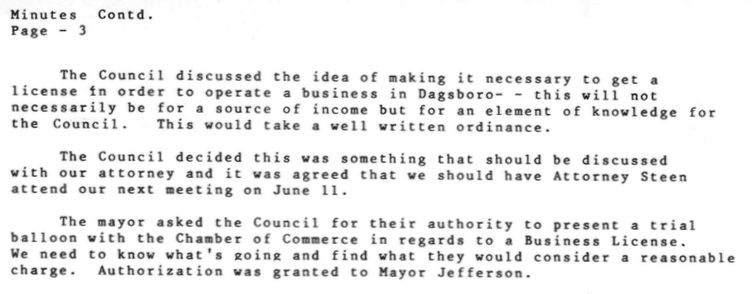
On May 14, 1990, the Town Council of Dagsboro Delaware considered the topic of business licensure in a way James Scott would find familiar:
I am not how the conversation with the Chamber of Commerce went, with regard to this new effort to make business legible to the town government. I’m curious how Mayor Otis Jefferson pitched it to a group of businessmen generally unwilling to let the state in, even as they constantly sought to use the state for their own ends (including profit).
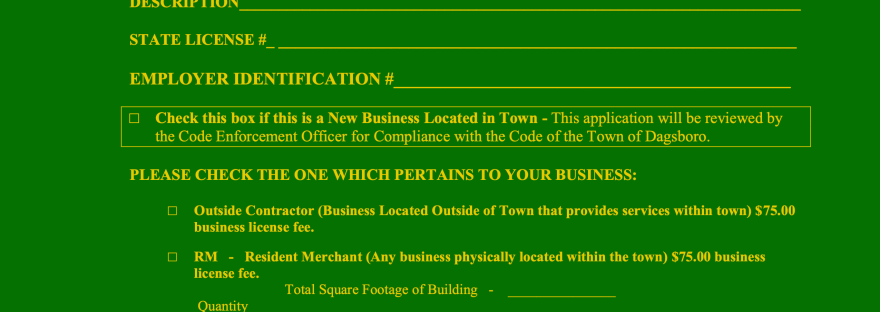
But something must have gone forward from 1990, because Dagsboro now not only allows businesses to vote – it requires them to be licensed.
Source: “Minutes, May 14, 1990” in Minutes of the Dagsboro Town Council, 1941-1993, Delaware Public Archives, RG 7040-000-001, roll 2
Or, An Investigation Into Just How Deep Delaware’s Commitment to the Bit Goes
Corporate Voters Project – Research Note #1
In Delaware, corporations can vote. So can LLCs, partnerships, and trusts, provided they own real property within the municipality where the election is taking place. In “The Company State,” capital not only has a voice – it has the franchise.
So just as I became a new, working citizen of Delaware, I discovered that my rights paled next to the those enjoyed by old, rentier capital.
Though the election raised many questions – as well as my blood pressure – in the busy season of a new semester on an unfamiliar campus, I let it lie as an oddity. In the wake of that bond election, there was enough concern expressed by other locals that the City Council petitioned the state legislature to revise its charter, to limit the franchise to human residents and human non-resident property owners “in accordance with the principle of ‘one person, one vote.’” The charter was successfully amended in 2019. [1]
But “dead labour” in the form of company capital, wasn’t done enlivening Delaware’s politics. In late spring 2023, news broke that the leaders of Seaford, DE had got a charter revision bill of their own introduced. It was the mirror image of Newark’s reform. Seaford wanted to empower a property owner, “whether a natural person or an artificial entity,” to vote in all town elections. (It seems the unpopular town council in Seaford was eager to substitute property for people, as voters). Delaware Republicans, eager to claim fifteen minutes of public infamy for supporting corporations’ right to stuff the ballot, used parliamentary tactics to bring the legislature to a screeching halt until the bill passed in the House. It did – though the measure was later quietly smothered in a Senate committee, and never became law. [2]
Needled twice by the news, my interest – and my ire – was piqued. And if that’s not a reason for research, what is?
~*~
If there was anywhere in the United States you might expect to find a corporation voting, Delaware is it. A state that only recently reached the milestone of one million human residents, the self-proclaimed “Corporate Capital of the World” is home to over two million business entities, including two-thirds of the Fortune 500.
Corporations and LLCs don’t come here for the beaches, though. They sink shallow roots into our clayey soils because the state government offers a uniquely “business-friendly” regime. In return for filing a simple registration form and paying some light taxes and fees, DE state officials ask few questions, and impose fewer regulations. When conflicts between companies arise, as they tend to in the hurly-burly world of modern business, Delaware’s uniquely commercially-oriented Court of Chancery offers speedy, jury-free resolutions. And if that service fails to satisfy, well, the Delaware legislature is ready to bend to meet the whims of capital with a flexibility an Olympic gymnast would envy.
While intentionally obscured from ordinary residents, “The Franchise,” so-called, is well understood by CEOs and corporate lawyers, as well as the state’s politicians and their lobbyist handlers. For multinational conglomerates, secretive shell companies, and mom & pop landlords alike, Delaware offers the best deal within U.S. territory for running your business cheaply, opaquely, and just “legally” enough.
This frictionless pliability pays for Delaware’s government. In fiscal year 2023, for example, the various fees and taxes levied on nominally Delaware-domiciled corporations and business entities provided $2.9 billion in revenue – a fairly typical 46.4% of total state collections. Whether clued in or not, all Delawareans are complicit in these arrangements. Their tax burden is low, yet their roads remain well-paved – because the First State has decided to use its sovereign power to charge a light toll in return for displacing the true costs of unchecked capitalism onto the rest of the nation, and the world. [3]
It’s a little gift, from our little state.
~*~
Still, even in Delaware, the idea that a corporation can vote gives people pause. It sure as heck arrested my attention, and puzzled me. So as the furor of the 2023 Seaford bill died down, and with my new hometown’s recent bond vote in mind, I’ve spent the last month or so digging into the practice of corporate voting in Delaware.
I’ve tried to keep my questions simple, obvious, and answerable:
How widespread is corporate voting? Does it only happen in Delaware towns, or beyond?
When did the practice take hold – and under what circumstances? Is corporate voting a relic of the state’s Jim Crow past, or a more recent disease of the body politic?
And finally: why? Of all the ways to arbitrarily pervert the democratic process to favor the wealthy, why have Delawareans chosen this method? And how is the local “corporate franchise” connected to “The Franchise” – if it is at all?
My research plan is similarly straightforward. I’ve completed the first step, a close examination of the current charters of all 57 municipalities incorporated in the state of Delaware.
Some early findings:
70% of DE municipalities (40 towns & cities) allow corporations and other “artificial entities” to vote in at least some circumstances, usually referenda on annexation and/or bonds;
Three towns (Dagsboro, Fenwick Island, and Henlopen Acres) allow corporate voting in all circumstances
The local corporate franchise is premised on property ownership: the “entity” must own real property within municipal limits (or proposed municipal limits, for annexations); and generally companies exercise their voting rights through a representative with power of attorney;
Most towns that allow corporate voting limit it using a “one person / one entity” rule – but not all of them do;
There is also a pronounced geography to corporate voting rights in Delaware: it gets more common as you travel south. New Castle County only counts 3 municipalities that allow it; Kent Co. has 16; and Sussex Co., land of beaches, chicken farms, and confederate monuments, has a whopping 21.
Since it quickly became apparent to me reading charters that property ownership is critical to local corporate voting rights, I also tallied how many Delaware towns enfranchise non-resident property owners, and found that:
81% of DE municipalities (46 towns & cities) allow non-resident real property owners to vote in at least some circumstances (again, most commonly annexation and bond elections);
However, fully 23% of them (13 towns & cities) allow non-residents to vote in all elections – and some even allow people who don’t reside within the municipality to govern, as members of the town council!
As with corporate voting, the enfranchisement of non-resident property owners is more common in Sussex (24 towns), than it is in Kent Co. (17 towns), with New Castle coming last in the number of municipalities that allow it (just 5 towns).
Now that I’ve gotten a sense of the current landscape of corporate and property-defined voting, my next task is to dig into the history of a handful of municipalities, using newspapers and legislative archives, to see if I can find out when – and perhaps why – this corporate citizenship first appeared.
I have no doubt but that further unpleasant surprises await; but that’s history, in Delaware.
[2] HS 1 for HB 121: “An Act to Amend the Charter of the City of Seaford Relating to the City’s Ability to Authorize Artificial Entities, Limited Liability Corporations’ Partnerships and Trusts to Vote in Municipal Elections Held in Seaford,” (April 20, 2023), https://legis.delaware.gov/BillDetail?LegislationId=130205.
In my calculation of the revenues generated by “The Franchise,” I include the corporate income tax, the franchise tax, the LLC/LP tax, business entity fees, “unclaimed property” (aka escheatment, aka Delaware skimming off of unused gift cards), and the bank franchise tax.


 Dael A. Norwood