Or, Some Early Investigations into the History of Delaware’s Revenues, with Particular Attention to Corporate Franchise Fees
Value of the Franchise – Research Note #1
Today, many Delawareans (and esp. state politicians) consider maintaining the state’s dominance in corporate registrations to be one government’s most urgent tasks. Having an outsized number of outside companies domiciled in the First State supplies a hefty portion of state revenues – $1.3 billion in franchise fees alone in 2025, nearly 20% of total revenues for that year.
Delaware’s dependency on outside businesses for government funding makes the state unique – and perhaps uniquely corrupt, too – but the situation also raises some urgent historical questions. Namely: how long has this been going on?
To hear Delaware’s current judicial, legislative, and executive officials tell it, Delaware’s current situation is of ancient standing, defining its political economy since at least 1911, when New Jersey supposedly “lost” the registration game, or perhaps even 1899, when Delaware changed its corporate law to attract more fee-paying registrants.
But I’m a historian; a lot of water has passed under the bridge in 127 years, particularly when it comes to how American states organize and pay for themselves. Is the common wisdom of Delaware today true? Has the Small Wonder really had its political economy stuck in amber for more than a century?
To find out, I went looking for data that could help put Delaware’s current, desperate efforts to maintain it’s corporate franchise in context. And I found some!1 And now I’ve got information on Delaware state revenues, 1880-2024, from two series (see note on sources, below, for details).
What follows is a first pass look on patterns that jump out, illustrated with some ugly graphs (because I don’t know yet how to make nice ones).
~~~
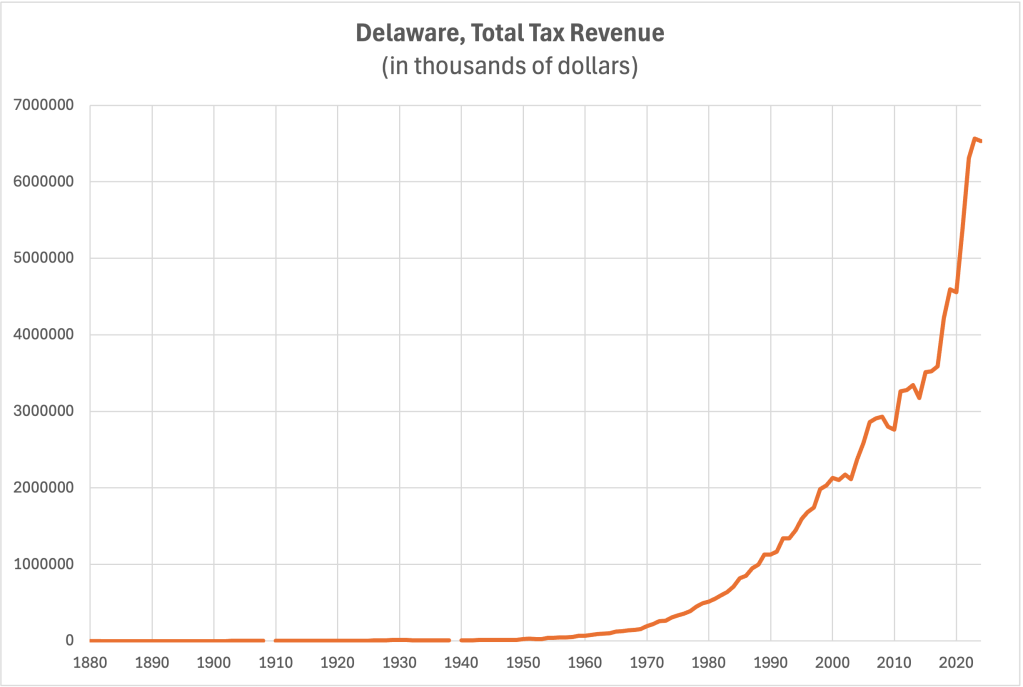
First: the fiscal resources captured by Delaware’s state government through taxation have dramatically increased since WWII, with an especially steep rise since the turn of the 21st century. This graph illustrates some of that change.
Graph 1: Delaware, Total Tax Revenue (in thousands of $)
Source: Annual Report of the Delaware State Tax Commissioner (1950), pp. 18-19; US Census Bureau, Annual Survey of State Government Tax Collections (STC)
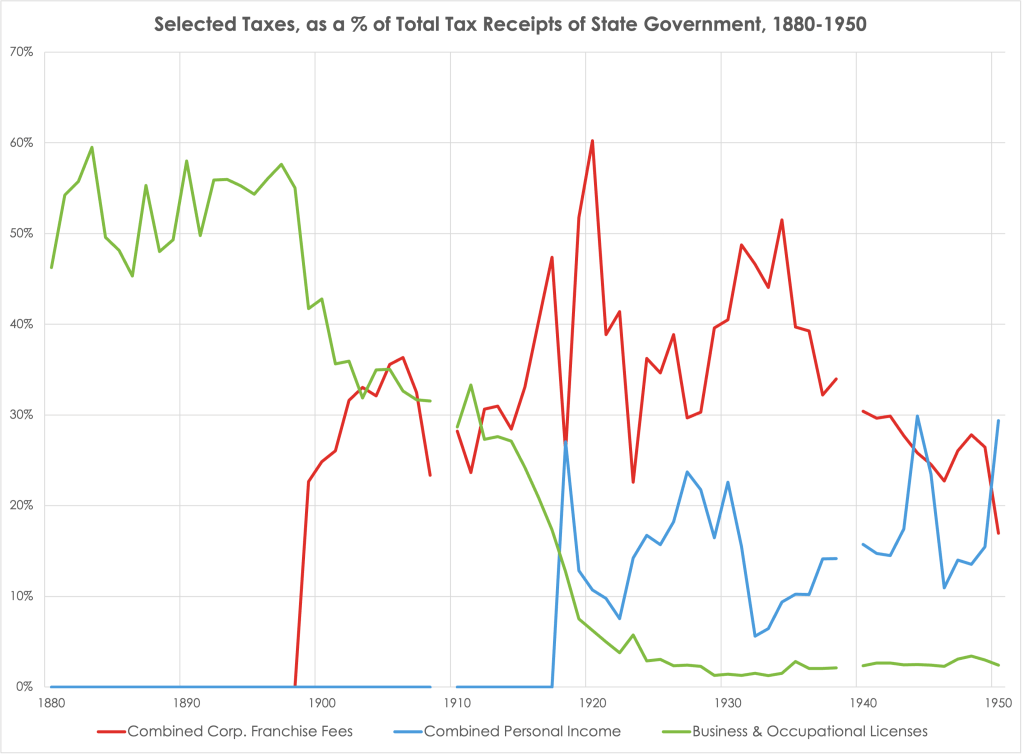
Second: Delaware’s revenue mix changed dramatically in the 1910s. Prior to WWI, the state’s overall revenues were quite small, and business and occupational license fees accounted for a clear majority of them (that is: things like barber’s licenses). The introduction of corporate franchise fees in 1899 changed that – but only after war kicked off in Europe did the franchise start kicking in more than official permissions to give haircuts. These growing franchise revenues were additive: other revenue sources did not disappear, but instead combined to grow the entire pie – which rose still higher starting in 1919 with the introduction of personal income taxes and hikes in the inheritance tax.
Graph 2: Selected Receipts of State Government from Taxes, 1880-1950
Source: Annual Report of the Delaware State Tax Commissioner (1950), pp. 18-19;
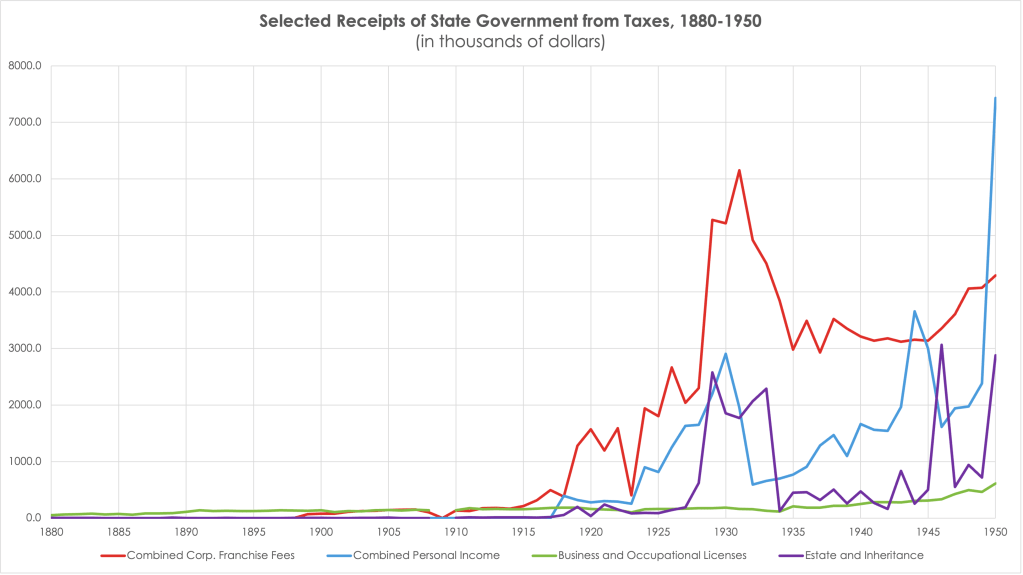
The 1940s, and WWII, marked another turning point: franchise revenues decline, in terms of overall dollars, and as a share of total revenues.
Graph 3: Selected Taxes, as a % of Total Tax Receipts of State Government, 1880-1950
Source: Annual Report of the Delaware State Tax Commissioner (1950), pp. 18-19;
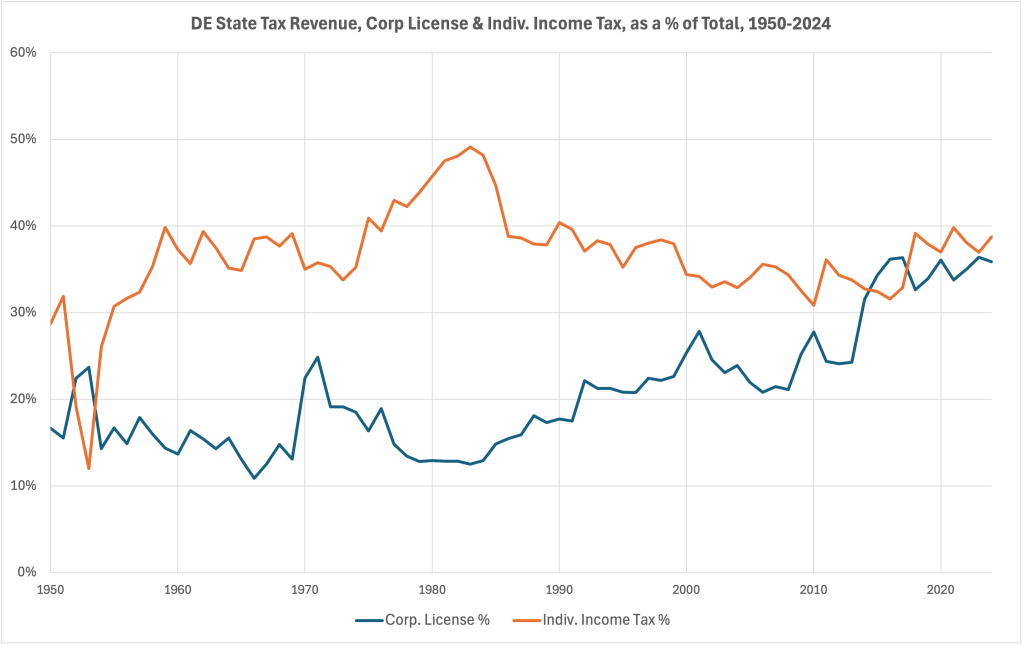
Third: Postwar, individual income tax revenues routinely outpaced the total dollar contributions of the corporate franchise and its percentage of total revenues. That’s the “normal” of modern Delaware: for 70 out of 75 years covered by this data (1950-2024), income taxes contribute more to state revenues than the corporate franchise – and usually 2-3X more.
Graph 4: DE State Tax Revenue Contributions, Corp. Licenses & Indiv. Income Tax, 1950-2024
Source: US Census Bureau, Annual Survey of State Government Tax Collections (STC)
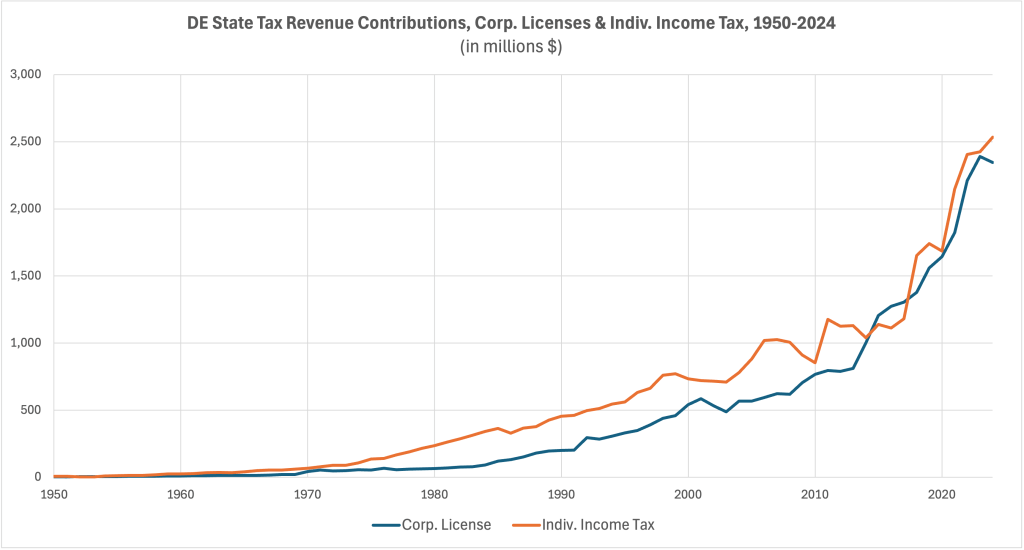
That gap is large in the immediate postwar decades, but starts to narrow steadily in the 1990s – and 2015, the corporate franchise’s contributions briefly outpace individual income taxes again. The current status quo, where the franchise is as important, or nearly so, as personal income taxes dates from the post-2008 crisis era, aka the Markell administration
Graph 5: DE State Tax Revenue, Corp License & Indiv. Income Tax, as a % of Total, 1950-2024
Source: US Census Bureau, Annual Survey of State Government Tax Collections (STC)
~~~
So how long has the State of Delaware been dependent on the corporate franchise? It depends. The franchise has contributed substantively to state revenues since its inception, and, at times, provided the a clear majority of fiscal resources. Too, the growth of the corporate franchise tracks closely with the expansion of the state government of Delaware – insofar as our little backward province has a modern fiscal apparatus, it’s origins and development are coincident with the franchise.
But! The current status quo, where corporate franchise fees account for a third of total tax receipts is a relatively new circumstance. That is: the state’s deep dependency on oligarchs’ whims is younger than Zoom, more recent than the MCU – more youthful, even, than my undergraduate students. Which suggests that it’s something that could be unwound, or at least altered – if Delaware politicians wanted to expose themselves, and residents of the state, to less extreme exploitation from the richest of the rich.
——
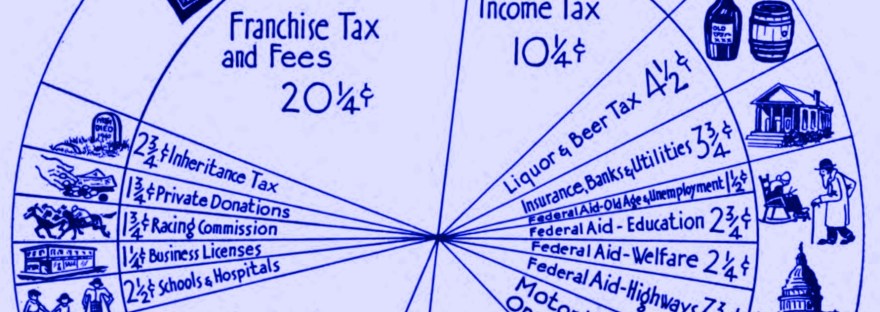
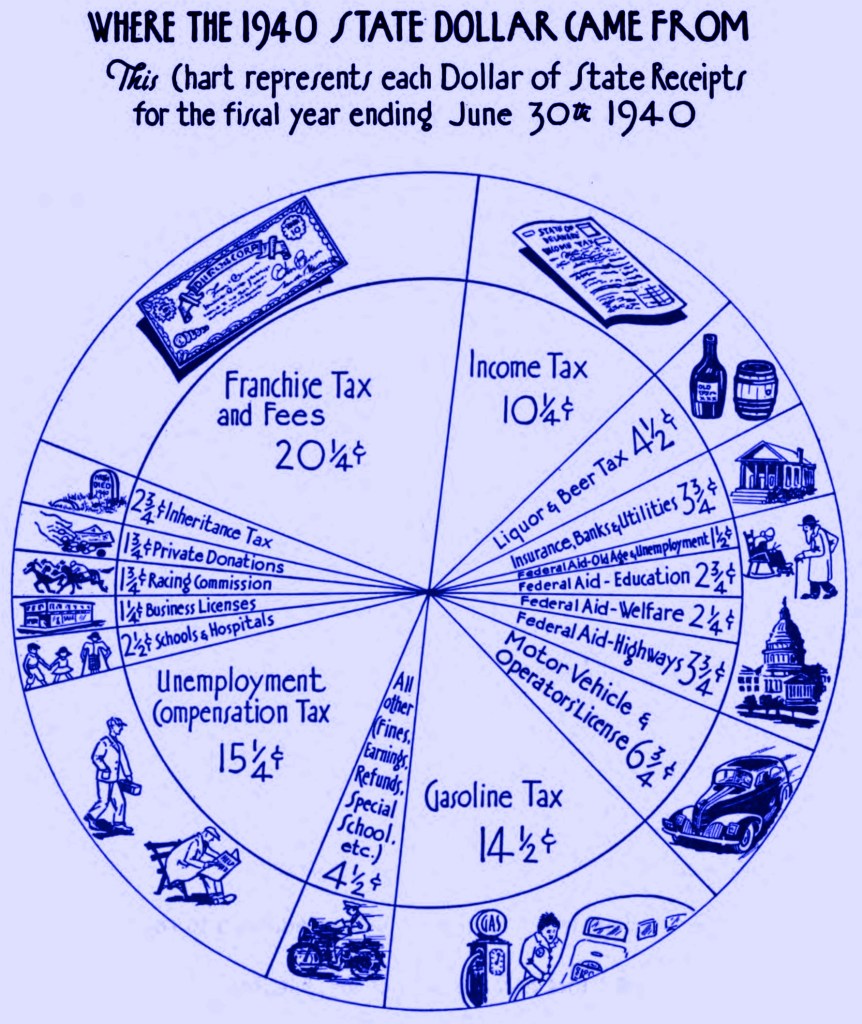
Header image source:“State of Delaware: Where the 1940 State Dollar Came From,” Annual Report of the Delaware State Tax Commissioner, 1939-1940 (Dover, DE), p. 26.
A Note on Sources:
I drew on two sets of sources to compile a dataset on Delaware state revenues from 1880-2024.
1) Annual Report of the Delaware State Tax Commissioner, (Dover, DE), https://catalog.hathitrust.org/Record/000061018.
These printed reports are idiosyncratic: their contents depend, in large part, on the whims of the State Tax Commissioner. I drew from two specific reports that featured an especially detailed series of historical data on tax receipts, 1880-1950: 1930-940, pp. 34-35 and 1950, pp. 18-19. While later reports are extant – even digitized through to 1970 – they tend to report annual data only, and not longer historical series.
2) US Census Bureau, Annual Survey of State Government Tax Collections (STC), https://www.census.gov/programs-surveys/stc.html.
Though it draws on state officials for data, the Census Bureau organized that data slightly differently, using standard categories rather than state-specific terms. (What in the Delaware State Tax Commissioner’s hands is often denoted as “Corporate Franchise” revenues are in the STC described as “Corporate Licenses.”) Though the STC includes a few scattered datapoints for the 1940s, the records run in series only from 1950 to 2024.
Neither of these series provided data on other state revenues that derive from corporate registrations, like escheatment; that’s a significant blind spot, as some of these have paid out hundreds of millions into the state treasury in recent years.
There are other data available, but I have not found any sources offering the historical detail I need. For example, Delaware OpenData, the state’s “open data portal,” offers Revenue by Fiscal Year and Fund, https://data.delaware.gov/Government-and-Finance/Revenue-by-Fiscal-Year-and-Fund/p8jh-4xxn .
While this dataset is extremely detailed, and includes many different details on the specific funds revenues feed into, as well as categories, divisions, and departments, it goes back only to 2017 – a few years after one of the major shifts in the importance of the franchise to state revenues, overall.
—
- Well, eventually I did, in print sources and online datasets. That was after I visited the Delaware Public Archives to try and locate historical tax records – an effort proved to be a waste of time because the State of Delaware does an awful job when it comes to recording and archiving its past revenues, either in their original format or even the annual aggregate reports. (When it comes to government reports, most executive department records are organized by Governor, and held in that officials’ personal papers – and mixed together willy-nilly with all kinds of other material, like dinner invitations, like the state is some kind of medieval kingdom.) It may be these records exist in more or discoverable or usable form, but I’ll be damned if I could figure out where they are. ↩︎
 Dael A. Norwood