Uncategorized

Bloggitty blog blog blog

Or, My Navel is Quite Interesting, Thank You

navel_orange

As far as solipsistic synopses of premature punditry go, this, by Scott Rosenberg (author of Say Everything: How Blogging Began, What It’s Becoming, and Why It Matters) is pretty damn sharp. (h/t)

It starts off with some throat-clearing repetition of conventional wisdom about technological history (of fairly recent vintage, incidentally), which initially made me a bit doubtful (which isn’t to say I disagree, precisely; it’s just history and its interpretation are a bit…elastic), but then quickly starts flinging the analytic insights fast and furious.

For example:

A blog lets you define yourself, whereas on a social network you are more likely to be defined by others. Sure, blog readers can write comments — but the blogger can delete the comments, or disemvowel them, or turn them off entirely. Sure, a blog is dependent on the links you point outward and those that others point in; but it has its own independent existence in a way that no amount of messaging and chat and interaction on a social networking site can match.

and

A blog lets you raise your voice without asking anyone’s permission, and no one is in a position to tell you to shut up. It is, as the journalism scholar Jay Rosen puts it, “a little First Amendment machine,” an engine of free speech operating powerfully at a fulcrum-point between individual autonomy and the pressures of the group.

and

Blogging uniquely straddles the acts of writing and reading; it can be private and public, solitary and gregarious, in ratios that each practitioner sets for himself. … Nothing else so richly combines the invitation to speak your mind with the opportunity to mix it up with other minds.

Now, if I were a history blogger truly worthy of being listed on the Cliopatria blogroll, I’d follow this with some kind of comparison to how people thought about the invention of the rotary printing press or the clipper ship or political parties some such thing…but I have quasi-valid philosophical objections (see above, re: history of technological progress) and besides, it’s late and I am tired, so no go. Have an orange instead, they’re cheap.


Image cite:Robert S. Donovan, “navel oranges 99¢ LB,” Flickr, CC License

Uncategorized

A Plethoric Cyclopedia of Links

Or, Why Not Blog and Be Sick at the Same Time

Everyone_loves_kites

Your devoted correspondent has of late been sidetracked by a nasty bout of bilious fever (never eat a salad at Chipotle!), preventing trips to both the Archives and the Intertubes. However, because I do not wish you, my kind and gentle readers, to be deprived of my avatarial presence for too long, please enjoy the following random links in lieu of more developed musings:

  • Sterling Fluharty, at Cliopatria, asked a really good question the other day: “Who Reads History Books?” His proposed method of finding out, using Amazon and a method poached from social scientists, strikes me as a good start. Anyone with the expertise that could help a fellow historian? Also, his post reminds me of how terrible the commenting mechanism over at Cliopatria is (so terrible). MoveableType anyone? WordPress? please? Goodness.
  • If you love Kate Beaton (and I know you do), allow me to recommend the lovely work of Sydney Padua who’s in the midst of doing a great alt-history series on Ada Lovelace and Charles Babbage.The comics are longer-form, and the drawing a bit more detailed, and so actually a bit more in the style of someone like Dylan Meconis more than Beaton; but in any case, who can resist a story that name checks Martin Van Buren, the panic of 1837, and the Duke of Wellington and his horse? Not I; and neither you. You may want to start with the origin story. (h/t)
  • Sean Safford has a fascinating post, over at OrgTheory, about the possible consequences of Penske’s purchase of Saturn. Safford argues that the shift that Penske could be initiating is from a “producer-driven” commodity chain to a “buyer-driven” one — basically shifting the auto industry into the same sort of model that governs most other industries now (think: computers, sneakers, etc). This is the clearest statement about this deal that I’ve heard, and should be of interest to all students of American capitalism (of which this blog hopes/purports to be, in part). It might mean that the M-form corporation is finally, and completely, dead. That could have consequences…
  • This is a bit of old(ish) news, but Caleb Crain, Lingua Franca alum, generally great reviewer and correspondent of many a tony publication, and proprietor of the excellent blog Steamboats are Ruining Everything, has recently (self) published a dead-tree version of his best posts, titled The Wreck of the Henry Clay. He also had an interesting talk about the process of turning a blog into a book over at the New Yorker. The book is on my to-read list, and I’ll let you know how it goes.
  • Finally, on a note that at least touches on the steampunk vibe that partly animates this establishment: there is robot unemployment in Japan.

Image cite: Balakov, “Everyone loves kites,” Flickr, CC License

History and Historians, Our Glorious National Heritage, Uncategorized

Searching for Sustainable Sovereignty

Or, The Axes of Ideology Don’t Just Split Hairs

Chopping

Sean Safford, one of the OrgHeads, has just put up a very astute post about movements in contemporary U.S. political ideology. Essentially, he thinks that the ideological axis in the U.S. has shifted away from an emphasis on “fairness” vs. “conservation” — CEO pay is far too high! 40 million are uninsured! v. the market works great! If it [institutions] ain’t broke don’t fix it!– to an emphasis on “sustainability.”

Here’s his description of the “sustainability” argument:

The argument goes something like this: We live in a highly interconnected society which operates within a series of interconnected systems. Resources (physical, material, social, and political) are not only scarce, they are extinguishable. The system is in place, not so much to keep social order, but to ensure the reproduction of the resources needed to reproduce society over time. Undermining any of the systems on which society depends threatens to have ripple effects on others. But importantly, the biggest threat to the system comes not from external threats, but from individuals acting in their own self interest in ways that could undermine the delicate balance on which interdependencies of the system depends. Government action is needed, not to ensure fairness, but in order to save us from ourselves.

Continue reading “Searching for Sustainable Sovereignty”

Uncategorized

Only with Twelve Men, On the Outside of the Wall

Or, Now That’s some doux commerce

Those that know me IRL know that there’s no…way…I… could… resist. Sorry, sober scholarship will return tomorrow.

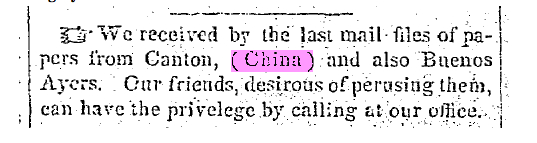
Our young readers may not feel much interest in ordinary wars, at best they are infringements of the laws of God and humanity; but a war with the empire of China, with whose inhabitants no intercourse has been allowed for centuries, except on the outside of the walls of the single city of Canton with only twelve men called Hong merchants, is a war of considerable novelty.

~”About the British Taking Chusan,” Parley’s Magazine (New York) January 1841, v9, p.64

Uh, that’s what she said?

This makes a bit more sense (or less?) if you know that Parley’s was a family magazine? And double entendres were still in beta, in France.