Uncategorized

A waste, really

Or, Won’t Anyone Please Think of the commodities!

Waste_orange

So today, in my endless backpacking through the archives of early Sino-American relations, I ran across this passage in a despatch from the U.S. diplomatic representative to China, the notoriously obstreperous Humphrey Marshall:

When I look upon this noble country and especially upon its magnificent inland water communications, its broad valleys, and the vast productive capacity of its fertile plains, I can but deplore the woeful, criminal mismanagement, by a feeble despotism, of its abundant resources. I am convinced that there never has been in the history of Mankind a worse government than that which for some years past has afflicted China. It is without strength, spirit, or capacity – too vain to learn wisdom – too ignorant to behold its own gross want of intelligence. It sits, an incubus on the spirit and upon the prosperity of the people. But, really I see very little to prefer in those who essay its overthrow. It would be very important to the United States, indeed to the world, could western powers unite in sending their diplomatists to Peking, or to Nanking and so, by a timely interference, put an end to this internal strife which promises nothing half so much as the utter paralysis of trade for years to come. [emph added]

~Humphrey Marshall, U.S. Commissioner to China, to the William L. Marcy, Secretary of State, 21 June 1853

This is a fairly standard-for-the-time diatribe from a Westerner about China, and certainly one that is repeated often in the State Department’s China mission archives. Typical, too, in its callousness. And finally, it reiterates the themes so prominent in that American genre of justification for conquests, a popular series that had recently reached new heights (see: Invasión Estadounidense de México, 1846-1848).

(Oh, and Marshall’s comment about “those who essay its overthrow” is a reference to the recently begun Taiping rebellion, headquartered at Nanking (Nanjing). He feels it necessary to indicate that the rebels are not the lesser evil because many Western missionaries in China – especially Americans – at this point regarded the Christian-influenced mysticism of the Taiping as an indication that Christianity was finally sweeping China, and that their work had not, in fact, been for naught.)

Thus, the passage is in some (okay, many) ways unremarkable. But what I find interesting about it is how Marshall – a Kentucky Whig and staunch supporter of the plantation system in the U.S. – was able to shift the physiocratic “producer” rhetoric ( “broad valleys … and … fertile plains” ) in the service of a very different, if no less exploitative, kind of imperial conquest: one that focused on commerce.

That may not seem all that remarkable (and perhaps it isn’t — one needs markets to export the products of a plantation system, after all), but it nonetheless strikes my ear as profoundly unusual for a politician from anywhere but New York or Boston (and perhaps Philadelphia) to be expressing this kind of focus on cooperative international action in pursuit of commercial empire. Marshall’s other despatches indicate that he was a man profoundly concerned — at least while minister to China — with furthering American commerce all over the world, by force, if necessary.

(He was, in fact, continually asking Washington for a fleet of armed steamboats under his direct command, with which to patrol Chinese waters for pirates, and to threaten Qing officials. Commodore Perry had taken all the good ships to bully Japan with, you see.)

Incidentally, though the “internal strife” Marshall mentions — the Taiping Rebellion – did impede trade somewhat, it also claimed the lives of some 20 to 30 million people over the next ten years, making it by far the deadliest civil war in the nineteenth century, and perhaps ever (ours “only” killed around 620,000 and we’re still talking about it). This in a conflict largely, though not exclusively, fought using small arms. The rest of the world had to wait until the mid-twentieth century (WWII: 40-72 million) to surpass such a ghoulish mark, and then we had lots more toys to play with.

But yes, trade was impacted.


Image cite: Schilling 2, “What a waste, and so sweet,” Flickr, CC License
Uncategorized

Wars and Reminiscences of Wars

William Gladstone, on the (First) Opium war:

I am not competent to judge how long this war may last, nor how protracted may be its operations but this I can say, that a war more unjust in origin, a war more calculated in its progress to cover the country with disgrace, I do not know and have not read of.

~as quoted in John Morley, The Life of William Ewart Gladstone (1911), 226.

Ulysees S. Grant, on the Mexican War:

… one of the most unjust ever waged by a stronger nation against a weaker nation. It was an instance of a republic following the bad example of European monarchies, in not considering justice in their desire to acquire additional territory.

~Ulysses S. Grant, Personal memoirs of U. S. Grant (1895), I:32

The irony (unsurprising reality?) here is that plenty of commentators in the U.S. decried the Opium war — in precisely Gladstone’s terms — but many of those same voices were raised just a few years later to call for Mexican territory and blood.

It occurs to me that unjust wars are all alike, yet still each unjust in its own way (cf. Tolstoy, families).

Uncategorized

Kickass Whig Letterhead

Or, Goodness that looks expensive and full of republican virtue

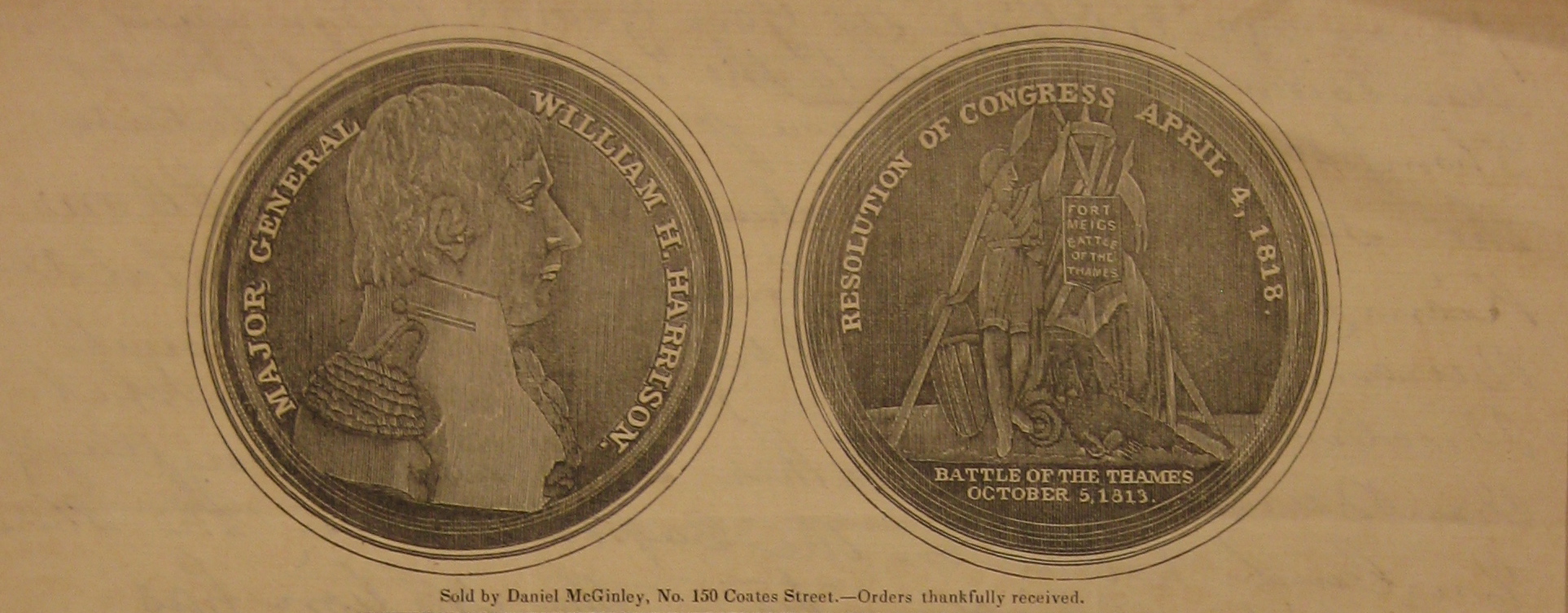
So, in digging through various (endless) letters about the election of 1840, I’ve come across a couple of examples of extreme dedication to the Whig cause: William Henry Harrison letterhead.

Here’s one of a coin apparently minted in Harrison’s honor (click to embiggen):

WHH_small1

Here’s one with WHH in profile, with a vignette at his famous log cabin, complete with hard cider (click to embiggen):

WHH_small2

How’s that for showing your dedication to the cause, eh? Buying reams of stuff stamped with ‘Ole Tip’s noble schnoz?

Sad thing is, these guys were probably stuck with it well after WHH’s untimely demise. Hopefully they had the tact not to use it …

I don’t know if the Democrats had similar stuff, though I’d expect so (but with, y’know, the Little Magician on it).

Uncategorized

Bloggitty blog blog blog

Or, My Navel is Quite Interesting, Thank You

navel_orange

As far as solipsistic synopses of premature punditry go, this, by Scott Rosenberg (author of Say Everything: How Blogging Began, What It’s Becoming, and Why It Matters) is pretty damn sharp. (h/t)

It starts off with some throat-clearing repetition of conventional wisdom about technological history (of fairly recent vintage, incidentally), which initially made me a bit doubtful (which isn’t to say I disagree, precisely; it’s just history and its interpretation are a bit…elastic), but then quickly starts flinging the analytic insights fast and furious.

For example:

A blog lets you define yourself, whereas on a social network you are more likely to be defined by others. Sure, blog readers can write comments — but the blogger can delete the comments, or disemvowel them, or turn them off entirely. Sure, a blog is dependent on the links you point outward and those that others point in; but it has its own independent existence in a way that no amount of messaging and chat and interaction on a social networking site can match.

and

A blog lets you raise your voice without asking anyone’s permission, and no one is in a position to tell you to shut up. It is, as the journalism scholar Jay Rosen puts it, “a little First Amendment machine,” an engine of free speech operating powerfully at a fulcrum-point between individual autonomy and the pressures of the group.

and

Blogging uniquely straddles the acts of writing and reading; it can be private and public, solitary and gregarious, in ratios that each practitioner sets for himself. … Nothing else so richly combines the invitation to speak your mind with the opportunity to mix it up with other minds.

Now, if I were a history blogger truly worthy of being listed on the Cliopatria blogroll, I’d follow this with some kind of comparison to how people thought about the invention of the rotary printing press or the clipper ship or political parties some such thing…but I have quasi-valid philosophical objections (see above, re: history of technological progress) and besides, it’s late and I am tired, so no go. Have an orange instead, they’re cheap.


Image cite:Robert S. Donovan, “navel oranges 99¢ LB,” Flickr, CC License