Stock certificate, 30 shares @ $50 par, Kennebec Ice and Coal Company, January 26, 1884, Artisans' Savings Bank of Wilmington, Delaware records, 1861-1960 (1099), Box 164, Item 31, Hagley Library & Museum (Wilmington, DE).
Uncategorized

History Never Repeats Itself But …[sigh]… It Rhymes 

Or, Delaware Stands Ready To Perpetrate Any Sort of Corporate Enormity (Again)
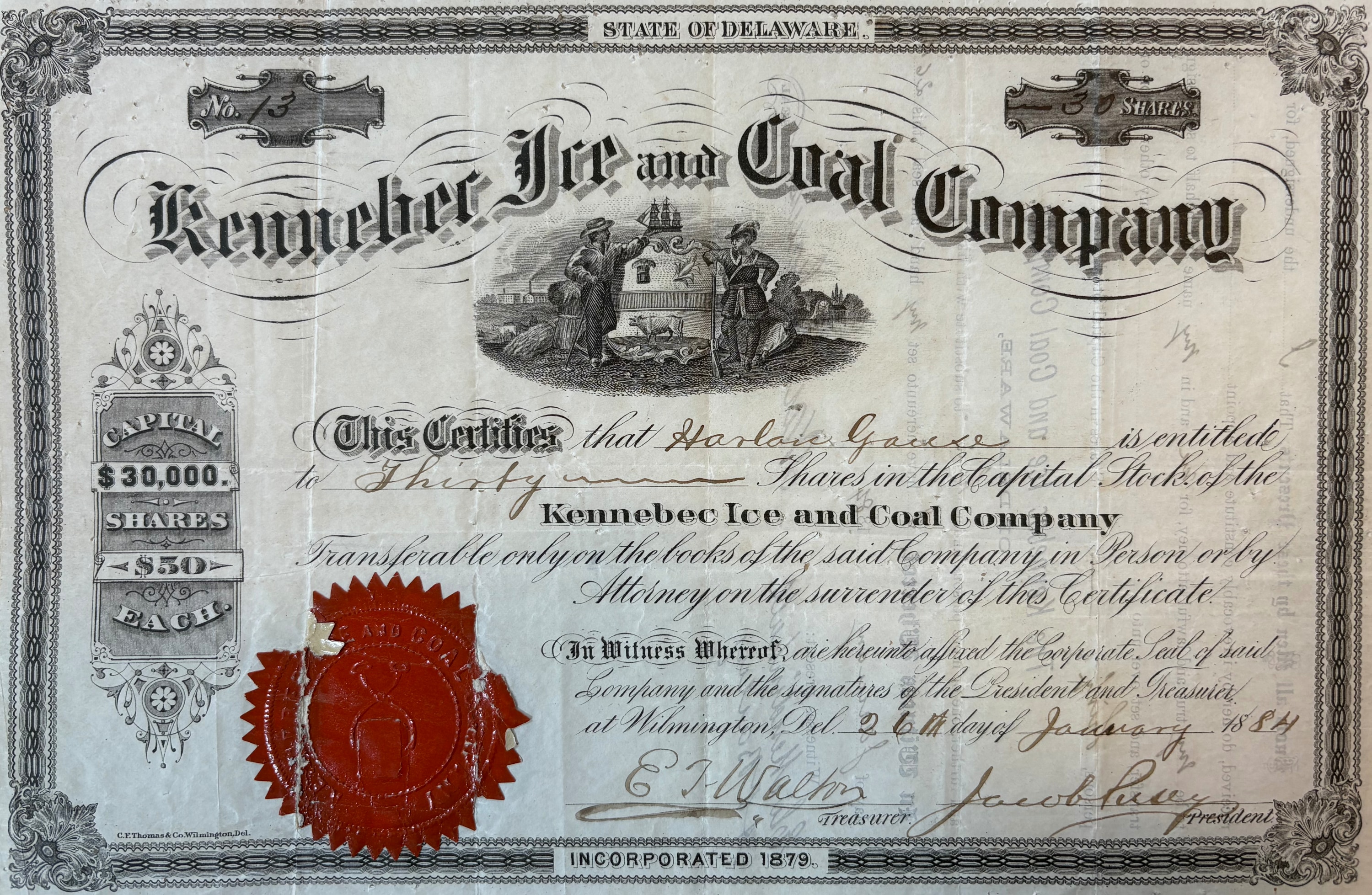
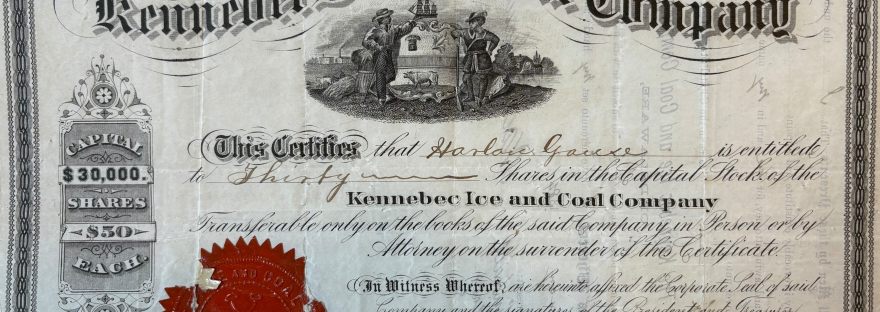
Stock certificate, 30 shares @ $50 par, Kennebec Ice and Coal Company, January 26, 1884, Artisans' Savings Bank of Wilmington, Delaware records, 1861-1960 (1099), Box 164, Item 31, Hagley Library & Museum (Wilmington, DE).
Stock certificate, 30 shares @ $50 par, Kennebec Ice and Coal Company, January 26, 1884, Artisans’ Savings Bank of Wilmington, Delaware records, 1861-1960 (1099), Box 164, Item 31, Hagley Library & Museum (Wilmington, DE).

Mark Twain never said that “history never repeats itself, but it rhymes.”(1) But if he had taken time out to consider the past, present, and future of corporate corruption, with particular attention to the the diminution of shareholder rights, I put it to you, dear reader – he might’ve done.*

The author of the Gilded Age came to mind recently when I ran across more evidence that our simulation is caught in a loop, repeating the obvious mistakes of the past, again. William Z. Ripley (believe it or not) was who caught my attention. 

In the mid-1920s, Ripley, an Ivy League social scientist and popular Progressive railroad reformer, took aim at corporate governance; or rather, the startling lack thereof. In a series of Atlantic articles and then in a 1927 book, Ripley catalogued the recent legal and financial innovations that had put “Main Street” at the mercy of “Wall Street” in new and destructive ways.(2) Though he claimed to not be any kind of muckraker (or, horrors, a socialist), Ripley still wanted to get down to the “root of things” – to diagnose how “property” and been “allowed to degenerate into an instrument of oppression” in America.(3)

Delaware, in part, was to blame. (But you knew that already.)

For Ripley, private property turned into a tool of tyranny when corporations severed ownership from control. Ripley argued that this wicked wound had first been cut by the proliferation of corporations across all lines of business – a tendency, he noted, that was peculiarly well advanced in the US, but not in Europe. That laceration was deepened by the widespread practice of watering-down corporate shareholder rights. He was particularly disturbed by two phenomena: the advent of “no-par” stock issuances, and the rise of non-voting tiers of stock. 

Of the two, no-par stock bothered him more. Prior to its invention, corporations assigned each unit of stock a face-value, and printed that value (say $50) on the certificate; that amount was “par.” The buyer and holder would then know they had contributed $50 to the capital of the Kennebec Ice and Coal Company, Inc. – say – and that that amount was their claim on a particular percentage of the firm’s equity; secondary traders would also have a clear sense of how the current price of the stock compared to its initial value. If a corporation later decided to accumulate more capital by selling additional equity, common law practice before the late nineteenth century made it unlawful to offer new shares at less than the original par value – and existing shareholders had a preferred right to buy in to the new issuance, and thus keep the size of their stake equal with other shareholders. 

The advent of no-par stock changed all that. In practice, no-par stock issuances meant “much below par” and sometimes “zero cost.” And for Ripley, they destroyed the moral relationship between investors and the corporation. He decried them as an “egregious malversation of the rights of shareholders and of the public generally” because they allowed companies to dilute stock, effectively robbing earlier investors of value and future buyers of much-needed information. They could also inflate the control of well-positioned insiders, like members of the board of directors, who could load up on new no-par shares to acquire more dominant voting rights.(4)

For similar reasons, Ripley opposed the proliferation of corporations issuing non-voting stock. Rooted in the deep Anglo-American legal tradition, he considered corporations to be voluntary commonwealths, premised, like all republican polities, on equality among members to function (municipalities are also a form of corporation, one might here recall…). Tiered stock structures separated equity into classes with different voting rights – building in inequality. A corporation might issue 100,000 shares, divided between 1,000 Class A shares, with rights to vote for the board of directors, and the remaining 99,000 as non-voting Class B shares – securities with no controlling powers, just vague claims to a portion (“aliquot”) of the corporation’s wealth.  

Ripley thought both methods were perversions of the “essence of corporate democracy” – the premise that “all members of the company shall stand upon an even footing with one another.”(5) This posed a problem for corporate investors, internally – an inside group had means to gain control without matching their stake, and therefore the means to steal from other stockholders, by arranging sweetheart contracts for themselves, or simply by voting special dividends. It also posed a dilemma for society, at large, because in combination with holding companies and trusts, it accelerated the dispersal of responsibility for corporate actions beyond any readily identifiable individuals – common stock holders didn’t have any say on corporate decisions! –while, paradoxically, concentrating control of corporate wealth into an ever-smaller number of hands (again via holding companies). In a moment where corporations had become not just one form of economic entity among many, but the default choice for *any* and *every* form of business, Ripley saw an invitation for un-remediable theft and fraud – and documented dozens and dozens of actual instances of it. 

And wouldn’t you know it, Delaware shows up as one of the authors of this disaster! Ripley traces the spread of these terrible innovations to competition between states for “chartermongering.” The race-to-the-bottom between sovereign states for charter revenue opened the door for ever-looser laws, making insider dealing between directors and controlling stockholders not only legal, but a core business strategy for modern corporations. “The little state of Delaware has always been forward in this chartermongering business,” he noted – and led in this laxity, too. (Though unlike many later Delaware lawyers and state officials, Ripley in 1927 doesn’t credit Delaware with dominating the chartermongering business; the First State is one of several mean jurisdictions, like Maine, Arizona, and New Jersey, making life worse for all Americans).(6)

Ripley is worth quoting at length about how this corrupt legislative process proceeds, partly because he really decides to go for the gusto in his language: 

“But it is the evidence of an unholy alliance between private profit and the exercise of this supposedly sovereign function which is at times the most debasing in its influence. The system tends to create a horde of shysters, ready to perpetrate any sort of corporate enormity, provided only that the fees are sufficiently ample. And attorneys, on their part, as one of them writes me, ‘pick their states of incorporation as you or I would pick out a department store at which to trade.’ 

Another shameful angle to this business is that it tends to envelop our state legislative chambers in a noisome atmosphere of political honeyfugling, if not of downright corruption. A minor modification of a state statute may be worth large sums of money, because of its effect either upon plans in contemplation, or else as affording possible relief from the untoward results of acts already committed. And just because these amendments are seemingly so insignificant, they may be slipped through without arousing comment and perhaps almost entirely without notice. The temptation to spend money in what amounts to bribery, in order to attain such results, may upon occasion be very great. Nor need the immediate accountability for such corruption necessarily rest upon the corporations themselves. The system gives rise to a considerable body of irresponsible intermediaries — henchmen, lobbyists if you please — specialists in such branches of the law, hangers on about the state capital. The great corporation merely whispers its need. Subservient agents hasten to bring about the desired result, and perhaps no questions are asked. …”(7)

Now, if “political honeyfugling, if not downright corruption” doesn’t describe the ugly process of passing SB 21 (and its recent predecessor “reforms”), I don’t know what does. 

But beyond the remarkable resemblance between Ripley’s description of how legislative corruption works at the state level – the “henchmen” and other “subservient agents” who rush a bill through are extremely familiar figures in Delaware – the substance of Ripley’s complaints about the evils of insider string-pulling toll quite recognizable tones. He’s lamenting the structural abuse of what today’s corporate legal specialists call “private ordering.” And easing the rules on private ordering for controllers is what current Delaware legislators, and their affiliated henchmen, have been gunning for, over these last few years.

There’s another thread that links Ripley’s century-old critique to today’s miseries. Ripley was an acknowledged influence on Adolf Berle and Gardiner Means, his contemporaries and the major (if constantly misread) theorists of structural problems in corporate governance. Like Berle and Means, Ripley’s concern was about the problem of control in corporations – not the divide between professional managers and stockholders owners, per se, as is usually claimed, but the one between any stakeholders in the control of the business itself.(8) Ripley, like his colleagues Berle and Means, cared about any mechanism that produced a power imbalance between members of a corporation – and in the 1920s, as now, that threat came most clearly from controlling minority shareholders, not the managers they hired. 

Berle and Means are now the more famous writers – but a century ago, Ripley was a much louder and more well-known voice.(9) Over the next decade his profile only grew in prominence, because, among other things, he predicted the Great Depression (which … other famous economists quite infamously did not). Ripley’s concerns with corporate opacity, controlling shareholders, and insider dealing contributed directly to the New Deal reforms that came less than a decade later, after the crash (and specifically the federal Securities Exchange Act of 1934). It’s not a stretch to say that the Ripley’s specific complaints shaped the specifics of financial regulation in the United States,  at least until recently.

Which leads me back to my sense of chronological vertigo.  In the last few years, the Delaware General Assembly has taken a hacksaw to shareholder rights, reversing judicial rulings that had curtailed the amount of insider dealing (“private ordering”) that corporate boards could do. Alongside this strangling of the main venue for private redress of corporate wrongs, federal regulatory agencies, most notably the SEC and CFPB (but increasingly the Federal Reserve, too), have been captured or closed outright – eliminating the public arm of corporate regulation. The nation’s feeble protections against the same corporate fraud and thefts Ripley decried are now dead letters in their state and federal forms – and controlling shareholders are free, once again, from any restraints that bound them from freely picking the pockets of fellow shareholders, and citizens.    

Thus, the unbound and unaccountable corporate immorality that Ripley decried in his own time – the oppressive property of corporate property – is back again, a boot pressing on all of our necks. Which makes it all a bit rich – or perhaps a bit ironic? – that the group of Delaware legal professionals, academics, jurists, and defense attorneys, who are – putatively – among most familiar with Berle and Means (and, thus Ripley, one step removed) should have been the intellectual architects of this repeat disaster.(10) 

One can only hope that long dead Progressives like Ripley retain the capacity to haunt their traitorous professional descendants, even as the rest of us are horrified by the specter of what Delaware has, once again, wrought.

——

A brief note: This is not a William Zebina Ripley fan account. He was one of the most influential writers on modern scientific racism. He came to national prominence first, not for his scholarship on colonial finance, railroad management, or corporate governance, but for his 1899 book, The Races of Europe. Originally developed as a lecture series at Columbia University and at the Lowell Institute, it’s a fantastically stupid piece of work, exemplary of the time, filled with tedious ethnic and racial stereotypes “proven” by tendentious skull measurements. It was, of course, a huge hit with eugenicists, white supremacists, and other evil, awful people, both in the US and abroad – including Madison “Hitler’s My No. 1 Fan” Grant. Ripley’s intellectual legacy has a body count in the hundreds of millions – and one that grows by the day, as his theories persist through the AI-“trained” ideas drug-addled billionaires and quack failsons have used to justify horrific revisions in US federal policy. He’s also from Medford, MA (derogatory)

——

*You’re going to tell me the guy that wrote A Connecticut Yankee in King Arthur’s Court couldn’t time travel? 

1. As far as I know, Twain never used the phrase, exactly – though in his 1873 co-written novel, The Gilded Age, a character quotes a newspaper offering a similar sentiment: 

“History never repeats itself, but the Kaleidoscopic combinations of the pictured present often seem to be constructed out of the broken fragments of antique legends.” 

~Mark Twain and Charles Dudley Warner, The Gilded Age: A Tale of to-Day (American Publishing Company, 1873), p.430.

Quote Investigator finds the closest instance of this phrasing in a poem by John Robert Colombo – in the text, the phrase is attributed to Twain. John Robert Colombo, “A Said Poem,”Neo Poems, p. 46.

2. William Z. Ripley, “From Main Street to Wall Street,”The Atlantic, January 1, 1926; William Z. Ripley, “The Shareholder’s Right to Adequate Information,”The Atlantic, September 1, 1926; and William Z. Ripley, Main Street and Wall Street (Little, Brown, and Company, 1927)

3. “Personal Note,” in William Z. Ripley, Main Street and Wall Street (Little, Brown, and Company, 1927), v.

4. Ripley, Main Street and Wall Street, 46.

5. Ripley, Main Street and Wall Street, 38.

6. Ripley, Main Street and Wall Street, 30.

7. Ripley, Main Street and Wall Street, 35-36

8. As historians Ken Lipartito and Yumiko Morrii note, “[t]he conflict that Berle and Means emphasized was not between managers and owners, but between owners and owners.”Kenneth Lipartito and Yumiko Morii, “Rethinking the Separation of Ownership from Management in American History,”University of Seattle Law Review 33, no. 4 (2010):1048; on Berle and Means’ relationship to Ripley, see p. 1045-46 (though note that Lipartito and Morrii misdate the publication of Ripley’s “exposé” in the text to 1928; it was 1927).

9. He got a lot of positive press, and was recognized as sufficiently prominent to scare the NYSE in to pretending to act to prevent no-par stock issuances. Ralph W. Barnes, “A Professor Who Jarred Wall Street,”Brooklyn Eagle (New York), April 18, 1926; S. T. Williamson, “William Z. Ripley –and Some Others,”The New York Times, December 29, 1929. (He also made the news wires when he was injured in a car accident in Manhattan, riding with a woman who wasn’t his wife. See, for ex: “Prof. Ripley in N.Y. Taxi Crash,”Transcript-Telegram (Holyoke, Massachusetts), January 20, 1927; “Noted Economist Hurt in Crash,”The Herald Statesman (Yonkers, NY), January 20, 1927. 

10. For examples of the legal beagles undoing Ripley’s work, and the New Deal era’s financial protection, session by session, see: William Chandler and Lawrence Hamermesh, “Delaware Plays Fair: Corporate Law Amendments Will Protect Investors,”The News Journal, March 5, 2025; William Chandler and Lawrence Hamermesh, “Delaware’s Corporate Law, Proposed Amendments Play Fair,”Delaware Business Times, March 6, 2025; Lawrence Hamermesh, “Letter in Support of the Proposed Amendments to § 122 DGCL,”The Harvard Law School Forum on Corporate Governance, June 11, 2024; Lawrence A. Hamermesh et al., “Optimizing the World’s Leading Corporate Law: A Twenty-Year Retrospective and Look Ahead,”Business Lawyer 77, no. 2 (2021): 321–80. 

Cf. Joel Friedlander, “Are Hamermesh, Chandler and Strine Making Delaware Corporate Law Great Again?,”The News Journal, March 17, 2025. 

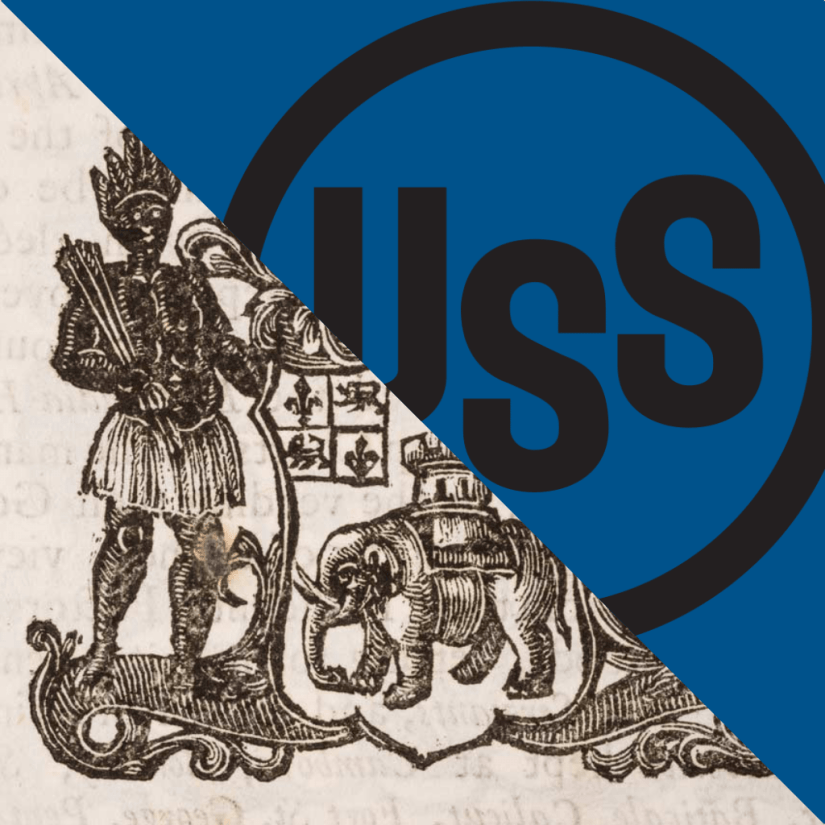
Coat of arms for the Royal African Company on left, and on Right, the logo for US Steel
Uncategorized

Autocracy, Incorporated 

Or, How U.S. Steel Now Resembles the Royal African Company – and What That Means for American Democracy & American Capitalism

How does an autocrat affect the business world? As Leviathan thrashes his bulk and churns the seas, how many adventurers’ ships do his waves swamp and founder? And how might the folks interested in those ships attempt to appease Leviathan?

The US is six months into the MAGA Restoration, and having effed around, I think we’re starting to find out.   

Coat of arms for the Royal African Company on left, and on Right, the logo for US Steel
Left: Coat of Arms of the Royal African Company; Right: Logo of U.S. Steel

~~*~~

On June 18, 2025, Nippon Steel acquired U.S. Steel for $14.1 billion dollars, making the long-lived American industrial corporation into a wholly-owned subsidiary of the Japanese company. The deal to create the world’s second-largest steel operation was a long-simmering one, running over eighteen months, largely due to federal opposition on “national security” grounds, first from the Biden administration and then the Trump regime. 

The impasse broke in mid-June, when the companies involved found a novel way to satisfy Trump’s vanity: they promised him a powerful, personal “golden share.” Journalists at the NYTBloombergWSJ and elsewhere all reported – seemingly only on the basis of company-issued materials – that holding this “Class G share” would grant President Midas-Touch unusual power over the operations of the new subsidiary, still to be named U.S. Steel. 

Per Bloomberg

“Nippon Steel and U.S.Steel struck a National Security Agreement with the US, in which US Steel will issue a so-called golden share to the government. The golden share gives consent rights to the US president concerning reductions in capital investments, changing US Steel’s name and headquarters, redomiciling outside the US, transferring jobs or production outside the US, acquisitions and decisions to close or idle existing facilities.”

Some context: a “golden share” is a special class of stock that allows its holder, typically a government, to outvote all other shareholders in some circumstances, like during proposed charter amendments. The term appears to date to Thatcher-era Great Britain, though the practice of a government assuring itself control of an important corporation by taking an ownership stake is far older (central banks, for example, often operate this way). In the contemporary moment, “golden shares” seem to function like a glitzed-up, nationalized version of the dual class shares that oligarchs, like Mark Zuckerberg and Warren Buffett, use to maintain personal control of their companies without tying up their capital in equity. 

But while “golden share” structures are common outside the US – Brazil holds a “golden share” in aircraft manufacturer Embraer, the PRC owns shares of companies like ByteDance, etc – the arrangement is quite rare, and perhaps unique, in the US. Even when the federal government re-capitalizes failing companies, as it does during bailouts (e.g. GM’s after 2008, or any number of railroads, airlines, and financial institutions), US officials have stayed far away from using the resulting equity to assert control over operations, much less business strategy.

And indeed, the US Government still does not own a “golden share” of U.S. Steel. As corporate law professor Brian JM Quinn noted on Bluesky, the amended certificate of incorporation for the post-merger U.S. Steel – the corporation’s charter document – does not create any “G-Class” shares, nor does it grant the US Government stock of any kind. The business press’s breathless reporting was inaccurate – or rather, reflected the statements of corporate and regime officials, but not the legal documentation. [1] 

Instead, Article VI U.S. Steel’s new charter grants “Donald J. Trump” vast control over the operations of the company. While he is serving as president, “written consent of Donald J. Trump or President Trump’s Designee” is required for the corporation to: alter its charter, change the company name, move its headquarters out of Pittsburgh, re-domicile outside the US, change its capital investments, sell any production location, acquire any other company, implement price changes, accept financial assistance from the Japanese government, reduce employee salaries, or “make material changes to the Corporation’s existing raw materials and steel sourcing strategy in the United States.”[2] 

When or if Donald J. Trump is no longer president – a future the new charter does not contemplate except by implication – these powers fall to the US Department of Treasury and the US Department of Commerce, though who within those departments can act, or how they are to act together, is unspecified. 

So: Nippon Steel has provided a specific person, President of the United States Donald J. Trump, with governing power over their subsidiary corporation, a company worth (as of last week) $14 billion dollars. He holds this power not as an owner of equity, or as a director with fiduciary duties to equity owners, but simply by virtue of his office and political power. 

To be blunt: is the kind of thing corporations do to satisfy autocrats. Only in a personalist dictatorship do you give the head of state a role in your foundational corporate charter; it’s a courtier’s pact, made to curry special favor, and bind a political patron to the business. 

What’s curious, here, is not that corporations are seeking Trump’s favor – his constant demands for bribes are by now a regular feature of American governance, part of the wider MAGA Restoration’s effort to manage government as a protection racket. Nor is it surprising, these days, that the President of the United States has arranged matters such that his office provides him with ill-gotten cash flows through ownership of corporate ownership or licensing of corporate assets; that, too, is standard federal procedure now.

No, what’s odd about this U.S. Steel deal is that the Trump regime appears to have arranged personalized governing power over a corporation, without acquiring ownership. They seized the opportunity to assert sovereign authority over a national enterprise, through a single person, not an owner’s property rights. In U.S. Steel, they have recreated the powers of a king. 

~~*~~

There are many ways to think about the shape that business takes in an autocracy. We don’t lack for models: from the Congo Free State under Leopold II to Jim Crow Mississippi to fascist Italy or today’s PRC, there are diverse examples of how capitalist expansion continues – and, arguably, thrives – under despotic rule of many different types and in many different places. 

But this U.S. Steel disaster resonates with a deeper history, I think, the place and period of where capitalism first emerged, alongside – and in partnership – with ambitious autocrats: early modern England. At least, there seem to be several familiar chords in this music. First, in this period, the British (neé English) empire relied on corporations as a critical tool for colonial and commercial expansion – corporations that, for the most part, were created by the Crown, not Parliament. Second, the early British empire was quite unstable, riven by repeated cycles of revolution and restoration, coups and counter-coups – which provided lots of opportunities for negotiating and re-negotiating the relationship between state and corporations, monarchs and market institutions, and a lot of explicit writing and wrangling about what these relationships could, should, or did mean.

Finally, the autocrats of the period – and in particular, the well-coiffed but fragile-necked Stuart kings – provided the whetstone against which early Americans, and their political heirs, sharpened their ideas about liberty to a cutting edge. It’s a period rich in relevant material, as well as direct influence, on the politics of our present moment. 

Which brings me to the Royal African Company. The RAC was a joint stock trading corporation with a monopoly on all English trade with West Africa. First granted letters patent (e.g. a charter) by Charles II in 1660 under the title “Company of Royal Adventurers into Africa,” it took on its more well-known name, and some additional powers, with a re-chartering in 1672. [3]

The RAC was, in many respects, a bog standard corporation of its time and place. It was one of dozens of companies chartered in 17th-century England, and like the Levant Company, the East India Company, or the Hudson’s Bay Company, its charter not only granted its associates unified legal personhood – and thus the ability to concentrate and deploy capital beyond the means of any one merchant – but also monopoly rights over a specific trading territory, and governing power there. Like these other companies, the RAC was explicitly a tool for colonization and imperial competition: it could establish forts, manors, and plantations, set up courts, and develop, marshal, and maintain military force on land and sea, as needed to fulfill that purpose.

While it’s fashionable in corporate law and finance circles today to approach corporations as organizations with ultimately “private” origins that the state must, reluctantly, regulate to maintain the basic health, safety, and financial transparency standards markets need to function, the RAC reminds us that this libertarian conception of corporate life is detached both from historical reality as well as the letter of the law. Like modern corporations domiciled in Delaware, the Royal African Company was a subdivision of the state, a temporary division of sovereign authority, granted to a body of subjects to accomplish a purpose – and therefore ultimately and always a creature of government, in all senses. [4]

Two things made the RAC unique, amid this host of incorporated adventuring companies. First, while the company’s initial business was the gold trade, it quickly – and quite successfully – expanded into slave trading. Indeed, a few years into its existence, the RAC became the dominant player in the trans-Atlantic traffic in human beings, and over its life it shipped more people across the Atlantic into chattel bondage than any other single institution. [5] 

Second, from its first charter onward, the company’s lead founder and “first governor” (e.g. board chairman and CEO) was the king’s brother, James, Duke of York. And James… James was a special guy. Amid some serious competition from his grandfather, father, and elder brother, James Stuart, Duke of York and (briefly) King James II (of England and Ireland) and VII (of Scotland) distinguished himself for his zeal for building an absolute monarchy based on the divine right of kings – and, unsurprisingly, also by his penchant for cruelty and the brutal persecution of his critics.

While James II didn’t meet the sharp end his father did – he fled England before anyone could effect the traditional familial separation between head and body – his time as Duke and then King made a lasting impression on British political development, as an example of what not to do. Following his fall, the power of British kings was forever broken, more tightly circumscribed by law and kept in check by the active exercise of sovereign power by Parliament. 

Why? Well, all the Stuarts had been committed a project of centralizing power under the Crown, and growing the monarchy’s bureaucracy at the expense of other governing institutions. Briefly checked by the loss of Charles I’s head and the interregnum, the post-Restoration Stuarts doubled down on the monarch’s right to arbitrary authority. So under Charles II, the monarchy took to simply disappearing troublesome subjects to foreign prisons “beyond the seas” – a practice Parliament attempted to circumscribe by legislating habeas corpus in 1679. And because James II was the last – and arguably the most aggressive – champion of this project, he receives particular opprobrium for it. As historian Holly Brewer has recently reminded us, James II expanded on his family’s efforts, efficiently corrupting the judiciary with patronage in order to remove any check on the monarch’s whims. (A tune that should sound familiar to modern Americans…)  

But back to the RAC: James’s executive role in the company was not in name only. He used the company to advance his colonial projects all over the Atlantic world, as a means to supply the slaves that his colonial adventures in North America and the Caribbean needed to profit. And he also wielded state power on its behalf – directing the Royal Navy to seize African forts during wars against the Dutch, for example. (Among other wartime accidents, these Anglo-Dutch conflicts led to James, as the Duke of York, briefly becoming the proprietor of the tiny, failing sub-colony of Delaware – a disappointment to all involved, surely). 

In practice and in theory, there was no clear line between the operations of the RAC as a capitalist enterprise, and James’s personal exercise of autocratic power. Indeed, they co-constituted each other – with humanity all the worse for it. 

~~*~~

The Destruction of Leviathan by Gustave Doré (1865)
The Destruction of Leviathan by Gustave Doré (1865), Wikimedia, https://commons.wikimedia.org/wiki/File:Destruction_of_Leviathan.png

But what does the Royal African Company have to do with U.S. Steel? I would argue there is a similarity in political shape. The grant of governing power to a ruler is not an act undertaken in a political economy defined by free enterprise and universal rights; it’s not even the kind of play one makes in a robust oligarchy. Rather, it’s the move a board of directors makes when playing court politics, in a monarchy. 

Too, the fact the Trump and his minions worked to produce this outcome – and not a simple bribe – makes it worse than bare graft. It’s an enactment of the MAGA Restoration’s theory of politics, of a piece with the anti-democratic philosophy the movement’s intellectuals advocate, the same philosophy that’s leading the regime to crush universities, the press, and tighten its chokehold on the federal courts and Congress. It’s a politics of absolute monarchy akin to what the Stuarts and their lackeys celebrated as divinely justified (an apologia constantly offered by Trump supporters, too). That autocracy has now come to corporate America.   

But despite it’s best attempts, tyranny is never the only game in town. The House of Stuart was nearly a century fled from Britain’s empire, and their pretense to rule equally dead, when the American Revolution took its first percussive bloody breaths on Lexington Green. And yet, the Stuarts’ shade remained, substantial enough to cast a defining shadow when American patriots submitted a “history of repeated injuries and usurpations” to a “candid world” to demonstrate the “absolute Tyranny” of King George III. As they sought to justify themselves for rising to rebellion and declaring independence by reference to the King’s outrageous acts (like “transporting usbeyond Seasto be triedfor pretended offences”) American revolutionaries recalled and remade a political language first articulated by by a group of seventeenth century anti-Stuart partisans, the “Country Whigs,” within a broader European discourse about the necessarily popular roots of political order and legitimacy (e.g. “republicanism”). Stuart tyranny was the lens through which revolting colonials observed the actions of King George and Parliament, and it served as the foil to the English liberty they sought to restore through rebellion.

Americans identified the dangers of arbitrary monarchical rule in part through its corporate manifestations. The Tea Act, the legislation granting the East India Company a monopoly on tea sales in North America and laying a small tax on tea to pay for government bureaucracy, was condemned by Massachusetts Whigs as a “master-piece of policy for accomplishing the purpose of enslaving us.”[6] 

That sounds like a wild overreaction to tax policy – and a weird reason to destroy millions in fragrant property – until you understand that like other British colonials, Massachusetts activists saw political events through the lens of Stuart abuses. A corporate monopoly, designed to generate taxes to fund state action, wasn’t just a discrete policy, but a conspiracy to undermine the imperial constitution and drown free men’s liberties. How did they know? Their political forefathers had lived through it one before, and written a great deal about it – and those essays survived and circulated widely among the politically engaged colonial elite; and too, the colonies they inhabited took the shape and form they did in no small part due to the actions – and reactions – to James II’s wielding of corporate power. 

Based on their understanding of the Stuart example, they thought the leviathan’s bulk was necessarily nourished by blood flowing through corporate veins. 

Thus, the legacy of the Royal African Company, and the importance of its corrupt echo in the corporate structure of U.S. Steel lies not only in the personal despotism these companies actively embodied or embody. It rests also in the liberatory ideology that tyranny inspired, as an instrument that detects corruption in the body politic as the rot sets in, identifies it as a danger to free people, and provides the means  – the words and the actions – through which it can be opposed, and destroyed.

The best way to survive a cancer is to catch it early, and treat it. U.S. Steel’s new charter shows up as a large malignant mass on America’s scan; will we be willing to cut the tumor out before its too late?


————

[1] This is not the only way the business press’s breathless reporting was inaccurate. Several news reports have mentioned that Trump will also have the privilege of appointing a member of the board of directors. This claim appears to be based on social media posts from the US Secretary of Commerce, Howard Lutnick. But like the “golden share” itself, this provision this is not included in the merger agreement, the revised certificate of incorporation, or the revised corporate bylaws – though a more recent filing, from June 25, 2025, states that a new “Class G Director” will be appointed per the terms in the National Security Agreement, a document that has not been made public, and may never see daylight.

[2] Of course U.S. Steel was and remains a Delaware registered corporation. In some regards, one could read the new subsidiary’s corrupt charter as the logical fulfillment of the new permissive “private ordering” regime that that billionaire oligarchsDelaware corporate defense attorneys, and their lackeys in the state legislature have been working overtime to retrofit into the Delaware General Corporate Law. What is a grant of power to a monarch, if not an exercise in removing shareholders’ influence on the corporation they own a putative stake in?

[3] For the 1660, 1662, and 1672 charters of these corporate entities that became the Royal African Company, see Cecil T. Carr, Select Charters of Trading Companies, A.D. 1530-1707, Publications of the Selden Society (London: B. Quaritch, 1913), pp. 172, 177, and 186 et seq.

[4] The source of “sovereign” authority was disputed, however. In theory, in the US today “the People” constitute “the state,” which creates corporations (state and federal). In seventeenth century England, however, the Crown asserted that authority, through the sovereign body of the monarch – though, at various moments Parliament also claimed that authority too, leading to some rather nasty civil conflicts, coups, counter-coups, and counter-counter coups, that were only resolved once the Dutch got involved – a messy outcome.

[5] The RAC shipped some 150,000 people during its primary years of activity, from 1672 to the 1720s. William A. Pettigrew, Freedom’s Debt: The Royal African Company and the Politics of the Atlantic Slave Trade, 1672-1752 (Chapel Hill, NC: The University of North Carolina Press, 2013), p.11.

However, British slave trading would soar to all-time world-historical highs only after the RAC’s monopoly was broken. Independent British slave traders then far surpasses – in a shorter amount of time – the human trafficking of every other slave-trading Atlantic nation. The end of the RAC’s monopoly was a development that planters in North America welcomed, by the way, as now they had cheaper sources for slaves. Another example of the magic of the free market, a blood-soaked sort of necromancy. 

[6] In Consequence of a Conference with the Committees of Correspondence in the Vicinity of Boston . . . (Boston, 1773). See also: Benjamin L. Carp, Defiance of the Patriots: The Boston Tea Party and the Making of America (New Haven: Yale University Press, 2010), 20, 246n33.

Uncategorized

Christmas, Slavery, & Freedom in Medford

[It’s been too long since I had a post, so here’s something with a bit of Christmas theme, cobbled together from my instagram and the closing lecture of my US survey course this year – DN]

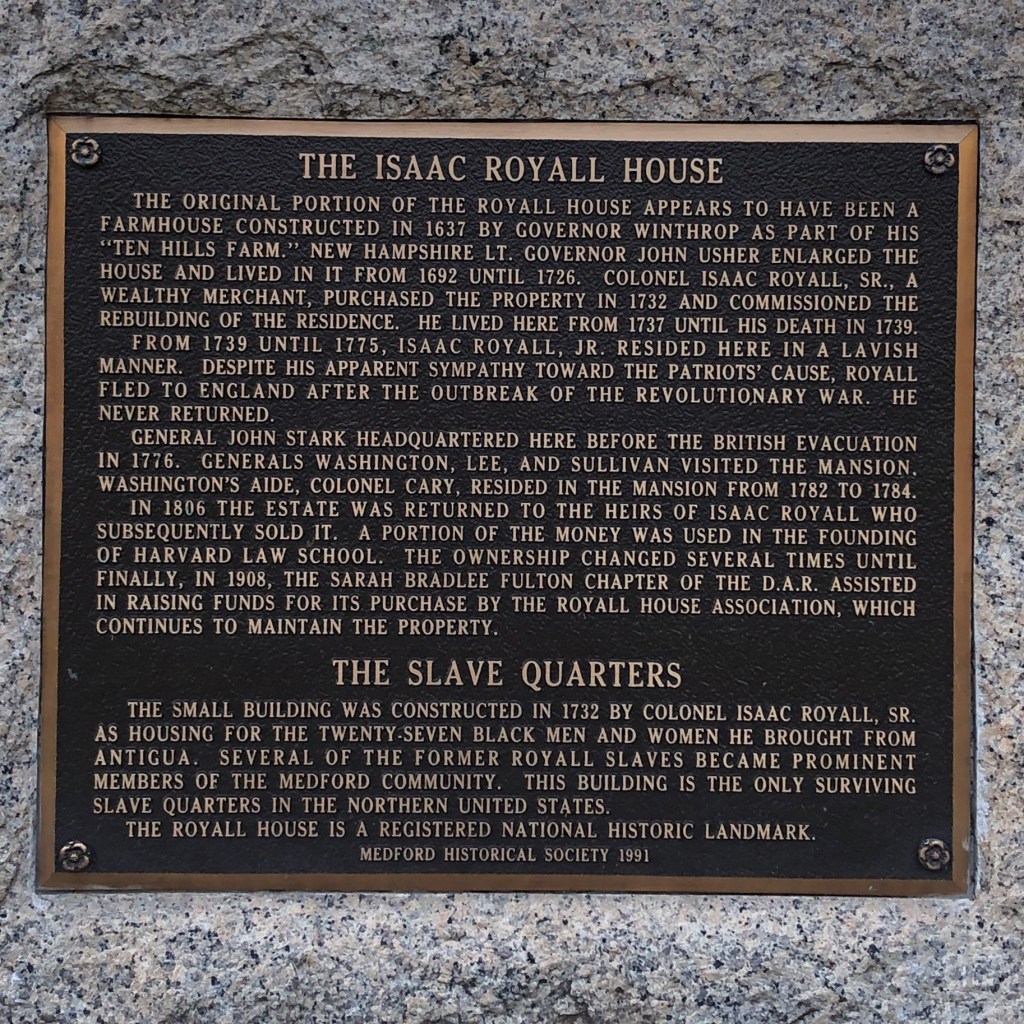
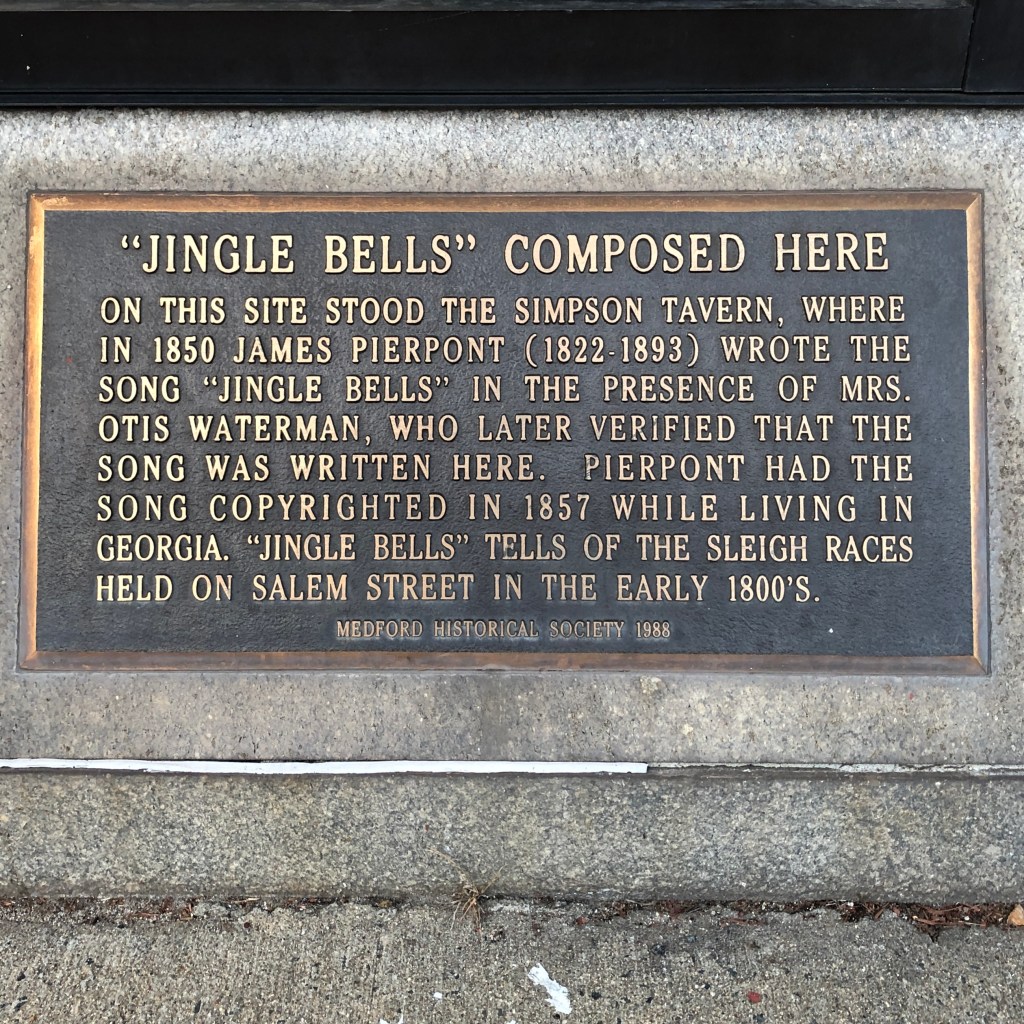
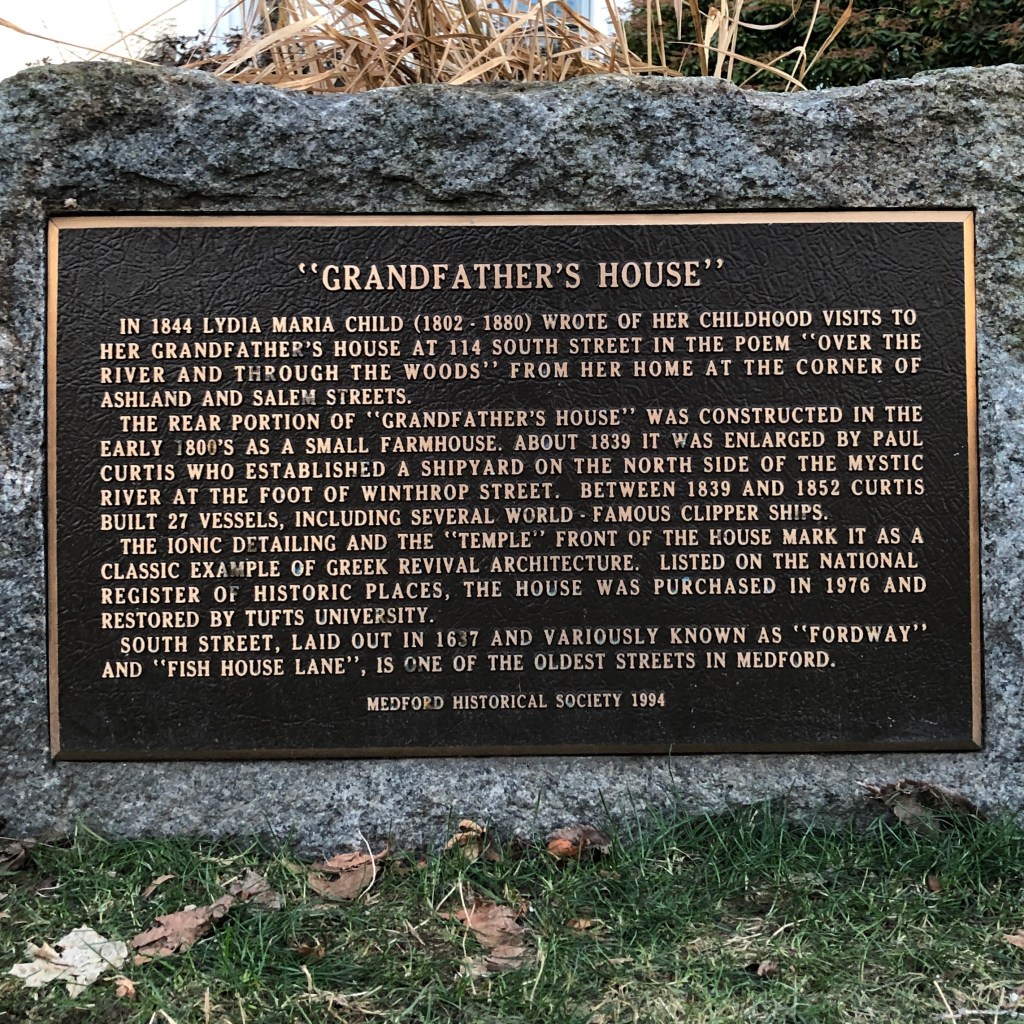
A few years ago, visiting family for Christmas, I stretched my legs for a walk in Medford, MA. Over the course of a short hour, I encountered three sites, all with historic markers, that together neatly illustrate the ways New England is defined by slavery – and how New Englanders have defined Christmas for the rest of the United States.

The first stop was Royall House, at the corner of George and Main Streets. An 18th-century estate built by a Massachusetts slave trader, rum distiller, and plantation owner, aka the unholy trinity of colonial New England business synergy. The building has long been known as a great example of local Georgian architecture – and thanks to a more recent interpretation, also of the central importance of enslavement and slave ownership to wealth among the colonial Massachusetts elite, too.

Next: Simpsons Tavern, on High Street.

It claims to be the site of the composition of “One Horse Open Sleigh,” in 1850 – better known today as “Jingle Bells.” It dominates holiday music now, but in the 1850s it was generic piece, one of dozens of contemporary “sleighing songs” about taking sexy, fast rides with single, fun girls. James Lord Pierpont published it in 1857; after failing as a whaler, gold miner, and photographer, he found success in writing it and similar pieces for minstrelsy singers, who performed his compositions in blackface. The uncle of J.P. Morgan (yes, that J.P. Morgan) Pierpont later moved to Georgia to teach piano, joined the Confederate Army, and wrote shitty ditty’s for rebel traitors before dying in Florida.

And finally, one last house: 114 South Street. Just across the Mystic river from Simpsons Tavern, it was the home of Paul Curtis, Lydia Maria Child’s grandfather. Curtis was a shipbuilder, famous for clipper ships designed to make quick voyages in the tea and opium trade.

His granddaughter Lydia was much more important, and famous.  An activist, editor, author, and publisher, she was a powerhouse in reform movements to promote women’s rights, arrest the U.S. government’s mistreatment of Native Americans, and end slavery. (Among other things, she was the editor of The Freedmen’s Book, a collection of works by and about freed people, which includes the best epistolary work in the English language, Jourdon Anderson’s letter to his former enslaver).

Child made her childhood journey to 114 South Street the subject of a poem, “The New-England Boy’s Song about Thanksgiving Day” – a composition better known now from its first line: “Over the river and through the woods, to grandfather’s house we go.” Much like Pierpont’s cheap song, Child’s short poem helped fix New England winter as the image for the Christmas season (and winter, generally) in American culture. Hallmark movies would look a lot different without the two of them (and Currier & Ives).

Elite enslaver, racist failson, and effective abolitionist. You can see the spaces of all their lives within the circuit of short winter walk.

Merry Christmas, Medfahd. Don’t forget your past.

Uncategorized

A Collection of Altered States

Fun facts from this morning’s research:

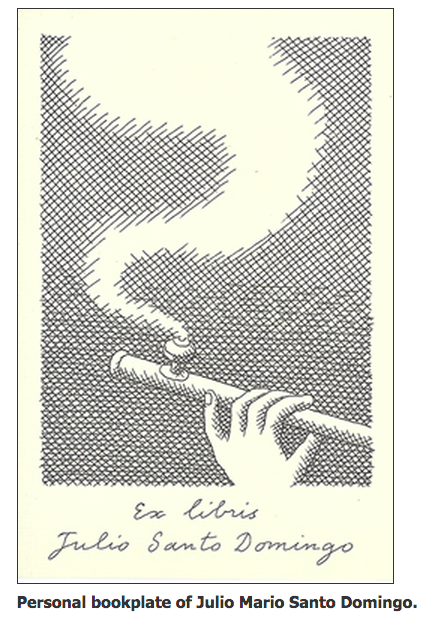
Harvard has on deposit “the world’s largest private collection of material documenting altered states of mind,” The Julio Mario Santo Domingo Collection.

The archive was compiled and donated (well, loaned) by an investment advisor(Julio Mario Santo Domingo), whose interests “centered on sex, drugs, and rock and roll.” In addition to the 50k+ print and audiovisual materials held by Harvard’s libraries, Santo Domingo also “formed a major Rock and Roll Collection (now at the Rock and Roll Hall of Fame in Cleveland)” and owned “the world’s largest collection of opium pipes.”

This is his bookplate, as displayed on the collection description website:

this book kills fascists

Appropriately, “[t]he Santo Domingo Collection is not physically together in one location,” but rather distributed across the university and the virtual world because it just can’t be contained, man. (Happily, that also means that Harvard’s diligent librarians have scanned many items and made them publicly accessible – so the collection is a great online resource if you’re looking for 19th-century works on opium, say).

If you’re interested in learning more, see the collection description on the Houghton Library website, search the HOLLIS catalog, or watch the Modern Books and Manuscripts Blog.

Our Glorious National Heritage, Power At Play, Uncategorized

This Slave Trade of the … 21st Century?

Or, Horrible Things Briefly Noted

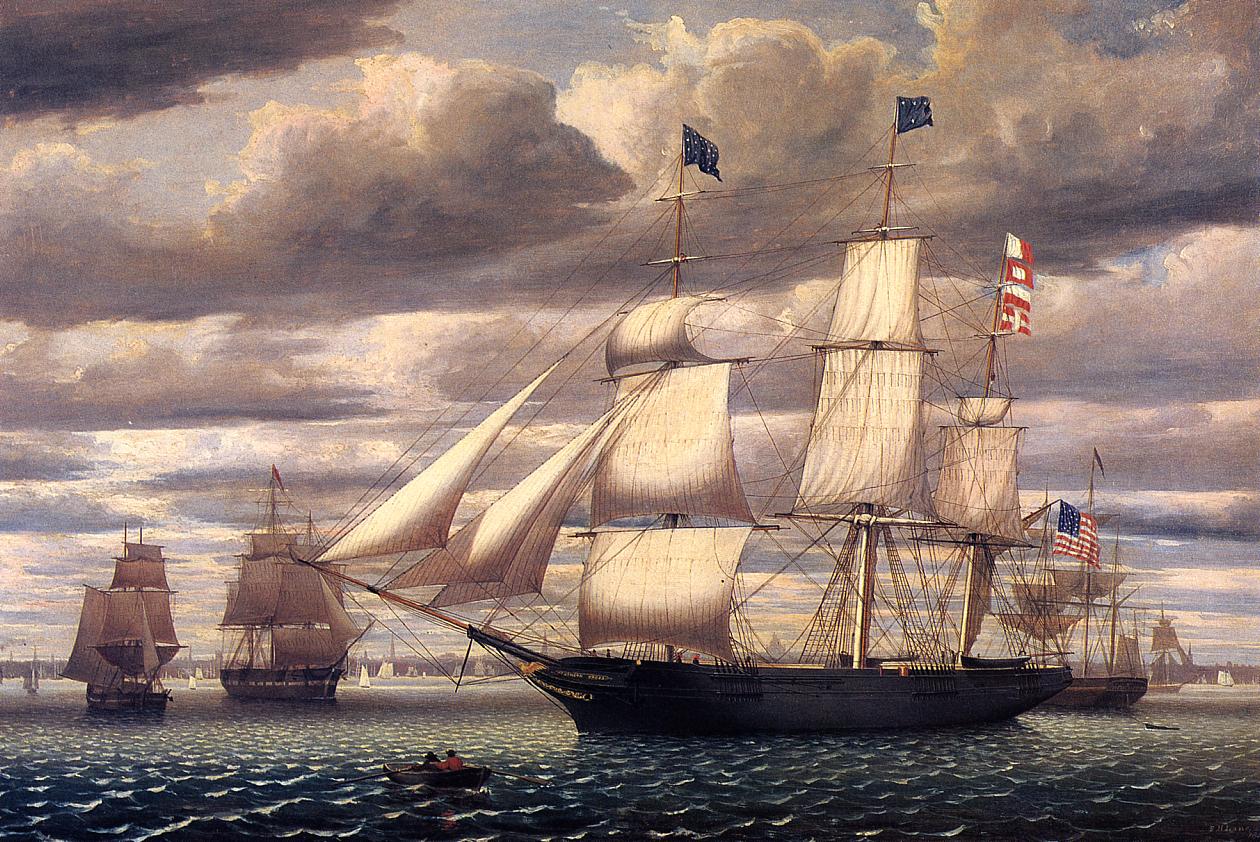
http://en.wikipedia.org/wiki/File:Clipper_Ship_Southern_Cross_Leaving_Boston_Harbor_1851.jpeg

A specter is haunting today’s localized edition of the International Herald Tribune – the specter of nineteenth-century labor. In the appropriately (but I’m convinced utterly un-irionically) titled “Modern slavery: How bad is bonded labour,” a modern day Swift-sans-satire offers his readers a new modest proposal : why not re-legalize bonded labor?

The benefits, he says, are obvious: “[a] loyal workforce is more cost-effective” than one comprised of “floating and opportunistic workers who follow the bucks and switch frequently in pursuit of better pecuniary benefits and career progression.” Besides, the “economist” with “a PhD from Cambridge University” notes, Pakistan’s laws prohibiting slavery are ill-enforced; better instead and do away any prohibition, and replace it with a regime whereby owners – sorry, employers – are proded to take care of workers and their families “in terms of shelter and health.” Better for everyone! And certainly more profitable.

I snark, but these arguments should sound familiar to any student of proslavery rhetoric – although they were attacked as the utterly immoral statements they are by slaveholders in the past.

~

For some years now, the IHT has been owned by The New York Times. Founded as a conservative pro-business paper in 1851, just as the sectional conflict over legal chattel slavery was really starting to heat up in the United States, the NYT not infrequently weighed in on the subject of slavery, generally advocating a quiet and peaceful end to the institution, but with as little fuss and cost as possible. To that end, in the early 1850s the editors of the Times supported the introduction of a special kind of bonded labor into the United States: so-called “coolie” labor.

“Coolies” were workers from Asia (usually China or British India) who contracted to work eight-year stints in the Americas. They were hired most often to replace slave laborers on tropical plantations. (NB: the term “coolie,” now a highly derogatory racial slur, was seen by writers at the Times primarily as a legal category of workers from Asia – though that makes it no less a symbol of the virulent white supremacy that formed the foundation for the politics of the period). Asian laborers were needed on these plantations because slaves were becoming scarce, either as a result of legal emancipation (as in the British Caribbean) or indirectly as a result of the enforcement of transatlantic slave trade bans. This was in contrast to the American South, where slave populations were growing, and highly mobile. The editors at the Times promoted the traffic in Asian workers’ labor as a anti-slavery solution to slavery – which was conceived as as a problem of political economy, not morality. And they wielded that advocacy as a weapon in smaller political conflicts.

Responding in 1852 to Southern slaveholders’s agitation in 1852 agitate New York Times took up the subject from the perspective of economics, articulating what had become the conventional wisdom among Northerners on the topic. Noting that in Cuba the “experiment” in Chinese labor “has proved successful,” the Times wondered if Cuba’s labor system would not be “coveted by the Planter in the neighboring American States?” A few weeks later, the editors went further, suggesting that “the real malady of the South is defective labor, and the remedy the same as that now employed in Cuba – the introduction of the Chinese Coolies.” Should contracted Chinese coolie labor be successful, the Times editors thought, “the peculiar institution will at once give way to imitation; and so will end the great economical pestilence of the South.” The Times and its readers among the bourgeois elite indentured Chinese labor was a panacea for the economic and political ills of slavery, and, notably, a system that would benefit their style of investment and management handsomely.1 (The Times was not alone in this admiration for “coolie” labor, of course).

~

The system was acceptable to the Times in 1850 and their foolish successor at the IHT because it is founded – in theory – in the sine qua non of the liberal market economy: the freedom and sanctity of contracts. In this case, that means the freedom of a worker to sign away control over their body for a limited amount of time.  In practice, all evidence is on the side of the “freedom” here being no more than a myth, a viscious fantasy.

Ironically, in the United States, evidence of the evils of  indentured (or “bonded”) Asian labor were brought to light by slaveholders. Fearing that “free” indentured Asian labor would cut into their profits and political power, slaveholders across the United States in the mid-1850s began using reports of forced contracts, cruel ship conditions, and on-plantation mistreatment to argue, loudly, that the system was too cruel and too exploitative to be allowed to continue. They were acting in their own interests, of course, and their counterargument that their slaves were better treated was clearly a lie; but they were quite successful in getting other parties in the U.S., including the NYT, to abandon the trade as a proposal (at least for a time). By 1859, the “coolie trade” was described by one popular commercial encyclopedia as a subsection of the slave trade:

This trade has sprung up since vigorous efforts have been made to suppress the slave-trade proper. Although theoretically the coolie trade promised benefits to both planters and coolie, yet practically it is only another form of the slave-trade.

~J. Smith Homans, ed., A Cyclopedia of Commerce and Commercial Navigation (Harper & Brothers, 1859), II:1728-9

This sentiment carried into the Civil War; in 1862, a fervent abolitionist named Thomas Dawes Eliot pushed a bill banning American participation in the trade of “Chinese cooleys” through Congress – but that’s another story, and its own set of (no less dark) problems.

~

To return to the main point: whatever you call it, bonded labor is bondage. It’s slavery. That was true in 1859, and it’s true now, whatever ahistorical argument a Cambridge Econ PhD makes.2 But for a better approach to the problem of poverty and slavery in the contemporary world, one that’s actually historically informed, why don’t you take a look at what the Historians Against Slavery have been up to?

That should help rinse out some of the bitter taste, at least.


h/t @karpmj to for passing the IHT article along

1.) The Times was prolific on the topic for a time. See: “Orientals in America,” New York Times, 15 April 1852; “Cotton, Cane and the Coolies,” ibid., 3 May 1852; “Labor in Cuba,” ibid., 10 December 1852 for relevant examples.

2.) The headnote in the IHT, in attempting to frame the piece as a courageous anti-politically correct piece, really only demonstrates the author’s ignorance of historiography by claiming to be “following the academic tradition set by Robert William Fogel and Stanley L. Engerman in their fiercely debated book ‘Time on the Cross: The Economics of American Negro Slavery’ (1974).”