History and Historians, Our Glorious National Heritage

The whole epoch is disorienting

Or, Atlantic Linkages

Disorient

Listen everybody: if you aren’t reading Ta-Nehisi Coates over at the Atlantic, you are missing out.

He’s a very good writer, and a very deep thinker. I mention him here — rather than just by grabbing you by the collar and preaching the cant of the converted to you individually — because recently he’s been reading through the historical literature on slavery, the Civil War, and Reconstruction, and blogging his reactions. The result is some of the most thoughtful and powerful writing on the topic, and its present relevance, that I’ve had the pleasure of encountering.

What I like best of about Coates’s writing (and thought) is his how open he is to new ideas. Not uncritical; but willing to engage. That is as true of his reading of history as it is in his conversations with ideological opponents. There is, in his postings, a constant autobiographical refrain where he tracks the development of this willingness in himself, which gives it an anchor and a sincerity which even the most plaintively open-minded writers lack.
Continue reading “The whole epoch is disorienting”
History and Historians, Our Glorious National Heritage, Uncategorized

Searching for Sustainable Sovereignty

Or, The Axes of Ideology Don’t Just Split Hairs

Chopping

Sean Safford, one of the OrgHeads, has just put up a very astute post about movements in contemporary U.S. political ideology. Essentially, he thinks that the ideological axis in the U.S. has shifted away from an emphasis on “fairness” vs. “conservation” — CEO pay is far too high! 40 million are uninsured! v. the market works great! If it [institutions] ain’t broke don’t fix it!– to an emphasis on “sustainability.”

Here’s his description of the “sustainability” argument:

The argument goes something like this: We live in a highly interconnected society which operates within a series of interconnected systems. Resources (physical, material, social, and political) are not only scarce, they are extinguishable. The system is in place, not so much to keep social order, but to ensure the reproduction of the resources needed to reproduce society over time. Undermining any of the systems on which society depends threatens to have ripple effects on others. But importantly, the biggest threat to the system comes not from external threats, but from individuals acting in their own self interest in ways that could undermine the delicate balance on which interdependencies of the system depends. Government action is needed, not to ensure fairness, but in order to save us from ourselves.

Continue reading “Searching for Sustainable Sovereignty”

Our Glorious National Heritage, The Past is a Foreign...Something

A Scurvy Affair in the History of Bloodshed

Or, They Don’t Make War Like They Used To

TreeFocus

Raleigh Register, and North-Carolina Gazette, (Raleigh, NC) Tuesday, June 02, 1840

Great Britain vs China. – We are more than half inclined to join the Peace Society – buy the Prize dissertations – and go against all wars, just as Mr. Ladd does. If Great Britain can’t get up a better war than that which she is waging against China, she ought to be ashamed of herself, and never go to war at all. We have never known a more scurvy affair in the history of bloodshed.

Many of her own statesmen, who have either honesty or shame, blush for her. A resolution disapproving the course of the British government in relation to China, was lately introduced into the House of Commons, and after a stormy debate of three days, was lost by a majority of ten only. Ten righteous men would once have saved a Sodom, but they must have been a very different sort of men from the ten in the British Parliament who justify the war with China. – Exeter News Letter

I’m beginning to really like the editors of the Raleigh Register, and North Carolina Gazette.

To close a few loops here: The American Peace Society was a Christian organization that campaigned for pacifism. Ladd was an Exeter and Harvard grad who became a sailor and worked his way up to captain in the New England merchant marine. He settled in Maine, where he ran the organization, and published its poorly edited house organ, The Harbinger of Peace from his home in Minot, ME.

Prior to his settling in Maine, Ladd ran a plantation in Florida that failed because he refused to use slave labor (sound like anyone?).

He was partly inspired to his activism by the Aroostook War, a conflict over timber rights in a valley whose ownership was disputed by the US and Canada (or, more accurately, the local citizens of each nation). This conflict was one of several diplomatic issues that was, circa 1840, souring British-American relations.


bobtravis, “The tree in focus,” Flickr, CC License

Our Glorious National Heritage, The Past is a Foreign...Something

If You Try Sometimes, You Just Might Find, You Get What You Knave

Or, Yankee Ingenuity Not All That Unique

From the Raleigh Register, and North-Carolina Gazette, Friday, February 07, 1840:

Knavery

Confused as to why Yankees might have a reputation for offloading clever frauds? Ever wonder why Connecticut is known as the “nutmeg” state? See here for all the answers.

Our Glorious National Heritage, The Past is a Foreign...Something

Bigger, Faster, Stronger…Pianos?

Or, Thank God We Solved That Problem

Piano

This from a Charleston, South Carolina newspaper:

A New Article of Trade to China, in the shape of Pianos, is about to be tried.

The great difficulty of preserving pianos in the climate of Canton, owing to its extreme dampness has deterred many from importing them. Messrs. Dubois, Bacon & Chambers, however, Piano Manufacturers of this city, have just completed two, which, from the strength of their construction, a better mode of securing the parts, and great care in the selection of the materials, will, they confidently believe, resist the climate.

They are, moreover, instruments of great sweetness, compass and delicacy, and have been pronounced by eminent pianists of superior quality – N.Y. Amer.

~The Southern Patriot (Charleston, SC), 28 May 1838, p.2, col. 3

I’d say this is just more evidence that Americans were interested in East Asia far sooner than we give them credit for, but I think the Southern Patriot and the NY American were motivated more by boredom, than anything else, to run this story.

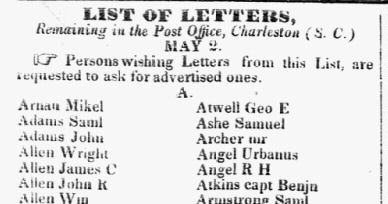
I say that, partly, because in the former’s case, the entire front half of the front page was taken up with this:

LettersList

Talk about being the voice of the community. I wonder if they reminded you to pick up some milk at the store, too…


Image cite: Sashamd, “We have a map of the piano,” Flickr, CC License