Archival Follies, Knowledge Droppings, Our Glorious National Heritage

A Song of Whales and Profits

Or, Winter Is Coming (to New England)

Earlier this summer I read (consumed, devoured) the latest installment of George R. R. Martin’s Song of Ice and Fire, and perhaps that’s why I can’t help but see in my sources a certain Westerosian tinge now and again.

But honestly, I’m only reading that into it so far –- sometimes it’s just there. For example, doesn’t this French official make the semi-desperate, post-Revolutionary mariners of New England sound a bit…Ironborn?

“Those [states] that manage best are the Northern States; New England especially displays astonishing activity and resources: I am assured that this year Massachusetts alone has put to sea 900 ships of 70 to 180 tons. Forty have been Whaling in the seas off Brazil and on the coasts of the Country of the Patagonians up to the Falkland Islands. These voyages are long and perilous. But the Seafarers of the North are hardened to fatigue and to the Sea: they live with an extreme sobriety, and the size of the profits makes them scorn danger.1

A bit less raiding, I suppose. But is it so much of a stretch to think that Ahab’s ancestors, limned here, might have worshipped the Drowned God in a slightly different universe?


1.) François Barbé de Marbois to Comte de Vergennes [translation], Philadelphia, 14 July 1784, in Mary A. Giunta, et al., eds., The Emerging Nation: A Documentary History of the Foreign Relations of the United States Under the Articles of Confederation, 1780-1789, 3 vols. (Washington, D.C.: National Historical Publications and Records Commission, 1996), II: 418.

Image: Abraham Storck, “Walvisvangst bij de kust van Spitsbergen — Dutch whalers near Spitsbergen,” Stichting Rijksmuseum het Zuiderzeemuseum. 022296, Wikimedia Commons, accessed 16 September 2011.

Archival Follies, Knowledge Droppings

Antebellum America Runs on Dunkin’

Or, A Democratic Party Plank Worth Bringing Back

you moused over! good for you!

You may celebrate the Jacksononians for their commitment to democracy, or you may loathe them for their violent, heathenish, small government ways and fanatical campaign against of sensible currency regulation.

But whatever the case, I now offer you proof that must come together and appreciate their foresight in at least one area. For the Dems did get one thing right: America runs on Dunkin’! Or rather, cheap caffeine. Sweet cheap caffeine … And in the 1840s, that meant the cry of FREE COFFEE echoed throughout Congress’s halls alongside meeker requests for free soil and labor, etc.:

No person can deny that the Democrats came into power with professions against a tea and coffee tax; and it is equally undeniable that to the Democratic party is entitled the credit of keeping those articles free ever since the year 1832. Sir, this good old Democratic policy of keeping the foreign necessaries of life down as low as you can, has gained our party a great many votes; and both policy and justice require that we should not turn our backs upon it. Had Mr. Clay been for free tea and free coffee and Mr. Polk against it, who doubts but the election of 1844 would have differently resulted?

~John Wentworth, Free Tea, Free Coffee, Free Harbors, and Free Territory.: Remarks of Mr. John Wentworth, of Illinois, Delivered in the House of Representatives, February 2, 1847, Upon the Civil and Diplomatic Appropriation Bill, with His Personal Explanations, in Answer to the Attacks of the Washington Union. To Which Is Added a Portion of the Speech of His Colleague, (Mr. Douglass,) Touching the Course of the Union’s Reports Thereof (Washington, D.C.: Printed at the Office of Blair & Rives, 1847). Emphasis mine.

UPDATED:Turns out that coffee is still free! and tea nearly so (for some reason, only green tea imports are taxed, but then only at a very low 6.4% rate).

So it would seem that our current union still maintains some vestiges of the old, pure Democracy… or that modern governments are funded by income taxes rather than customs.

But definitely one of those, for sure.


Image: “Dunkin’ Donuts,” Steve Garfield / SteveGarfield.com, Flickr, CC License

And now for something completely different..., Archival Follies

My New Favorite Jefferson Quote

In Which TJ Explains Why It’s Okay That He Changed His Mind

In this case, he’s explaining why he went from being dead set against protecting manufacturing in the U.S., to seeing protectionism as a positive good (hint: it has to do with Great Britain).

“For in so complicated a science as political economy, no one axiom can be laid down as wise and expedient for all times and circumstances. Inattention to this is what has called for this explanation to answer the cavils of the uncandid, who use my former opinion only as a stalking-horse to keep us in eternal vassalage to a foreign and unfriendly nation

~Thomas Jefferson to Benjamin Austin, as quoted in Mathew Carey, Addresses of the Philadelphia Society for the Promotion of National Industry(Philadelphia: Published by M. Carey and Son, 126, Chesnut Street, 1819), 161. Emphasis in Carey’s original.

Also? “cavils of the uncandid” is my new “stalking-horse of eternal vassalage” cover band.

Archival Follies, Our Glorious National Heritage

A House Divided Will Not Subscribe

Or, The Damn Thing Is All Ads Anyway

As those of you who are so unlucky as to follow me on Twitter know already (twitter being what I’ve been distracting myself in between bouts of what I’ll call, for the sake of argument “writing”), of late I’ve been mucking through Congressional records.

Yes, yes, I see you nodding off, but listen: this time it’s different. This time I’m bushwhacking through the annals of the First Congress. The beginning one!

The timing lends the even the most boring speeches and bills a brassy burnished halo. The Era of Washington! The birth of our empire, and all our liberties! Days when spirits were brave, the stakes were high, men were real [republican] men, women were real [republican] mothers, and small furry creatures from [the Indies] were real small furry creatures from [the Indies], to paraphrase my favorite Adams.

Good times.

Right, where was I? Ah yes, mucking through annals. Well, today I ran across something that makes me think that — age of heroes or no — there never was a newspaper printer with sound marketing sense.

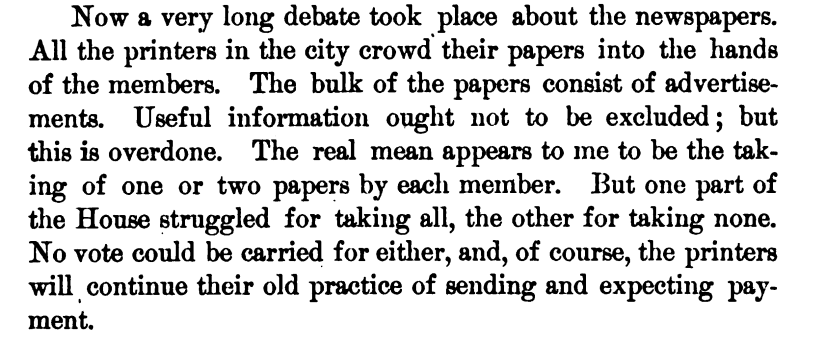
Consider, if you will, the following passage from the journal of William Maclay, a delightfully cantankerous one-term U.S. senator from Pennsylvania:

nothing clever to see here

Maybe I’m misunderstanding Maclay here, but were the local printers really trying to drum up business by scamming members of Congress? Hoping a politician will pay you for services unordered…well that seems a bit daft. Moreover, there’s the question of subscriber base. The combined houses of Congress, at this point, consisted of about ninety members* — hardly a sustainable audience. And once the House voted down subscribing to anything…this seems like it got perverse right quick, no? And if cash wasn’t the goal, that’s even worse; this was decidedly not the group most likely to be swayed by hacky political commentary — or interested in advertisements, either.

Seems to me like the printers of the Early Republic operated on the same principle as all the (failing) local newspaper publishers who insist on stacking eternally unread issues like cord-wood on my stoop every morning. I doubt it worked any better then…

*It was early days. Not every state got their act together to send representatives on time…


Source:

William Maclay, Journal of William Maclay, United States Senator from Pennsylvania, 1789-1791, ed. Edgar S. Maclay (New York: D. Appleton and Company, 1890), 64. The passage appears in the entry for June 3, 1790.

Archival Follies, History and Historians, Now in Actual Work

Ex Readex: Redux

Or, the world in a grain of ads

You’ll recall that in my last I wondered “What am I getting wrong?” — a big question, for sure, with many and varied answers, as friends, acquaintances and passer-by would be happy to tell you. But in this case I was specifically concerned with what I was misunderstanding about the search results I was receiving from a Readex database, America’s Historical Newspapers.

Well, you’ll be pleased to know that Readex, in the person of their marketing director, David Loiterstein, was kind enough to get in touch by e-mail and tell me exactly that. And the answer? Granularity.

Basically, the AHN database does not consistently break down advertising sections at the same level of granularity; it has changed over time. As David explained:

Initially, particularly for the 18th century in which the first series of newspapers was so heavily concentrated, we identified individually every advertisement on every page; however, in later series multiple contiguous advertisements were identified in groups.

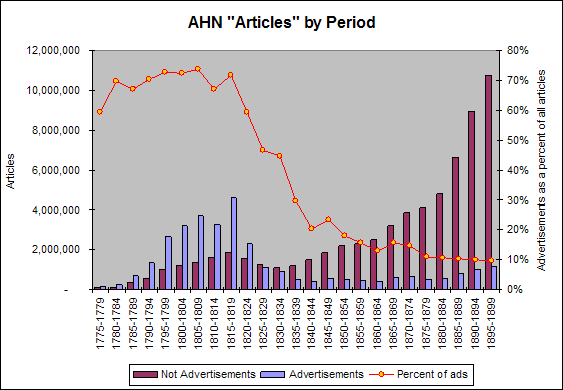
So: sometimes individual ads count as individual “articles,” sometimes a multiple-ad block count as one, and sometimes entire columns of ads count as one unit; and the granularity of the ads goes down, generally speaking, over time. Which means that my results — which included all article types, including ads — were skewed by the ways ads are counted.

David provided a graph of his own, illustrating this effect, and suggesting a way to get clear of it (reproduced here with permission):
AdBlocker
I’ll let him explain:

This approach seen above—in which advertisements are isolated and an aggregate number of the other article types is counted separately—provides a more representative measure of available “texts.” While the data does in fact indicate fewer “articles” available between 1820 and 1850 in what is otherwise a steady increase in articles available between 1690 and 1819 and between 1850 and 1922. The declining number of ads as a percentage of “articles” or “text” is a result not of fewer ads but the changing approach by which we identify them.

Thus, practically speaking, if you want to get some kind of a baseline for how representative a given search’s results are, you’re going to have to sacrifice including ads in those search results. Not ideal, of course, but much better than not knowing what your results mean. In addition to responding directly to this specific question, David also mentioned that Readex was working to update the Readex Help section, and fix the discrepancy between the two portals I had noticed.

So where does this leave us?

Well, with a much better understanding of how one of the most important databases in Early American historical research functions, for which I am grateful to David and his colleagues for their quick response and kind explanation.

I would note, though, that even using the new numbers, the curve still shows an unexpected dip in the 1820s and 1830s — the heart of the Jacksonian era, where most historians would tell you that print, and especially newspapers, exploded. As I said before, this is not something I think unique to Readex, but rather an artifact of the way many digitization projects have done triage (or, alternately, it might be proof that print output indeed declined, in which case steam-powered presses were not actually all that important in the development of American democracy! But let’s hope not, as then we’d have to revise a lot of historiography…).

In any case, all good factors to keep in mind when trying to use large collections to buttress claims about relative representativeness, ubiquity, or uniqueness. And now on to new and exciting problems…