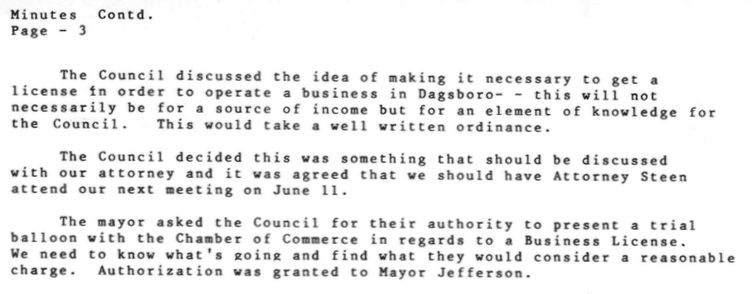
On May 14, 1990, the Town Council of Dagsboro Delaware considered the topic of business licensure in a way James Scott would find familiar:
I am not how the conversation with the Chamber of Commerce went, with regard to this new effort to make business legible to the town government. I’m curious how Mayor Otis Jefferson pitched it to a group of businessmen generally unwilling to let the state in, even as they constantly sought to use the state for their own ends (including profit).
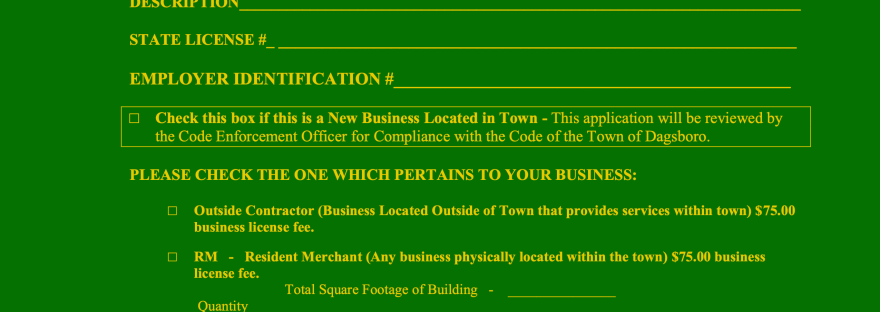
But something must have gone forward from 1990, because Dagsboro now not only allows businesses to vote – it requires them to be licensed.
Source: “Minutes, May 14, 1990” in Minutes of the Dagsboro Town Council, 1941-1993, Delaware Public Archives, RG 7040-000-001, roll 2
Or, Did a Shit Storm Over Sprawl Lead to Corporate Enfranchisement?
Corporate Voters Project – Research Note #4
When I first heard of Smyrna, Delaware, I thought of smoking opium. But now, I think of corporations voting.[0]
Let me start again.
In the early nineteenth-century, Americans went to the Ottoman port of Smyrna to buy opium, to resell it in China. They were eager to find a cheaper way to pay for the tea they bought at Guangzhou (Canton) – the Spanish silver dollars that Chinese merchants preferred were too expensive, and shipping kegs of coins cut into their profit margins something fierce. So, taking a page from the East India Company’s business plan, Americans sailed the Mediterranean to visit Smyrna (modern-day Izmir, Turkey) and buy smokable opium, which they then smuggled into China, exchanging it for tea. American firms profited massively from trafficking in an illegal narcotic from West Asia to buy a popular stimulant in East Asia – drug dealing is good money, turns out! – and in the process helped kick off a century of violent invasion and civil war in the Qing empire that killed tens of millions of people, and addicted millions more. [1]
I spent over a decade reading and writing about this history, and it pickled my brain in a specific way: which is why when I first moved to Delaware and heard about “Smyrna,” I thought “smoking opium.”
But the nineteenth-century people living in Duck Creek Cross-Roads – what became Smyrna, Delaware – had a different obsession. The local lore is that they renamed their dockside village after an ancient Anatolian city because a Methodist evangelical extraordinaire named Francis Asbury had preached them the good dope about Christ’s redemption of mankind from sin, and in his sermon quoted a Bible verse mentioning Smyrna. The holy flame of Asbury’s call to Christian conversion – mixed, perhaps, with some of hellfire’s heat – branded the city’s name upon the Kent County villagers’ hearts. Later that year they appealed to the General Assembly, asking to have the name of their unincorporated hamlet changed to “Smyrna.”[2] The wise men of Dover agreed, and it’s been an easy-to-mumble moniker ever since.
My more recent research has changed what Smyrna means to me. The town is one of the 70% of Delaware municipalities that allows corporations to vote in local elections. I’ve spent the last couple of weeks investigating how a small town came to enfranchise corporations in special elections for annexation and for bond referenda. And further, I wanted to figure out why Smyrna used two different mechanisms for corporate voting: for annexations, “one man, one vote” – but for bonds, one vote per land parcel (e.g. the more you own the more you get to vote).
I’m not sure I’ve come up with good answers to either of these questions, yet. But I did find some further confirmation for some of my developing theories: to wit, that corporate voting came after, and in some ways replaced, other forms of municipal oligarchy in Delaware; and that the problem of paying for sewers – and the political economy of suburban housing development they support – has something to do with why Delaware towns have granted corporations the right to vote during the last half-century.
So let’s dig into Smyrna’s charters, and its night soil, and see what we find.
~*~
As best as I can determine, corporate voting first appeared in Smyrna when the town was re-incorporated in 1980. Prior to the Reagan era, Smyrna’s municipal charters had focused on more traditional methods of ensuring oligarchy: restricting who could vote using status, wealth, race, and/or gender requirements. The earliest version of the municipal charter, in 1817, required that voters be “persons,” who were free, white, male, and owned real estate. Later, in the 1859 charter, the property ownership requirement was dropped in favor of a tax-paying requirement: a poll tax, specifically. An 1897 charter revision removed explicit restrictions based on race (though I have to imagine they were enforced, implicitly), but kept the pay-to-play proviso. The municipal charter approved in 1929 removed restrictions based on gender – and opened the door to non-resident and possible non-human enfranchisement, by granting “every resident and non-resident taxable of said Town” the right to vote at any special “town meetings” called to decide on extra tax levies. Votes at these meetings were allotted based on the dollars of tax a “taxable” paid, much like Dagsboro charters of the a similar vintage.[3] But though Smyrna had a surprising number of corporations for a tiny Delaware town – the state even chartered one to build the town hall, which is a bit like using a chainsaw to shave, in terms of legal structure overkill – I have not yet found evidence that property-owning local corporations voted in these early 20th-century town meetings.[4]
Smyrna’s 1980 charter, though, carved out a clear role for corporations in the municipal electorate. Its opening section grants “[e]ach legal entity (whether an individual, partnership, corporation, association, trust, or any other entity capable of holding legal title), owning property in its own name” one vote in annexation elections – though carefully limited such votes to the “one-man, one-vote” principle. But a later section, about special town meetings to levy special taxes, laid out a different principle, re-using the 1929 charter’s language to apportion “every resident and non-resident taxable” a number of votes on the basis of dollars of “taxes paid.” Now that the annexation section had opened the door to non-human “non-resident taxables,” it’s possible this provision was intended to apply applying to corporations, too.[5]
As seems to be standard with charter revisions in Delaware, no one noticed these sections – at least not in print. Newspaper reports on the 1980 recharter mentioned other features – a bump in council member pay, the lowering of the voting age to 18 – but passed over the enfranchisement of corporations, explicit or implied, entirely. The recharter bill passed the legislature with no incident, or comment. [6]
That was not the last ratchet toward an incorporated electorate. Smyrna’s 2003 charter expanded and altered corporations’ voting rights. For annexation elections, “any legal entity” owning property is allowed one vote, on a one-man, one-vote” basis; and for bond elections, “any person(s) or artificial entity(s)” [sic] owning property are “entitled to cast one vote for each separate parcel of real property.” Note that this new process privileges the concept of divisible landed property over raw wealth – and divorces voting from the concept of paying in to the community. It’s the number of land lots you own, not how much tax you contribute to public coffers, that counts. [7]
(Smyrna’s charter-writers finessed this a decade later. The 2012 charter revision scaled back corporate property owner’s voting power: today, owners of “an unfinished subdivision” only get one vote per the entire set of parcels, rather than one vote per empty lot.[8])
To sum up: after a century of limiting the franchise by property and tax-paying, in 1980 Smyrna dipped its municipal toes in corporate voting, and in 2003 submerged itself to the waist, granting corporations that owned developments and subdivisions – in particular – unprecedented, and frankly odd, voting rights.
But why? I wasn’t able to find a smoking gun explaining everything in detail, but there is circumstantial evidence that this shift was part of a larger conflict with the county and state governments over the pace, space, and structure of new land development, aka sprawl.
And as with Dagsboro, the debate flowed through the sewers.
~*~
The facts are these: at the start of 2003, Smyrna, Delaware was wholly in Kent County. Then, in August 2003 – after eight months of very public, and increasingly acrimonious, political conflict that ranged across official town, county, and state venues – the town council approved the annexation of 500 acres of land north of Duck Creek, extending the town boundaries into New Castle County on the basis of a one-vote majority (the mayor broke the tie). [9]
A few things are interesting about Smyrna’s decision. First: the town annexed this territory over the opposition of the full hierarchy of New Castle County and State of Delaware officials, up to and including the Governor. A few years before, these same authorities arrogated control over local development to themselves – part of a larger effort to manage growth, and suburban sprawl. In the county, this took the form of a new comprehensive plan, with a massive $100 million sewer construction program at its heart – to be paid for using fees levied on sewer hookups to new houses built on unincorporated (i.e. county) land. For the state, Gov. Ruth Ann Minner had created a new bureaucracy for assessing and approving town and county comprehensive plans: an administration known formally as the Office of State Planning Coordination, which developed processes and principles called “Livable Delaware.” If it had worked as intended, “Livable Delaware,” would have allowed political appointees and civil servants to direct development across the state, ensuring a more orderly, healthy, and environmentally-beneficial growth, perhaps – but it also consolidating a large amount of what had been local patronage in state hands. But – importantly – as they implemented these new planning processes, neither state or county had moved to alter all the municipal charters in Delaware that provided towns with annexation powers.[10]
That became a problem because county and state planning centralization came at the cost of municipal control of development – and its associated revenues. This set the table for what Al Mascitti, a News Journal columnist, called in May 2003 an “epic struggle.” The stakes, he said, were “how and where thousands of Delawareans will live” – and where they would pay taxes, and to whom. Mascitti dubbed this brewing fight the “Sewer Wars,” after the expensive, nasty, and difficult-to-build infrastructure that all new developments required.[11]
~*~
Smyrna’s 2003 annexation proposal was the first test case for these new county and state administrative protocols. And here is the second reason it’s interesting: they all failed. The town successfully annexed the land it wanted, over the opposition of the entire hierarchy of county and state elected officials and civil servants – and faced no legal or political penalty. Livable Delaware was discredited, and New Castle County lost a major source of revenue, setting back planning efforts for decades.
What’s particularly curious about these losses is that they occurred at the same time as the Delaware legislature granted Smyrna a new charter that juiced corporations’ voting rights when it came to annexation and bond and tax issues. The passage of the new charter seems to have added new momentum to the town’s resolve to beat the state. In May, after a state review board rejected the town’s proposal, Smyrna’s part-time mayor, Mark Schaeffer, a full-time real estate professional, said the town would comply with the state’s process. But after the new town charter passed the General Assembly became law in early July, he changed his tune. With Governor Minner’s signature still drying on his town’s new charter, Mayor Schaeffer announced Smyrna would move forward, without the state’s blessing – and build its own sewers.
In defying the state and county, Schaeffer also deployed new, aggressive arguments in favor of Smyrna’s expansion. First, that “growth” was inevitable – a force of nature that it would be foolish to try and “stonewall.” Second, he argued that municipal annexation was a matter of fundamental law: “We believe all the property owners have certain inherent constitutional rights, and we find it inappropriate to pull the rug out form under then once the process had gotten started.” Schaeffer’s language is notable. It isn’t town residents, or human beings, in whom he thinks fundamental rights inhere: it’s property owners. (Did I mention that Schaeffer was both a realtor and a life-long Republican? Well…) [12]
~*~
Mayoral profession and partisanship aside, what role corporate voters played in all this remains unclear. Delaware newspapers in 2003, preoccupied with promoting the Iraq war and opposing gay marriage, did not note the charter revision process at all, much less its provisions.
But some of realtor-mayor Schaeffer’s comments suggest that business entities advocacy was at least part of the annexation push: “[W]e have property owners expressing an interest in annexing into Smyrna. There also are a couple of businesses that have failing septic systems that have a dire need of our services.” [13] Though the town won the legal and political battles, it’s unclear what Smyrna gained in the end – aside from untreated sewage. The Wilmington newspapers condemned the town’s actions, and said its officials should “be ashamed.” And a decade later, both the Office of State Planning Coordination and New Castle County, each with new staff, still carried enough of a grudge to block Smyrna’s other plans.[14]
From a historical perspective, the muddiness of the shit storm in Smyrna is a clear indication that I need to find better, or at least different, sources. Municipal charters are useful for nailing down when the formal definitions of the corporate electorate changed; but they don’t show that system at work. Newspaper coverage, while nicely keyword searchable, has hard limits: if journalists don’t cover something, I can’t find out about it – and journalists rarely noticed, and never investigated, charter revisions.
In the absence of an unexpected public confession of backroom maneuvering, I think my next best set of sources will be minutes of town council meetings, town elections records, and internal town legal memos – which, if they exist, will be accessible only in-person, at municipal record rooms, and may require FOIAs. Too, since this sewer-development-charter change troika seems to be replicated across multiple towns, there may be records of that structure being communicated, and spread, as specialized knowledge. If so, developer’s trade association meetings, or chamber of commerce conferences, may be sites that have produced records of that communication (Is there a YouTube lecture advising home builders to take over local politics with a charter change?). State archives may have useful material: it’s possible the Office of State Planning Coordination recognized its enemies at some point, and drafted a report about them. Finally, if a home builder or real estate company has made internal records available – say, as part of a collection a business history archive, like the Hagley – those corporate materials could shed light on municipal changes.
That’s all for the future, though; for now I plan to keep grinding through towns and cities, and see if my legal history and newspaper search method produces more insights – or at least more sewer cites.
On to the next municipality!
————
[0] What can I say? Age changes you, man.
[1] See Ch.3 of my book – Dael A. Norwood, Trading Freedom: How Trade with China Defined Early America, American Beginnings, 1500-1900 (Chicago, IL: University of Chicago Press, 2022) – if you’d like a scholarly account of all the intricacies and political implications of Americans’ opium dealings. For a comprehensive but sharply written overview of the global patterns, see Amitav Ghosh, Smoke and Ashes: Opium’s Hidden Histories (New York: Farrar, Straus and Giroux, 2024).
[2] 4 Del. Laws, c. 1, “An Act to change the name of Duck-Creek Cross-Roads to Smyrna,” Approved January 16, 1806.
Note: this is not an act of incorporation; just an official change in place name. Smyrna was incorporated first in 1859 (see cites below).
[3] Though officially incorporated in 1817, the legislation has the appearance of a road bill: 5 Del. Laws, c.129, “ An Act to survey, lay out and regulate the streets of Smyrna, and for other purposes,” Approved January 20, 1817.
In 1859 Smyrna was reincorporated, to match village boundaries were surveyed and expanded in 1855; so you have to read both pieces of legislation together for them to make sense. 11 Del. Laws, c 280, “A Further Additional Supplement to the Act Entitled ‘An Act to Survey, Lay Out, and Regulate the Streets of Smyrna,” March 1, 1855; 11 Del. Laws, c. 670, “An Act in Relation to the Town of Smyrna,” Approved February 25, 1859, pp. 772-781;
[6] “Smyrna proposes new charter,” The Morning News, Tue, May 6, 1980, p.2; “Legislature,” Morning News, Thu Jun 26, 1980, p.6; “Legislature,” Morning News, Sat Jun 28, 1980, p.4
[9] Melissa Tyrrell, “Smyrna to annex disputed property: Decision will cost town $2.9 million,” News Journal, August 19, 2003, p. 1, 10.
[10] Melissa Tyrrell, “Panel Advises against Smyrna Growth: Livable Delaware subcommittee recommends town not be allowed to annex 1,200 acres in NCCo,” News Journal, Tue, Apr 29, 2003, B1, B5; Charlotte Hale and Melissa Tyrrell, “South NCCo Revisits disposal of sewage,” News Journal, Sun, May 11, 2003, p.1, 8; Charlotte Hale, “State group splits on Smyrna growth proposal,” News Journal, May 13, 2003, p.B1, B2; Patrick Jackson, “Governor Rejects Smyrna Annexation Plan: Mayor says town will comply with state’s decision,” News Journal, Sat, May 17, 2003, pp.1, 5; J. L. Miller, “Smyrna pursues NCCo Annexation: Governor, county are against plan,” News Journal, Wed, July 23, 2003, pp.1, 13; James Merriweather, “Sewers rejected for Smyrna: Kent County to Withhold Service in annexed area,” News Journal, Nov 27, 2003, B1, B5
[11] Al Mascitti, “Struggle over south NCCo Development just starting,” News Journal, Tues, May 6, 2003, p.15.
This column was published a year after Star Wars: Attack of the Clones and two years before Star Wars: Revenge of the Sith, which may be why Mascitti was so ready to say “Begun the Sewer Wars have.”
[12] Patrick Jackson, “Governor Rejects Smyrna Annexation Plan: Mayor says town will comply with state’s decision,” News Journal, Sat, May 17, 2003, pp.1, 5; J. L. Miller, “Smyrna pursues NCCo Annexation: Governor, county are against plan,” News Journal, Wed, July 23, 2003, pp.A1, A13;
[13] Patrick Jackson, “Governor Rejects Smyrna Annexation Plan: Mayor says town will comply with state’s decision,” News Journal, Sat, May 17, 2003, p. 5
[14] “Our View: Veto of Smyrna’s plan to annex 1,2000 acres was responsible,” News Journal, Fri, May 2, 2003, p.14; “Our View: Country Shouldn’t Revert to Relying on Septic Systems,” News Journal, Mon, May 5, 2003, p.A10; “Our View: State Must Hold Its Ground Against Defiant Smyrna,” News Journal, Aug 15, 2003, p.14 ; Melissa Nann Burke, “Smyrna, NCCo at odds on growth: New Sewer Service Contentious Issue,” News Journal, Mon. Mar 26, 2012, pp.1,7.
[15] On the town’s great expectations, see: Mark Finney, “The Turning of Smyrna: A Former Farm Town Nestled Next to an Expressway will See its Population Double in Three Years,” News Journal, August 18, 2003, E1, E3
Or, What’s a Little Light Voting Restriction Between Friends, Across Decades?
Corporate Voters Project – Research Note #3
Having surveyed the swampy landscape of corporate voting in present-day Delaware, I’ve now turned to digging post holes in it. That is, to get a clearer sense of when as well as why the practice of enfranchising business entities took hold, I’m taking a closer look at a handful of municipalities with corporate citizens, by investigating the legal history of their charters – specifically, when corporate voting entered their basic law – and trying to contextualize those developments using historical newspapers.
Ten miles from the coast as crows and google maps fly, Dagsboro was first incorporated in 1899. The town proper was carved out of Dagsborough Hundred, in Sussex County. (“Hundreds” are unincorporated subdivisions of counties – not unique to Delaware, but unusually long-lived here, where they served as the primary local political unit from the colonial era through to the 1940s. Most were defined by waterways: “White Clay Creek Hundred,” in what is today Newark, centered on said creek, for example; there’s a similar story behind the much more metal “Murderkill Hundred”) [1].
According to Thomas Scharf, the excitable, voluble, and occasionally reliable nineteenth-century chronicler of Delaware history, Dagsborough Hundred was named after its lead proprietor under late British rule, John Dagworthy. Alternately described by Scharf in the course of one printed page as a captain, colonel, and general, in 1774, Dagworthy was granted generous tracts of land – known as “Dagworthy’s Conquest” – as a reward for military service rendered, and well-placed connections worked, in the Seven Years’ War. He repaid this boon during the American Revolution by seizing British war matériel and arresting accused loyalists. When not offering such forceful signs of ingratitude to the British Crown, Scharf records that “General” Dagworthy:
“built a capacious one story house upon an eminence at the east end of the town…The approach was a broad avenue lined with trees. There surrounded by his family and a retinue of slaves he dispensed a liberal hospitality.”[2]
What a swell a petty tyrant, eh?
When he died, Dagworthy was buried under the chancel at Prince George’s Chapel, a tiny but persistent house of worship, just off the main drag of what became the Town of Dagsboro in 1899.
Dagsboro’s inaugural charter has a number of interesting features – but corporate voting is not one of them. The municipal franchise, per Section 3, is reserved for tax-paying property owners: “every male taxable of said town above the age of twenty-one years” as well as the “husbands of woman freeholders in said town.” (It pays to marry well!)
The franchise was premised on landholding – a “freeholder” is a resident who owns real estate in fee simple – and, critically, paying in to the town treasury: to vote you had to be up-to-date on your assessed taxes.[3]
The amount of tax you paid mattered, too. You’ve heard of voting with your dollars? Well, so had the legislators who chartered Dagsboro. In their wisdom, they decided that this jumped-up village was going to be an oligarchy, not a democracy. At town elections “each person entitled to vote shall be entitled to one vote for each dollar, or fractional part thereof, which shall have been paid by them or their wives as town tax on the property so assessed.”
To put it more plainly: the more land you owned, and the more tax you paid, the more votes you could cast! Like most oligarchies, this regime lasted only a short while: in 1903, the charter was amended to eliminate the vote-per-dollar scheme – though voting was still restricted to landowners, or men who married women who owned land.[4]
The press noted the Dagsboro charter’s passage through the legislature in January 1899 only perfunctorily. There are more stories about the sick wife of the charter bill sponsor (and first town commissioner), Rep. William P. Short, and his subsequent arrest for bribery (later dismissed), than there are about Dagsboro’s creation itself.
That’s understandable: a town with at best one crossroads warrants little notice most days, and much less in a year when Delaware politics were as lively and consequential as they ever get. Dagsboro’s competition for column inches was, first, the extensive extralegal efforts of one J. Edward Addicks, erstwhile Republican, to bribe himself into the U.S. Senate (Rep. Short was part of that effort – caught but not prosecuted); and then second, the total revolution in the state’s political economy, via the wholesale adoption of the New Jersey corporate code. (This was Delaware’s bid to steal their northern neighbor’s revenue scheme – though it took until 1913 for fruit of that poisonous tree to fully ripen).[5]
~*~
Corporate voting first appeared in Dagsboro with the town’s re-chartering and re-incorporation in 1941. So far, I have only found spare notices of this in state or local newspapers: Sen. Alden P. Short shepherded the bill through the General Assembly, but what his relation was to William P. Short, or why 1941 was the year to do this civic business, remains unclear.[6]
What is clear, though, is that the 1941 charter enfranchises corporations to vote in bond referenda. In these “special elections,” residents and property owners, “whether individual, partnership or corporation” all received “one vote for every dollar and fractional part of tax paid.” Oligarchy, again!
Voting for annual municipal elections in Dagsboro was, in this revision, more open – reserved for taxpayers 21 and over, with no stated racial or gender restrictions – but the process became malignly unusual. To indicate their choice for town commissioner, voters “shall cross out the names of all candidates which he or she does not desire to vote for” – that is, in Dagsboro you vote via negation. I read this as a form of Jim Crow-restrictions in action: a purposefully confusing process put in place to allow white election officials to reject votes at their discretion. [7]
And while thus far, I have not found any newspaper accounts that shed light on why this re-incorporation happened when it did, I think it’s notable that the bond referenda section re-used the 1899 charter’s “one dollar, one vote” mechanism – even while other voting restrictions were loosened, or altered.
The past is never truly past, especially if property is involved.
~*~
In 1991, the Town of Dagsboro re-incorporated again, and once again revised its charter. This time corporate voting was brought fully into all elections, both annual and special. The path, again, for corporate enfranchisement was property ownership – though now limited to one vote per person/entity.[8] As with the 1941 revisions, the motivation for this overhaul is not immediately clear from the newspaper record – but there is a notable coincidence, involving sewers.
The charter revision bill was sponsored by Sen. Richard S. Cordrey, a powerful pol from nearby Millsboro, who was then serving as Senate pro-tem. And while Cordrey’s other initiatives made the newspapers regularly – there was a redistricting that session, as well as smaller fights with the Governor over appointments and the budget – Dagsboro’s new charter only appears in the press as a one-line entries in legislative recap articles.[9]
What did make the papers was a slow-moving effort by Sussex County to build new sewers to accommodate an ongoing wave of new residents and housing developments. Beginning in 1990, the County and affected towns – including Dagsboro – were involved in a series of lawsuits and legislative wrangling to select sites for wastewater treatment and disposal. By 1991 work was sufficiently underway on the job of replacing Dagsboro’s private septic systems with a County-administered municipal flush that the Wilmington News Journal, the state’s biggest newspaper, thought it warranted a town profile.
The New Journal’s Southern Delaware correspondent noted the Dagsboro was a sleepy place, with one hill, one stoplight, and one predatory, “hawk-eyed lawman” eager to “fatten the town’s coffers” with tickets written to out-of-towners. But beyond that picaresque character, the story was that Dagsboro’s citizens – and possibly it’s corporate voters, too – expected the sewers to set off a “boom time,” attracting new residents and new economic vibrancy into the town.[10]
My hunch is that sewers and corporate voting are linked, both metaphorically and politically. The 1991 charter revision, by empowering non-resident property owners, both human and corporate, could have been part of a horse trade, to get the infrastructure investment needed to enable a “boom time.” Giving corporations the vote could have been what was needed to get them to invest in the project of the town’s growth – and in return, corporations got to help decide how much they’ll pay for all the new shit they bring.
Call it the “Cum Cloacarum et Corporationes, Civitas” theory of government.[11]
~*~
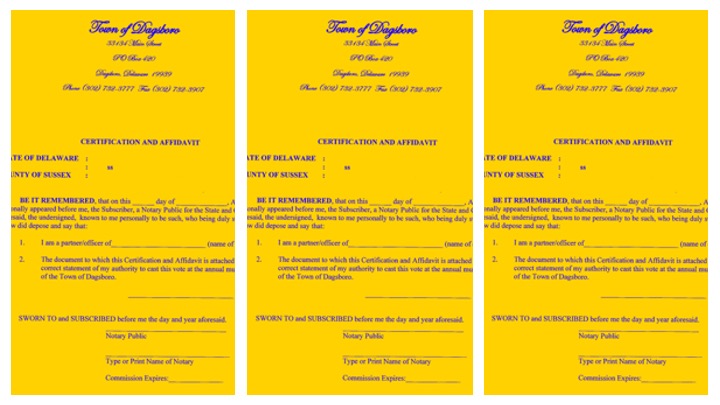
For the curious and civic-minded, the Town of Dagsboro website explains local election procedures. If you are a human resident – but not lucky enough to be a property owner – you face some hurdles. You have to present yourself with identification and documentation at the Town Hall office, during business hours, to be certified and entered into the town voter registration book. (Unlike other Delaware municipalities, Dagsboro does not participate in the state voter registration system). Then, come election time, provided the clerk can find and verify you in that book, you can vote.
However, if you are a property owner – whether a natural person or artificial entity – your task is requires less of a time expenditure. Simply appear at the polling place with your name on a deed to a property within the corporate limits; and if “you” are a business entity – a partnership, or a corporation – you proxy must appear with that deed, plus “a certified resolution of said entity authorizing the person therein to vote for the entity.” Two pieces of paper, and you’re golden, no fuss, no waiting.
[1] The best and most detailed account of Delaware’s extraordinarily creaky administrative state that I have encountered is Penjerdel Corporation and Pennsylvania Economy League, Historical Development of Local Government in the Penjerdel Region, Penjerdel Governmental Studies 1 (Philadelphia, PA: Penjerdel, 1961), https://catalog.hathitrust.org/Record/005888599.
[3] 21 Del. Laws, c. 285: “An Act to Incorporate the Town of Dagsboro,” Approved February 9, 1899, pp. 549.
[4] 22 Del. Laws, c. 437: “An Act to Amend Chapter 285, Volume 21, Laws of Delaware, Being Entitled ‘An Act to Incorporate the Town of Dagsboro, Approved February 9, 1899’,” Approved March 31, 1903, p.435.
[5] Typical of press coverage of the charter is “Legislature,” News Journal, Mon, May 5, 1941, p.4. On Short’s wife’s pneumonia, “Mr. Short’s Sad Message,” Wilmington Daily Republican, February 24, 1899, p.2. On his dismissed bribery indictment: “Kent Bribery Cases,” Middletown Transcript, April 29, 1899, p.3, https://chroniclingamerica.loc.gov/lccn/sn84026820/1899-04-29/ed-1/seq-3/
[6] 43 Del. Laws, c. 161: “An Act to Reincorporate the Town of Dagsboro,” Approved May 14, 1941; “Legislature,” News Journal, Mon, May 5, 1941, p.4.
[7] On bond elections, 43 Del. Laws, c. 161, Sec. 22(B)6; on regular muncipal elections, Sec. 5(D).
[8] 68 Del. Laws, c. 138; “An Act to Reincorporate the Town of Dagsboro,” Approved July 9, 1991. On annexations, see Sec. 3(F); on muncipal elections Sec. 7(G); and on bond referenda, Sec 33(A)5
[9] “Legislature,” News Journal, Thu, June 20, 1991, p.19; “Legislature,” News Journal, Thu, June 27, 1991, p.15; “Legislature,” News Journal, Sat, June 29, 1991, p.7; Nancy Kesler, “Castle OKs restrictions on adult entertainment,” News Journal, July 10, 1991, p.12
On the Susex sewers saga – which involved the legislature overturning a Chancery Court decision within weeks of its announcement – see: Bruce Pringle, “Court Blocks Sewer Plants Outside District,” News Journal, Wed, Mar 21, 1990, p.1; Bruce Pringle, “Sussex: Change Sewer District Rules,” News Journal, Thu, Mar 22, 1990, p.1; Bruce Pringle, “Sussex OKs boundaries for sewer district,” News Journal, Fri, Mar 23, 1990, p.5 ; Nancy Kessler, “Castle Signs Sussex County Sewer District Bill,” News Journal, April 19, 1990, p.22; “Sussex County Has Eye On Parcel,” News Journal, May 30, 1990, p.2; Bruce Pringle, “Decision on Sussex disposal site expected within 2 weeks,” News Journal, Thu, June 28, 1990, p.1; Bruce Pringle, “Piney Neck Picked for sewage disposal site,” News Journal, Wed, July 4, 1990, p. 1
[11] Google translate latin for “With Sewers and Corporations, [the] City.”
Much like the recent revisions to state law themselves, these reactions to mild criticism are expressions of myopia. Criticism of the sort SB 313 attracted in 2024 – that it proceeded anti-democratically, that it harmed ordinary people, that it was motivated by a small set of special interests’, and would lead to abuse – were leveled at Delaware state legislators when the state’s corporate law first passed in 1899.
If anything, earlier observers of Delaware corporate law in the Gilded Age were far more blunt in their criticism than anyone in the 21st century has ever thought about being. To illustrate, lend your eyes to this brief article from the American Law Review, a legal journal based in St. Louis: “Little Delaware Makes a Bid for the Organization of Trusts,” American Law Review 33, no. 3 (May-June 1899): 418–24.
Well-known to Delaware lawyers – and recently, at least one historian – the article takes the form of an unsigned “note,” one of a few dozen that appeared at the back section of every journal issue, after the treatises and articles, but before the listings of recent major court decisions. My assumption is that it is either written by the editors, Seymour D. Thomson and Leonard A. Jones, or one of their close associates – and either way expresses their editorial views.
And my goodness, are the Am.L. Rev. editors unimpressed with Delaware trying to copy New Jersey’s loose corporate charter rules, much less their attempt to “improve” on them by giving corporations even more expansive powers. After some praise for Delaware’s old Democratic (and enslaving) political establishment (and some sharp elbows at the emerging state Republican party), the editors note that the curious feature of US federalism – that state sovereign powers are equal, and that states set corporate law – is what provides the temptation that Delaware has now given into:
“The “sovereign” States of the American Union are equal: equal in the Senate, for little Delaware wields the same voting power there as does great New York. They are also equal in regard of the deviltry they can do – equal in regard of the injury they can inflict upon their sister States. It is as though a Klondike gold mine had been discovered in New Jersey, and all Delaware were on the rush to get there. In other words little Delaware, gangrened with envy at the spectacle of the truck-patchers, sand-duners, clam-diggers and mosquito-wafters of New Jersey getting all the money in the country into her coffers, – is determined to get her little tiny, sweet, round, baby hand into the grab-bag of sweet things before it is too late.” (p. 419)
And, the editors note, this law will be a jobs-employment program for Delaware politicians; they may need to even import labor:
“But with this exception; and herein the little great “State of Delaware” casts its little great anchor to the windward. Although ” any three persons may organize a corporation,” yet ” only one director need be a resident of Delaware.” And this ” one director'” is going to be paid for being a director, and don’t you forget it. If the rush to organize corporations and trusts under this new Delaware law is as great as under the New Jersey law, there will not be politicians enough in Delaware to serve as directors of corporations and trusts for all the other States of the Union, but professional directors will have to migrate to Delaware from other States, and their name will be Legion.” (p.420)
Delaware legislators’ grandiose proclamations about their new law’s global applicability seem to be particularly grating:
” Nor will you be confined, in the conduct of your business, when so happily incorporated, to your drought-smitten and grasshopper-eaten prairies. “It,” – that is to say you when you have turned yourselves into Delaware corporations – ” may conduct business anywhere in the world.” Certainly you may. Why not? The great State of Delaware says so, and is not that enough?” (p. 421)
Halfway through, the editors re-frame their note as addressing the great political enemies of the Big Corporations in this particular moment – the hardworking, Populist Party-supporting farmers of Kansas. (This is for rhetorical effect; I doubt too many populists were reading this attorney-specialty journal). And in this section, the editors suggest that should these farmers try to use the state power they control, they’ll face a potent force – in law, if not actually in the military.
“If Kansas attempts, through its legislation, to interfere with the sovereign prerogatives of Delaware, Delaware will be there with its oyster-boat and clam-boat navy, and with its unterrified militia; and what then will Kansas do about it?” (p.423)
And then finally, they note the alchemical aspects of Delaware’s new law.
“Let us not forget, oh, toiling brothers of the Kansas deserts, one other feature of this congenial law: 6. “The liability of the stockholder is absolutely limited when the stock has once been issued for cash, property or services.” Brother, do you need to photograph this sentence by means of an X-ray? Can you not see through it? Is it not pellucid ? It says, ” issued for cash.” It does not say paid for in cash. Is it not ” issued for cash” when it is issued for the promise of cash? and is it not issued for property or services when it is issued for the promise of such commodities? And if the gold bugs, bond- holders and other octopi, should render it hard to redeem your promise to pay for your shares – even in chips and whetstones, – why should you so pay? You have launched your corporation; the sovereign laws of Delaware allow you to commence business before any “sum whatever was paid in; ” and who or what is going to stop you from continuing your business? Do you not see that here is a scheme to turn the world into a sudden millennium? And if you object that a millennium must consist of a thousand years and cannot be created in a day, the answer is that all things are possible with the sovereign State of Delaware. What were the dreams of the ancient alchemists to this? They at most could, by processes somewhat tedious and expensive, convert gross metal into gold. But, without any gross metal of any kind to work upon, not even silver at the ratio of 16 to 1, the sovereign State of Delaware stretches forth her wand over the prairies of Kansas and calls upon money to come, and it comes.” (p.424)
What the irritated attorneys have described here is the central magic of finance, generally, and corporate finance, in particular. With some law and a bit of market faith – and a willingness to grift – you can conjure something out of nothing, and profit. Devolving sovereign power onto private parties who derive artificial persons, and then mortgage those “persons’ ” future cash flows for current income to actually do something (well, sometimes) – That’s Capitalism, Baby! If it feels like fraud, well, you probably don’t sit on the right corporate boards.
This is all to say that criticism of those would weave this kind of spell – and of Delaware legislators’ meddling in its magics, specifically – is nothing new in 2024. The First State’s legislators been catching heat for playing sorcerer’s apprentice, and carrying water for outside financial interests, for a very long time. Maybe they should get used to it? (Or, I dunno, change their ways?)
Or, An Investigation Into Just How Deep Delaware’s Commitment to the Bit Goes
Corporate Voters Project – Research Note #1
In Delaware, corporations can vote. So can LLCs, partnerships, and trusts, provided they own real property within the municipality where the election is taking place. In “The Company State,” capital not only has a voice – it has the franchise.
So just as I became a new, working citizen of Delaware, I discovered that my rights paled next to the those enjoyed by old, rentier capital.
Though the election raised many questions – as well as my blood pressure – in the busy season of a new semester on an unfamiliar campus, I let it lie as an oddity. In the wake of that bond election, there was enough concern expressed by other locals that the City Council petitioned the state legislature to revise its charter, to limit the franchise to human residents and human non-resident property owners “in accordance with the principle of ‘one person, one vote.’” The charter was successfully amended in 2019. [1]
But “dead labour” in the form of company capital, wasn’t done enlivening Delaware’s politics. In late spring 2023, news broke that the leaders of Seaford, DE had got a charter revision bill of their own introduced. It was the mirror image of Newark’s reform. Seaford wanted to empower a property owner, “whether a natural person or an artificial entity,” to vote in all town elections. (It seems the unpopular town council in Seaford was eager to substitute property for people, as voters). Delaware Republicans, eager to claim fifteen minutes of public infamy for supporting corporations’ right to stuff the ballot, used parliamentary tactics to bring the legislature to a screeching halt until the bill passed in the House. It did – though the measure was later quietly smothered in a Senate committee, and never became law. [2]
Needled twice by the news, my interest – and my ire – was piqued. And if that’s not a reason for research, what is?
~*~
If there was anywhere in the United States you might expect to find a corporation voting, Delaware is it. A state that only recently reached the milestone of one million human residents, the self-proclaimed “Corporate Capital of the World” is home to over two million business entities, including two-thirds of the Fortune 500.
Corporations and LLCs don’t come here for the beaches, though. They sink shallow roots into our clayey soils because the state government offers a uniquely “business-friendly” regime. In return for filing a simple registration form and paying some light taxes and fees, DE state officials ask few questions, and impose fewer regulations. When conflicts between companies arise, as they tend to in the hurly-burly world of modern business, Delaware’s uniquely commercially-oriented Court of Chancery offers speedy, jury-free resolutions. And if that service fails to satisfy, well, the Delaware legislature is ready to bend to meet the whims of capital with a flexibility an Olympic gymnast would envy.
While intentionally obscured from ordinary residents, “The Franchise,” so-called, is well understood by CEOs and corporate lawyers, as well as the state’s politicians and their lobbyist handlers. For multinational conglomerates, secretive shell companies, and mom & pop landlords alike, Delaware offers the best deal within U.S. territory for running your business cheaply, opaquely, and just “legally” enough.
This frictionless pliability pays for Delaware’s government. In fiscal year 2023, for example, the various fees and taxes levied on nominally Delaware-domiciled corporations and business entities provided $2.9 billion in revenue – a fairly typical 46.4% of total state collections. Whether clued in or not, all Delawareans are complicit in these arrangements. Their tax burden is low, yet their roads remain well-paved – because the First State has decided to use its sovereign power to charge a light toll in return for displacing the true costs of unchecked capitalism onto the rest of the nation, and the world. [3]
It’s a little gift, from our little state.
~*~
Still, even in Delaware, the idea that a corporation can vote gives people pause. It sure as heck arrested my attention, and puzzled me. So as the furor of the 2023 Seaford bill died down, and with my new hometown’s recent bond vote in mind, I’ve spent the last month or so digging into the practice of corporate voting in Delaware.
I’ve tried to keep my questions simple, obvious, and answerable:
How widespread is corporate voting? Does it only happen in Delaware towns, or beyond?
When did the practice take hold – and under what circumstances? Is corporate voting a relic of the state’s Jim Crow past, or a more recent disease of the body politic?
And finally: why? Of all the ways to arbitrarily pervert the democratic process to favor the wealthy, why have Delawareans chosen this method? And how is the local “corporate franchise” connected to “The Franchise” – if it is at all?
My research plan is similarly straightforward. I’ve completed the first step, a close examination of the current charters of all 57 municipalities incorporated in the state of Delaware.
Some early findings:
70% of DE municipalities (40 towns & cities) allow corporations and other “artificial entities” to vote in at least some circumstances, usually referenda on annexation and/or bonds;
Three towns (Dagsboro, Fenwick Island, and Henlopen Acres) allow corporate voting in all circumstances
The local corporate franchise is premised on property ownership: the “entity” must own real property within municipal limits (or proposed municipal limits, for annexations); and generally companies exercise their voting rights through a representative with power of attorney;
Most towns that allow corporate voting limit it using a “one person / one entity” rule – but not all of them do;
There is also a pronounced geography to corporate voting rights in Delaware: it gets more common as you travel south. New Castle County only counts 3 municipalities that allow it; Kent Co. has 16; and Sussex Co., land of beaches, chicken farms, and confederate monuments, has a whopping 21.
Since it quickly became apparent to me reading charters that property ownership is critical to local corporate voting rights, I also tallied how many Delaware towns enfranchise non-resident property owners, and found that:
81% of DE municipalities (46 towns & cities) allow non-resident real property owners to vote in at least some circumstances (again, most commonly annexation and bond elections);
However, fully 23% of them (13 towns & cities) allow non-residents to vote in all elections – and some even allow people who don’t reside within the municipality to govern, as members of the town council!
As with corporate voting, the enfranchisement of non-resident property owners is more common in Sussex (24 towns), than it is in Kent Co. (17 towns), with New Castle coming last in the number of municipalities that allow it (just 5 towns).
Now that I’ve gotten a sense of the current landscape of corporate and property-defined voting, my next task is to dig into the history of a handful of municipalities, using newspapers and legislative archives, to see if I can find out when – and perhaps why – this corporate citizenship first appeared.
I have no doubt but that further unpleasant surprises await; but that’s history, in Delaware.
[2] HS 1 for HB 121: “An Act to Amend the Charter of the City of Seaford Relating to the City’s Ability to Authorize Artificial Entities, Limited Liability Corporations’ Partnerships and Trusts to Vote in Municipal Elections Held in Seaford,” (April 20, 2023), https://legis.delaware.gov/BillDetail?LegislationId=130205.
In my calculation of the revenues generated by “The Franchise,” I include the corporate income tax, the franchise tax, the LLC/LP tax, business entity fees, “unclaimed property” (aka escheatment, aka Delaware skimming off of unused gift cards), and the bank franchise tax.






 Dael A. Norwood