The Past is a Foreign...Something

Bubbles, Apparently

Bubbles

This both charmed and baffled me when I ran across it:

Bubbles!

Hurrah for bubbles! I go for bubbles, my dear – stopping for a moment on his way through the large drawing-rooms, and looking at his wife and the baby, very much as a painter might do, while in labor with a new picture. ‘Bubbles are the only things worth living for!’

‘Bubbles, Peter! – be quiet baby! – hush, my love, hush! Papa can’t take you now!’ Baby jumps at the table.

‘Confound the imp! There goes the inkstand.’

‘Yes, my dear – and the spectacles – and the lamp –and all your papers. And what else could you expect, pray? Here he’s been trying to make you stop and speak to him, every time you have gone by the table, for the last half hour, and holding out his little arms to you, while you have been walking to and fro as if you were walking for a wager, with your eyes rolled up in your head, muttering to yourself — mutter, mutter, mutter — and taking no more notice of him, poor little fellow! than if he was a rag baby, or belonged to someone else’

‘Oh don’t bother! – little arms, indeed! – about the size of my leg – I do wish he’d be quiet – I’m thinking out a problem.’

‘A problem! fiddl-de-dee! [sic] – hush baby! – a magazine article, more like – will you hush!’

Papa turns away in despair, muttering with a voice that grows louder and louder as he warms up – ‘wisdom and wit are bubbles! – “atoms and systems into ruin hurled and men a bubbleburst! – and now a world!” – I have it – hurrah! – can’t you keep that child still !’

Thoughts?


Cite:
“Bubbles!” n.p., n.d., Box 5: Documents & Manuscripts, Cataloged, Park Benjamin Papers, Rare Books & Manuscripts Library, Butler Library, Columbia University

An archivist’s note on the document itself attributes the piece to John Neal (1793-1876). Emphasis and quotation marks are as in original.

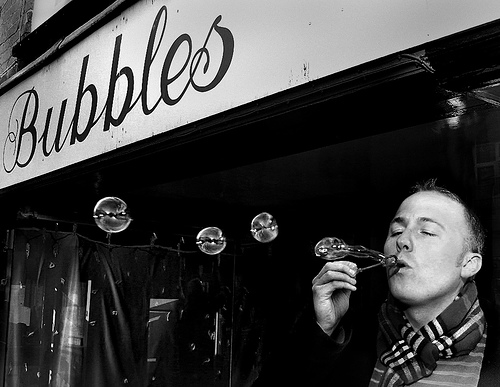
Image cite: Aeioux, “Bubbles,” Flickr, CC License

The Past is a Foreign...Something

John Murray Forbes and the Coolie Colony on St. John’s River, Part II

Boiler

The Unbearable Ubiquity of Steamship Accidents

Last we left John Murray Forbes, China trader and nascent railroad baron extraordinaire, it was 1860 and he was all het up about a possible Federal ban on the coolie trade. In a letter to a Massachusetts Congressman, he argued that banning this trade — as opposed to regulating it — would play into the Slave Power’s hands. Banning the importation of cheap Chinese labor would eliminate a source of free labor in the South, and thus remove a threat to the antebellum plantation complex.

He supported this point with a host of ad hominem attacks on a former American consul, and, more interestingly, an anecdote about a Chinese colonization scheme he’d once supported, but had subsequently dropped on the advice of a planter friend. Forbes’s unnamed interlocutor had made it clear that planters’ “jealousy,” of “any scheme of labor outside of their ‘peculiar institution’ ” would make such any importation of free labor untenable in the South.(1)

Thus was Forbes’s plan to simultaneously “improve the condition of the Chinese, and show in our tropics the benefits of free labor,” strangled in its cradle.

But let’s step back a moment. Who was this planter friend? And what was their actual exchange? How well does Forbes’s story in 1860 match up to what the document’s tell us?

Let’s start at the beginning. Forbes’s planter-adviser was one James Hamilton Couper, or as it’s misspelled in JMF’s published letters, Cowper.(2)
Continue reading “John Murray Forbes and the Coolie Colony on St. John’s River, Part II” →

Ivory Towers

A Question

Old Coins


Why is it that papers about money always read like Hegel wrote them? I.e. simultaneously Really Important and Uncannily Soporific.

Seriously folks, time to deploy some verbs, start using normal capitalization, and use words that make sense.

And then maybe I won’t fall asleep like four times while trying to read your work.

Maybe.


Image cite: Lesleyraez, “Old Coins,” Flickr, CC License

The Past is a Foreign...Something

I Feel Warm

Or, your daily dose of archival intrigue.

toasty
toasty

Two notes, One sheet:

First hand (top of page)

Will you do me the favour to destroy the papers I sent you last night — I may have spoken more unnreservedly of a third person than I ought — It is growing colder — will you have a fire.”

Second hand (bottom of page):

My dear Madam

I considered your paper precious to me, and I thought it better to keep it, but since you express a wish to have it destroyed, I will comply. No need of fire. I feel warm.”

Continue reading “I Feel Warm” →

History and Historians

#AmazonFail and History

World's Largest Axe

Two quotes, intentionally out of context*, from Clay Shirky:

Metadata is worldview; sorting is a political act.

and

We’re used to the future turning out differently than we expected; it happens all the time. When the past turns out differently, though, it can get really upsetting, and because people don’t like that kind of upset, we’re at risk of finding new reasons to believe false things, rather than revising our sense of what actually happened.

Worth thinking about; mainly caught my attention because I’ve been thinking a lot about history and tech for a while now. That, and the ax I’m grinding about the purpose of History (the discipline) being the eradication of nostalgia (in political spaces; keep the nice family memories).

h/t


*Context: ruminations on the moral failings of the #amazonfail furor

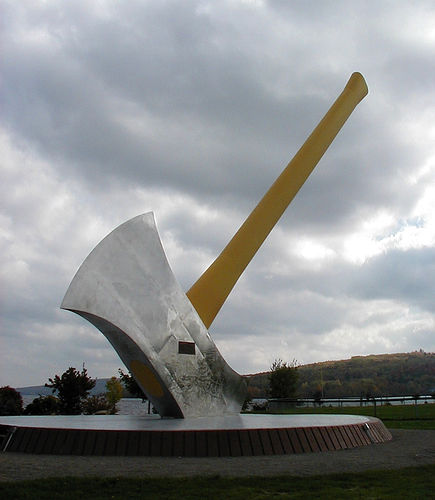
Image cite: Chris Campbell, “The World’s Largest Axe,” Flickr, CC License