Or, Thanks Buffalo
Historian
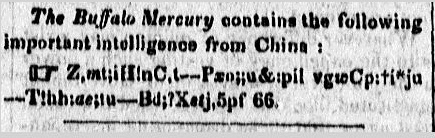
This from a Charleston, South Carolina newspaper:
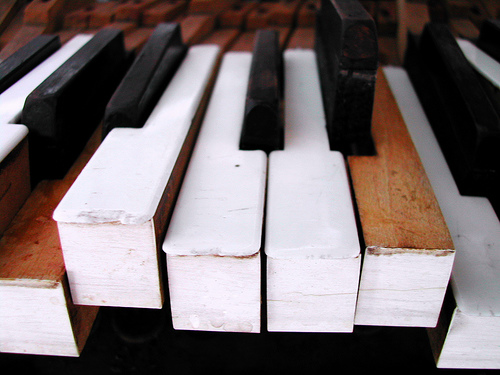
A New Article of Trade to China, in the shape of Pianos, is about to be tried.
The great difficulty of preserving pianos in the climate of Canton, owing to its extreme dampness has deterred many from importing them. Messrs. Dubois, Bacon & Chambers, however, Piano Manufacturers of this city, have just completed two, which, from the strength of their construction, a better mode of securing the parts, and great care in the selection of the materials, will, they confidently believe, resist the climate.
They are, moreover, instruments of great sweetness, compass and delicacy, and have been pronounced by eminent pianists of superior quality – N.Y. Amer.
~The Southern Patriot (Charleston, SC), 28 May 1838, p.2, col. 3
I’d say this is just more evidence that Americans were interested in East Asia far sooner than we give them credit for, but I think the Southern Patriot and the NY American were motivated more by boredom, than anything else, to run this story.
I say that, partly, because in the former’s case, the entire front half of the front page was taken up with this:
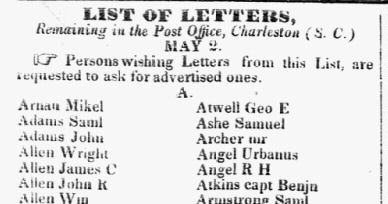
Talk about being the voice of the community. I wonder if they reminded you to pick up some milk at the store, too…
Image cite: Sashamd, “We have a map of the piano,” Flickr, CC License

Deep in the depths of catching up on e-mail and reading teh interblags, I just found a new blog, and I might be in love.
It’s The Scholar As Teacher, put out by Princeton’s in-house professional development office, the McGraw Center for Teaching & Learning.
Don’t let the bureaucrat’s dream of a originating body throw you: it’s attractive to look at, smartly written to take advantage of the bloggy medium, and, most important, offers some ideas on teaching — both tips and tricks for the classroom, and ways of thinking about teaching more generally.
Not things I personally have much cause to use at the moment (woo hoo summer! boo hoo dissertation!), but I’m filing it away in the category of “good procrastination” (think “good cholesterol”).
Reminds me, in tone and deliciousness of content, of the stuff that the CHNM folks put out.
And, not to be rude, but it’s a bit easier on the eyes than the Tomorrow’s Professor Blog. So there.
PS – “JBFC,” a tag for a lot of the posts over there, stands for “Just Back From Class.”
Image Cite: Ms. Tina, “An Apple for the Teacher (3/365),” Flickr, CC License

If pop-economics hasn’t crushed the joy out of enough of your life yet, now you can experience naive mechanical logic as applied to yet another ridiculous topic: comics.
I present to you Eco-comics.
(this moment of disciplinary name-calling brought to you courtesy of the joy-crushing geniuses at MR)
Image cite: Capt. Joe Kickass, “Economics Demotivator,” Flickr, CC License

Though, in fairness to Mr. Jackson, I think this one was much more sincerely offered:
Unfortunately, for the Captain and his Guard the animosity ran deeper than a few office seekers. Both Cushing and Tyler received “hate mail” from around the country. Vituperative James Campbell of Philadelphia urged Cushing to intercede and persuade Tyler, “a miserable, paltry, third rate county court scoundrel,” to resign. Campbell, somewhat more irrational than most of Cushing’s correspondents, suggested that for his treason to his party Tyler should “have his privates cut off and while yet still alive to have them nailed to a cross as a warning to political traitors hereafter.” In case any doubt existed he attached a graphic color rendering of his intent.
~John M. Belohlavek, Broken Glass: Caleb Cushing and the Shattering of the Union (Kent, Ohio: The Kent State University Press, 2005), p.136.
Here’s the primary source cite for the letter and “graphic color rendering”: James Campbell, Philadelphia, July 16, 1842, to Caleb Cushing, in Caleb Cushing Manuscripts, Library of Congress.
Yikes.
Image cite: Tony the Misfit, “John Tyler, 10th Union President, Confederate Congressman,” Flickr, CC License

