Lots of people find this blog by searching for “bacon”
Author: daelnorwood
Print is New Media
Or, Back in My Day, We Used to Write the Newspapers By Hand — Both Ways!
Random Google hits are fun:
Between 1844 and 1854 there were at least three handwritten newspapers published in the frontier town of Washington, Iowa. They were the “Domestic Quarterly Review,” the “Washington Shark,” and the “Quarterly Visitor.”
While calling Iowa part of the Old Northwest is a bit of a stretch (it was part of a separate land grab, part of the Black Hawk territory), this sounds pretty interesting. Also, my next band/baseball team/journal is going to be called “The Washington Shark.”
Here’s the paper from whose abstract I pulled the quote:
Roy Alden Atwood,“Handwritten Newspapers on the Iowa Frontier, 1844-54,” Paper presented at the Annual Meeting of the Association for Education in Journalism (63rd, Boston, MA, August 9-13, 1980).
Ctrl+C, Ctrl+V, Can’t Control Me
Or, Limited (Antebellum) Government in Action

So: there I was, reading through the official “instructions” (orders) to Commodore Lawrence Kearny, commander of the East India Squadron, on how he was to engage with the Chinese authorities while on his mission to protect American commerce during the first opium war … when I ran across this:
Heretofore on the arrival of an American vessel in the waters of China, the Chinese authorities have always been given to understand by the American merchants, that the principal objects in view, were to visit desolate Islands for the purpose of rescuing shipwrecked mariners, & returning them to their native Country; to capture piratical vessels preying on their commerce; and to instruct their young men and boys to navigate vessels of war. – It might be well to keep up such impressions in the minds of the Chinese, as they are not incompatible with what you are to represent as you leading object, namely to prevent the smuggling of opium under cover of the American Flag, which your government has understood had been, or may be attempted by other nations.
~Sec. James K. Paulding to Com. Lawrence Kearney, Navy Department, 2 November 1840, Roll 32,
M149: Letters Sent by the Secretary of the Navy to Officers, 1798-1868 (Washington: NARA, 1950)
Huzzah what? Americans had convinced the Chinese that they were only sending warships up to Canton to teach kids how to sail and play rescue boats? And that was a ruse to continue in the name of better relations? Weird, right?
Now, Secretary James Kirke Paulding, though an imaginative fellow, and good enough with a pen, was not among the finest diplomats or naval strategists of his day. And was certainly no expert on China.* So then the question becomes: where on God’s green earth did he get such an idea?
A few days later, I found a far more direct answer than I expected, in a letter from a prominent China trader to Paulding. A few sections of its paragraphs were marked with large X’s, as if to highlight them ; the paragraph excerpted below had two such marks:
“Heretofore on the arrival of American vessels of War in the Chinese waters, the Chinese authorities have always been given [to] understand by the American Merchants that their object was to visit desolate Islands [to] rescue unfortunate shipwrecked seamen & to return them to their country & friends, and to capture piratical vessels, and also to give instruction to many young lads on board, and to learn them to navigate and manage vessels of War.”
~William S. Wetmore to J. K. Paulding (SecNav), New York, 22 July 1840, roll 174, M124: Miscellaneous Letters Received by the Secretary of Navy, 1801-1884 (Washington: NARA, 1960)
Aha.
Gotta love cut and paste governance.
I don’t know for sure if what Wetmore says is true, but I strongly suspect that the probability of the U.S. mercantile community at Canton maintaining a stable set of lies for nearly 60 years is quite low — so at best this particular bundle of nonsense was only laid on the Chinese once or twice.
Though to be fair to Paulding, this kind of drafting of orders appears to have been (or have become) normal procedure. A few years later, when preparing for Caleb Cushing’s mission to China, then-Secretary of State Daniel Webster sent out a form letter to American merchants active in the trade asking for information and advice:
Sir:
You will have learned that, under the authority of an act of Congress, a public mission is about to proceed from the United States to China, for the purpose of cultivating friendly relations with that Empire, and of opening and enlarging, as far as practicable, commercial intercourse between the two countries.
For its own information, and the use of the mission, the Government desires to avail itself of opinions and suggestions of intelligent persons, who have had personal acquaintance with that country, or have been concerned extensively in the trade between it and the United States.
The general objects of the mission sufficiently indicate the points to which these suggestions may refer.
Any communication from you upon the subject would be gratefully received by this Department.~Daniel Webster, Circular, Department of State Washington, March 20, 1843, roll 101, M179:Miscellaneous Letters of the Department of State, 1789-1906 (Washington, DC: NARA, 1963)
Basically, this is step one of a process analogous to that which led Paulding to use Wetmore’s advice verbatim.**
Say what you will in favor of limited government, but it has its drawbacks: namely, when the time comes, your bureaucracy knows absolute squat about anything, and you have to depend on the kindness of strangers to help you sail (literally, in this case) the ship of state.
*Yes, that is his actual name. No, he was not awesome enough to have it — though he did have a certain way with words, even when he was wrong wrong wrong.
For example, here’s JKP on feeling pressure to build steam ships for the Navy: ” After asking how anyone could ‘consent to let our old ships perish, and transform our navy into a fleet of sea monsters,’ James Paulding gasped: ‘I am being steamed to death!'” Stephen Howarth, To Shining Sea: A History of the United States Navy, 1775 – 1998 (Norman, OK: University of Oklahoma Press, 1999), p. 141
**The situation was even a bit sadder than that, because Webster — despite all his contacts / backing from Northeastern merchants — also did not know which ports dealt in the trade, and which had to first find out who the major China traders were. A few days before he sent out the form letter, he asked the each of the customs collectors of the major East Coast ports to compile a list of merchants “interested” in the China trade; this list appears to have served as a basis for soliciting further advice.
Antebellum America Salutes the British Empire!
One Fingered, Naturally

In April 1841, whilst conducting the East India squadron to Chinese waters to safeguard American merchants against from harm during the First Opium War, Commodore Lawrence Kearny received some interesting supplementary orders:
“Sir,
It is understood that the citizens of the U. States who were made prisoners by the British forces during the late troubles in Canada [e.g. the Rebellion of 1837], and subsequently banished to distant parts of the Globe, are at liberty to return to their native land, but have no means of conveyance – Therefore, should the Constellation or Boston fall in with any of those persons, it is the desire of the department that a free passage to the United States should be offered them.”
~George E. Badger to Lawrence Kearney, Navy Department, 23 April 1841
In other words, Kearny – and any and all other Navy captains – was to give Americans who had been transported to Australia, and similar, as punishment for participation in a rebellion a free ride back to the good old U.S. of A.
Maybe not quite as egregious as if Saudi Arabia started playing taxi for GTMO detainees – but certainly in the same ballpark of diplomatic subtlety.
The early 1840s were not great years for Anglo-American relations, needless to say.
1.) “Squadron” was the somewhat grandiose title the Navy applied to the grouping of the 42-year old frigate Constellation and the sloop-of-war Boston under one command.
Theske Slijkerman, “Irritatie,” Flickr, CC License
Unacceptable
Or, They Got the Letter, but not the Spirit
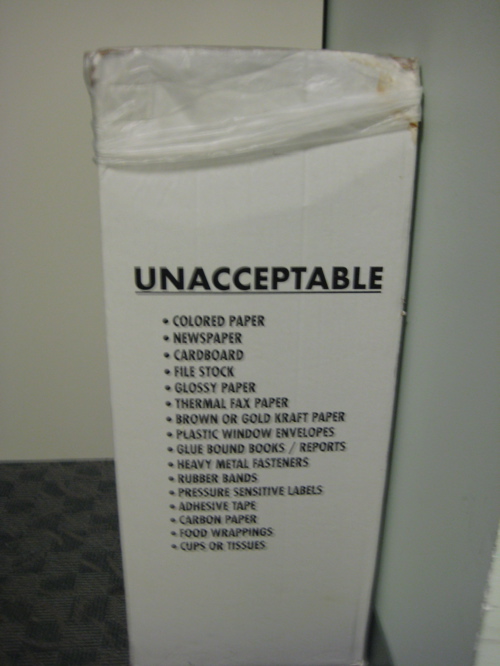
From the microfilm room of the National Archives, Washington DC branch. It’s a recycling bin, I think.
On a related note: archives are fun, but so are days where you don’t have to empty your pockets and have all your personal effects X-rayed to go get a cup of coffee.
(Also: sorry for the poor image quality, but I didn’t want to use a flash in a dimly-lit microfilm room, and possibly incur the wrath of whatever humorless troll made this sign)
Bonus!
Just a normal phone, no?

Oh but wait there is a helpful danger list! (click to embiggen)

From another (undisclosed) high-risk government office, where they keep moldy papers from 19th-century amateur science clubs. Woot!

