Uncategorized

Duly Noted

In the (b)Log

ChainLinkage

Folks, I’m in the middle of backing up The Establishment here in Washington, and preparing to open up shop In Merry Ole soon, with stops at the someday-hopefully-an-alma-mater, so nothing substantive for the moment. But just so you don’t think I don’t love you, here are some Links To Amuse:

Unnatural Lincoln-Calhoun hybrids
I’m fairly surprised at the compositor’s (ideologically and morally) bizarre choice. I am emphatically not surprised that the first Cowen/Tabarrok co-production was about the public choice theory of the Marxist of the master class.

(Bonus! In the comments, someone declares Calhoun “a good looking man,” further demonstrating to what heroic lengths some people will go to be wrong.)

Ranke and his Archive of Truth gets the History of Science Treatment (nb: paywall for non university folks)
(h/t to Historiography Lab)

Three series of historical iconographyof the Tower of Babel.
Fascinatingly variable, apparently. (h/t)

The State as a nexus-of-contractors
A really interesting idea from one of the brilliant orgtheorists, which I wish I had time to think about a bit more fully, but don’t right now. Seems esp. relevant to the early 19th century, when the American federal state, was largely contractors.


Image cite: Max Klingensmith, “Chain Linkage,” Flickr, CC License

Archival Follies

Index of Awesome

Or, Craaazy Cross-Referenced Cacophony of Cool

nph_unicorn

Sometimes you can tell a source is going to be good just from the index.

Case in point, some selections from the index to the “Squadron Letters” (reports to the Navy Department) for Commodore John H. Aulick’s cruise to China, 1851-1853:

California Joe, Chinese coolie, participation in mutiny on the ROBERT BROWNE, 510
…
CELESTIAL, American clipper ship, chased by a fleet of piratical junks, 565, 685
…
Flag, United States:
Insult offered to, by the govt of Zanzibar, 267
Saluted by the govt of Zanzibar, 238, 239, 262, 265
…
Flogging, effects of abolition of, in the US Navy, 99, 100, 161, 162
…
Shipwrecked Japanese mariners:
Death and burial of leader, 717
Protest their return to Japan in one of our warships, 477, 478
ST MARYS ordered to receive them on board from U.S. revenue cutter POLK, 761
Thirteen of, still on U.S.S. SUSQEUHANNA, 566
Transferred to U.S.S. SUSQEUHANNA from U.S.S. ST MARYS at Macao, 417, 418
…
Sultan of Muscat and Zanzibar
Detained at Muscat by troubles among Arabian subjects, 230, 261
Not at home, 226
…

Busy trip, eh? And I’ve left out most of the mutinies.

Unfortunately, awesome means lots more work. Everything has a price…

Archival Follies, History and Historians

Guess the Ref

Or, Am I Doing Digital History? Like Right Now? …. How about now?

Steampunk_Desktop

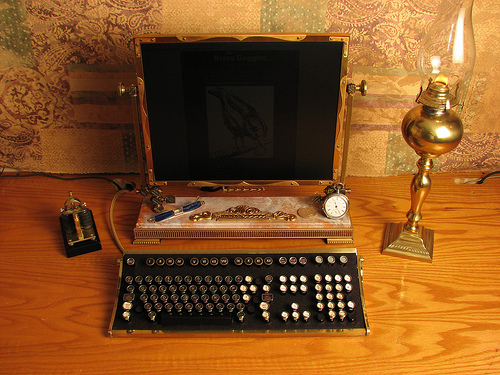
Following a conversation with fellow grad student, also excited about the applications for new media, and after perusing an old issue of Perspectives, I came back to a knot of questions that’s bothered me since I started my graduate career (oh distant day!) How does one do digital history? Am I doing it right now? How is it different than analog history? And, not to forget that classic historian’s question: So what?

Things like this keep me up at night because I cut my teeth, intellectually, reading the manifestos of the Free Software movement (now in tamer, if more ubiquitous, form as the Open Source movement/industry). My heroes were phone phreaks, Richard Stallman, white hat hackers, and Melvil Dewey (not in that order). I was the kid bothering the Barnes & Noble clerks once a month to ask if the newest issue of 2600 had arrived yet (and no, the irony of asking for a copy at a chain store was not lost on me). I was thrilled by the idea that the ethos of yippiedom could be channeled to do cool, anti-authoritarian, productive things, like make operating systems with recursive acronyms. It fit with my other nerd-love, the library, and the potential for democratic education that it represents.

All a way of saying that my predilections are entirely in the utopian internet evangelist camp.

Continue reading “Guess the Ref” →

Golden Ghetto, History and Historians, Our Glorious National Heritage

A Brief Account of Cushing’s America

Or, Contractually Bound, Peaceful, Prosperous, and Surprisingly Plural

FanFlag

~I~

A portrait can tell you a lot about a person. Especially one done in the older style — before the head shot — where objects and landscapes were visible at the margins of the frame. The value lies, not it its status as as a representative image of a person (though that’s usually approximated), but rather in what it says about both the idealized self of the person pictured and the cultural context within which they lived – the materials from which they pulled together their ideals. In trying to squeeze information from such paintings, a nose for discrepancies – in historical ones, our sense of what’s foreign about the past – are among our best tools, and have long served historians well.

(Of course, the information thus obtained is as much a creation of our own selves as it is of those pictured in the past … but that’s history, folks.)

As luck would have it, the archival record of the first American diplomatic mission to China gives us an opportunity to do the same thing for the United States. From the pen of Caleb Cushing, U.S. minister to China, we have an idealized portrait of the country in the form of a memo he drafted for circulation among Chinese officials and merchants.

He wrote the piece, he explained to his superiors, to correct the “very imperfect and incorrect notions” in China “as to the constitution and character of the United States.” At the end of July 1844, the State Department received a copy of the 1,200-word pamphlet that Cushing, with input from other members of the legation’s staff, had written and translated into Chinese. In his cover letter for the pamphlet, he promised to deliver it “to official and other persons in China” to help achieve the mission’s goals, and further U.S. interests in general. He called the memo “A Brief Account of the United States.”

Cushing’s memo was not the first attempt at American image control in China, of course. The American mercantile community was no stranger to keeping up particular (and peculiar) appearances at Canton. But Cushing’s mission in 1844 was the first instance of an official, organized, and duly deputized national self-presentation to China, and as such should be accorded a bit more weight. He represented more — at least to his countrymen — than the aggregate of a dozen mercantile houses.

More than a PR piece, though, what Cushing had written was, in effect, a snapshot of what he thought the U.S. was, or should be, refracted through some ideas about what he thought would appeal to the Chinese.

Continue reading “A Brief Account of Cushing’s America” →