Or, Corporations are Pardoned People, Too
News on the “government treating corporations like human people” beat…
Ava Benny-Morrison reported for Bloomberg this week that Trump has been extending pardons to businesses. Most recently, in early July he pardoned a clutch of truck repair and fleet services companies – LLCs and corporations – found guilty of conspiring to violate the Clean Air Act, extending clemency to the individuals involved and wiping away the fines their businesses owed. The beneficiaries of the big man’s largesse were not precisely the “car dealers” that some use as shorthand for the (not-so) petite bourgeoise that have driven the rise of fascism in the US – but they come damned close, and definitely fit the “American gentry” profile of the MAGA base.
This wasn’t the first time Trump has used the presidential pardon power to wipe away the reparative debts of artificial persons, however. He started his term by erasing consequences for two much larger financial criminals: HDR Global Trading Ltd. (d/b/a BitMex) and Ozy Media, Inc. Both were guilty of large-scale white collar crime (violating laws against banking secrecy in the course of running a crypto exchange, in the first case, and wire fraud, and securities fraud, in the other).
One pattern in the pardons: the companies pardoned for financial crimes were both registered in Delaware (HDR Global Trading Ltd. was registered in the Seychelles, but in its guise as BitMEX it was a DE entity; Ozy Media Inc. simply as itself), while the conspiring trucking companies were all registered in the states they actually did business in (Michigan, Idaho, and Oregon)
Pardoning corporations – like allowing them to vote! – is not a well-studied subject. Bloomberg’s reporter linked to a U. Chicago Law Review study – published, notably, after Trump’s first corporate pardons – that seeks to provide a post hoc justification. That article is a typical effort in the “originalist” school, seeking to substantiate executive action by locating an authorizing precedent – in this case in the acts of Stuart tyrants. The article is not intended as a historical analysis – and it isn’t – but it does go beyond legitimizing Trump’s actions by arguing that states, too, could pardon companies if they so choose. (So mark that federalist solution as a future option for corporate corruption, in the event a MAGA regime is no longer in power, nationally.)[1]
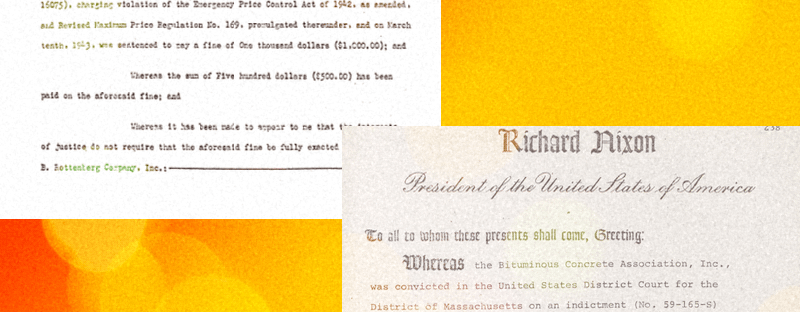
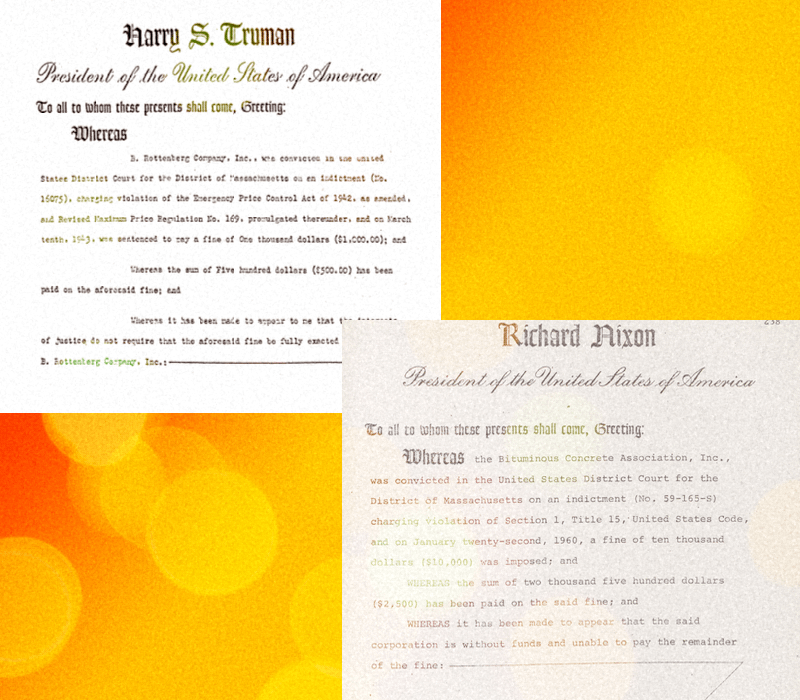
While we’re on the topic of historical precedent: Bloomberg claims that Trump “is the first in modern US history to issue clemency to businesses” – but that’s not true.[2] A quick search of the collection of clemency warrants the DOJ’s Office of the Pardon Attorney has shared online – which runs from 1945-2009 – reveals that Harry Truman and Richard Nixon both commuted fines levied on corporations. Since this collection is limited and poorly scanned (and thus difficult to search), there may well be many more such examples in the history of the US – though I would be surprised if any prior presidents exercised this derogatory prerogative so frequently, or in the expectation of any direct personal benefit (maybe Truman, he liked to pretend to be poor) [3]
[1] On this argument that states have powers to pardon corporations, see: Brandon Stras, “Pardoning Corporations,” U. Chi. L. Rev. 92, no. 8 (2025): 2359–63, https://doi.org/10.2139/ssrn.5202339.
[2] Timothy Noah, riffing similarly ahistorically, claims Trump “invented” this power, and locates the origins of corporate personhood in the infamous 1886 Santa Clara County v. Union Pacific Railroad decision. Timothy Noah, “Trump Invents the Corporate Pardon,” The New Republic, July 23, 2026, https://newrepublic.com/article/213393/trump-corporate-pardons-rise.
While a common refrain on the left, that reference is not quite accurate, either. Since they emerged in the early modern era corporations have always been legal persons, bodies politic that – at the pleasure of the sovereign – serve as containers for groups of people that can act together and be treated by other entities (governments, economy agents, etc) as individuals. What’s changed over time is what rights they can claim, and that’s where Santa Clara was important; it applied the 14th amendment to “persons” none of the framers of that law had – at the time – considered relevant.
[3] See: No. 56, “B. Rottenberg Company, Inc.,” September 11, 1952, Executive Clemency Warrants, President Harry S. Truman, pp.111-112 and No. 238, “Bituminous Concrete Association, Inc.,” December 23, 1969, Executive Clemency Warrants: President Richard Nixon, pp. 1021-1022; available “Clemency Warrants (1945-2009),” Office of the Pardon Attorney, April 27, 2026, https://www.justice.gov/pardon/clemency-warrants-1945-2009.
Oddly, Stras notes the existence of the Nixon commutation – tracing a citation to it in a DOJ memo – but then says “this claim is hard to verify” while linking the primary source that could verify the claim. Perhaps examining primary sources is beyond the scope of legal scholarship? See Stras, “Pardoning Corporations,” U. Chi. L. Rev. 92, no. 8 (2025): 2347n137.


