[It’s been too long since I had a post, so here’s something with a bit of Christmas theme, cobbled together from my instagram and the closing lecture of my US survey course this year – DN]
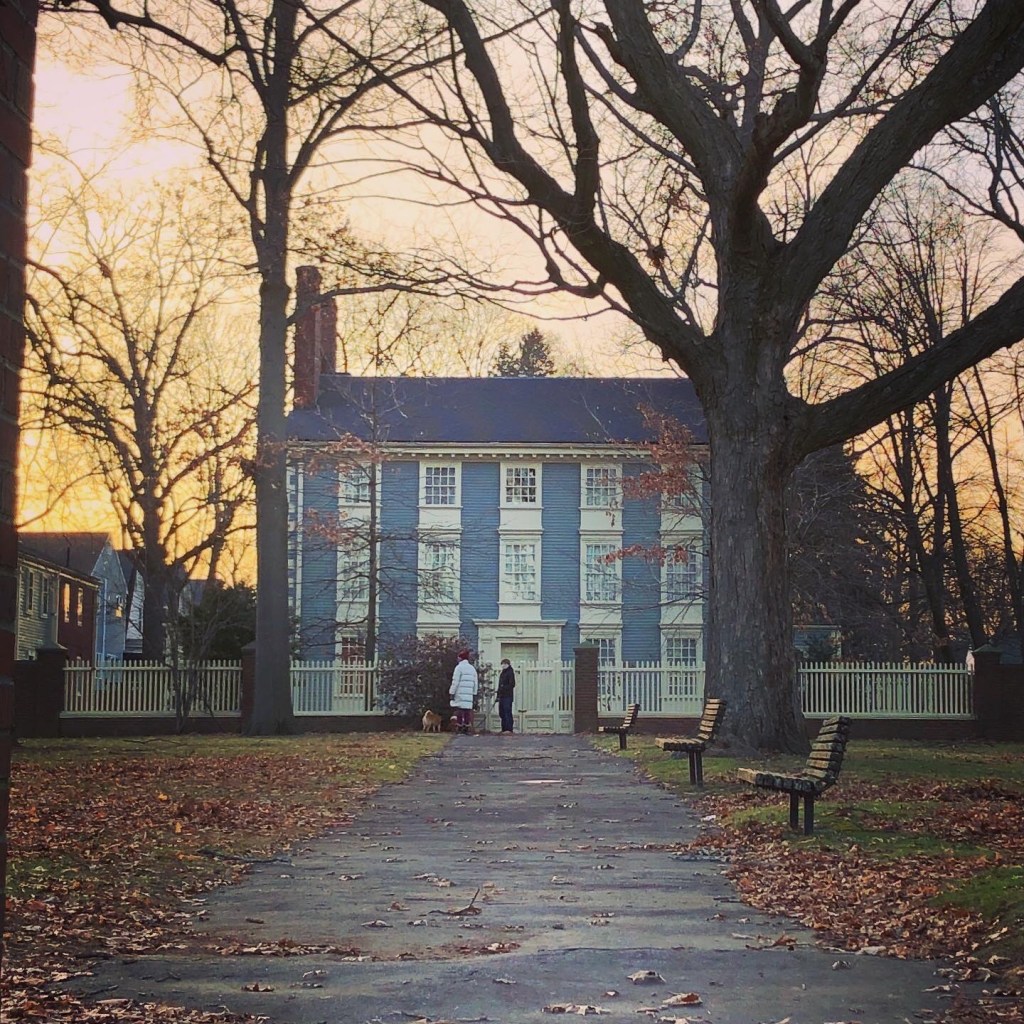
A few years ago, visiting family for Christmas, I stretched my legs for a walk in Medford, MA. Over the course of a short hour, I encountered three sites, all with historic markers, that together neatly illustrate the ways New England is defined by slavery – and how New Englanders have defined Christmas for the rest of the United States.
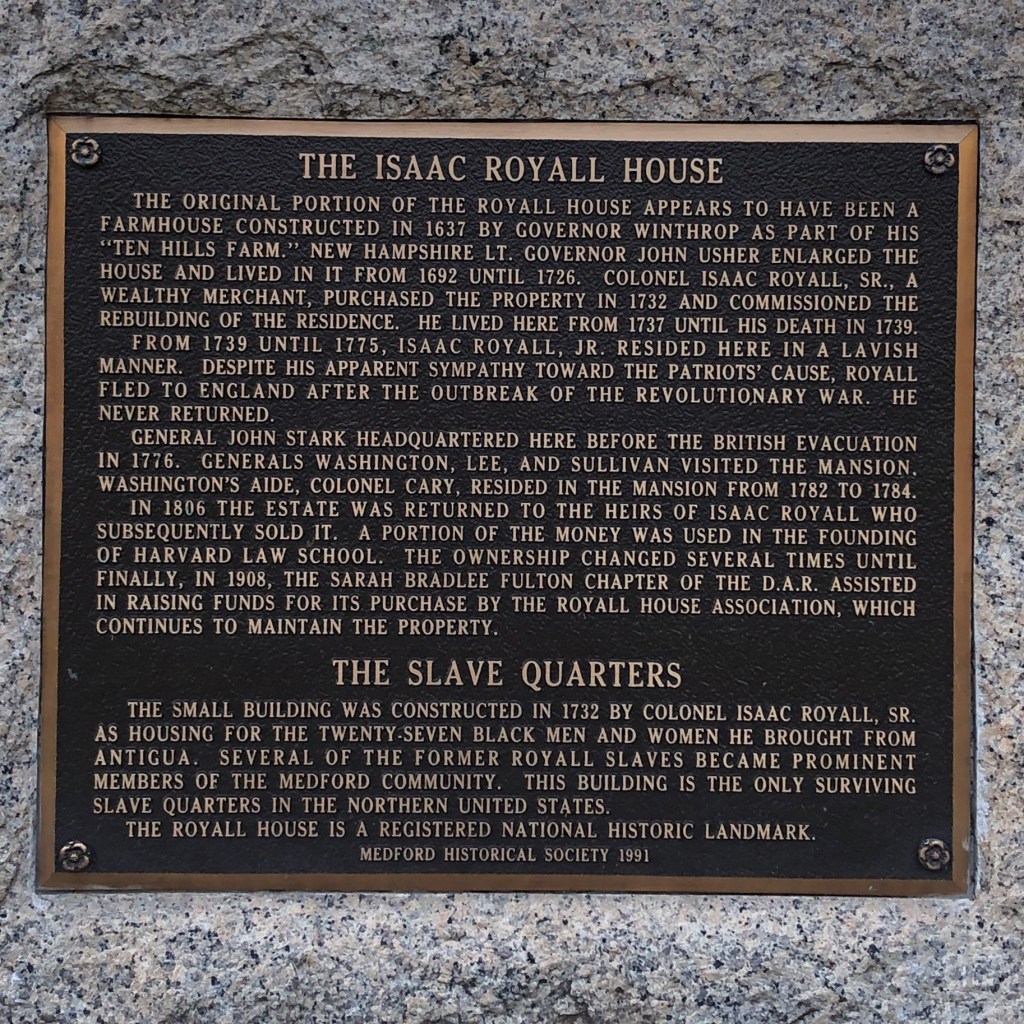
The first stop was Royall House, at the corner of George and Main Streets. An 18th-century estate built by a Massachusetts slave trader, rum distiller, and plantation owner, aka the unholy trinity of colonial New England business synergy. The building has long been known as a great example of local Georgian architecture – and thanks to a more recent interpretation, also of the central importance of enslavement and slave ownership to wealth among the colonial Massachusetts elite, too.
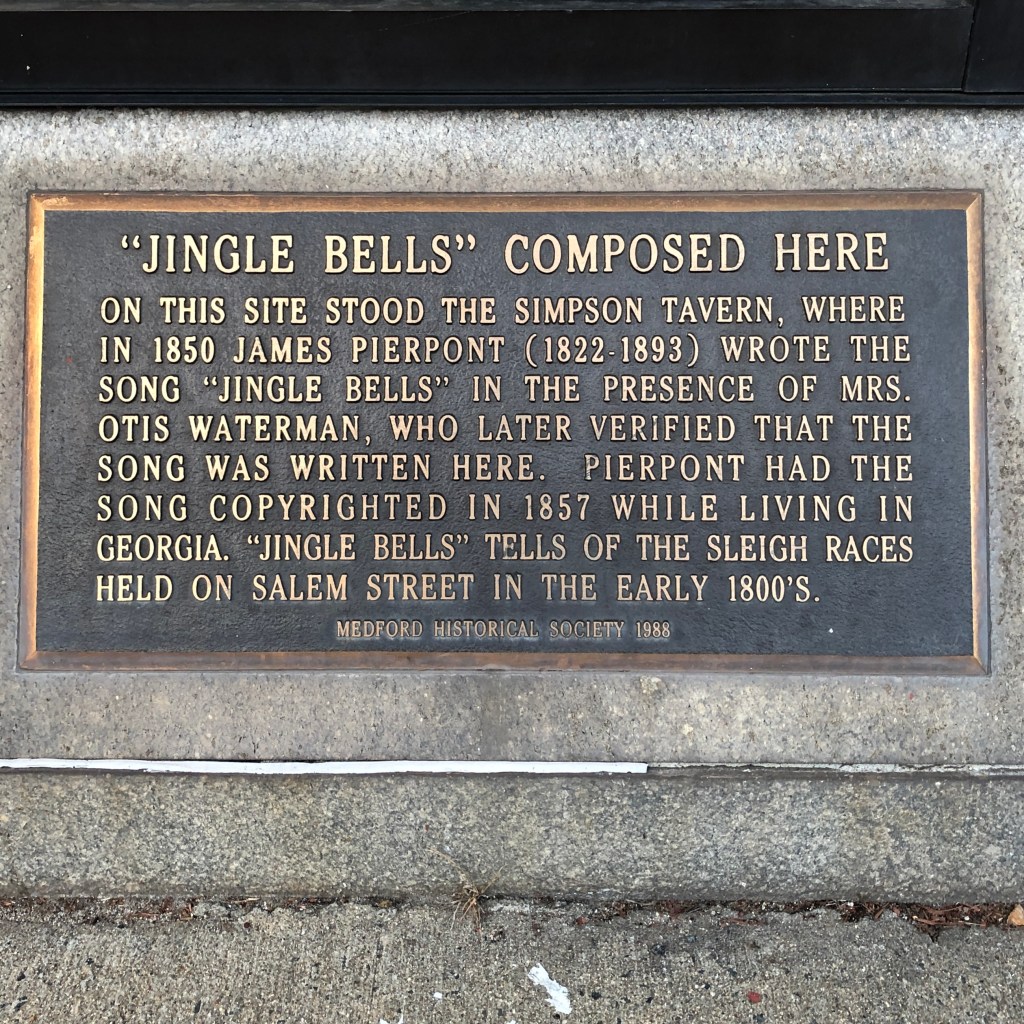
Next: Simpsons Tavern, on High Street.
It claims to be the site of the composition of “One Horse Open Sleigh,” in 1850 – better known today as “Jingle Bells.” It dominates holiday music now, but in the 1850s it was generic piece, one of dozens of contemporary “sleighing songs” about taking sexy, fast rides with single, fun girls. James Lord Pierpont published it in 1857; after failing as a whaler, gold miner, and photographer, he found success in writing it and similar pieces for minstrelsy singers, who performed his compositions in blackface. The uncle of J.P. Morgan (yes, that J.P. Morgan) Pierpont later moved to Georgia to teach piano, joined the Confederate Army, and wrote shitty ditty’s for rebel traitors before dying in Florida.
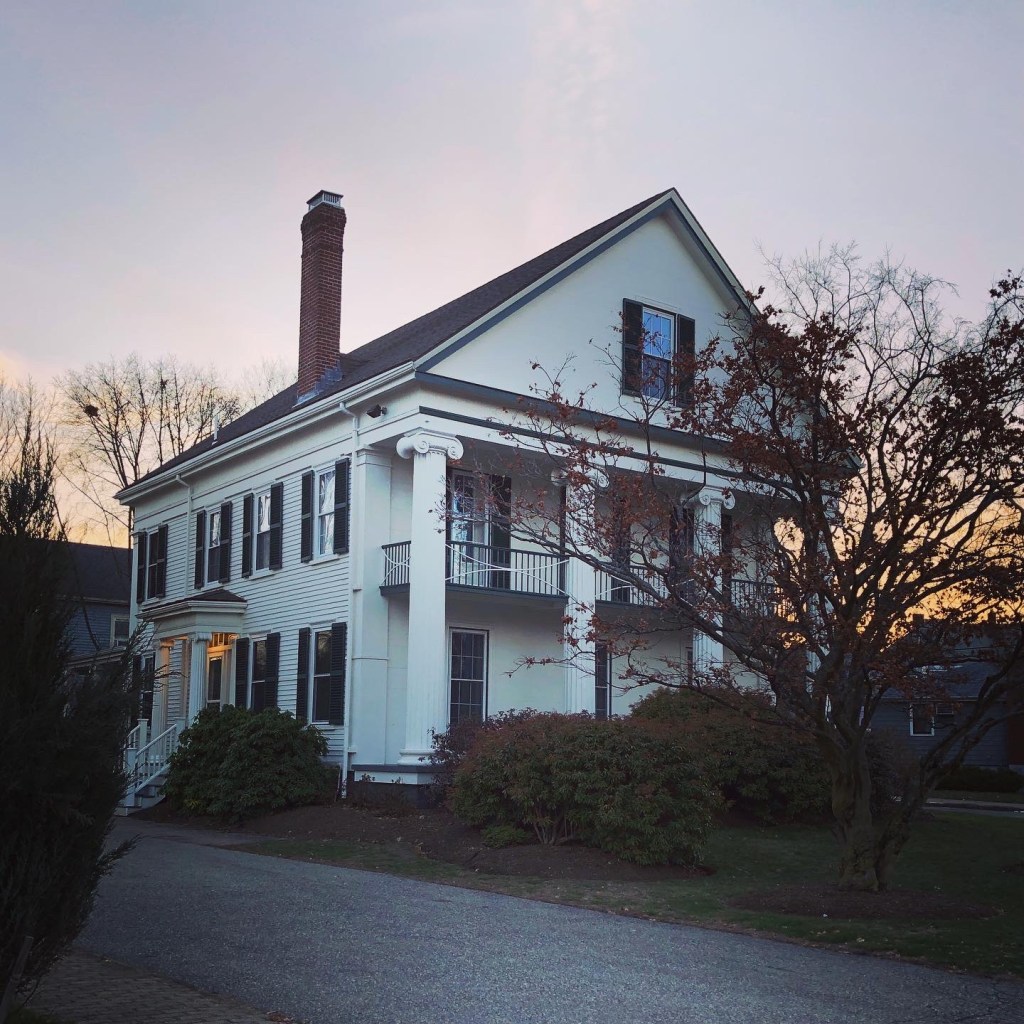
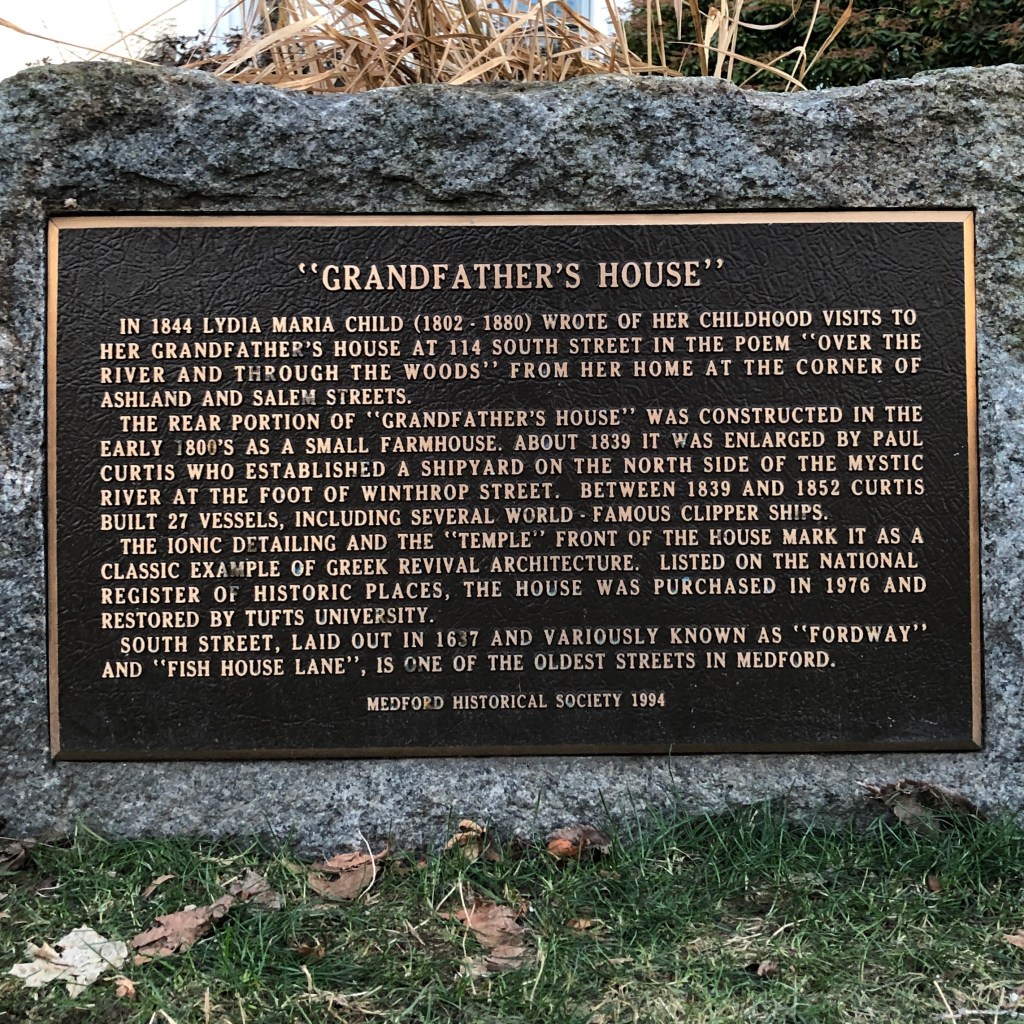
And finally, one last house: 114 South Street. Just across the Mystic river from Simpsons Tavern, it was the home of Paul Curtis, Lydia Maria Child’s grandfather. Curtis was a shipbuilder, famous for clipper ships designed to make quick voyages in the tea and opium trade.
His granddaughter Lydia was much more important, and famous. An activist, editor, author, and publisher, she was a powerhouse in reform movements to promote women’s rights, arrest the U.S. government’s mistreatment of Native Americans, and end slavery. (Among other things, she was the editor of The Freedmen’s Book, a collection of works by and about freed people, which includes the best epistolary work in the English language, Jourdon Anderson’s letter to his former enslaver).
Child made her childhood journey to 114 South Street the subject of a poem, “The New-England Boy’s Song about Thanksgiving Day” – a composition better known now from its first line: “Over the river and through the woods, to grandfather’s house we go.” Much like Pierpont’s cheap song, Child’s short poem helped fix New England winter as the image for the Christmas season (and winter, generally) in American culture. Hallmark movies would look a lot different without the two of them (and Currier & Ives).
Elite enslaver, racist failson, and effective abolitionist. You can see the spaces of all their lives within the circuit of short winter walk.
Or, What Value Did Role-Playing Have in 19th-Century Business School?
AKA Improv Everywhere, Even the Counting House
#BizManBook Research Note #4
Author’s note: this piece is an abstract draft for a proposed paper; that’s why the style at the end gets a bit formal and academic – or more so than usual. Space and time allowing, I’d rewrite it to be less so…but, well, space and time haven’t allowed.
Imagine you’re young, ambitious, and living in the hinterland of Gilded Age Chicago. Once burned (but never shy), Nature’s Metropolis is booming beyond a booster’s wildest dreams. It’s a gigantic, thudding piston, pumping the heart of North America’s capitalist machine. Every day the buildings are getting taller, the sky’s getting blacker with smoke, and the bellows from the stockyards louder and more baleful. It’s a city on the rise, figuratively and literally, and you want to get in on the action – but how?
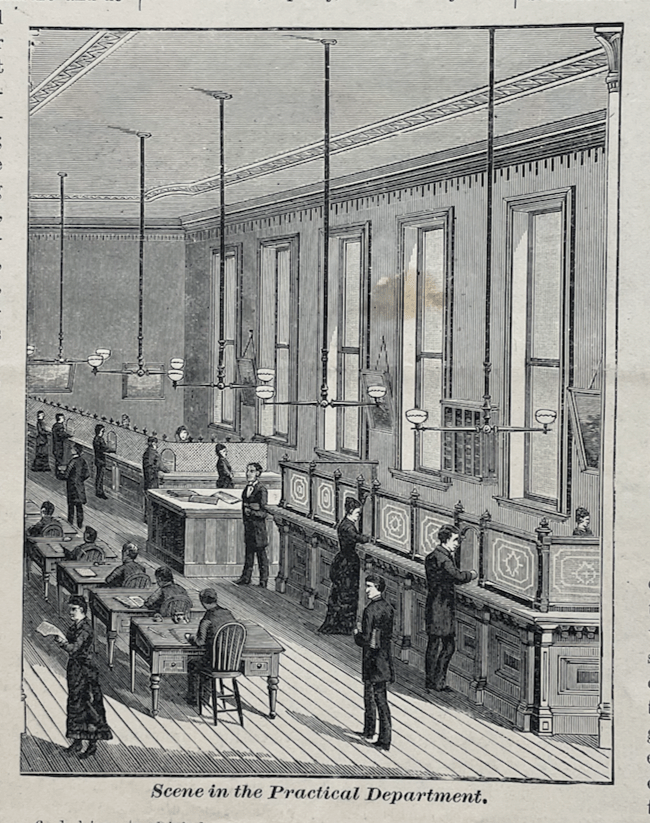
Metropolitan Business College (1883), Chicago History Museum, MBC – Misc Pamphlets
Enter the Metropolitan Business College. Maybe you spot one of the school’s lavishly illustrated pamphlets in the mail piled high on the shabby entryway table at your boarding house; or maybe a relative eager to foster your independence – and limit your drain on family expenses – pressed it into your hands at the last potluck. However it got to you, what catches your eye – beyond the arresting graphic design, all ornate capital letters and naturalistic vignettes – is what the college promises: a “thorough, practical business training and education” in “the shortest possible time and at a moderate expense.” It’s an opportunity, the proprietors claim, that “every young man who is ambitious to rise in the world to distinction, independence, and wealth” should look to, valuable not just for would-be clerks and bookkeepers, but merchants, lawyers, legislators, teachers, editors – even widows! In a nation that buzzes like “one vast busy hive,” where “commerce is king,” every young man or woman needs a “knowledge of business matters, and the ability to keep accounts correctly.” Exciting, certainly; but what does that mean in practice?
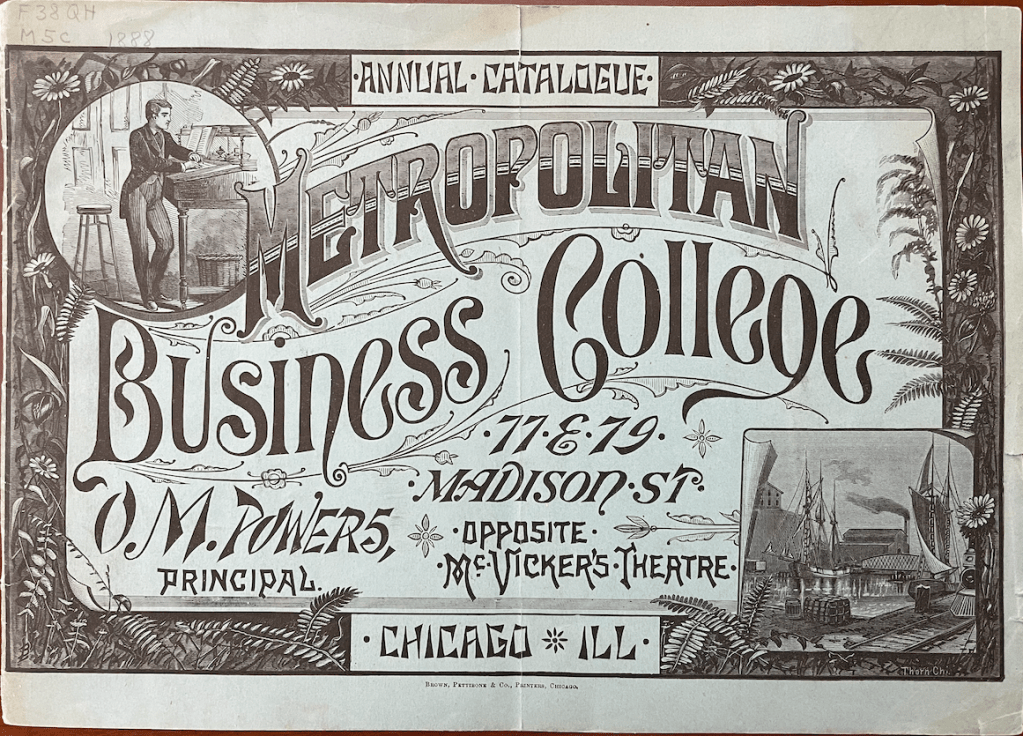
Metropolitan Business College, Annual Prospectus (1888) Chicago History Museum
The Metropolitan’s circulars and handbills were peppered with claims about the institution’s many virtues: an accessible location, an affordable price, an able and experienced faculty, etc., etc. But the for-profit private business college’s core pitch – and the subject depicted in finely illustrated detail in much of its advertising – was the “PRACTICAL DEPARTMENT.” A “business world in itself,” the “practical department” was both place and pedagogy. Physically, the department was a “great counting room” on the second floor of the college’s main building, where “Banking, Manufacturing, Importing, Commission and Wholesale Houses, Real Estate, Insurance, and Transportation Offices” could be found. Each “business” in the Department was defined by its proper teller windows and office furniture, and fully supplied with “everything necessary to conduct the business as it is conducted in the large business houses of Chicago.”
Metropolitan Business College (1883), Chicago History Museum, MBC – Misc Pamphlets
“Everything necessary” included pens and ink as well as blank ledgers, blank day books, blank journals, blank bills, blank sales slips, blank insurance contracts, blank partnership agreements – the whole specialized apparatus of modern commercial paperwork. These expensive, extensive fixtures set the stage for accelerated learning through creative improvisational acting. (Yes, the Metropolitan Business College wasn’t just in the Second City, it anticipated The Second City’s methods, too.)
Assigned to an office with a role and a desk to match, Metropolitan students learned white collar work first-hand by doing deals and organizing transactions between and among themselves, running their “firms” to model the operations of the real industrial economy. Under expert game master, er, faculty guidance, students mastered business skills in a fraction of the time required by an old-style apprenticeship; and paired with the college’s other lectures and classes, their knowledge was more thorough, too. Critically, the “practical department” produced real, useful feelings. Role-playing as business men and women, the Metropolitan’s proprietors claimed, filled students with a “zest and determination” for knowledge that was “unseen and unknown in the history of Business Colleges in this country.”
It’s possible Metropolitan students’ zeal might be “unseen and unknown” in the annals of business history, but the “practical department” was a common feature of late nineteenth-century private for-profit business colleges. Bryant & Stratton’s national chain of fifty colleges featured “business departments” that combined “office and stationery store, fitted throughout in solid walnut, richly carved,” while branches of the Eastman National Business College provided students with a dizzying array of blank printed forms (articles of copartnership, ledgers, and shipping receipts) all stamped with the logo of their “Actual Business Department.”[2] But despite their apparent ubiquity – and abundant material culture – “practical departments” seem not to have merited inclusion in narratives about the historical development of business education, or to have entered into debates about the balance modern business schools should strike between “theory” and “practice.” They are almost as overlooked as for-profit schools are generally in business education history. [3]
Eastman National Business College records, 1865-1866, Chicago History Museum
Yet careful consideration of “practical departments,” and the private for-profit business colleges to which they were attached, can open new questions about the early development of American business education, as well the intellectual and physical infrastructures of industrializing America. Too, they can potentially shed new light on what’s novel – or not – in modern business education. The materials for such a study are plentiful: common institutions with often surprising durability (several Bryant & Strattonbranch colleges are still operating today), the advertisements, curricula, and textbooks produced by for-profit private business colleges are held in digital and physical libraries in virtually every major city in the United States; and while manuscript materials are less common, collections of notes, correspondence, and personal papers from educators and students exist in significant numbers, and are readily available.[4]
While this research is as-yet-ongoing, I see three questions where “practical departments” may be particularly useful as objects of study for business history and the history of business education:
1) How did for-profit business colleges model the economy for students – and what role did material culture play in that instruction?
Divided into firms linked together through paper transactions, “practical departments” were intentionally-designed working models of the economy, and as such provide new insights into how Gilded Age business people sought to apprehend and manage it using accounting methods and other technologies. The specific furniture and material culture of “Practice Departments” reveals the long-standing importance of physical environments to business education, anticipating later lauded trends in business education that also depended on specific arrangements in space, like the case method’s “horseshoe-shaped classrooms.”[4] Comparing different schools’ approach to “practical departments” could reveal the role that material culture and spatial arrangements played in affording or structuring economic models, and vice versa.
2) How did for-profit business colleges produce knowledge – and what were the consequences?
Exploring materials related to “practical departments” can help uncover the processes of knowledge-creation. As students rotated through the different firms in this Potemkin business world, they apprehended its multiple angles and interrelationships; a shipping office’s books revealed a different set of operations than a bank’s, and understanding their connections was greater than the sum of understanding either, separately. In promotional materials, business colleges highlighted the benefits of this gestalt: a year of preparation at Bryant & Stratton fitted a student out not just for a specific business, like an apprenticeship or work experience would, but for the world as a whole – present and future. Business colleges collectively trained hundreds of thousands of students – and graduates not infrequently made up a significant portion of a given city’s white collar workforce. The influence of the “practical department” was thus potentially significant – and explorable, through students’ correspondence and reflections on their experiences, as well as through more public discussion of different schools curricula and benefits.
3) What can “practical departments” reveal about the purpose(s) of business education – and its intended role for individuals, and in society?
That institutions commonly understood as narrow vocational operations sought to develop a broad perspective is perhaps surprising from a contemporary position – but is perfectly consonant with Gilded Age for-profit business colleges’ own claims, as well as those of supporters. Editor and politician Horace Greeley, for example, claimed that “Business Colleges will find their greatest sphere of utility” in “developing a larger capacity to apprehend and to seize the opportunities that so abundantly exist on every side, for giving new activity and new power to the creation of material wealth.” Facing the challenge of adapting the American nation in a post-slavery, globalized, and industrializing world, Greeley argued young people needed to develop “a many-sided-ness,” through an “education that teaches men to look in various directions” – a capacity that for-profit business colleges employed “practical departments” to provide. [5] In contrast to the higher education industry today, where disciplinary and professional knowledge is valued primarily for its capacity to secure students’ individual future earnings in specific occupations, supporters of Gilded Age business education organizations championed values aligned – at least rhetorically – with the broader social and intellectual goals of the “liberal arts.”
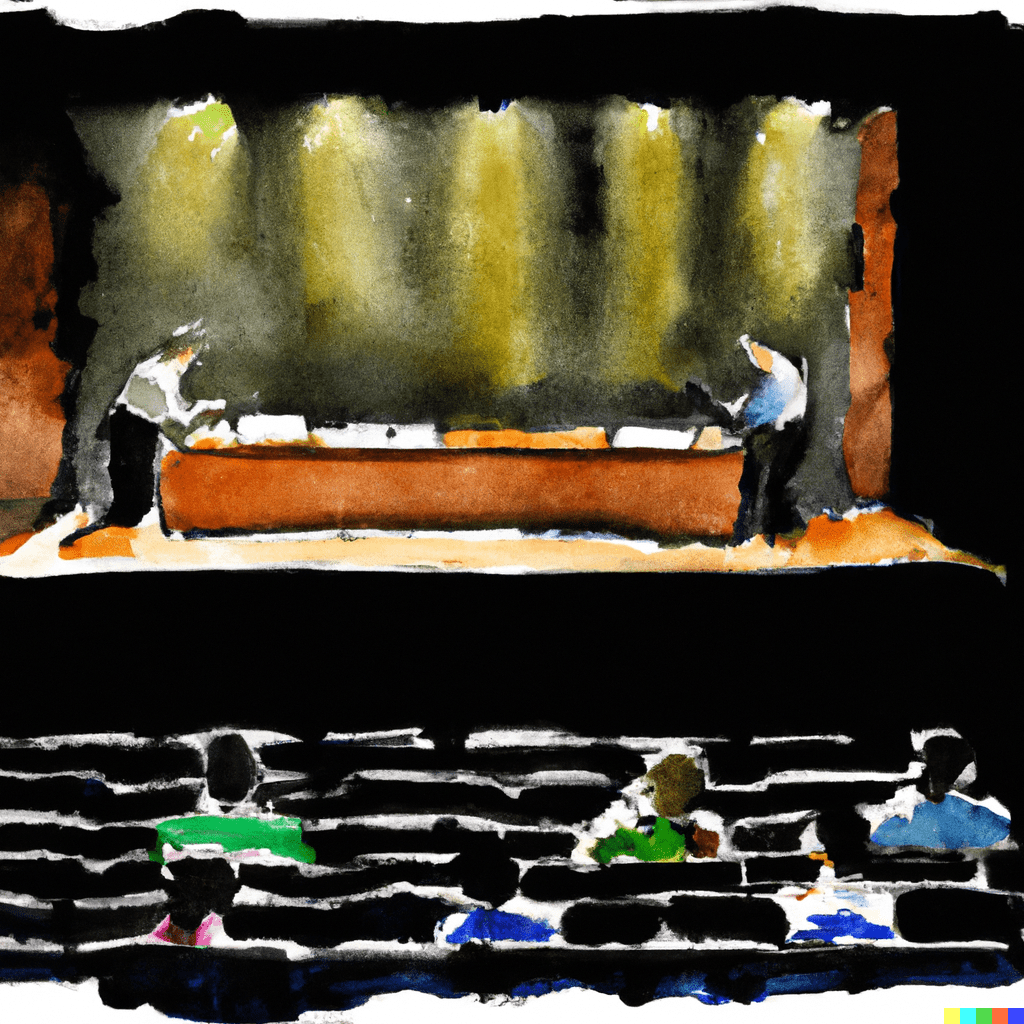
DALL*E Image (AI-generated), from prompt “Watercolor, Businessman and Businesswoman Working at a Desk on a Stage in Black Box Theater”
Learning through role-playing is not an unusual pedagogical technique; arguably, it’s the oldest there is. But in their widespread “practical departments,” Gilded Age for-profit American business colleges made playing at bookkeeper into a serious, significant experience – one, indeed, which usually formed the capstone of a business education. A closer examination of how these “practical departments” modeled the business world in paper, how they functioned to produce knowledge, and how and why they served as the foundation for business college advocates’ claims about their contribution to individual lives and national projects has the potential to add a new chapter to the history of business education, illuminate the infrastructures and assumptions supporting 19th-century business practice, and better contextualize ongoing debates in modern business schools.
——
NOTES
[1] Metropolitan Business College, 77 & 79 Madison Street, Chicago, Howe & Powers, Proprietors (1883), Chicago History Museum, MBC – Misc Pamphlets, F38QH .M5Z
[2] H. B. Bryant’s Chicago Business College (1875), 24; Eastman National Business College records, 1865-1866, Chicago History Museum
[3] While for-profit business colleges, like other kinds of “lower ed,” have received less attention than their more prestigious counterparts, graduate schools at major research universities, they do appear in some standard narratives about business education – but primarily for their role in transmitting and popularizing new kinds of technology, like typewriters, shorthand, or filing systems. E.g. Rakesh Khurana, From Higher Aims to Hired Hands: The Social Transformation of American Business Schools and the Unfulfilled Promise of Management as a Profession (Princeton, NJ: Princeton University Press, 2007). On “lower ed”: Tressie McMillan Cottom, Lower Ed: The Troubling Rise of For-Profit Colleges in the New Economy (New York: The New Press, 2017).
[4] However, these materials are often not cataloged or identified as specifically pertaining to business colleges, or their “practical departments,” but rather left in generic categories; discovery is somewhat difficult as a result. This is a familiar problem in business history; see the discussion of “account books” as sources in Caitlin Rosenthal, Accounting for Slavery: Masters and Management (Cambridge, MA: Harvard University Press, 2018).
[6] Horace Greeley, An Address on Success in Business, Delivered before the Students of Packard’s Bryant & Stratton New York Business College by Hon. Horace Greeley at the Large Hall of the Cooper Union, Nov. 11, 1867, (New York: S. S. Packard, Publisher, 1867), http://catalog.hathitrust.org/Record/001123944, 21, 29.
Tom Scocca’s recent snarking on smarm has got me thinking about the connections between history, as it is written and pursued, and one of the defining literary styles of our time. But before I bloviate over a blog post, here’s the essay: go have a look.
Listen everybody: if you aren’t reading Ta-Nehisi Coates over at the Atlantic, you are missing out.
He’s a very good writer, and a very deep thinker. I mention him here — rather than just by grabbing you by the collar and preaching the cant of the converted to you individually — because recently he’s been reading through the historical literature on slavery, the Civil War, and Reconstruction, and blogging his reactions. The result is some of the most thoughtful and powerful writing on the topic, and its present relevance, that I’ve had the pleasure of encountering.
What I like best of about Coates’s writing (and thought) is his how open he is to new ideas. Not uncritical; but willing to engage. That is as true of his reading of history as it is in his conversations with ideological opponents. There is, in his postings, a constant autobiographical refrain where he tracks the development of this willingness in himself, which gives it an anchor and a sincerity which even the most plaintively open-minded writers lack. Continue reading “The whole epoch is disorienting”→
Ran across this the other day, and thought it worth “commonplacing”:
Ultimately, I hoped to show that we should not think of “agency” and “structure” as rivals, or even as being mutually exclusive. As I state in the last paragraph of the book, “The constraints and structures of any particular period are, however, often the creation of a previous generation’s political agents. In the short term, politics is, in fact, a world of constraints, but to agents willing to wait for effects that may not emerge for decades, the world is full of opportunity.” Agents have to operate in a world of structures. But if they have a long time horizon, they can create new structures, which will then act to constrain the next generation of agents. And so on.
~Steven Teles, “Response,” Crooked Timber, 1 May 2009, describing one of the themes of his book The Rise of the Conservative Legal Movement: The Battle for Control of the Law (PUP, 2008).






 Dael A. Norwood