Archival Follies, Delaware

Behind every (alleged) great crime lies a Delaware business entity registration form

A Continuing Series…

For a while now on social media (Bluesky, mainly), I’ve taken to making short threads about the ways that Delaware’s corporate franchise hooks into the headlines about the (alleged) crimes, frauds, and scams that fill our daily feeds.

My tag for this bit – the title of this post – is an overly-wordy riff on an oft-paraphrased line from Balzac’s 1835 novel, Le Père Goriot: “Behind every great fortune is a great crime.”

Balzac’s actual language is a bit different. For one, it’s more clearly coming from the perspective of a scheming character, Vautrin:

“Le secret des grandes fortunes sans cause apparente est un crime oublié, parce qu’il a été proprement fait.”
~Honoré de Balzac, Le Père Goriot (Paris: Calmann-Lévy, 1875), p. 137

“The secret of a great success for which you are at a loss to account is a crime that has never been found out, because it was properly executed.”
~ Honoré de Balzac, Old Goriot / Le Père Goriot, trans. Ellen Marriage, with George Saintsbury (London:J.M. Dent , 1896), p. 124

Balzac’s venturesome villain is an operator. In context of the novel, he isn’t simply offering us a read on the world’s decadence. He’s explaining to the protagonist (whom he is trying to recruit) that white collar crime kills no less surely than basic assaults do – but you can get away with it, because the law is such that “properly executed” crimes go unpunished.

(Six decades later, another French novelist, Anatole France, would offer a similarly cynical bon mot. But instead putting in the voice of the villain, France puts the sentiment in an animated monologue delivered by anarchist mystic character, the slightly comic Choulette:

Cela consiste pour les pauvres à soutenir et à conserver les riches dans leur puissance et leur oisiveté. Ils y doivent travailler devant la majestueuse égalité des lois, qui interdit au riche comme au pauvre de coucher sous les ponts, de mendier dans les rues et de voler du pain.

“For the poor it consists in supporting and maintaining the rich in their power and their idleness. At this task they must labour in the face of the majestic equality of the laws, which forbid rich and poor alike to sleep under bridges, to beg in the streets, and to steal their bread.”

Anatole France, Le Lys Rouge (Paris: Calmann-Lévy, 1894) p.118 / France, The Red Lily, tras. Winifred Stephens (New York, Dodd, Mead and Company, 1925), p. 91.

Such is the softening effect of time, I suppose. The once-powerful villain becomes a harmless eccentric.)

In my series-slash-recurring-bit, I’ve taken upon myself the small task of making connections between the various moral, social, or actually legal offenses that crest to notice in the waves of the news cycle, and the various tools that Delaware’s lawmakers, jurists, and advocates have put at the public’s disposal (and especially the publicly rich and powerful). These links are usually manifest Division of Corporations business entity search results – bare bones listings anyone can pull – but sometimes more verbose sources, like SEC filings. (Some of data is replicated elsewhere, with a small lag – notably at Open Corporates).

~

That’s all too much introduction to the (alleged) crime I dug into today, a new (alleged) bribery platform being set up by the President of the United States’s family under the corporate name “ALT5 Sigma Corporation.”

The NYT describes it thusly (gift link)
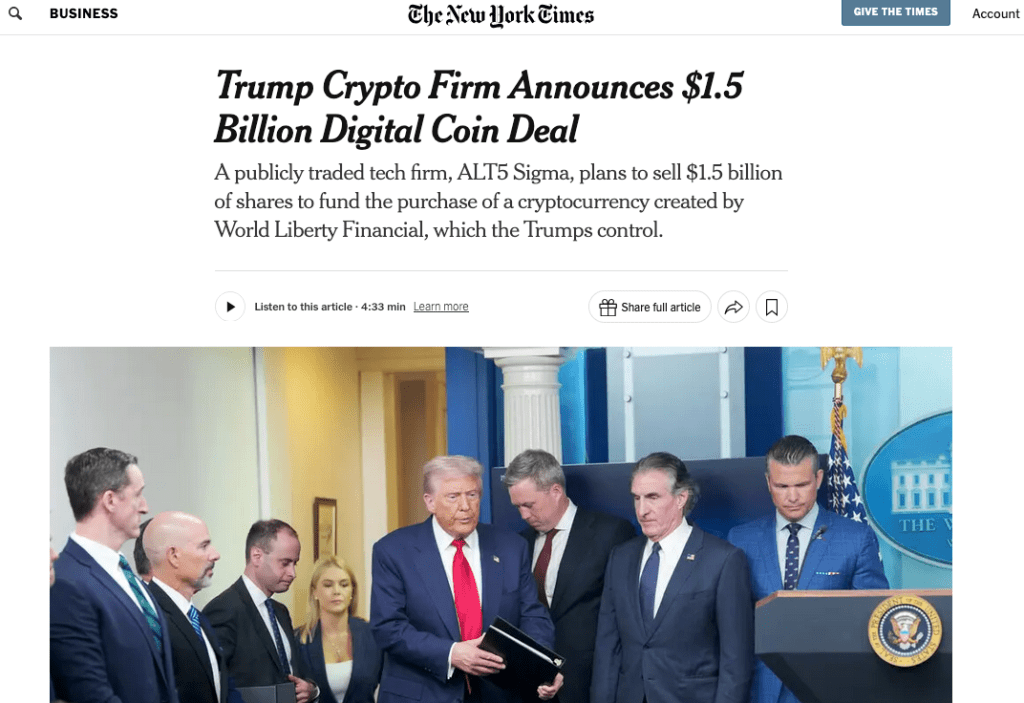
Trump Crypto Firm Announces $1.5 Billion Digital Coin Deal

A publicly traded tech firm, ALT5 Sigma, plans to sell $1.5 billion of shares to fund the purchase of a cryptocurrency created by World Liberty Financial, which the Trumps control.

“World Liberty Financial, the cryptocurrency start-up founded last year by the Trump family, announced on Monday that a publicly traded technology firm would begin buying large quantities of its signature digital coin.

The firm, a little-known tech company called ALT5 Sigma, is planning to sell $1.5 billion worth of shares, using the proceeds to buy $WLFI, a cryptocurrency created by World Liberty, the announcement said.

Similar initiatives have become wildly popular in the crypto world this year, after the success of Strategy, a public tech company formerly known as MicroStrategy that has built a Bitcoin stockpile worth billions of dollars. Strategy’s stock price has soared in sync with the price of Bitcoin, which has set a series of record highs in recent months.

As part of the deal, World Liberty will receive shares in ALT5, according to securities filings, in return for $750 million worth of $WLFI coins. Eric Trump, the president’s middle son, will join ALT5’s board, and Zach Witkoff, a World Liberty founder and the son of President Trump’s Middle East adviser, will serve as chairman of the board.”

ALT5 started life in 1983 as a Minneapolis household appliance retailer & recycler. In 2018 it reincorporated in NV, then “broadened its business perspectives,” going into biotech, buying & merging w/ JanOne Inc., researching “non-opioid painkillers” made out of sodium nitrite. 

Yes, like hot dogs.

A plate of hot dogs, in buns, on a table
Hot Dogs“/ CC0 1.0

(FYI, the 10-K this company filed for 2019 is truly a WILD ride. Other filings indicate that while the company has historic roots in Minnesota and a present presence in Las Vegas, Nevada, it also has had ties to New York, Delaware, and Ontario and Quebec. Reading quickly, it seems like the company’s SEC filings started to be sparse and chronically late in the 2000s. It seems like the original appliance retailing and recycling company – Appliance Recycling Centers of America Inc. – started faltering, and that sputtering is what led to the move to Nevada, and a concomitant shift in core business model from safe appliance disposal to more … imaginative assets.)

The Delaware connection to the latest Trump bribery deal came more recently. In May 2024, JanOne acquired ALT5 Sigma, Inc., a DE fintech corporation (file no. 6782648) founded in 2018 and operated out of a Lexington Avenue, New York address. After the acquisition, JanOne merged the DE corp into the Nevada entity, and then renamed the parent company to ALT5 Sigma Corporation. (JanOne Inc. then became the name of a subsidiary).
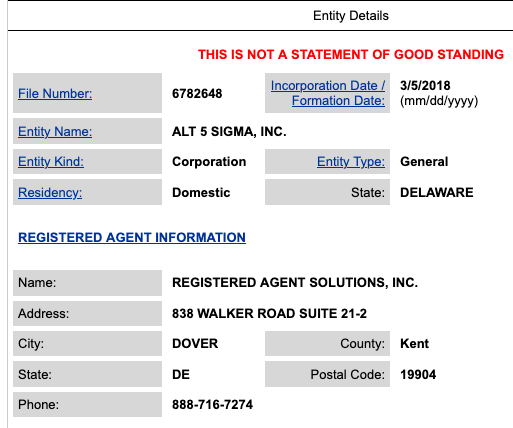
DE Business Entity Filing Search Result for ALT 5 Sigma.

ALT5 Sigma, Inc. remains integrated into ALT5 Sigma Corporation’s rat’s nest of subsidiaries and holding companies in a manner so obscure the image of their org chart they include in their SEC filings is blurry as bigfoot. (Unlike the pictures of mouse surgeries, also included in the 10-K, high are all-too-crisp).
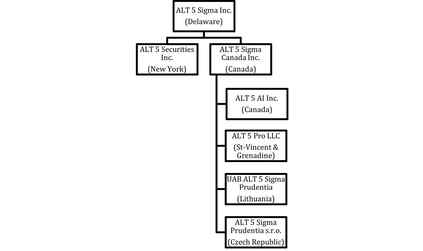
ALT5 Sigma Inc. org chart. Yes, the original is that blurry.
Yes, it’s that blurry in the original. Yes, that’s on the nose.

So, to recap: a Minnesota appliance recycling company hit hard times in the 2010s, moved to Nevada to become a vehicle for biopharmaceutical investments, and then pivoted again in 2018, buying a Delaware corporation and adopting its name (but not its domicile) to become a crypto trading platform. And then this week, the extended Trump family took out a controlling stake in that crypto firm. Trump et al. managed the simultaneous takeover and bribe through their memecoin vehicle, World Liberty Financial, Inc. (also DE-registered) – and they seem to be interested in using ALT5 as a platform to provide themselves a percentage on their own bribes, by charging a vig on sales of their own cryptocurrency.

~

To further tie some threads together: 

In the 8-K ALT5 filed Aug 11th, ALT5 announced they’re swapping their shares to World Liberty Financial in exchange for $750m in $WLFI coins. It’s in some ways a standard “equity for assets” swap – though the assets in this question are presidential bribery tokens.

In that same filing, ALT 5 notes the exchanged shares “will not be, and are not, registered under the Securities Act of 1933” – because the deal falls under the “accredited investor” exemption. 

No registration, no disclosures needed in this $750m deal involving POTUS.
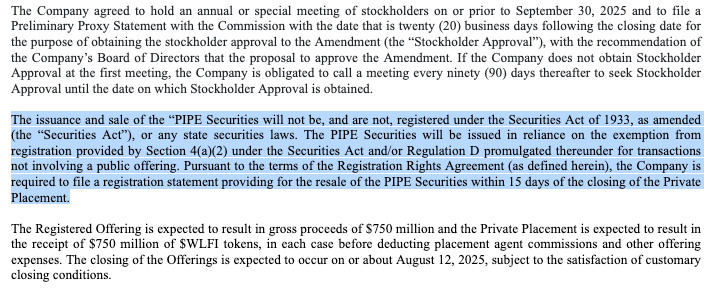
Selection from the 8-K
the highlighted portion is where the magic happens.

This kind of transaction – in which the Trump family is opening a new storefront to process bribes – is exactly the kind of bogus investment that Congress, led by DE Rep. McBride, is trying to make more widely marketable to non-insiders by gutting the law defining “accredited investors.

Untangling this kind of mess, and making all the connections clearer, is the justification for the bit. It also illustrates how and why I insist that Delaware law and Delaware lawmakers are often directly implicated in the vast corruption that’s turned the US into an autocracy. Neither POTUS nor his family would be able to sell their office this way – or plan to sell even more – without the First State’s say-so.

It’s on our heads, as Delaware citizens.
Archival Follies, Delaware

In Close Touch, But Not Commanded

Or, a New Deal Democrat describes a Delaware Senator as … unbought?

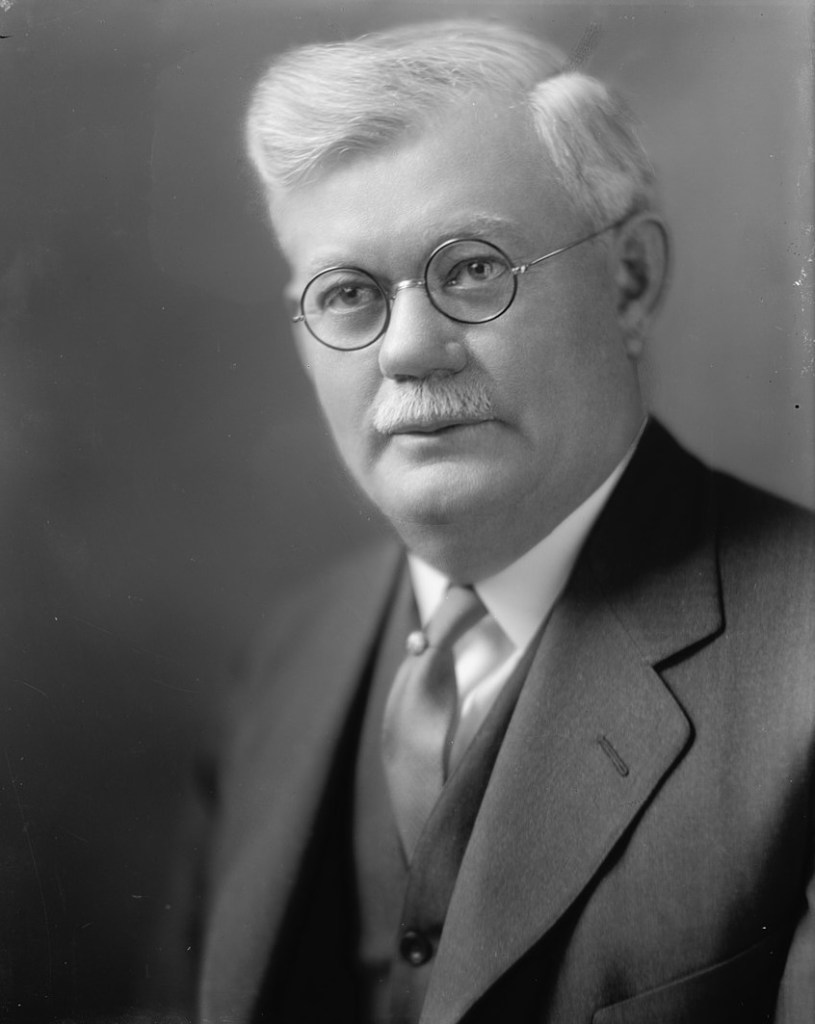
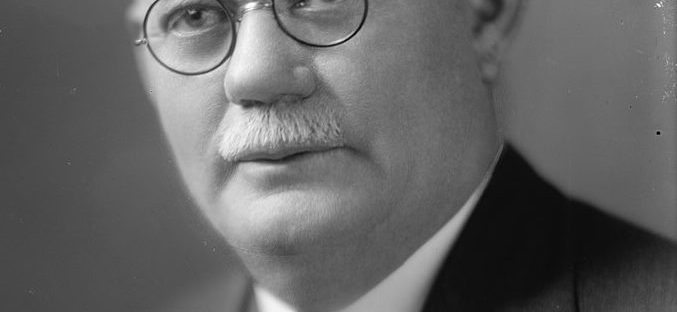
A portrait of a pale, elderly white man wearing a suit and glasses, with white hair and a neatly trimmed mustache. TOWNSEND, JOHN G. SENATOR Abstract/medium: 1 negative : glass ; 8 x 10 in. or smaller. Harris & Ewing Collection, Library of Congress. between 1905 and 1945, possibly circa 1930. Avail via Wikipedia. https://commons.wikimedia.org/wiki/File:TOWNSEND,_JOHN_G._SENATOR_LCCN2016860876_(Cropped).jpg
Sen. John G. Townsend, Jr., of Delaware. Apparently not fully owned by corporate interests!

In the course of researching the political history of the Securities Act of 1933, I encountered a rather surprising description of a Delaware politician. In 1959, “Dean” James M. Landis, one of the aides primarily responsible for drafting the bill and shepherding it through Congress, published a close account of his experience getting this critical New Deal legislation off the drawing board and into the law books.

His article is a brief but quite detailed play-by-play of the political process – an Aaron Sorkin narrative, but with substance – and includes a number of deft character sketches of the various politicos and operators he dealt with as he hustled the most important federal financial regulation ever written over the finish line.

At the moment of high drama of his narrative (the House-Senate bill reconciliation conference meetings) he characterizes Senator John G. Townsend, Jr. (R-DE) this way:

“The tenseness of the first day’s session became relieved as [Rep. Sam] Rayburn made it plain that any suggestion of any Senator would receive the most careful consideration. A goodly number of suggestions came from Senator Townsend of Delaware, a Republican, who was in close touch with the financial world but who under no circumstances would take their suggestions as commands or as ideas to hold on to in the face of a compelling argument to the contrary.” [emphasis mine]

~James M. Landis, “Legislative History of the Securities Act of 1933,” George Washington Law Review 28, no. 1 (1959): 45-46

FDR’s man on the ground, a Felix Frankfurter student and Louis Brandeis protégé, a future chair of the SEC, Landis was impressed with how uncorrupted a Delaware Senator was by corporate financiers. As far as I know, that makes Townsend the first – and perhaps only – senator thusly described (certainly that differentiates him from other Delaware (state) senators who share his name…)

In short: history is full of surprises!

And ironies, too: the latest neoliberal salvo aimed at fatally wounding the New Deal regulatory state – and specifically, to gut the Securities Act of 1933 that Townsend helped design – was co-sponsored by none other than Delaware’s own Rep. Sarah McBride. As Rep. McBride’s personal PR page notes, this attack on financial transparency and good government is “Her First Bill in Congress.”

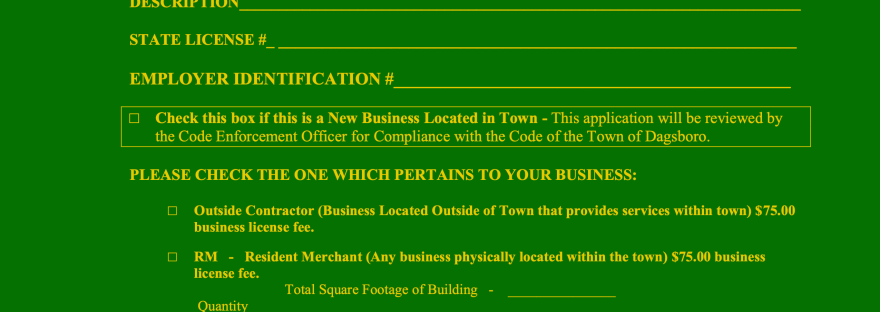
A colored copy of Dagsboro's business registration form
Archival Follies, Corporate Voters Project

Seeing Like a (Tiny) State

Or, Dagsboro Considers the Legibility of Business

Corporate Voters Project – Research Note #5

On May 14, 1990, the Town Council of Dagsboro Delaware considered the topic of business licensure in a way James Scott would find familiar: 

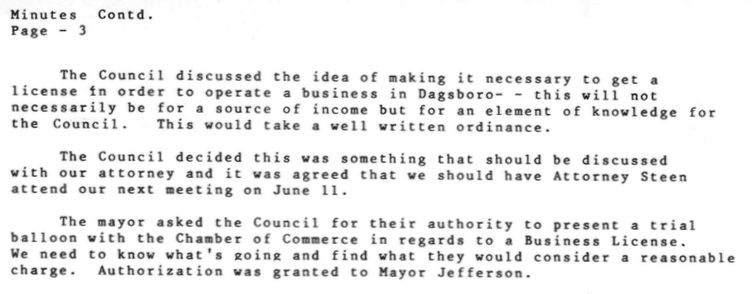
“... The Council discussed the idea of making it necessary to get a license in order to operate a business in Dagsboro- - this will not necessarily be for a source of income but for an element of knowledge for the Council. This would take a well written ordinance. 

The Council decided this was something that should be discussed with our attorney and it was agreed that we should have Attorney Steen attend our next meeting on June 11.

The mayor asked the Council for their authority to present a trial balloon with the Chamber of Commerce in regards to a Business License.

We need to know what's going and find what they would consider a reasonable charge. Authorization was granted to Mayor Jefferson.”

I am not how the conversation with the Chamber of Commerce went, with regard to this new effort to make business legible to the town government. I’m curious how Mayor Otis Jefferson pitched it to a group of businessmen generally unwilling to let the state in, even as they constantly sought to use the state for their own ends (including profit).

But something must have gone forward from 1990, because Dagsboro now not only allows businesses to vote – it requires them to be licensed.  

Source: “Minutes, May 14, 1990” in Minutes of the Dagsboro Town Council, 1941-1993, Delaware Public Archives, RG 7040-000-001, roll 2

And now for something completely different..., Archival Follies, Beginning the "Businessman", The Past is a Foreign...Something

Fear is the neuro-mudkiller

Or, figuring out if you’ve hit a typo, a fnord, or some history 

Doing historical research – reading sources – you find things. That’s more or less the point, after all. But sometimes the things you find are … odd things. Confusing things, things that raise more questions than they answer. 

The historian’s standard approach to this situation is to to explore further, to keep reading until you know what’s going on. The only way out is through; ever upwards – excelsior and etc. One reason historians work this way is that confusion is a sign of context collapse – you can’t see the window until you find the frame. The other is that confusion is a sign of a gap. Reading until you figure out why Parisian apprentices thought murdering cats was so damned funny can isn’t just a key to understanding the (horrible) joke, but something bigger about the constellation of power and people in a critical moment in the past. And that’s more or less the point, after all. 

Sometimes, you fail to figure out your little mystery. Sometimes, your little detour doesn’t lead to enlightenment, at least not directly. Sometimes, the puzzle remains unsolved.

And sometimes, you run into a neuro-mudkiller, and it leaves you flat.

~~~

Last week, following up on a suggestion from a colleague, I was poking around in some early 20th-century US newspaper databases to see if people in the 1920s were reinterpreting Paul Revere like they had done George Washington – that is, reading him as a “businessman.”  While I didn’t find much to support that theory, I did run into an unexplained historical phenomenon.(1) 

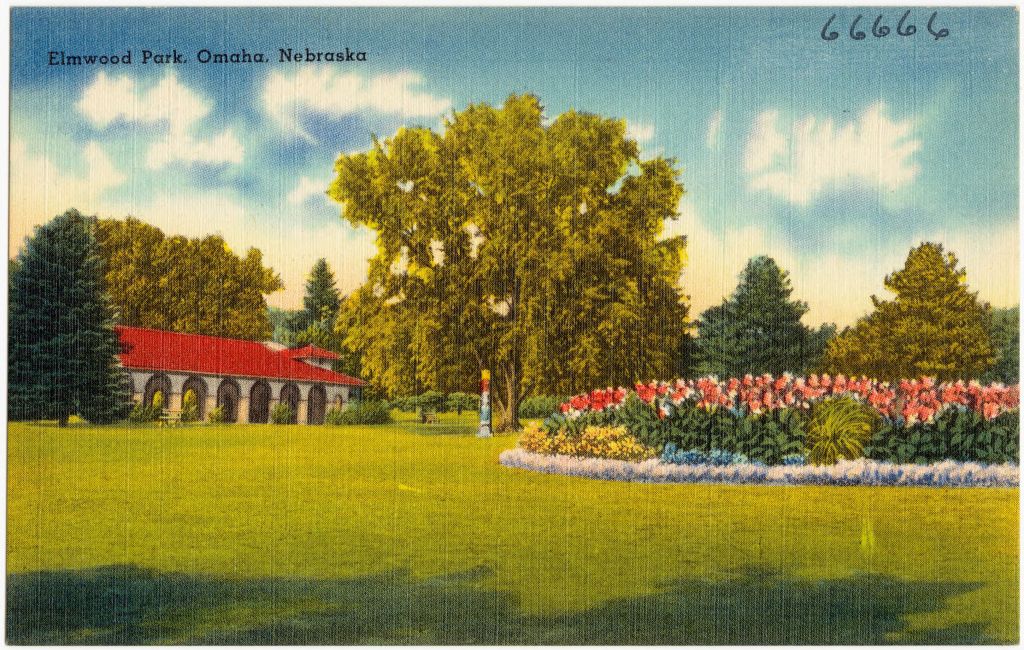
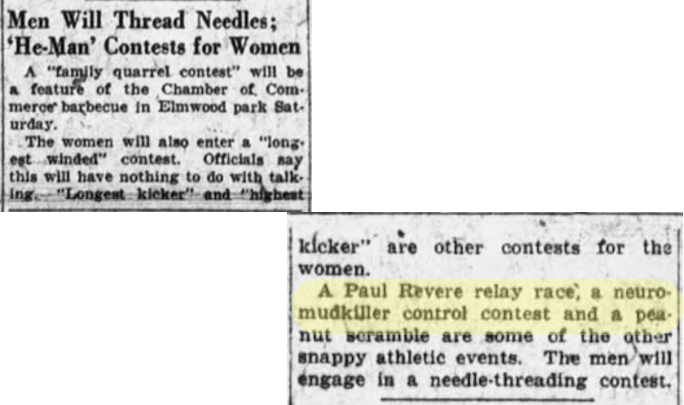
It took the form of a short notice in the Omaha Daily Bee published Friday, May 25, 1923.  Sandwiched in the middle of page two was a two paragraph article describing a public barbecue to be hosted Chamber of Commerce the following day in Elmwood park, a major recreation area on the city’s western side. The C. of C. party, the piece promised, would feature a “ ‘family quarrel contest.’” Most events on the roster for this “battle of the sexes” are readily legible as games or contests of skill, like a “longest kicker” match or a “needle-threading contest.” Others took a bit more to understand: a “peanut scramble” is when you toss candy and peanuts in the air for children to catch and collect. 

But as I read through this piece, I ran across one event that defied my understanding: “a neuro-mudkiller control contest.”(2) And <BOOM> went the Parisian cat.

~~~

I tried a number of different methods to get a handle on this phrase. I searched for the term in other newspapers, and then, when that failed, other large full-text databases, like the Internet Archive and HathiTrust. I read other reports about the event, and accounts of previous’ years similarly-organized Chamber-sponsored “field days.” 

Then I tried that all again with variants of the phrase, its components, its near alikes: mudsiller, mudskipper, mudbiller, etc. I broke each term into component parts.

Alas, nothing has led me any closer to figuring out what a “neuro-mudkiller control contest” might be – or what, ssuming the intervention of some wandering fingers on the linotype machine, the Daily Bee reporter had intended to say, originally.

Having lost hours down this rabbit hole, the phrase for me now conjures Melville’s white whale, by way of Frank Herbert’s desert-addled space opera. (Or perhaps a “neuro-mudkiller control contest” is a fnord that slipped through spacetime for surrealist ends, or to waste my time.)

~~~

Friends, the neuro-mudkiller still eludes me. But by plinking away at search bars and reading across morning editions and evening issues, I learned some things about Omaha and its roaring twenties denizens. I learned that Omaha newspapers have a non-trivial amount of typos, for one. 

I also learned the Omaha Chamber of Commerce was an active, and seemingly successful, civic association. In May of 1923 alone, the body sponsored a “trade booster tour” to Wyoming, built and hosted a new “rest room” for business women and professional at its downtown headquarters, and weighed in on a dozen different matters of public import, from traffic regulations to fraternal organizations’ convention bookings.

I further learned that the Chamber of Commerce in Omaha was operating, organizationally, as a primus inter pares. Its leading members led the city’s other leading civic, social, and charitable institutions; and those organizations participated in Chamber events, like the party in Elmwood park. Internally, the Chamber was structured with standing committees of volunteers and a guiding, paid manager (a “commissioner and secretary”) – a successful implementation of the Cleveland “modern chamber” model that famed commercial secretary Ryerson Ritchie developed and then theorized, to national acclaim. (3)

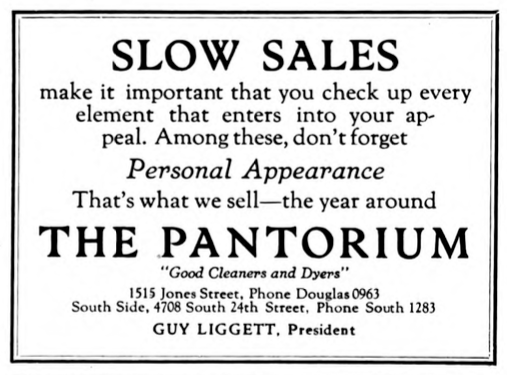
I learned that there was a local laundry called “Pantorium” (they did more than just wash pants). (4)

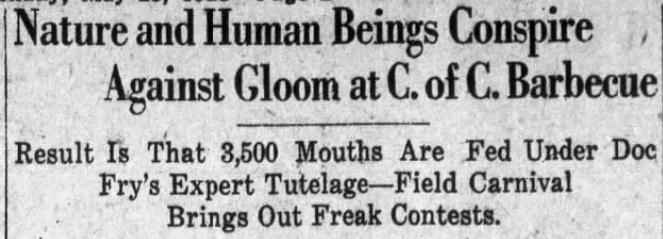
And I learned that the party at Elmwood park was a “Great Success,” at least in the eyes of local reporters. It fed “3,5000 Mouths” with “1,500 pounds of Steer and Lamb” prepared under the expert eye of “Doc Fry,” a local “master of the art of barbecue,” and served alongside with truckloads of bread, pickles, mustard, onions, radishes and – distressingly, given the temperature and the hour – coffee. Attendees were “knocked…dead” with delight by an amateur “minstrel show” and a fake horse race, sponsored by the Continental and the Lions clubs, respectively. With Boy Scouts and visiting nurses on hand to organize and aid participants, the barbecue’s roster athletic events went off without a hitch; winners got a prize donated by a local business, and their names – and addresses – in the paper. (Congratulations, Doris Frederick of 5020 California street, for winning the “longest-winded” (balloon blowing) contest). And as the afternoon turned to evening, a twenty-piece band started playing and “those who cared to tripped and stumbled the light fantastic until it was time to go home.”(5)

Finally, I learned that while the “neuro-mudkiller control contest” was happening – or not, if it wasn’t actually real – another conspiracy was being busted across town, when the Omaha “police morals squad” raided the house of a man named Nick Carmo, and seized his sugar, corn, mash and still.(6)

Violent and unpleasant, that history at least made some sense.


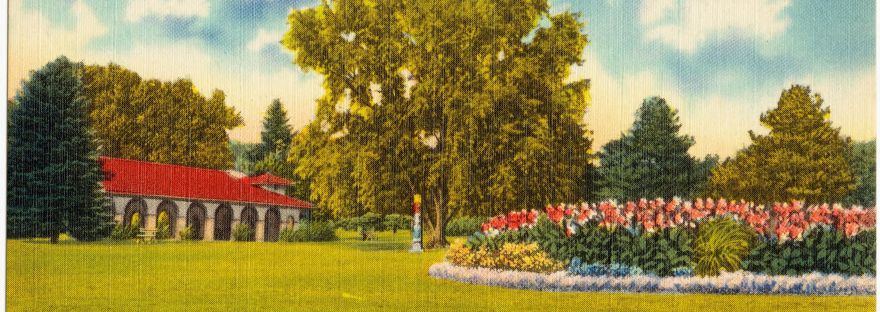
Image Source:”Elmwood Park, Omaha, Nebraska.” Card. Pub. by General Distributors Company, Omaha, Nebraska. “Tichnor Quality Views,” Reg. U. S. Pat. Off. Made Only by Tichnor Bros., Inc., Boston, Mass., [ca. 1930–1945]. Digital Commonwealth, https://ark.digitalcommonwealth.org/ark:/50959/xs55mk23n (accessed June 27, 2024).

(1) David Hackett Fischer, in his biography of Paul Revere, includes an appendix in which he tracks the popular and academic historical “image” of Paul Revere through the centuries. He dates the reconceptualization of Revere as a “Capitalist Democrat” (a propagandist for “free enterprise”) to the early Cold War – a more than a generation later than when Washington was reconfigured. David Hackett Fischer, Paul Revere’s Ride (New York: Oxford University Press, 1995), 339.

(2) “Men Will Thread Needles: ‘He-Man’ Contests for Women,” Omaha Daily Bee, Friday, May 25, 1923, p. 2, https://www.newspapers.com/article/omaha-daily-bee-men-will-thread-needles/150182706/

(3) “Firms Sign for 1923 Trade Booster Tour,” Omaha World-Herald, Sat. April 1923, p.8; “Open Women’s Lounge C. of C., With Reception,” Omaha World-Herald, Fri, May 25, p.1; “Meetings,” The Omaha Daily News, Mon., June 4, 1923, p.11

(4) “Slow Sales,” Omaha Chamber of Commerce Journal, vol. 9, no. 15 (November 27, 1920): 3.

(5) “Entertain 4,000 at Big Barbecue,” Omaha Daily News, Sat, May 26, 1923, p.1;  “Crowd of 3,500 at Field Day Barbecue: Annual Stunt of Chamber of Commerce Proves Great Success: Appetites Enormous,” Omaha World Herald, Sunday, May 27, 1923, p. 2; “Barbecue Guests Eat 1,500 Pounds of Steer and Lamb,” Omaha Daily News, Sunday, May 27, 1923, p.2C; “Nature and Human Beings Conspire Against Gloom at C. of C. Barbecue: Result is that 3,500 Mouths Are Fed under Doc Fry’s Expert Tutelage–Field Carnival Brings Out Freak Contests,” Omaha Daily Bee, Mon. May 28, 1923, p.2

(5) “Sugar, Corn, Still Are Seized in Raid,” Omaha World Herald, Sunday, May 27, 1923, p.2. 

Archival Follies, Beginning the "Businessman", Our Glorious National Heritage

Welcome to the Business Parade

Or, A Grand and Imposing Branding Opportunity 

#BizManBook Research Note #5

“When I was a young boy, my father
Took me into the city to see a marching band…”

On February 22, 1864, Harvey Gridley Eastman, founder, president, and proprietor of his namesake business college in Poughkeepsie, NY, threw a business parade. 

Technically, it was just “a parade” – he footed the bill for an expansive, city-wide celebration of George Washington’s birthday. A public spirited sort, at least when it came to associating his name with winning causes, Eastman likely calculated that a patriotic celebration in the waning days of a war where Union victory looked increasingly certain was a win-win proposition, for both his private enterprise (Eastman College) and the Republic for whose business world it stood ready to supply with clerks. 

Putting a corps of his students hailing from “every loyal state” on display to wave the flag was certainly good advertising, at least in New York – and gave Eastman chance to claim to rival the “honored festivities” of a similar nature that Yale and Harvard had recently observed.

The parade followed what was by then a standard script. There were invited guest of honor, local dignitaries, and faculty members on hand to fill leading carriages and add dignity to the proceedings; while a grand “corps d’arme”of Eastman students marched formed the primary body of the parade, marching in time to the “Cornet Band of the College” brassily sounding patriotic tunes in bright new blue uniforms. There were floats with brave Union officers and wounded veterans, and some regimental bands, too. Patriotic animals got in the act, too: reporters made note of how the parade included dozens of “spirited horses” – including Prof. Eastman’s “elegant black team,” turned out with “silk flags” and “gold plated harness” (the latter ornaments all gifts from grateful, successful alumni).

Crowds of Poughkeepsie citizens, supplemented by “hundreds from the country and towns,” provided a cheering audience for all this pomp and circumstance as it wound through the downtown streets, and past the College’s campus. Some in the multitude shouted huzzahs for Washington, alone; others, ecumenically anticipating future car dealer’s sales, hoorayed for Lincoln and Washington as presidents together; and one onlooker, confused but supporting the right side at least, clapped and hooted all honors to General Grant. 

The city’s “fair maidens,” meanwhile, waved handkerchiefs from “windows, verandahs, stoops, and side walks” – a sign, perhaps, that they favored Eastman’s humble clerks over those “to the manor born. Even the “ladies” of Vassar College, normally secluded on their hill, graced the town with their presence and “honored the procession with smiles.” 

The parade, and its encore events – a reading of Washington’s “Farewell Address” and a closing torchlight march – was a big hit, “a great success in every sense of the word.”

No slouch, Eastman immediately put the event to work for the cause of “practical, popular education,” generally, and his proprietary brand, specifically, inviting press from local and metropolitan newspapers to report on the event, and republishing an official account in pamphlet form.

~~~

Now, the infusion of George Washington’s commemoration and public memory with the public performance of a “business man’s” identity is a longstanding interest of mine, so for me this whole affair is as much catnip, as you might expect.   

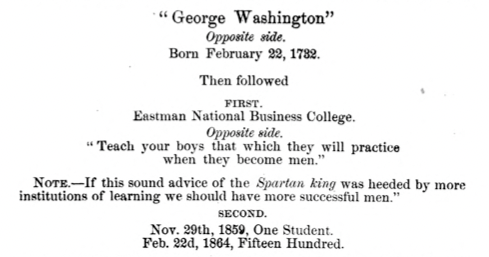
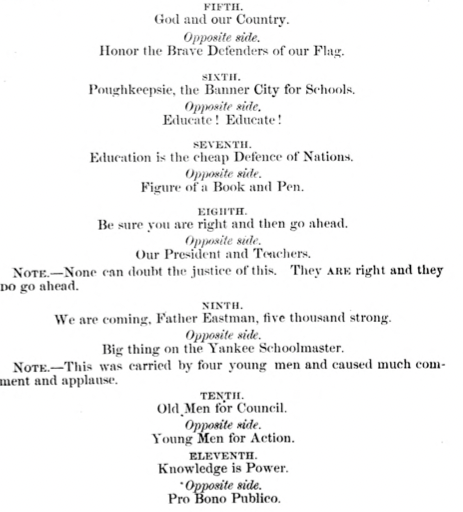
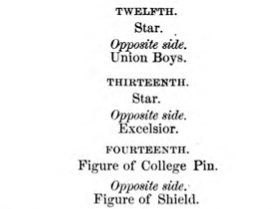
But! What moved me to write it up was not the founding father appropriation, but rather the what Eastman students carried. As they marched along Poughkeepsie’s streets, witnessed by thousands of people, the students hoisted seventeen double-sided banners, with mottos and aphorisms inscribed on each side. 

They started off fairly on-brand: an announcement of what the parade was about (George Washington’s birthday), the college’s name and motto, and some key facts and figures from Eastman’s catalogue. 

Then came some more pointed comparison to Ivy League upstarts, a celebration of the students shift from business to war, and praise for “their” president.

The next half-dozen banners shifted gears into pure aphorism territory – a familiar for Eastman and his employees, who bedecked the margins of all the college’s print ads and the halls of the college itself with seemingly-random words of instruction and encouragement. (Though backside of banner number 9 – “Big thing on the Yankee Schoolmaster” – ventures into more… vernacular assertions of masculine pride.)

Then the banners trend to more boring graphics indicating education and patriotism …

… before winding up with a frankly odd, but striking trio.

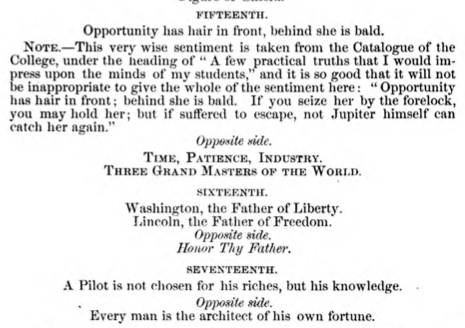
No. 15 is baffling (“Opportunity has hair in front, behind she is bald”), while No. 16 reminds everyone of who the important daddies in American politics are, before No. 17 ends the celebration with some solid perfectionist theology metaphors. 

And that’s how Harvey Gridley Eastman welcomed you to the business parade.


Header image, generated by DALL*E (AI) with the phrase “A parade of chibi emo businessmen carrying american flags”  

Source: Grand and Imposing Celebration of 22d February, 1864 in Commemoration of George Washington by the Students of Eastman National Business College (Poughkeepsie, NY: Telegraph Press, 1864), https://catalog.hathitrust.org/Record/100406934.