Or, figuring out if you’ve hit a typo, a fnord, or some history
Doing historical research – reading sources – you find things. That’s more or less the point, after all. But sometimes the things you find are … odd things. Confusing things, things that raise more questions than they answer.
The historian’s standard approach to this situation is to to explore further, to keep reading until you know what’s going on. The only way out is through; ever upwards – excelsior and etc. One reason historians work this way is that confusion is a sign of context collapse – you can’t see the window until you find the frame. The other is that confusion is a sign of a gap. Reading until you figure out why Parisian apprentices thought murdering cats was so damned funny can isn’t just a key to understanding the (horrible) joke, but something bigger about the constellation of power and people in a critical moment in the past. And that’s more or less the point, after all.
Sometimes, you fail to figure out your little mystery. Sometimes, your little detour doesn’t lead to enlightenment, at least not directly. Sometimes, the puzzle remains unsolved.
And sometimes, you run into a neuro-mudkiller, and it leaves you flat.
~~~
Last week, following up on a suggestion from a colleague, I was poking around in some early 20th-century US newspaper databases to see if people in the 1920s were reinterpreting Paul Revere like they had done George Washington – that is, reading him as a “businessman.” While I didn’t find much to support that theory, I did run into an unexplained historical phenomenon.(1)
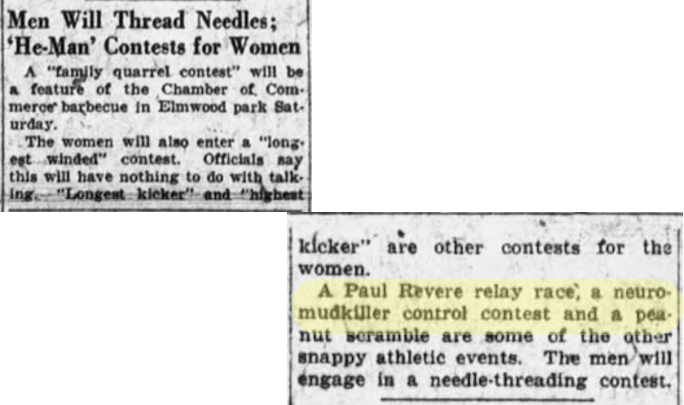
It took the form of a short notice in the Omaha Daily Bee published Friday, May 25, 1923. Sandwiched in the middle of page two was a two paragraph article describing a public barbecue to be hosted Chamber of Commerce the following day in Elmwood park, a major recreation area on the city’s western side. The C. of C. party, the piece promised, would feature a “ ‘family quarrel contest.’” Most events on the roster for this “battle of the sexes” are readily legible as games or contests of skill, like a “longest kicker” match or a “needle-threading contest.” Others took a bit more to understand: a “peanut scramble” is when you toss candy and peanuts in the air for children to catch and collect.
But as I read through this piece, I ran across one event that defied my understanding: “a neuro-mudkiller control contest.”(2) And <BOOM> went the Parisian cat.
~~~
I tried a number of different methods to get a handle on this phrase. I searched for the term in other newspapers, and then, when that failed, other large full-text databases, like the Internet Archive and HathiTrust. I read other reports about the event, and accounts of previous’ years similarly-organized Chamber-sponsored “field days.”
Then I tried that all again with variants of the phrase, its components, its near alikes: mudsiller, mudskipper, mudbiller, etc. I broke each term into component parts.
Alas, nothing has led me any closer to figuring out what a “neuro-mudkiller control contest” might be – or what, ssuming the intervention of some wandering fingers on the linotype machine, the Daily Bee reporter had intended to say, originally.
Having lost hours down this rabbit hole, the phrase for me now conjures Melville’s white whale, by way of Frank Herbert’s desert-addled space opera. (Or perhaps a “neuro-mudkiller control contest” is a fnord that slipped through spacetime for surrealist ends, or to waste my time.)
~~~
Friends, the neuro-mudkiller still eludes me. But by plinking away at search bars and reading across morning editions and evening issues, I learned some things about Omaha and its roaring twenties denizens. I learned that Omaha newspapers have a non-trivial amount of typos, for one.
I also learned the Omaha Chamber of Commerce was an active, and seemingly successful, civic association. In May of 1923 alone, the body sponsored a “trade booster tour” to Wyoming, built and hosted a new “rest room” for business women and professional at its downtown headquarters, and weighed in on a dozen different matters of public import, from traffic regulations to fraternal organizations’ convention bookings.
I further learned that the Chamber of Commerce in Omaha was operating, organizationally, as a primus inter pares. Its leading members led the city’s other leading civic, social, and charitable institutions; and those organizations participated in Chamber events, like the party in Elmwood park. Internally, the Chamber was structured with standing committees of volunteers and a guiding, paid manager (a “commissioner and secretary”) – a successful implementation of the Cleveland “modern chamber” model that famed commercial secretary Ryerson Ritchie developed and then theorized, to national acclaim. (3)
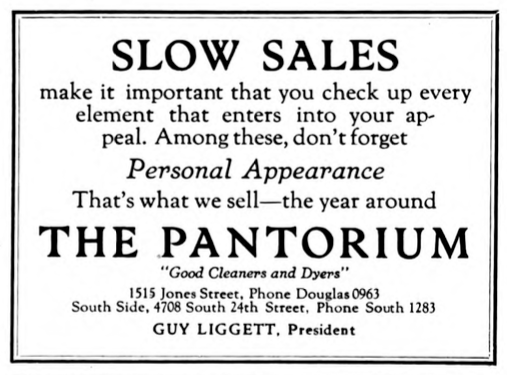
I learned that there was a local laundry called “Pantorium” (they did more than just wash pants). (4)
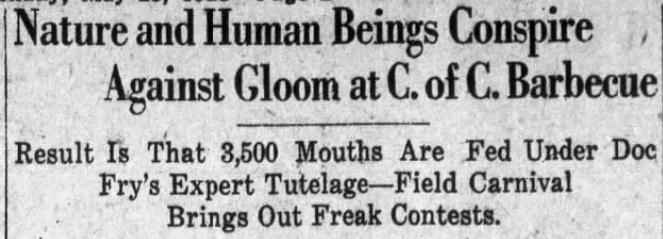
And I learned that the party at Elmwood park was a “Great Success,” at least in the eyes of local reporters. It fed “3,5000 Mouths” with “1,500 pounds of Steer and Lamb” prepared under the expert eye of “Doc Fry,” a local “master of the art of barbecue,” and served alongside with truckloads of bread, pickles, mustard, onions, radishes and – distressingly, given the temperature and the hour – coffee. Attendees were “knocked…dead” with delight by an amateur “minstrel show” and a fake horse race, sponsored by the Continental and the Lions clubs, respectively. With Boy Scouts and visiting nurses on hand to organize and aid participants, the barbecue’s roster athletic events went off without a hitch; winners got a prize donated by a local business, and their names – and addresses – in the paper. (Congratulations, Doris Frederick of 5020 California street, for winning the “longest-winded” (balloon blowing) contest). And as the afternoon turned to evening, a twenty-piece band started playing and “those who cared to tripped and stumbled the light fantastic until it was time to go home.”(5)
Finally, I learned that while the “neuro-mudkiller control contest” was happening – or not, if it wasn’t actually real – another conspiracy was being busted across town, when the Omaha “police morals squad” raided the house of a man named Nick Carmo, and seized his sugar, corn, mash and still.(6)
Violent and unpleasant, that history at least made some sense.
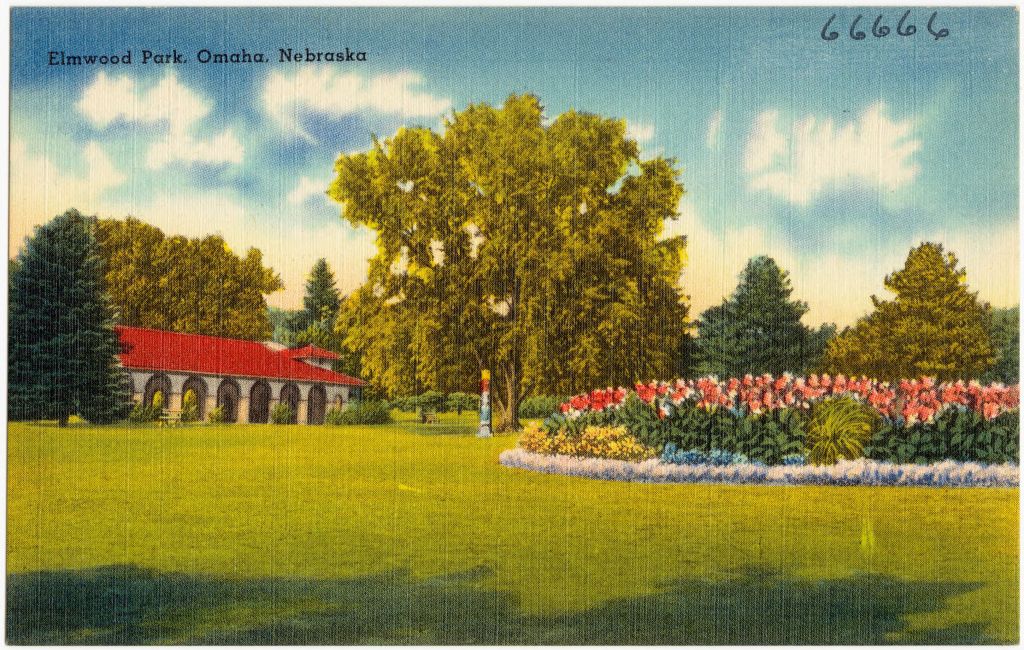
Image Source:”Elmwood Park, Omaha, Nebraska.” Card. Pub. by General Distributors Company, Omaha, Nebraska. “Tichnor Quality Views,” Reg. U. S. Pat. Off. Made Only by Tichnor Bros., Inc., Boston, Mass., [ca. 1930–1945]. Digital Commonwealth, https://ark.digitalcommonwealth.org/ark:/50959/xs55mk23n (accessed June 27, 2024).
(1) David Hackett Fischer, in his biography of Paul Revere, includes an appendix in which he tracks the popular and academic historical “image” of Paul Revere through the centuries. He dates the reconceptualization of Revere as a “Capitalist Democrat” (a propagandist for “free enterprise”) to the early Cold War – a more than a generation later than when Washington was reconfigured. David Hackett Fischer, Paul Revere’s Ride (New York: Oxford University Press, 1995), 339.
(2) “Men Will Thread Needles: ‘He-Man’ Contests for Women,” Omaha Daily Bee, Friday, May 25, 1923, p. 2, https://www.newspapers.com/article/omaha-daily-bee-men-will-thread-needles/150182706/
(3) “Firms Sign for 1923 Trade Booster Tour,” Omaha World-Herald, Sat. April 1923, p.8; “Open Women’s Lounge C. of C., With Reception,” Omaha World-Herald, Fri, May 25, p.1; “Meetings,” The Omaha Daily News, Mon., June 4, 1923, p.11
(4) “Slow Sales,” Omaha Chamber of Commerce Journal, vol. 9, no. 15 (November 27, 1920): 3.
(5) “Entertain 4,000 at Big Barbecue,” Omaha Daily News, Sat, May 26, 1923, p.1; “Crowd of 3,500 at Field Day Barbecue: Annual Stunt of Chamber of Commerce Proves Great Success: Appetites Enormous,” Omaha World Herald, Sunday, May 27, 1923, p. 2; “Barbecue Guests Eat 1,500 Pounds of Steer and Lamb,” Omaha Daily News, Sunday, May 27, 1923, p.2C; “Nature and Human Beings Conspire Against Gloom at C. of C. Barbecue: Result is that 3,500 Mouths Are Fed under Doc Fry’s Expert Tutelage–Field Carnival Brings Out Freak Contests,” Omaha Daily Bee, Mon. May 28, 1923, p.2
(5) “Sugar, Corn, Still Are Seized in Raid,” Omaha World Herald, Sunday, May 27, 1923, p.2.





 Dael A. Norwood
