And now for something completely different...

Dissertation Epigraph?

Or, some things never change

I know that the book is unequally written, that the order is not always as happy as it might have been, that the facts and observations are miscellaneously presented to the reader, and that sometimes those belonging to the same subject are separated from each other at too great a distance.

~Amasa Delano, Narrative of voyages and travels in the northern and southern hemispheres (1817), p.18


Image cite: eye of einstein, Halakahiki, Flickr, CC License

History and Historians, Ivory Towers

The Golden Ratio

Or, Φ Upon Lesser Calculations!


If have any interest in the whole Library of Congress / Twitter development, you should go read Dan Cohen’s smart post on the topic:

Cohen’s post is largely about how to apply the key insight from William Press’s work on the efficacy of “strong” profiling to archival practice like the LoC’s acquisition of the Twitchive (Twarchive?). He comes up with what he terms a “calculus of importance” — but what I’m going to call Press-Cohen’s law, cause that’s more internet sciency — for best allotting collection and curation resources:

In other words, if you believe that the notebooks of a known writer are likely to be 100 times more important to future historians and researchers than the blog of a nobody, you should spend 10, not 100, times the resources in preserving those notebooks over the blog. It’s still a considerable gap, but much less than the traditional (authoritarian) model would suggest. The calculus of importance thus implies that libraries and archives should consciously pursue contents such as those in the Cambridge University Library tower, even if they feel it runs counter to common sense.

An perspicuous friend and colleague of mine wondered if a corollary to Press-Cohen’s law would make sense for research, as well as archive compilation. That is, “should a historian spend only 10 times as much effort pursuing the obvious characters and institutions (or historiographies), instead of 100?”

PF&C suggested that “standard disciplinary practice already says yes” — and I would agree, and even go further and say that it is probably worthwhile to make the use of such a ratio explicit (hence the post!).

Going to a known wells and looking from a new perspective needs to be part of our practice, but within limits (you should dig in lots of new places, too). The 100/10 ratio seems a pretty reasonable rule of thumb, in a world of limited time and resources for research.

What think you, yea historians of teh internets?

PS: Isn’t quasi-social science fun?


Image cite: fd, “Golden Spirals,” Flickr, CC License

Found Historiography

Nourishing History

Or, Bacon-Lettuce-History-Tomato

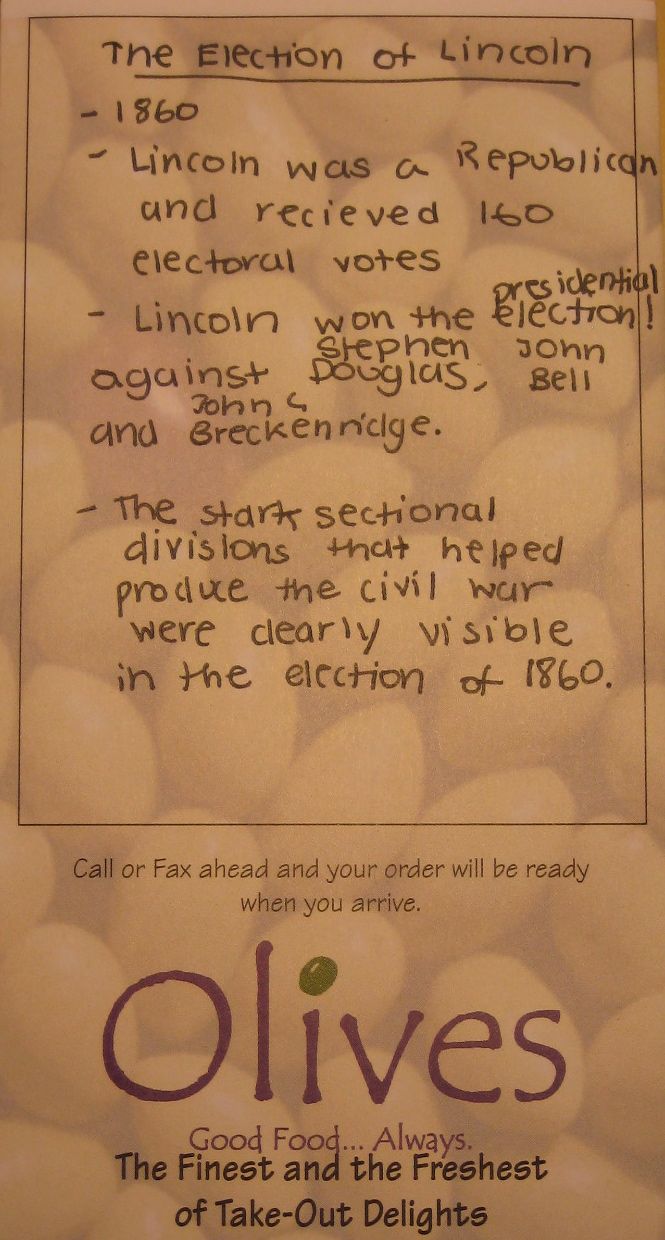
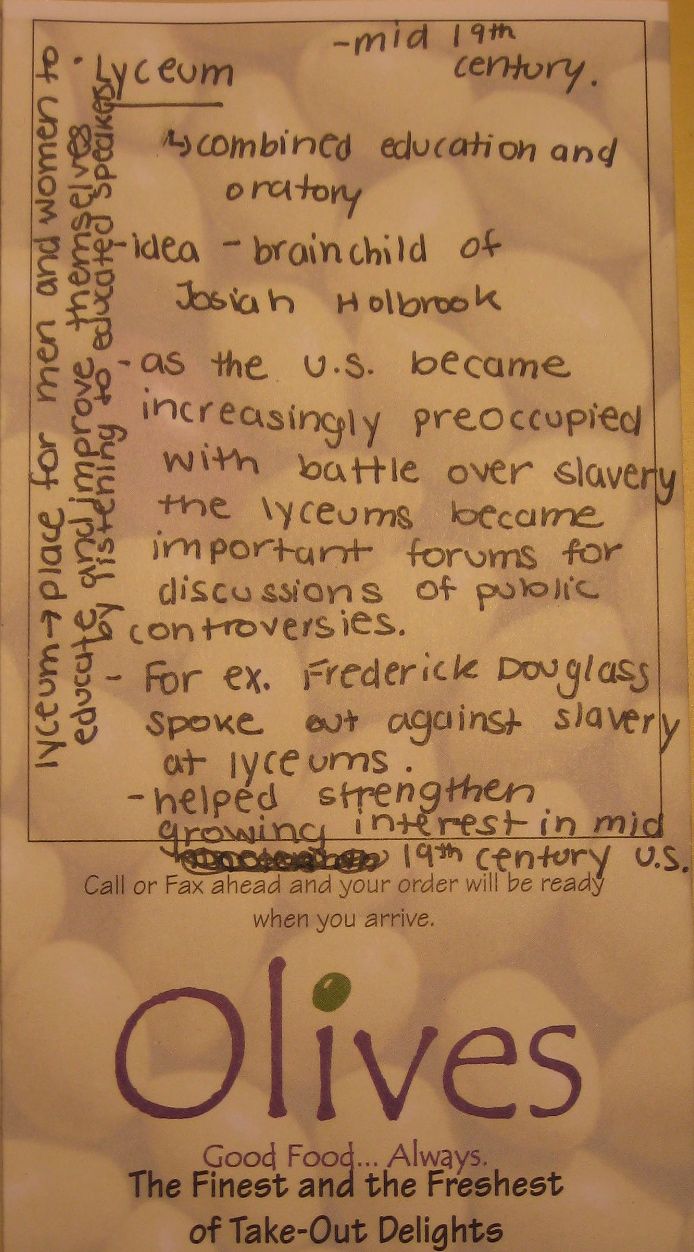
How do you bring history to the masses who hunger for knowledge, and perhaps a sandwich, too? One denizen of my fair city has a solution: write up deli menus with Civil War-related historical facts. I found the following while brunching on bagel and coffee at my local lunch counter.

Everything you need to know about the Election of 1860:

…or lyceums (better than the scanty Wikipedia entry!)?:

And it’s not too soon to order flowers and remember the cultural work of Reconstruction and Redemption:

Historiography while you digest. I like it.


Image cite: im_alex, “Special BLT,” Flickr, CC License

Uncategorized

Bad, Mad, and Sometimes Just Stupid

Spoiled Found History

You’ve probably heard all about the Governor of Virginia’s confusing embrace of Neo-Confederacy, but what about the academic libertarian’s embrace of coverture?

I won’t even try to parse all this, but suffice to say, conservatives of all types are having a banner bad history month, my friends.

P.S. If you like your historians enraged and frothing about bad history, you may enjoy Chris Bray’s latest spatter of posts over at Cliopatria.

I didn’t, particularly — but perhaps my objection is just aesthetic. While I don’t think he’s incorrect about the basic facts, the expression of his interpretation launches him rhetorically into the bloggy equivalent of cable news, complete with spittle on the camera lens.

I think snark rather than snarl serves the purpose better, but what do I know? I’m just one of the fools who doesn’t see the need to stockpile ammunition because of a health care law.


Image cite: Kyle Kesselring, “Teller having a bad day,” Flickr, CC License

Link Round-Up

Friday Fnord Flippancy Fnord

Or, Jokes for Nerds, Links for Everybody

Some links to kill the time during today’s epic rain:

A quote I want on every flag I wave
Jesus Diaz, “It’s Time to Declare War Against Apple’s Censorship,” Gizmodo, 10 March 2010

Today they censor nipples, tomorrow editorial content.

Rob MacDougall is still a smart guy I often agree with
Shocking, I know. Two thought-provoking posts:

Rob MacDougall, Playful Historical Thinking,” Old is the New New, 8 March 2010

Professional historians can be playful in their thinking. Wineburg notes the “ludic” nature–right down to reading with silly voices–of a skilled historian’s engagement with primary texts. But playful historical thinking diverges in significant ways from the standard professional stance. … I want to make a case for playful historical thinking as a healthy, productive, and even responsible way for citizens of the 21st century to relate to the past.

Rob MacDougall, “Survival of the Funnest,” Old is the New New, 9 March 2010

In the world of historical texts, good stories win. What wins in the world of history games and play?

Fun. The history that is fun will win the day. If it’s also true, or useful, or responsible, great. If it’s false, frivolous, or irresponsible, that may be a problem. But for good or ill, fun is very hard to beat.

At least now the hole we’re in will be well-illustrated
“Edward Tufte Appointed to Help Track and Explain Stimulus Funds,” Slashdot, 8 March 2010

“The practical consequence is that I will probably go to Washington several days each month, in addition to whatever homework and phone meetings are necessary.”

Also: Tufte himself explains.

Kids today! Not even good at the computers
George H. Williams, “Digital Natives? Naive!, ProfHacker, 9 March 2010

Try a simple experiment. Ask your students these two questions: “1. How does the Google search engine work? 2. Who owns the exclusive rights to the pictures you’ve uploaded to Facebook?” My guess (and I could be wrong) is that a statistically insignificant percentage of your students will know the right answer.

Esther Hargittai, “Digital Na(t)ives? Variation in Internet Skills and Uses among Members of the ‘Net Generation’,” Sociological Inquiry 80 (1):92-113

People who have grown up with digital media are often assumed to be universally savvy with information and communication technologies. Such assumptions are rarely grounded in empirical evidence, however.

Alas, being a historian means never having to say “supersize me”
Robert B. Townsend, “New Salary Report Shows Little Growth in History,” AHA Today, 8 March 2010

Average faculty salaries in history were essentially unchanged from the previous year, as average salaries for regular full-time faculty at most ranks grew by less than one percent. This represents the smallest average increase in salaries for historians in 15 years.